









- Which customer acquisition channels will be affected by cross-border marketing trends in 2026?Sep 06, 2026View details
- Which homogenization risks should be considered in an analysis of the AI-powered website building industry?Aug 30, 2026View details
- How Will AI Marketing Trends 2026 Change Advertising Budget AllocationAug 28, 2026View details
- Is the EV SSL certificate market shrinking or upgrading? How should companies assess certificate procurement?Aug 11, 2026View details
- Why the old AMP SEO 2020 practices no longer work and what has changed in current optimization prioritiesAug 02, 2026View details
- How to Choose Topics for an Industry News Section to Attract More Organic Search TrafficJul 29, 2026View details
- Digital Marketing Shenzhen Market Insights: Why Are Companies Expanding Overseas Looking for Growth Teams in Shenzhen?Jul 31, 2026View details
- Can Zhejiang foreign trade independent websites still be developed today? Look at changes in traffic and lead generationJul 28, 2026View details
What do I need to prepare to configure payment in a WeChat Mini Program? Merchant ID, certificate, and review process explained.
Before configuring payment in a WeChat mini program, clarify all the necessary preparations at once.
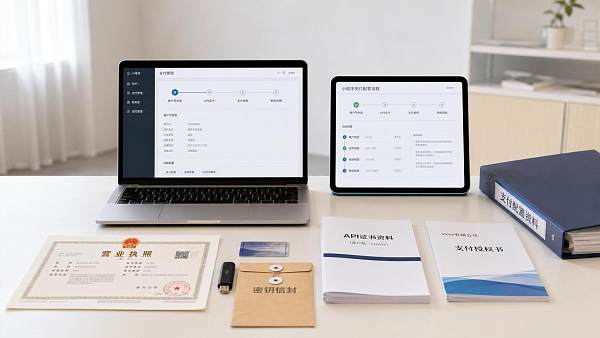
Configuring payment in a WeChat mini program may seem like simply adding a payment collection capability, but it actually involves accounts, qualifications, certificates, API permissions, and the review process.
If the initial preparation is incomplete, common results include interface failures, signature errors, or repeated rejections during the review process.
Before configuring payment in a WeChat mini program, you need to clarify key steps such as merchant account application, API certificate download, payment authorization, and platform review.
This article will explain what you need to prepare to configure payment in a WeChat mini program, as well as the details that are easily overlooked in each step, in the order of actual operation.
First, confirm the relationship between the entities: the mini-program and the merchant account must correspond.
When configuring payment for a WeChat mini program, the first thing to do is not to write code, but to confirm the main entity.
The main body of the mini-program, business license information, and settlement account information should ideally be consistent or have a clear authorization relationship.
If the entities involved are inconsistent, the platform will usually require supplementary supporting documents, and the review time will be significantly longer.
Especially for group companies, brand franchises, and outsourced operation scenarios, it is even more important to confirm the ownership of payments in advance.
The clearer this step is, the smoother the subsequent WeChat mini-program payment configuration will be.
Commonly needed basic materials
- Business license and unified social credit code
- Legal representative's ID information
- Corporate bank account information
- Mini Program AppID
- Contact person's mobile phone number and email address
- Business categories and corresponding qualifications
If the business involves industries such as education, healthcare, food, or ticketing, there are usually additional licensing requirements.
How to prepare a merchant account: This is the core prerequisite for configuring payment in WeChat Mini Programs.
Without a merchant account, configuring payment in a WeChat mini program is practically impossible.
Merchant accounts are the main entities for receiving payments in the WeChat Pay system, used to complete transactions, settlements, refunds, and bill management.
When applying, pay close attention to three things: the authenticity of the entity, the accuracy of the settlement information, and the completeness of the description of the business scenario.
The most common point of getting stuck when applying for a merchant account
- The business scenario is described too simply and fails to explain the transaction process.
- The category selection is inaccurate and inconsistent with the actual functions of the mini-program.
- Incorrect settlement account information caused subsequent verification to fail.
- The uploaded materials are blurry, and the edges of seals, text, or certificates are unclear.
In practice, auditors focus more on the actual transaction loop than simply whether documents have been submitted.
Therefore, it is best to have basic pages for product display, order placement, after-sales instructions, and contact information in advance within the mini-program.
What certificates and keys are needed: This is the key to whether the interface can run successfully.
Many people think that once they apply for a merchant account, configuring payment for their WeChat mini-program is finished. In fact, the real problem often lies in the certificate configuration.
The WeChat Pay interface typically involves API keys, API v3 keys, merchant certificate serial numbers, and platform certificates.
Different versions of the interface have different requirements, so a unified technical solution must be established before development to avoid using half old interfaces and half new interfaces.
Configuration items to be checked first
- Has the merchant account enabled the corresponding payment product capabilities?
- Has the Mini Program AppID been successfully bound to the Merchant ID?
- Has the API v3 key been generated and stored properly?
- Has the merchant API certificate been downloaded and deployed to the server?
- Is the platform certificate used in accordance with the current interface specification?
- Is the callback address publicly accessible and does it support stable responses?
Here's a common misconception: the certificate isn't uploaded to the mini-program's front end, but rather configured on the server side.
The front-end is only responsible for initiating payments; signature processing, unified order placement, and callback signature verification should all be handled on the server side.
Payment authorization and API configuration determine whether a payment can actually be initiated.
Configuring payment in a WeChat mini program involves more than just obtaining a merchant ID and certificate; it also requires completing the payment authorization process.
Typically, you need to add the Mini Program AppID to the corresponding merchant account on the WeChat Pay merchant platform to complete the association.
If it is a service provider model, it is also necessary to distinguish the boundaries of authority between contracted merchants, sub-merchants and the service provider itself.
Before the interface goes live, at least these integration tests should be completed.
- Does the order placement interface return the correct pre-payment information?
- Can the payment function initiated through the mini-program successfully launch the cashier?
- After successful payment, check whether the callback notification is correctly received by the system.
- Is the order status updated according to the payment result?
- Are basic APIs such as refund, order closure, and order tracking available?
A more reliable approach is to retain the logs, original signatures, return codes, and callback records together for easier troubleshooting.
How to understand the review process: Why might my application be rejected even though I have all the required documents?
Another common challenge in configuring payment in WeChat mini programs is the discrepancy between the approved data and the actual display.
The platform does not only review documents, but also checks whether the page can prove that the business actually exists and whether the transaction is compliant and traceable.
If the mini-program page is still an empty shell, with only the homepage and no product details, order rules, or customer service entry, the risk of review will increase.
Page content that is recommended for self-checking before review
- Is the product or service description complete?
- Are the price, specifications, shipping costs, and service descriptions clear?
- Are the refund policy, privacy policy, and user agreement available for viewing?
- Are the customer service contact methods available?
- Can the test path submitted for review be successfully completed?
Recent changes indicate that compliance statements and user rights displays have become important review points for configuring payment in WeChat mini programs.
Common errors and troubleshooting methods – knowing them in advance can save you a lot of trouble.
Many configuration issues are not exposed during the application stage, but rather emerge during the integration testing stage.
The following situations are the most common when configuring payment in WeChat mini programs.
High-Frequency Problem Troubleshooting Checklist
For mini-programs that are continuously operated by businesses, it is recommended to document the payment configuration to avoid the inability to maintain them after personnel changes.
To ensure a more stable payment configuration for your WeChat Mini Program, prepare this checklist before going live.
The key to successfully configuring payment in a WeChat mini program lies not in a single button, but in whether the preparation is complete.
You can proceed in this order: first confirm the entity, then apply for a merchant number, then prepare the certificate key, then complete the authorization binding and interface integration, and finally submit for review.
If the business also involves multilingual websites, cross-border e-commerce platforms, marketing landing pages, and subsequent promotions, payment is just one link in the overall digital chain.
Platforms like Yiyingbao, which integrate website and marketing services, typically plan the website building, transaction, promotion, and conversion processes together to reduce redundant modifications later on.
Returning to the practical level, as long as the information is accurate, the permissions are clear, the page is complete, and the integration process leaves a trace, configuring payment in WeChat mini programs can generally be approved and launched stably more quickly.
Related Articles



Related Products
 Yiyingbao SaaS Intelligent Website Building and Marketing SystemYiyingbao SaaS Intelligent Website Building and Marketing System, AI-powered no-code website building, rapid creation of multilingual B2B international websites in 10 minutes, global server acceleration, AI-powered SEO optimization, helping businesses connect efficiently with global markets. The perfect integration of technology and operation makes building an international trade website remarkably simple
 AI+SEM Intelligent Advertising Marketing SystemAI+SEM drives intelligent ad creation, empowering full-funnel precision advertising marketing. The system automatically generates weekly/monthly reports, AI recommends keywords and target countries, monitors core metrics in real-time with intelligent alerts, and enables one-click high-conversion ad solutions to help quickly acquire customers and improve ROI.
 AI+SEO Dual-Engine System Optimization ServicesYiyingbao’s AI+SEO dual-engine optimization system helps foreign trade enterprises acquire high-quality organic traffic through AI-powered keyword research, content generation, and comprehensive technical optimization, significantly improving search rankings and conversion rates.
 AI+SNS Social Media Marketing SystemYingbao AI+SNS Social Media Marketing System - Precision social capture for the social media era. Supports one-click content synchronization across major platforms like Facebook and LinkedIn. AI intelligently rewrites posts for enhanced relevance. 24/7 AI customer service and user profiling analysis empower businesses to efficiently expand into global markets.
 AI+SEO营销解决方案易营宝AI+SEO营销解决方案,通过AI批量写作、智能生成TDK、精准关键词扩词等功能,全面优化网站SEO效果,提升流量与转化率。助力企业构建高效智能网站新生态。
 AI+SEM Advertising Marketing SolutionsAI+SEM Advertising Marketing Solution leverages AI technology to deeply empower SEM ad campaigns. It automatically generates weekly/monthly reports using AI, presenting account data across multiple dimensions for comprehensive insights into campaign performance and trends. The system precisely recommends keywords and target countries, intelligently generates high-conversion ad copy, and enables one-click activation of efficient campaign plans to help businesses rapidly acquire customers. Simultaneously, it monitors core metrics in real time, intelligently identifies abnormal fluctuations, and issues timely alerts to ensure stable, high-return advertising results.
 Domain Name ServicesEasyWin provides professional domain name services, including intelligent queries, one-stop registration, brand protection, and full lifecycle management, helping businesses build a digital brand image.
 EasyOperate B2C Cross-Border E-Commerce Platform & Independent WebsiteEasyStore B2C Cross-border E-commerce Independent Store is an intelligent website building and cross-border e-commerce integrated solution independently developed by EasyStore Information Technology (Beijing) Co., Ltd. The system is specially designed for small and medium-sized as well as large export enterprises, integrating 'website building, operation, marketing, advertising, and conversion' into one, helping enterprises quickly establish cross-border e-commerce independent stores to achieve brand globalization and global sales growth.
The platform supports multiple languages, multiple currencies, and multi-channel marketing, with built-in AI intelligent translation and SEO optimization systems, suitable for mainstream markets such as Southeast Asia, Europe and America, Latin America, and the Middle East, assisting Chinese manufacturing enterprises in efficiently deploying international e-commerce strategies. SSL证书易营宝提供专业SSL安全证书服务,包括单域名和泛域名证书,确保网站数据传输加密、身份验证和完整性保护,助力企业建立安全可信的在线业务环境。









