What Business Scenarios Is AI Multilingual Website System Japan Suitable for?
When many companies prepare to enter the Japanese market, their first reaction is often, “Let’s translate the official website into Japanese first.” However, after the site goes live, they may find that although a Japanese version is available, the quality of inquiries has not improved significantly, search indexing remains unstable, and conversion rates are even low after advertising traffic arrives. These issues may not necessarily be caused by the traffic itself. They often result from whether the website system is genuinely suitable for the Japanese market.
AI Multilingual Website System Japan is more suitable for overseas businesses that need to provide multilingual content while also taking localized expression, search visibility, and conversion efficiency into account. For foreign trade companies, cross-border e-commerce brands, manufacturing factories, and regional investment promotion businesses, choosing the right system is not simply about adding “one more language version.” It is an important foundation that determines whether subsequent customer acquisition channels can operate effectively.
Why Do Many Companies Still See Average Results After Creating a Japanese Website?
A common situation is that a company already has an English website and has even added Japanese pages, but several typical problems arise during actual use. First, the translation sounds like a translation and does not read like a local website. Users may understand it, but they may not be willing to continue browsing. Second, the website structure is still built according to the logic of other markets, so the navigation, forms, button copy, and content flow do not match Japanese users’ reading habits. Third, the multilingual pages are poorly connected, making it difficult for search engines to accurately understand the corresponding relationship between different language versions. As a result, indexing and rankings remain unstable.
The impact of these problems is direct. B2B companies may find that inquiries are inaccurate and that users spend little time on the site. Cross-border e-commerce brands may experience high landing-page bounce rates and insufficient willingness to add products to carts or place orders. Manufacturing factories may find that although many people view their content, few send genuine cooperation requests. Many teams attribute this to the Japanese market being too difficult, but in reality, the more common issue is that the website system itself has not been properly prepared for this market.
Before Choosing a System, First Determine Whether AI Multilingual Website System Japan Fits Your Business
Not every business needs a dedicated multilingual website system designed specifically for the Japanese market. If your business mainly relies on platform traffic, your independent website serves only as a basic company profile, and you have no short-term plans for SEO, advertising, or localized operations, then a simple Japanese page may be sufficient.
However, if you are dealing with the following issues, you should seriously consider a solution such as AI Multilingual Website System Japan: First, you plan to develop the Japanese market over the long term and want your website not only to provide information but also to generate customers continuously. Second, your products are highly specialized and require content explanations, industry pages, and a multi-level structure to build trust. Third, you plan to conduct Google SEO, advertising, or social media traffic acquisition at the same time, so your website needs to receive traffic from different channels. Fourth, you already have an English website but have found that directly copying it for the Japanese market does not produce satisfactory conversions.
The key to determining whether it is suitable does not lie in whether there is a Japanese version, but in whether the website has three capabilities: content localization, page scalability, and coordination with subsequent marketing activities. The first two determine whether users can continue reading, while the third determines whether traffic can be converted continuously after it arrives.
Several Overseas Business Scenarios That Are More Suitable for This Type of System
The first category is foreign trade B2B companies. Companies engaged in machinery and equipment, industrial components, electronic components, materials, packaging, chemicals, and related industries often face longer decision-making chains. Japanese buyers typically review the company profile, product specifications, application scenarios, quality information, delivery capabilities, and contact options repeatedly. If a website merely lists products and lacks structured explanations and a clear page hierarchy, it is difficult to establish initial trust. In these scenarios, the value of AI Multilingual Website System Japan lies more in helping companies organize multilingual content more efficiently than in simply translating pages.
The second category is cross-border e-commerce independent websites or brand globalization businesses. Japanese users are often more sensitive to page details, information completeness, and the smoothness of the shopping process. Product selling points, specifications, delivery information, after-sales details, frequently asked questions, and campaign landing pages all need to remain clear and consistent. If the site will also be used for advertising or search optimization, the system must support independent configuration of different page templates and language versions, as well as subsequent iterative adjustments.
The third category is manufacturing factories and OEM/ODM companies. These companies often fall into a misconception: they believe translating the company profile is sufficient. In reality, the Japanese market often assesses whether a company is suitable for cooperation based on more detailed information, such as process capabilities, production procedures, quality control descriptions, ways of presenting industry experience, and prototyping and delivery information. A suitable multilingual website system should support dividing content according to industries and requirements, rather than placing all information on a single page.
The fourth category is companies that need regional operations. For example, if a brand targets not only Japan but also Europe and the United States, Southeast Asia, and South Korea, the site cannot simply “copy multiple language packages.” Different markets vary in keywords, page priorities, conversion entry points, and communication methods. In this scenario, the significance of AI Multilingual Website System Japan is to turn Japan from an “additional language” into a regional site that can be operated independently.
Several Common Misconceptions
The first misconception is understanding multilingual website building as plugin translation. Plugin translation can solve the problem of making content understandable, but it may not solve the problem of whether users are willing to contact you. In the Japanese market in particular, users are relatively sensitive to wording, page neatness, information completeness, and logical order. Mechanical translation can easily make a page appear less professional.
The second misconception is building the website first and considering SEO and advertising later. In reality, the initial website structure affects the subsequent cost of optimization. URL planning, language version management, navigation hierarchy, page templates, and metadata configuration capabilities are all issues that should be clarified at the beginning. Adding them after the pages are completed often requires rework.
The third misconception is using the same content logic for every market. Many teams copy the English content directly into the Japanese site. Although this appears efficient, it can easily make the content lose its relevance. Different markets care about different issues. The purchasing information, communication methods, and trust-building process valued by Japanese users may not be the same as those in Europe and the United States.
If You Are Preparing to Enter the Japanese Market, Use This Approach to Evaluate Your Options
- First, clarify the website objective. Is it intended for brand presentation, B2B inquiries, transactions through an independent website, or advertising landing pages? Different objectives require different page structures and content priorities.
- Organize the core information to be presented in the Japanese market. This includes product selling points, service procedures, frequently asked questions, qualification information, contact options, and after-sales information. Avoid directly copying content from websites in other languages.
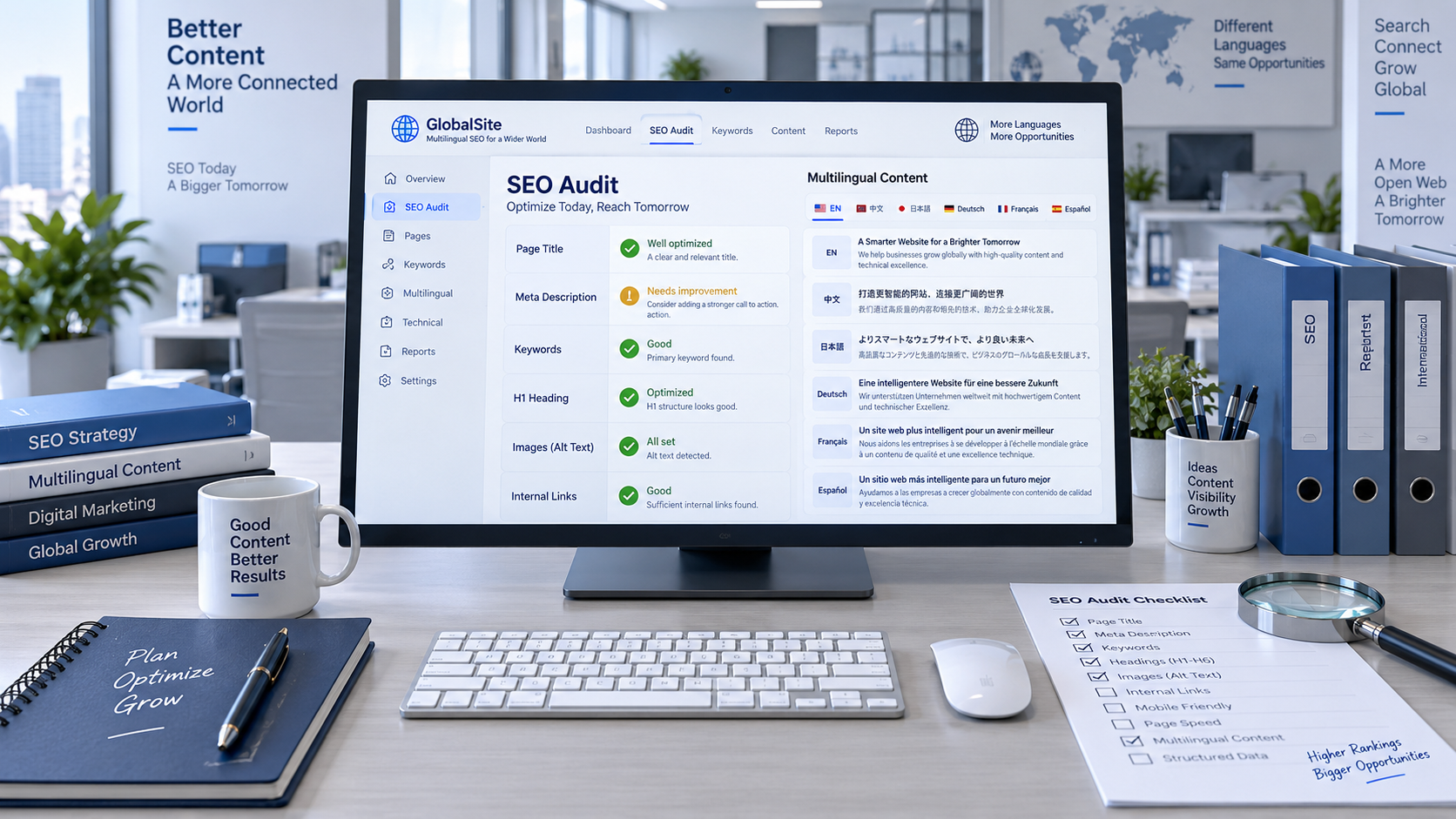
- Check whether the system supports standardized multilingual management. Whether each language version can independently configure pages, titles, descriptions, navigation, and forms determines whether continuous optimization will be possible.
- Confirm whether it supports coordination between SEO and marketing. For example, determine whether it supports content expansion, dedicated landing-page creation, and landing-page management, as well as subsequent SEO and advertising activities.
- Finally, consider implementation efficiency. If your team has limited development resources, a platform with AI website building, content management, and marketing coordination capabilities will be more suitable for long-term operations.
From this perspective, platforms such as Yiyingbao, which cover AI website building, multilingual website development, SEO optimization, and advertising marketing coordination, can serve as part of the solution. Their practical value does not lie in having “as many functions as possible,” but in enabling companies to connect website building, page iteration, and subsequent overseas promotion through a relatively unified system, reducing the efficiency loss caused by switching repeatedly between different tools.
When Is It Worth Prioritizing AI Multilingual Website System Japan?
If your team has clearly decided to develop the Japanese market and wants the website to become a long-term asset rather than a temporary showcase page, this type of system is worth prioritizing. The following situations are especially typical:
First, the product information is complex and requires multiple pages and levels of content to explain, making a one-page site or simple template unsuitable. Second, you plan to conduct Google SEO and continuously develop content around Japanese keywords. Third, you will use Google Ads, social media advertising, or content marketing and need multiple landing pages to receive traffic from different sources. Fourth, your company also targets other national markets and hopes to manage multi-region sites centrally in the future while retaining independent operating space for the Japanese market.
Conversely, if you are currently only testing market response, have no plans for sustained investment, and have no content operations or promotion arrangements, you can first validate demand through a small number of pages. The key is not how large the site is at the outset, but whether the website system can support the next stage of growth. If the site must eventually be rebuilt, the time saved in the early stage will often have to be spent twice over later.
Frequently Asked Questions
Is AI Multilingual Website System Japan Suitable Only for Large Companies?
No. More precisely, it is suitable for companies that already regard the Japanese market as a long-term business direction. Company size is not the only criterion. The key is whether you need stable multilingual management, continuous optimization, and subsequent marketing support.
If We Already Have an English Website, Do We Still Need a Separate Version for the Japanese Market?
If your goal is only to give users a general understanding of the company, an English site may be sufficient. However, if you want to improve search visibility, inquiry quality, or conversion efficiency in the Japanese market, it is generally more necessary to create a Japanese version that is better aligned with local user habits.
What Is the Biggest Difference Between This System and an Ordinary Translation Plugin?
The difference lies in whether it supports genuine localized operations. Ordinary translation plugins mainly address page language conversion, while AI Multilingual Website System Japan focuses more on multilingual content management, independent page optimization, search structure, and conversion path configuration.
When Developing the Japanese Market, Should the Website, SEO, and Advertising Be Considered Together?
It is recommended that they be considered together. The website structure directly affects subsequent SEO planning and the efficiency of advertising landing pages. If website development and marketing logic are separated at the beginning, page rework, confused tracking, or inefficient conversion processes will usually arise later.
Conclusion
AI Multilingual Website System Japan is not suitable for every company that “wants to create a Japanese website.” It is intended for overseas businesses that hope to develop the Japanese market in depth and maintain stable operations. The evaluation criteria are not complicated: if you need more than translated pages and instead require a website foundation that combines localized expression, search visibility, and subsequent conversion support, this type of system has practical value.
In practice, starting with business objectives, content structure, and operating plans before evaluating whether the system’s capabilities match will be more effective than simply comparing templates, prices, or the number of languages. For teams preparing to develop the Japanese market over the long term, a website is not a brochure. It is one of the most easily underestimated yet most influential links in the overseas expansion process.