









- Can the average annual growth rate reflect real opportunities in overseas markets?Oct 07, 2026View details
- Which customer acquisition channels will be affected by cross-border marketing trends in 2026?Sep 06, 2026View details
- Which homogenization risks should be considered in an analysis of the AI-powered website building industry?Aug 30, 2026View details
- How Will AI Marketing Trends 2026 Change Advertising Budget AllocationAug 28, 2026View details
- Is the EV SSL certificate market shrinking or upgrading? How should companies assess certificate procurement?Aug 11, 2026View details
- Why the old AMP SEO 2020 practices no longer work and what has changed in current optimization prioritiesAug 02, 2026View details
How AI Content Localization Reduces Multilingual Marketing Errors
How AI Content Localization Reduces Multilingual Marketing Errors
The most easily underestimated part of multilingual marketing is not translating Chinese into English, Japanese, or Spanish, but turning messaging that works in the original market into messaging that can be understood, trusted, and acted upon in the target market. After many foreign trade websites go live, the page grammar may appear flawless and ads may be launched smoothly, yet they still fail to generate valid inquiries. Often, it is not that the product is unsuitable, but that the content loses the information buyers truly care about during translation.
The value of AI content localization lies in reducing such hidden errors. It should not be merely a bulk translation tool; it should help operators identify market context, validate keyword intent, standardize brand messaging, and connect information across websites, ads, social media, and landing pages into a consistent conversion path. For operators who process materials for multiple regions every day, the real issue to address is whether they can reduce rework, misplaced ad spend, and cultural misunderstandings, rather than simply pursuing generation speed.
Correct Translation Does Not Equal Correct Marketing Messaging
The most common errors occur in product selling points. Domestic manufacturers are accustomed to emphasizing phrases such as “strong manufacturer,” “quality assurance,” and “customization available.” When translated directly, these phrases often appear overly broad. B2B buyers in Europe and the United States are more likely to focus on lead times, minimum order quantities, testing conditions, compatible specifications, after-sales response, and compliance documents. Communication in the Middle East may place greater emphasis on long-term cooperation and service commitments, while Japanese customers are generally more sensitive to parameter descriptions, process rigor, and page details.
Therefore, the same phrase, “customization available upon request,” should not merely be switched into another language for different markets. For engineering procurement, it may be necessary to specify adjustable materials, dimensions, tolerances, or interface ranges; for distributors, it is necessary to explain samples, packaging, regional supply, and brand support. AI can first generate different versions based on the page topic, product attributes, and regional language preferences, but operators still need to determine whether the content answers the local buyer's next question. If not, even a fluent translation only “looks professional.”
Another common pitfall is tone. Expressions such as “lowest price,” “industry-leading,” and “100% guaranteed” in Chinese may not only lack persuasiveness on certain overseas pages but may also sound exaggerated. Especially when performance, certifications, delivery times, or results are involved, AI-generated content must be limited to information the company can substantiate. Content unsupported by test reports, certificates, or clear service terms should not be written as an absolute conclusion merely to improve conversion rates.
Establish Content Standards Before Using AI for Batch Processing
In practice, multilingual content errors often arise not because a particular piece of copy is poorly written, but because different personnel and channels make their own revisions, eventually causing terminology, price units, product models, and call-to-action buttons to conflict with one another. An English ad may say “Get a Quote,” while the landing page asks users to “Contact Us for Catalog”; an ad may promise fast delivery, but the product page provides no corresponding explanation; social media may use popular local expressions while the website still relies on stiff literal translations. This erodes user trust and makes subsequent data analysis less reliable.
A more reliable approach is to prepare an AI content standard that can be continuously updated before generation. It does not need to be complex, but it should at least include brand names and non-translatable terms, product model and unit conventions, core terminology references, prohibited exaggerated language, commonly used calls to action for each market, and verified qualification and delivery information. In specialized fields such as machinery, chemicals, and medical device supporting products, technical parameters and marketing descriptions should also be managed separately: parameters should be verified against original materials, while marketing content may be localized and adapted, but facts must not be altered in reverse.
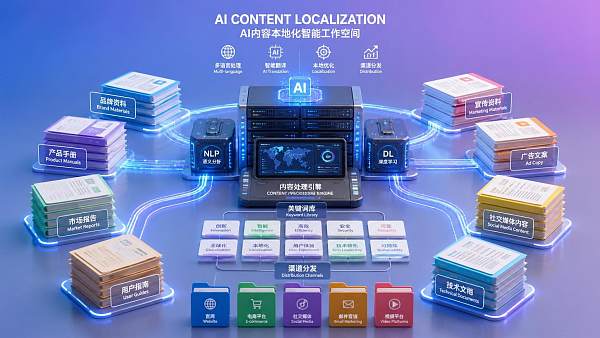
AI content localization is better suited to a small closed loop of “generation—verification—publication—review,” rather than rolling out dozens of language versions across an entire website all at once. First, select high-traffic product pages, core ad groups, and inquiry landing pages for testing, and observe whether search terms, on-page behavior, form submissions, and sales feedback reveal comprehension gaps. If customers repeatedly ask about information that has already been provided, this usually indicates that the content placement, wording, or commonly used local terminology still has issues; it does not necessarily mean the traffic quality is poor.
Keyword Localization Must Consider Search Intent, Not Just Dictionary Equivalents
Many teams translate Chinese keywords one by one and use them directly for SEO and advertising, which is a frequent source of wasted budget. A word may correspond to different stages of procurement in different countries: some terms are intended for information searches, some for price comparisons, and some clearly indicate a search for suppliers. Even when meanings are similar, whether the search results page presents tutorials, retail pages, or factory directories will affect how content should be written.
In practice, AI can first provide synonyms, industry terms, regional wording, and long-tail questions, which can then be filtered in combination with actual search term reports, on-site inquiry content, and product application scope. For example, some markets are accustomed to searching for products by application scenario rather than entering specific model numbers; in some languages, changes in plural forms, word order, or prepositions can directly affect search coverage. AI can improve the efficiency of keyword database organization and creative expansion, but it cannot replace judgment regarding business boundaries. Terms for products that cannot be sold or delivered, or that offer insufficient profit margins, should not be treated as primary promotion directions even if they generate traffic.
On the advertising side, localization errors are amplified more quickly. Ad headlines are subject to character limits, while body copy must simultaneously communicate demand, differentiation, and a call to action, so literal translation often results in incomplete information. In its coordinated services for intelligent website building, SEO, advertising, and overseas social media, EasyMarketing typically verifies ad copy, keywords, and landing page information within the same chain rather than optimizing only one link. For teams that need to enter multiple markets simultaneously, the AI+SEM Intelligent Advertising Marketing System can be used to generate multilingual ad creatives, recommend regions and keywords, and help identify anomalies through monitoring and alerts for core metrics. The key remains this: after automation is launched, a manual review checkpoint must be retained, especially for brand terms, sensitive categories, promotional prices, and geographic targeting.
Several Types of Content Must Retain Manual Review
Not every page needs to be manually rewritten sentence by sentence, but the following content is not recommended for direct publication: statements involving product safety, material composition, certifications, medical claims, or performance results; information including prices, discounts, taxes, shipping timelines, and return or exchange conditions; social media content involving local culture, holiday customs, or religious context; and brand introduction pages for first-time entry into a new market. Once errors occur in such content, the subsequent cost of correction is typically higher than the cost of upfront review.
Manual review does not mean finding external translators to check everything from scratch every time. A more practical division of work is for AI to complete first drafts, variations, and format adaptation; operators to check keywords, links, page consistency, and call-to-action buttons; product experts to confirm technical facts; and local partners or native-language reviewers to focus on tone, ambiguity, and cultural risks. This preserves efficiency without treating AI as an unsupervised publishing tool.
Turn “Language Versions” into Operable Market Versions
The key to truly reducing multilingual marketing errors is no longer treating pages in different languages as appendages of the original content. A page targeting industrial procurement in Germany and a page targeting distribution channels in Southeast Asia may require different supporting evidence, content sequences, and inquiry entry points even when selling the same product. Language is only the surface layer; buyers' decision-making methods are the core of localization.
A platform driven by AI and big data for overseas digital marketing can reduce disconnects between website building, content generation, search optimization, and campaign data. EasyMarketing has long served foreign trade companies, manufacturing factories, cross-border sellers, and brand globalization teams, covering multilingual websites, independent website promotion, AI search visibility, and other scenarios. For frontline operators, the most worthwhile thing to establish is not more language pages, but a content mechanism that makes it possible to trace why a sentence was written in a certain way, where it was delivered, and what feedback it generated. Validating one or two priority markets first and then replicating the approach in similar regions is usually more reliable than launching all language versions simultaneously, and it also makes it easier to identify the errors that truly affect conversion.
Related Articles

Related Products
 Yiyingbao SaaS Intelligent Website Building and Marketing SystemYiyingbao SaaS Intelligent Website Building and Marketing System, AI-powered no-code website building, rapid creation of multilingual B2B international websites in 10 minutes, global server acceleration, AI-powered SEO optimization, helping businesses connect efficiently with global markets. The perfect integration of technology and operation makes building an international trade website remarkably simple
 AI+SEM Intelligent Advertising Marketing SystemAI+SEM drives intelligent ad creation, empowering full-funnel precision advertising marketing. The system automatically generates weekly/monthly reports, AI recommends keywords and target countries, monitors core metrics in real-time with intelligent alerts, and enables one-click high-conversion ad solutions to help quickly acquire customers and improve ROI.
 AI+SEO Dual-Engine System Optimization ServicesYiyingbao’s AI+SEO dual-engine optimization system helps foreign trade enterprises acquire high-quality organic traffic through AI-powered keyword research, content generation, and comprehensive technical optimization, significantly improving search rankings and conversion rates.
 AI+SNS Social Media Marketing SystemYingbao AI+SNS Social Media Marketing System - Precision social capture for the social media era. Supports one-click content synchronization across major platforms like Facebook and LinkedIn. AI intelligently rewrites posts for enhanced relevance. 24/7 AI customer service and user profiling analysis empower businesses to efficiently expand into global markets.
 AI+SEO营销解决方案易营宝AI+SEO营销解决方案,通过AI批量写作、智能生成TDK、精准关键词扩词等功能,全面优化网站SEO效果,提升流量与转化率。助力企业构建高效智能网站新生态。
 AI+SEM Advertising Marketing SolutionsAI+SEM Advertising Marketing Solution leverages AI technology to deeply empower SEM ad campaigns. It automatically generates weekly/monthly reports using AI, presenting account data across multiple dimensions for comprehensive insights into campaign performance and trends. The system precisely recommends keywords and target countries, intelligently generates high-conversion ad copy, and enables one-click activation of efficient campaign plans to help businesses rapidly acquire customers. Simultaneously, it monitors core metrics in real time, intelligently identifies abnormal fluctuations, and issues timely alerts to ensure stable, high-return advertising results.
 Domain Name ServicesEasyWin provides professional domain name services, including intelligent queries, one-stop registration, brand protection, and full lifecycle management, helping businesses build a digital brand image.
 EasyOperate B2C Cross-Border E-Commerce Platform & Independent WebsiteEasyStore B2C Cross-border E-commerce Independent Store is an intelligent website building and cross-border e-commerce integrated solution independently developed by EasyStore Information Technology (Beijing) Co., Ltd. The system is specially designed for small and medium-sized as well as large export enterprises, integrating 'website building, operation, marketing, advertising, and conversion' into one, helping enterprises quickly establish cross-border e-commerce independent stores to achieve brand globalization and global sales growth.
The platform supports multiple languages, multiple currencies, and multi-channel marketing, with built-in AI intelligent translation and SEO optimization systems, suitable for mainstream markets such as Southeast Asia, Europe and America, Latin America, and the Middle East, assisting Chinese manufacturing enterprises in efficiently deploying international e-commerce strategies. SSL证书易营宝提供专业SSL安全证书服务,包括单域名和泛域名证书,确保网站数据传输加密、身份验证和完整性保护,助力企业建立安全可信的在线业务环境。









