









- CBP Finalizes Electronic Rail Export Manifest Rule, Effective October 26, 2026Oct 26, 2026View details
- Amazon’s 2026 peak season surcharge takes effect on October 25Oct 26, 2026View details
- AI Is Eating SaaS: Three Real-World Cases in One AfternoonOct 25, 2026View details
- Exiger CEO: The SaaS Apocalypse Is Real, but It Means Something DifferentOct 25, 2026View details
- Hengqin Cooperation Zone Shares Cross-Border E-Commerce Developments, Focusing on Macao-Hengqin Collaboration and International MarketsOct 24, 2026View details
- A Shenyang study highlights the development of the “cross-border e-commerce + industrial cluster” modelOct 24, 2026View details
Can Publishing More Articles on the Same Topic Build Topical Authority?
Can Publishing More Articles on the Same Topic Build Topical Authority?
Can publishing more articles on the same topic build autorité thématique (topical authority)? The answer is not simply a matter of quantity. Content depth, coverage of user needs, and internal linking logic matter more than publishing frequency. For an independent website serving international trade, dozens of similar articles may be less valuable than a set of resources that helps buyers make informed decisions.
Topical authority is not a ranking qualification that unlocks after publishing a certain number of articles. It is better understood as a website consistently providing reliable, coherent, and useful information about a specific field, giving readers a reason to keep reading, cite it, or trust it. Search performance can help you monitor this progress, but there is no article-count threshold that applies to every website.
Why Hasn’t Publishing More Articles Built Momentum?
A common problem is that editorial plans revolve around keywords rather than customer questions. “How to build a website for international trade,” “How to create a website for international trade,” and “What are the steps to building a website for international trade?” may have different titles, but the articles all discuss domains, servers, and page design. After reading the first one, readers may find little new information in the others.
This kind of repetition can also lead multiple pages to target the same type of search need, creating competition between pages on your site. However, having multiple pages that target the same keyword is not necessarily a problem; what matters is whether they serve different purposes. For example, “How to Break Down a Website Budget” and “How to Preserve Existing URLs During a Website Migration” both relate to building a website for international trade, but each has a distinct reason to exist.
Before creating a new article, ask: What decision will this content help readers make that they could not make before? If the answer is simply “say the same thing in a different way,” updating an existing page is usually a better option than creating a new URL.
Organize Topics Around the Customer’s Decision-Making Journey, Not a Keyword List
Consider a manufacturing company building an independent website for overseas markets. At first, it may want to know what features the site needs. Then it may ask how to maintain a multilingual site, organize product information, decide which fields to include in an inquiry form, and attract traffic after launch. These questions are related, but a broad “complete guide” cannot address them all in depth.
A more practical approach is to create a central page that helps readers understand the big picture, then use dedicated pages to answer specific questions. The central page explains the relationship between website development, content, promotion, and conversion; dedicated pages cover budget breakdowns, technical limitations, implementation steps, and maintenance responsibilities. The scope should be based on the products and services the company can genuinely provide, rather than expanding without limit to every marketing topic.
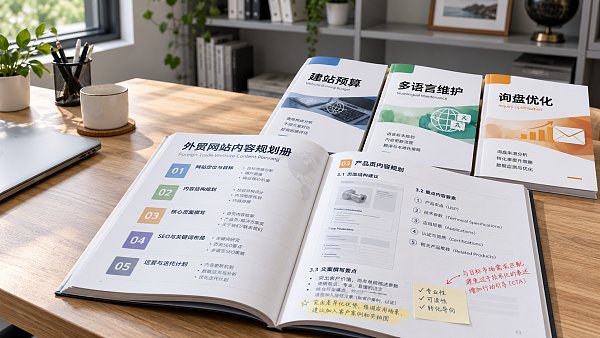
Internal links connect the steps in this journey. For example, an article about multilingual website development can link to a page about planning URLs for language versions, while an article about optimizing inquiry forms can link to a page about privacy notices for forms. Anchor text should explain what the destination page can help readers with. There is no need to repeat the same keyword every time, nor to link every article to every other article.
Depth Comes from Verifiable Details—and from Knowing Where the Boundaries Are
A long article is not necessarily a deep one. When discussing website migration, simply saying “watch out for ranking fluctuations” is not enough. Readers need to know whether to map old URLs, how to check redirects, and which important pages need to be reviewed individually. When discussing product certifications, regional requirements, or interface compatibility, specify the conditions under which they apply. Do not present information you cannot verify as a universal conclusion.
The same applies to website security. Yiyingbao’s SSL certificate solution can be integrated with its intelligent website-building system to handle application, validation, and deployment, as well as HTTP-to-HTTPS redirects and mixed-content issues. These capabilities affect website access and data transmission, but they cannot replace subject-matter expertise, and enabling HTTPS does not in itself establish topical authority.
Truly useful material often comes from within the company: product engineers explaining selection constraints, recurring questions received by the after-sales team, and acceptance checklists from project delivery. AI can assist with organizing information and drafting content, but relevant personnel still need to verify specifications, standards, and implementation conclusions. Otherwise, producing content at scale will only amplify the same information gaps.
Plan Your Website and Marketing Together, but Don’t Measure Success by Publishing Volume
Content can only be effective if pages are easy to access, navigation is clear, and readers can readily find product information and inquiry options. Founded in 2013, Yiyingbao Information Technology (Beijing) Co., Ltd. integrates intelligent website building, multilingual websites, SEO, and overseas advertising into its services. For projects like these, the key consideration is not how many services are listed, but whether the website structure connects effectively with ongoing content operations.
Multilingual operations involve more than translating titles and body copy. Buyers in different markets may use different terminology and care about different delivery conditions. The topical framework can be reused, but specific questions and supporting evidence should be validated through localization. Do not assume that because the Chinese version provides comprehensive coverage, versions in other languages are equally complete.
When evaluating performance, you can review search queries, page impressions and clicks, inquiry questions, and content update records to see which needs are being met and which pages still lack clear explanations. Ranking fluctuations for a single article are not enough to determine whether topical authority has been established, and neither is the total number of articles.
For your next content planning cycle, start by reviewing existing pages: Should duplicate content be consolidated? Do outdated figures need updating? Are customers’ most pressing questions still unanswered? Only create a new article when you have identified a clear information gap. That is how quantity becomes an asset rather than a maintenance burden.
Related Articles
 How Can an SEO Content Strategy Prevent Keyword Cannibalization?
 Website Rankings Stuck on Page Two? How to Find Opportunities for Improvement
 SEO traffic suddenly dropped. How can you identify the affected pages?


Related Products
 Yiyingbao SaaS Intelligent Website Building and Marketing SystemYiyingbao SaaS Intelligent Website Building and Marketing System, AI-powered no-code website building, rapid creation of multilingual B2B international websites in 10 minutes, global server acceleration, AI-powered SEO optimization, helping businesses connect efficiently with global markets. The perfect integration of technology and operation makes building an international trade website remarkably simple
 AI+SEM Intelligent Advertising Marketing SystemAI+SEM drives intelligent ad creation, empowering full-funnel precision advertising marketing. The system automatically generates weekly/monthly reports, AI recommends keywords and target countries, monitors core metrics in real-time with intelligent alerts, and enables one-click high-conversion ad solutions to help quickly acquire customers and improve ROI.
 AI+SEO Dual-Engine System Optimization ServicesYiyingbao’s AI+SEO dual-engine optimization system helps foreign trade enterprises acquire high-quality organic traffic through AI-powered keyword research, content generation, and comprehensive technical optimization, significantly improving search rankings and conversion rates.
 AI+SNS Social Media Marketing SystemYingbao AI+SNS Social Media Marketing System - Precision social capture for the social media era. Supports one-click content synchronization across major platforms like Facebook and LinkedIn. AI intelligently rewrites posts for enhanced relevance. 24/7 AI customer service and user profiling analysis empower businesses to efficiently expand into global markets.
 AI+SEO营销解决方案易营宝AI+SEO营销解决方案,通过AI批量写作、智能生成TDK、精准关键词扩词等功能,全面优化网站SEO效果,提升流量与转化率。助力企业构建高效智能网站新生态。
 AI+SEM Advertising Marketing SolutionsAI+SEM Advertising Marketing Solution leverages AI technology to deeply empower SEM ad campaigns. It automatically generates weekly/monthly reports using AI, presenting account data across multiple dimensions for comprehensive insights into campaign performance and trends. The system precisely recommends keywords and target countries, intelligently generates high-conversion ad copy, and enables one-click activation of efficient campaign plans to help businesses rapidly acquire customers. Simultaneously, it monitors core metrics in real time, intelligently identifies abnormal fluctuations, and issues timely alerts to ensure stable, high-return advertising results.
 Domain Name ServicesEasyWin provides professional domain name services, including intelligent queries, one-stop registration, brand protection, and full lifecycle management, helping businesses build a digital brand image.
 EasyOperate B2C Cross-Border E-Commerce Platform & Independent WebsiteEasyStore B2C Cross-border E-commerce Independent Store is an intelligent website building and cross-border e-commerce integrated solution independently developed by EasyStore Information Technology (Beijing) Co., Ltd. The system is specially designed for small and medium-sized as well as large export enterprises, integrating 'website building, operation, marketing, advertising, and conversion' into one, helping enterprises quickly establish cross-border e-commerce independent stores to achieve brand globalization and global sales growth.
The platform supports multiple languages, multiple currencies, and multi-channel marketing, with built-in AI intelligent translation and SEO optimization systems, suitable for mainstream markets such as Southeast Asia, Europe and America, Latin America, and the Middle East, assisting Chinese manufacturing enterprises in efficiently deploying international e-commerce strategies. SSL证书易营宝提供专业SSL安全证书服务,包括单域名和泛域名证书,确保网站数据传输加密、身份验证和完整性保护,助力企业建立安全可信的在线业务环境。









