









- Which customer acquisition channels will be affected by cross-border marketing trends in 2026?Sep 06, 2026View details
- Which homogenization risks should be considered in an analysis of the AI-powered website building industry?Aug 30, 2026View details
- How Will AI Marketing Trends 2026 Change Advertising Budget AllocationAug 28, 2026View details
- Is the EV SSL certificate market shrinking or upgrading? How should companies assess certificate procurement?Aug 11, 2026View details
- Why the old AMP SEO 2020 practices no longer work and what has changed in current optimization prioritiesAug 02, 2026View details
- How to Choose Topics for an Industry News Section to Attract More Organic Search TrafficJul 29, 2026View details
How much do website speed optimization tools help with SEO? How to interpret core webpage metrics?
How much do website speed optimization tools help with SEO? How to interpret core page metrics?
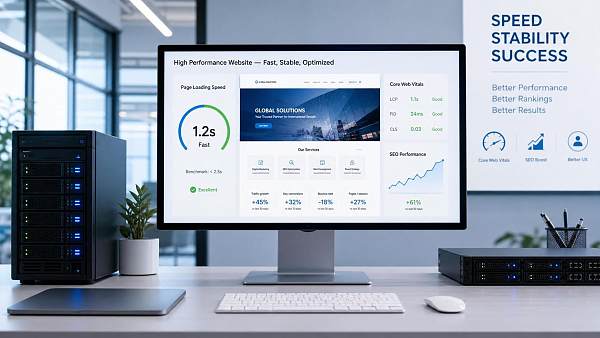
Website speed optimization tools are more than just diagnostic panels for technical personnel.
It directly affects page experience, crawling efficiency, conversion performance, and the stability of search rankings.
Many websites are indexed normally, but they don't get better rankings for a long time. The problem is often related to speed and user experience.
In recent years, search engines have placed increasing emphasis on core webpage metrics.
This also means that content and backlinks alone are not enough; whether a page is fast, stable, and smooth will also affect SEO results.
If you want to use website speed optimization tools effectively, you need to understand one thing first.
The score given by the tool is not the goal; what truly matters is the business impact.
Why do website speed optimization tools affect SEO assessments?
Search engines need to determine whether a page is worth prioritizing for display.
Speed performance is one of the most direct indicators of this.
Slow page loading speeds make users more likely to leave, resulting in decreased dwell time and engagement depth.
From an SEO perspective, this will weaken the page's competitiveness.
An even clearer signal is that website speed optimization tools can also help identify waste at the crawling level.
For example, too many scripts, excessively large images, slow server response, and lack of caching strategies.
These issues not only affect access speed but also the efficiency of search engine crawling.
As crawling costs increase, page updates and indexing may also slow down.
Therefore, the value of website speed optimization tools lies not in "measuring scores," but in "finding bottlenecks."
What exactly do core webpage metrics look for?
When discussing website speed optimization tools, core webpage metrics are indispensable.
It primarily focuses on three dimensions: loading, interaction, and visual stability.
LCP: How long does it take to see the main content of the page?
LCP refers to Maximum Content Rendering Time.
Simply put, it's about how quickly a user can see the most important content on a page.
If the main image, title, and product section on the homepage are slow to appear, the LCP (Local Content Value) will usually be high.
This metric is particularly critical for marketing websites.
INP: How responsive are the page operations?
INP reflects the interaction response speed.
Unresponsive buttons, laggy filtering, and delayed form input all negatively impact the user experience.
If a website speed optimization tool indicates script blocking, you should usually focus on this area.
CLS: Will the page jump around randomly?
CLS reflects the stability of page layout.
The text has just appeared, the image suddenly drops down, and the button position changes instantly—this is a typical problem.
It not only affects the user experience, but is also prone to accidental touches, directly impacting conversion rates.
When looking at website speed optimization tools, don't just focus on the overall score.
Many people look at the overall score first when they open a website speed optimization tool.
This step is correct, but we can't stop here.
Scores are just results; optimization requires understanding the reasons behind them.
In actual investigation, it is recommended to judge according to the following order:
- Let's look at mobile data first, because most search traffic is initially affected by the mobile experience.
- Next, look at real user data, and avoid relying solely on laboratory simulation results.
- Continue to pinpoint the specific resources that are slowing down the page, such as images, fonts, scripts, and third-party code.
- Finally, the optimization priority is determined based on the page type.
For example, the problems on the homepage, product page, landing page, and blog page may seem similar, but the order in which they are handled may not be the same.
In actual business operations, prioritizing the optimization of high-traffic, high-conversion pages is usually more cost-effective.
How to quickly locate common problems from tool reports
Website speed optimization tools offer many suggestions, but not all of them need to be addressed simultaneously.
Focusing on the most impactful points first will be much more efficient.
- Slow server response: First check host performance, caching strategy, database queries, and regional deployment.
- Images slow down the first screen: Compress file size, use appropriate dimensions, and avoid meaningless ultra-high-resolution images.
- Script blocking rendering: Delay non-critical scripts, reduce plugin stacking, and clean up duplicate code.
- Font overload: Reduce the number of font weights and control external font requests.
- Frequent layout changes: Reserve fixed space for images, ad slots, and embedded modules.
These kinds of problems may seem minor, but they can actually be quickly exposed by website speed optimization tools.
The key is not to understand every technical term, but to establish the correspondence between "problem and action".
The optimization focus differs depending on the website scenario.
While both B2B official websites and cross-border e-commerce platforms use website speed optimization tools, their focuses differ.
B2B marketing websites place greater emphasis on the efficiency of information delivery on the first screen.
Key selling points, industry solutions, and inquiry channels should be displayed as soon as possible.
Cross-border e-commerce platforms, on the other hand, pay more attention to the smoothness of interaction.
If the processes of filtering, adding to cart, switching specifications, and checkout become choppy, the loss of orders will be very noticeable.
Multilingual websites present additional challenges.
Different access speeds in different regions, font resources, translation scripts, and third-party components can all slow down the page.
This is why more and more companies are starting to adopt integrated website building and optimization solutions.
Taking AI-driven platforms like Yiyingbao as an example, their advantages go beyond just fast website creation.
More importantly, it takes into account the coordination of website structure, SEO rules, page loading, and subsequent promotion.
By doing this, problems identified by website speed optimization tools are often easier to resolve.
A more practical set of website speed optimization tools and their usage methods
If you want a more stable outcome, you can proceed at this pace.
- Select the core pages, which are usually the homepage, product pages, landing pages, and article pages.
- Use a website speed optimization tool to test both mobile and desktop versions.
- Record LCP, INP, CLS and server response time.
- Sort by impact, and deal with first-screen resources and blocking scripts first.
- After each round of optimization, a retest is conducted to avoid making too many changes at once and being unable to judge the effect.
- Look at speed metrics together with bounce rate, inquiry rate, and conversion rate.
The advantage of doing this is that optimization is no longer limited to the technical level.
You can directly see the SEO and business changes brought about by website speed optimization tools.
Conclusion: The tool itself is not the answer; continuous optimization is the key.
Returning to the original question, how helpful are website speed optimization tools for SEO?
The answer is yes, it is very helpful, but only if you know how to read, judge, and execute.
It can help identify problems with core webpage metrics and reveal the real bottlenecks affecting indexing and conversion.
However, if you only pursue scores without considering the page's objectives and business scenarios, optimization can easily go astray.
A more prudent approach is to use website speed optimization tools as a long-term monitoring method.
We continuously fine-tune everything from page structure and content loading to user experience and SEO strategies.
When a website can be opened quickly, understood efficiently, and used smoothly, its ranking and conversion rates are usually more solid.
First look at the metrics, then the page, and finally the actions – that's the true value that website speed optimization tools should provide.
Related Articles

Related Products
 Yiyingbao SaaS Intelligent Website Building and Marketing SystemYiyingbao SaaS Intelligent Website Building and Marketing System, AI-powered no-code website building, rapid creation of multilingual B2B international websites in 10 minutes, global server acceleration, AI-powered SEO optimization, helping businesses connect efficiently with global markets. The perfect integration of technology and operation makes building an international trade website remarkably simple
 AI+SEM Intelligent Advertising Marketing SystemAI+SEM drives intelligent ad creation, empowering full-funnel precision advertising marketing. The system automatically generates weekly/monthly reports, AI recommends keywords and target countries, monitors core metrics in real-time with intelligent alerts, and enables one-click high-conversion ad solutions to help quickly acquire customers and improve ROI.
 AI+SEO Dual-Engine System Optimization ServicesYiyingbao’s AI+SEO dual-engine optimization system helps foreign trade enterprises acquire high-quality organic traffic through AI-powered keyword research, content generation, and comprehensive technical optimization, significantly improving search rankings and conversion rates.
 AI+SNS Social Media Marketing SystemYingbao AI+SNS Social Media Marketing System - Precision social capture for the social media era. Supports one-click content synchronization across major platforms like Facebook and LinkedIn. AI intelligently rewrites posts for enhanced relevance. 24/7 AI customer service and user profiling analysis empower businesses to efficiently expand into global markets.
 AI+SEO营销解决方案易营宝AI+SEO营销解决方案,通过AI批量写作、智能生成TDK、精准关键词扩词等功能,全面优化网站SEO效果,提升流量与转化率。助力企业构建高效智能网站新生态。
 AI+SEM Advertising Marketing SolutionsAI+SEM Advertising Marketing Solution leverages AI technology to deeply empower SEM ad campaigns. It automatically generates weekly/monthly reports using AI, presenting account data across multiple dimensions for comprehensive insights into campaign performance and trends. The system precisely recommends keywords and target countries, intelligently generates high-conversion ad copy, and enables one-click activation of efficient campaign plans to help businesses rapidly acquire customers. Simultaneously, it monitors core metrics in real time, intelligently identifies abnormal fluctuations, and issues timely alerts to ensure stable, high-return advertising results.
 Domain Name ServicesEasyWin provides professional domain name services, including intelligent queries, one-stop registration, brand protection, and full lifecycle management, helping businesses build a digital brand image.
 EasyOperate B2C Cross-Border E-Commerce Platform & Independent WebsiteEasyStore B2C Cross-border E-commerce Independent Store is an intelligent website building and cross-border e-commerce integrated solution independently developed by EasyStore Information Technology (Beijing) Co., Ltd. The system is specially designed for small and medium-sized as well as large export enterprises, integrating 'website building, operation, marketing, advertising, and conversion' into one, helping enterprises quickly establish cross-border e-commerce independent stores to achieve brand globalization and global sales growth.
The platform supports multiple languages, multiple currencies, and multi-channel marketing, with built-in AI intelligent translation and SEO optimization systems, suitable for mainstream markets such as Southeast Asia, Europe and America, Latin America, and the Middle East, assisting Chinese manufacturing enterprises in efficiently deploying international e-commerce strategies. SSL证书易营宝提供专业SSL安全证书服务,包括单域名和泛域名证书,确保网站数据传输加密、身份验证和完整性保护,助力企业建立安全可信的在线业务环境。









