









- Which customer acquisition channels will be affected by cross-border marketing trends in 2026?Sep 06, 2026View details
- Which homogenization risks should be considered in an analysis of the AI-powered website building industry?Aug 30, 2026View details
- How Will AI Marketing Trends 2026 Change Advertising Budget AllocationAug 28, 2026View details
- Is the EV SSL certificate market shrinking or upgrading? How should companies assess certificate procurement?Aug 11, 2026View details
- Why the old AMP SEO 2020 practices no longer work and what has changed in current optimization prioritiesAug 02, 2026View details
- How to Choose Topics for an Industry News Section to Attract More Organic Search TrafficJul 29, 2026View details
What are the differences between template website systems and custom development? Which companies are more suitable to use template websites first?
What are the differences between template website systems and custom development? For business evaluators, the real comparison isn't just about budget, but also about launch speed, future scalability, marketing efficiency, and project risk. For most companies, using template website systems is usually more cost-effective during the business validation phase, market testing phase, or when budgets are relatively conservative. However, the value of custom development becomes more apparent when companies have specific requirements for brand expression, business processes, system integration, and long-term operation.
From a decision-making perspective, template websites and customized websites are not simply a matter of "low-end" and "high-end" configurations, but rather two different development paths with different goals at different stages. The key to determining whether a template website is suitable to be used first lies in understanding the company's current priorities: is it to quickly launch and acquire customers, or to build a complex, long-term digital infrastructure?
What do business evaluators really need to look at first?
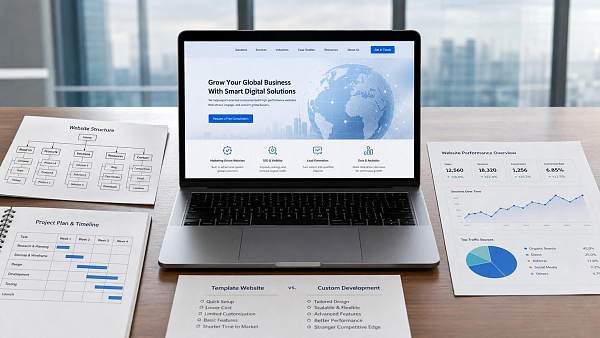
Readers searching for "template website systems" are often not simply looking to understand technical concepts, but rather hoping to quickly determine which website building method is more suitable for their current business. Business evaluators are usually most concerned with return on investment, launch time, post-launch maintenance costs, difficulty of cross-departmental collaboration, and whether the website can truly support customer acquisition and conversion.
In other words, this isn't a purely technical selection issue, but a business decision. If a website project is slow to launch, complex to maintain, and has weak promotional effects, even if it has complete functionality, it may not be the optimal solution at the current stage. Conversely, as long as the website can be launched quickly within a reasonable cost and meets the needs for display, indexing, inquiries, and ad placement, a template website system has strong practical value.
What are the core differences between template website systems and custom development?
Template website systems are typically built on mature platforms and existing page structures. Businesses can replace content, images, sections, and some functions within a ready-made framework, resulting in shorter development cycles, higher deployment efficiency, and more controllable overall costs. This is a significant advantage for businesses looking to quickly have a usable official website, marketing site, or multilingual site.
Custom development starts from business needs and redesigns the information architecture, interaction logic, front-end and back-end functions, and management processes. Its advantage lies in its high flexibility, which can deeply match brand style, complex business scenarios, and internal system integration requirements. However, the corresponding communication costs, project cycle, testing workload, and budget investment will increase significantly.
From a business perspective, the biggest difference between the two lies not in whether the page is unique, but in the trade-off between certainty and flexibility. Template website systems emphasize rapid deployment and predictable costs, while custom development emphasizes long-term scalability and depth of business adaptation. The choice depends on which aspect the company currently lacks most.
Why are template websites more suitable for many companies in the first phase?
For most businesses in their growth phase, the primary goal of website construction is not to create the "most complete" system, but rather to quickly establish online touchpoints, validate market feedback, and provide stable landing pages for SEO, advertising, social media marketing, and customer inquiries. Template website systems are perfectly suited to this need that prioritizes speed and effectiveness.
In particular, foreign trade companies, manufacturing plants, cross-border sellers, and brand overseas expansion teams often need to quickly launch multilingual official websites, product display pages, or independent websites when entering new markets. If these projects start with heavy customization, they often slow down the process due to repeated requests, insufficient content preparation, and approvals from multiple departments, causing them to miss the promotion window.
In contrast, template-based website systems make it easier to break down projects into actionable steps: choose a template, gather information, configure sections, implement basic SEO, integrate forms and analytics tools, and then quickly begin deployment and optimization. For business evaluators, this means projects are easier to assess, easier to control, and easier to see results in the short term.
Which businesses are better suited to use a template website system first?
The first category consists of businesses in the business validation phase. This includes newly established brands, factories just starting to expand into overseas markets, and cross-border sellers preparing to test independent website models. These businesses often lack a fully stable product structure and marketing strategy. Using a template website at this stage allows for cost-effective validation, and the decision to upgrade can be made based on actual data.
The second category is businesses with high time-to-market requirements. For example, before trade shows, product launches, business recruitment, or channel expansion, they need a website that can be showcased, indexed, and converted quickly. Template website systems can shorten the time from project initiation to launch, avoiding disruptions to business operations due to excessively long technical development cycles.
The third category consists of companies whose budgets prioritize efficiency over high personalization. Many companies aren't unwilling to invest, but rather prefer to allocate their budgets first to content creation, SEO optimization, advertising, and lead generation. In this case, choosing a mature template website system is often more pragmatic than putting the majority of the budget into initial development.
The fourth category consists of companies with relatively standardized needs. If the core objectives of the website are company display, product introduction, multilingual support, inquiry collection, case studies, and search engine optimization, then many mature templates can already cover more than 80% of the needs, and there is no need to develop a complete system from scratch.
In what situations is custom development a worthwhile investment?
If a company's website is not just a showcase, but carries complex business processes, such as membership tiers, distributor systems, pricing logic, ERP or CRM integration, personalized permission management, and complex e-commerce transaction processes, then template website systems may gradually reach their limits, and custom development will have greater long-term value.
Furthermore, when a company has already established a clear brand system, has high requirements for visual consistency, interactive experience, and content structure, and the website needs to be operated continuously as a long-term digital asset, custom development makes it easier to achieve brand differentiation. Especially in highly competitive and homogenized industries, custom websites can bring stronger brand recognition and greater control over the user experience.
However, business evaluators should note that suitable customization doesn't mean the earlier the better. Many companies' problems aren't a lack of templates, but rather that their marketing strategies, content capabilities, and promotion systems are not yet fully operational. Investing heavily in custom development before these foundations are established may not yield immediate commercial returns.
When evaluating a template website system, you can't just look at whether the page looks good or not.
In actual procurement, a common misconception is that template website systems are simply "cheap showcase pages." However, for marketing-oriented companies, what they should really evaluate is whether the template system has an SEO-friendly structure, mobile-friendly design, multilingual capabilities, page loading speed, form conversion capabilities, and whether subsequent content updates are convenient enough.
If a template website can be built quickly, but has a messy URL structure, limited TDK settings, weak page indexing ability, redundant code, and difficult-to-manage form leads, then its value in customer acquisition will be significantly weakened. Conversely, a template website system designed for marketing scenarios, even if not fully customized, can support long-term promotion and continuous optimization.
Therefore, when comparing solutions, business evaluators should upgrade their assessment from "usability" to "promotionability, indexing capability, conversion rate, and sustainable operation." This is the key to determining whether a template system truly has value, rather than relying solely on subjective visual evaluations.
When conducting business evaluations, it is recommended to focus on these five dimensions.
First, consider whether the launch timeline matches your business milestones. If your company plans to participate in international trade shows, launch Google Ads, or begin overseas social media operations, delaying the website launch by a month could result in losses that outweigh the savings in development costs. The value of template website systems often lies in saving time.
Second, consider whether the template system is flexible enough for future expansion. A good template system, while not fully customizable, should support the addition of language sites, landing pages, product pages, blog content, SEO modules, and data tracking capabilities, rather than locking the company into a rigid structure from the outset.
Third, consider its marketing synergy capabilities. Websites don't exist in isolation; they need to work in conjunction with SEO, advertising, social media content, and AI-driven search visibility. If a website building system can't support these functions, then even the lowest price won't reflect its true value.
Fourth, consider the maintenance threshold and team adaptability. Business personnel need to consider whether the operations team can independently update content, adjust pages, and publish news in the future. If each modification heavily relies on technical personnel, long-term maintenance costs will often continue to rise.
Fifth, consider whether the service provider understands the business scenario. For foreign trade, cross-border e-commerce, and brand globalization companies, website building is not a standalone delivery, but rather a link in the global marketing chain. Service providers who can understand website building, SEO, advertising, and multilingual markets are usually more helpful than teams that only develop web pages.
Using a template site first doesn't mean you'll be stuck with templates forever.
Many businesses worry that implementing a template website system first might hinder future upgrades. In reality, as long as the platform architecture chosen in the early stages is reasonable, the content planning is clear, and the SEO foundation is solid, a template website can absolutely serve as the first stage of a company's digital transformation, enabling customer acquisition and validation before gradually transitioning to deeper functional development.
A more pragmatic approach is usually to first launch a template website quickly to validate its effectiveness in the target market and channels; only after the content system, product structure, customer journey, and promotion strategy have become clear should a decision be made on whether to proceed with custom development. This not only reduces the risk of early decision-making but also ensures that subsequent customization is closer to real business needs rather than based on mere speculation.
In summary: whether to use a template or customize depends on the stage of the business.
The difference between template website systems and custom-developed websites essentially lies in how a company balances speed, cost, flexibility, and long-term planning at its current stage. For business evaluators, the most important thing is not to pursue a solution that "looks more sophisticated," but to choose the solution that best supports the business objectives at present.
If a company currently needs to launch quickly, validate the market, capture traffic, and control investment, then using a template website system is usually a more efficient choice. However, if the company has entered a mature operational phase and has higher requirements for system capabilities, brand expression, and deep integration, then custom development is a more worthwhile investment. There is only one criterion: which solution is more responsible for business growth?
Related Articles


Related Products
 Yiyingbao SaaS Intelligent Website Building and Marketing SystemYiyingbao SaaS Intelligent Website Building and Marketing System, AI-powered no-code website building, rapid creation of multilingual B2B international websites in 10 minutes, global server acceleration, AI-powered SEO optimization, helping businesses connect efficiently with global markets. The perfect integration of technology and operation makes building an international trade website remarkably simple
 AI+SEM Intelligent Advertising Marketing SystemAI+SEM drives intelligent ad creation, empowering full-funnel precision advertising marketing. The system automatically generates weekly/monthly reports, AI recommends keywords and target countries, monitors core metrics in real-time with intelligent alerts, and enables one-click high-conversion ad solutions to help quickly acquire customers and improve ROI.
 AI+SEO Dual-Engine System Optimization ServicesYiyingbao’s AI+SEO dual-engine optimization system helps foreign trade enterprises acquire high-quality organic traffic through AI-powered keyword research, content generation, and comprehensive technical optimization, significantly improving search rankings and conversion rates.
 AI+SNS Social Media Marketing SystemYingbao AI+SNS Social Media Marketing System - Precision social capture for the social media era. Supports one-click content synchronization across major platforms like Facebook and LinkedIn. AI intelligently rewrites posts for enhanced relevance. 24/7 AI customer service and user profiling analysis empower businesses to efficiently expand into global markets.
 AI+SEO营销解决方案易营宝AI+SEO营销解决方案,通过AI批量写作、智能生成TDK、精准关键词扩词等功能,全面优化网站SEO效果,提升流量与转化率。助力企业构建高效智能网站新生态。
 AI+SEM Advertising Marketing SolutionsAI+SEM Advertising Marketing Solution leverages AI technology to deeply empower SEM ad campaigns. It automatically generates weekly/monthly reports using AI, presenting account data across multiple dimensions for comprehensive insights into campaign performance and trends. The system precisely recommends keywords and target countries, intelligently generates high-conversion ad copy, and enables one-click activation of efficient campaign plans to help businesses rapidly acquire customers. Simultaneously, it monitors core metrics in real time, intelligently identifies abnormal fluctuations, and issues timely alerts to ensure stable, high-return advertising results.
 Domain Name ServicesEasyWin provides professional domain name services, including intelligent queries, one-stop registration, brand protection, and full lifecycle management, helping businesses build a digital brand image.
 EasyOperate B2C Cross-Border E-Commerce Platform & Independent WebsiteEasyStore B2C Cross-border E-commerce Independent Store is an intelligent website building and cross-border e-commerce integrated solution independently developed by EasyStore Information Technology (Beijing) Co., Ltd. The system is specially designed for small and medium-sized as well as large export enterprises, integrating 'website building, operation, marketing, advertising, and conversion' into one, helping enterprises quickly establish cross-border e-commerce independent stores to achieve brand globalization and global sales growth.
The platform supports multiple languages, multiple currencies, and multi-channel marketing, with built-in AI intelligent translation and SEO optimization systems, suitable for mainstream markets such as Southeast Asia, Europe and America, Latin America, and the Middle East, assisting Chinese manufacturing enterprises in efficiently deploying international e-commerce strategies. SSL证书易营宝提供专业SSL安全证书服务,包括单域名和泛域名证书,确保网站数据传输加密、身份验证和完整性保护,助力企业建立安全可信的在线业务环境。









