









- Can the average annual growth rate reflect real opportunities in overseas markets?Oct 07, 2026View details
- Which customer acquisition channels will be affected by cross-border marketing trends in 2026?Sep 06, 2026View details
- Which homogenization risks should be considered in an analysis of the AI-powered website building industry?Aug 30, 2026View details
- How Will AI Marketing Trends 2026 Change Advertising Budget AllocationAug 28, 2026View details
- Is the EV SSL certificate market shrinking or upgrading? How should companies assess certificate procurement?Aug 11, 2026View details
- Why the old AMP SEO 2020 practices no longer work and what has changed in current optimization prioritiesAug 02, 2026View details
Why Is Indexing Still Slow Even When Structured Data Is Implemented Correctly?
Why is website indexing still slow even when structured data has been implemented correctly? This usually means the problem is not with the markup syntax, but with how search engines comprehensively evaluate page crawling efficiency, content quality, site trustworthiness, and update frequency. For those responsible for execution, the real issue to investigate is not “whether structured data has been added,” but “why search engines are still unwilling to process these pages more quickly.”
Many websites treat structured data as an indexing accelerator after launch. In reality, structured data primarily helps search engines understand the page topic and entity relationships. It does not necessarily increase crawl frequency, much less guarantee immediate indexing after submission. Its value is only fully realized when the page itself is crawlable, the content is valuable, internal links are clear, and the overall site signals are stable.
Why are search engines still in no hurry to index a page when the structured data is correct?
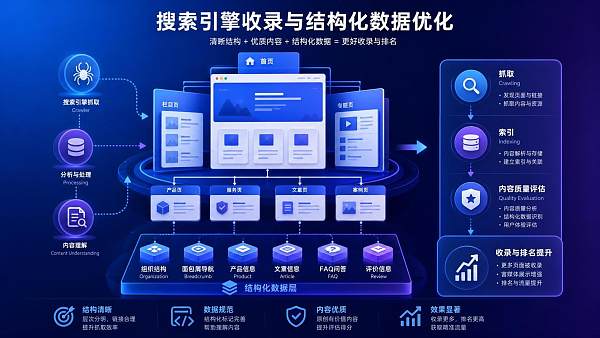
This is a problem encountered by many website operators. The page passes Schema validation, and Search Console shows no obvious errors, yet indexing remains slow. The core reason is often that structured data only addresses the issue of “understanding,” but does not solve the complete process of “discovery, crawling, evaluation, and ranking.”
Search engines typically index a page through several steps: first discovering the URL, then deciding whether to crawl it, evaluating the page quality, duplication level, site authority, and content value, and finally adding it to the index. Structured data plays a supporting role in the middle-to-later stages. It is not a prerequisite for crawling, nor is it the sole deciding factor.
If the website itself has problems such as too few crawl entry points, weak page updates, highly repetitive content, heavy template footprints, or slow server responses, search engines may delay processing even when the structured data is implemented correctly. In other words, slow indexing does not necessarily mean that your markup has no value; it may indicate that the overall site signals are not yet strong enough.
What execution teams should investigate first is not the markup code, but crawl entry points
When people see “not indexed,” they often start by modifying the Schema. In fact, they should first check whether the page is genuinely being discovered efficiently by search engines. Without stable crawl entry points, even fully implemented structured data may leave a page in a low-priority state for a long time.
Start with internal links. If a new page exists only in the sitemap and has no entry points from category pages, topic pages, related-article pages, or product aggregation pages, search engines generally will not assign it a high crawl priority. This issue is especially common on multilingual websites, product detail pages, and filtered pages.
Next, check whether the XML Sitemap accurately reflects recently updated pages. Many websites have sitemaps that exist technically but contain large numbers of parameter pages, duplicate pages, and invalid pages, which instead dilute effective crawl signals. A sitemap is not better because it is larger; it is better when it is more accurate.
Then review the robots, canonical, and noindex settings. Some pages may appear accessible and their structured data may be recognized, but resources may actually be restricted from crawling by robots, or the canonical may point to another page. As a result, search engines may not treat the current URL as the primary indexing target.
When a page is not indexed quickly, the content quality signals are often not strong enough
Structured data can tell search engines “what this is,” but it cannot prove for you “whether this page is worth indexing.” If the page content is vague, thin, heavily rewritten, or highly similar to other pages on the site, search engines may postpone indexing even after crawling it.
For operators, the key point is whether the page has independent value. For example, product pages for similar products may only replace the model number while leaving almost identical descriptions; or article pages may have different titles but highly repetitive core content. Both situations can reduce the search engine’s willingness to process them.
In addition, a common problem with template-based websites is that there is too little readable information in the main body. Navigation, footers, and recommendation modules occupy too much space, while the main content signals are not prominent. In such cases, adding structured data such as Article, Product, or FAQ is unlikely to fundamentally improve the indexing pace.
If your content involves business research, management solutions, or industry observations, you should also avoid presenting concepts without conclusions. For topics such as Research on Business Administration in the Context of Digital Transformation, the page needs to present clear issues, research value, and applicable scenarios so that search engines can more easily determine its independence and information density.
Weak overall site trustworthiness can also reduce the effectiveness of structured data
Many slow-indexing problems do not originate from an individual page, but from the site as a whole. Search engines assess whether a site is worth continuously allocating crawl resources to based on factors such as domain history, content stability, page quality distribution, backlink quality, and update patterns.
If a website frequently generates pages in bulk but lacks stable updates and meaningful traffic feedback, search engines generally adopt a more cautious strategy. New websites, redesigned websites, new multilingual directories, bulk product pages, and automatically generated landing pages are particularly likely to face a longer observation period.
This is why some older sites are indexed quickly even when their structured data is only average, while some new sites remain slow to index despite having comprehensive markup. The former benefit from accumulated long-term trust; the latter lack an overall site evaluation score, rather than a single technical element.
For corporate websites, international trade websites, and cross-border independent sites, the completeness of brand information, consistency of contact details, authenticity of pages, case-study content, and quality of language localization all affect how search engines assess site credibility. Structured data only amplifies these signals; it cannot replace them.
“No technical errors” does not mean “truly helpful”
This is a point that execution teams often overlook. When a tool indicates that structured data is valid, it only means that the format has passed validation. It does not mean that search engines will adopt it, nor does it mean that it sufficiently matches the main content of the page. There is still a long way to go between syntactic correctness and effective indexing.
For example, a page may clearly be a standard service page but be forced into the Product type; an article’s update date may remain unchanged for a long time despite repeated submissions; or Organization, Breadcrumb, and Article may all be present while the page contains too little main content, resulting in insufficient support between the markup and the body text. These issues may not generate direct errors, but they can weaken actual effectiveness.
Another common situation is that structured data is rendered on the front end, but the key body content depends on delayed script loading. When search engines crawl the page, the main content they obtain may be incomplete. This creates a mismatch in which “the markup appears complete, but the page is not fully understood.”
Therefore, determining whether structured data is truly working cannot rely solely on rich-results testing. It should be analyzed together with crawl logs, the number of discovered-but-not-indexed pages, page rendering results, and whether search engines are consistently accessing the relevant directories.
What should the actual optimization sequence be if you want to improve indexing speed?
If you are a website operator or SEO practitioner, it is recommended that you adjust the investigation sequence. First confirm that the page can be discovered, then confirm that it is worth crawling, and only afterward assess whether structured data has improved understanding efficiency. If the sequence is reversed, a great deal of time is often spent on details without addressing the real issue.
First, check whether the URL has stable entry points, including navigation, category pages, topic pages, breadcrumbs, and related-article recommendations. Second, check whether the page has duplicate titles, duplicate body content, or thin content. Third, check server response, rendering speed, and mobile accessibility.
Fourth, confirm whether the structured data type matches the page scenario and whether its fields are accurate, complete, and up to date. Fifth, use Search Console to review the numbers of crawled-but-not-indexed pages, discovered-but-not-indexed pages, and alternative pages, and determine whether the problem occurs before crawling or after evaluation.
When a page is a key conversion page, you can also strengthen external signals at the same time—for example, adding internal links from high-quality content pages, combined with social media exposure, backlink citations, and brand-term development—so that search engines can more quickly determine that the page has business value rather than existing in isolation.
What is the real value of structured data for corporate websites?
Many people understand structured data as an “indexing acceleration tool,” but this is too narrow. For corporate websites, marketing websites, and cross-border independent sites, its greater value lies in helping search engines accurately identify companies, products, articles, navigation hierarchies, and core entity relationships, thereby improving understanding efficiency and opportunities for enhanced presentation.
When a website is also engaged in AI website building, SEO optimization, advertising, and content marketing, the significance of structured data becomes even more apparent. It can help different types of pages establish clearer semantic labels, making it easier for search engines to understand the overall theme of the site rather than treating the pages as a loose collection of information.
This capability is important for long-term growth. Mature website optimization is never about obtaining short-term results through a single technical action. Instead, it aims to create a positive cycle involving crawling, indexing, understanding, ranking, clicks, and conversions. Structured data is important in this process, but it must work together with content quality, the technical foundation, and site planning.
If your page contains professional content or industry materials, such as the informational topic Research on Business Administration in the Context of Digital Transformation, you should place greater emphasis on the page’s independent viewpoints, focused topic, and searchability, rather than stopping at the code-level status of “added.”
Conclusion: The key reason for slow indexing is usually not the structured data itself
When structured data has been implemented correctly but website indexing is still slow, the most common causes are insufficient crawl entry points, weak page quality, low site trustworthiness, or hidden technical barriers affecting crawlability and renderability. Structured data can enhance understanding, but it cannot replace overall quality.
For practitioners, the most effective approach is to break the problem down according to the search engine workflow: Has it discovered the page? Is it willing to crawl it? After crawling, does it consider the page worth indexing? Only then should you ask whether it can understand the page more effectively. Investigating in this order makes it easier to identify the real bottleneck.
If you want your website to be promotable, indexable, and capable of generating conversions, you cannot view structured data in isolation. Only by improving page content, the technical foundation, link structure, and long-term site signals together can the value of structured data be fully released, giving indexing speed and subsequent ranking performance a better chance of improving steadily.
Related Articles



Related Products
 Yiyingbao SaaS Intelligent Website Building and Marketing SystemYiyingbao SaaS Intelligent Website Building and Marketing System, AI-powered no-code website building, rapid creation of multilingual B2B international websites in 10 minutes, global server acceleration, AI-powered SEO optimization, helping businesses connect efficiently with global markets. The perfect integration of technology and operation makes building an international trade website remarkably simple
 AI+SEM Intelligent Advertising Marketing SystemAI+SEM drives intelligent ad creation, empowering full-funnel precision advertising marketing. The system automatically generates weekly/monthly reports, AI recommends keywords and target countries, monitors core metrics in real-time with intelligent alerts, and enables one-click high-conversion ad solutions to help quickly acquire customers and improve ROI.
 AI+SEO Dual-Engine System Optimization ServicesYiyingbao’s AI+SEO dual-engine optimization system helps foreign trade enterprises acquire high-quality organic traffic through AI-powered keyword research, content generation, and comprehensive technical optimization, significantly improving search rankings and conversion rates.
 AI+SNS Social Media Marketing SystemYingbao AI+SNS Social Media Marketing System - Precision social capture for the social media era. Supports one-click content synchronization across major platforms like Facebook and LinkedIn. AI intelligently rewrites posts for enhanced relevance. 24/7 AI customer service and user profiling analysis empower businesses to efficiently expand into global markets.
 AI+SEO营销解决方案易营宝AI+SEO营销解决方案,通过AI批量写作、智能生成TDK、精准关键词扩词等功能,全面优化网站SEO效果,提升流量与转化率。助力企业构建高效智能网站新生态。
 AI+SEM Advertising Marketing SolutionsAI+SEM Advertising Marketing Solution leverages AI technology to deeply empower SEM ad campaigns. It automatically generates weekly/monthly reports using AI, presenting account data across multiple dimensions for comprehensive insights into campaign performance and trends. The system precisely recommends keywords and target countries, intelligently generates high-conversion ad copy, and enables one-click activation of efficient campaign plans to help businesses rapidly acquire customers. Simultaneously, it monitors core metrics in real time, intelligently identifies abnormal fluctuations, and issues timely alerts to ensure stable, high-return advertising results.
 Domain Name ServicesEasyWin provides professional domain name services, including intelligent queries, one-stop registration, brand protection, and full lifecycle management, helping businesses build a digital brand image.
 EasyOperate B2C Cross-Border E-Commerce Platform & Independent WebsiteEasyStore B2C Cross-border E-commerce Independent Store is an intelligent website building and cross-border e-commerce integrated solution independently developed by EasyStore Information Technology (Beijing) Co., Ltd. The system is specially designed for small and medium-sized as well as large export enterprises, integrating 'website building, operation, marketing, advertising, and conversion' into one, helping enterprises quickly establish cross-border e-commerce independent stores to achieve brand globalization and global sales growth.
The platform supports multiple languages, multiple currencies, and multi-channel marketing, with built-in AI intelligent translation and SEO optimization systems, suitable for mainstream markets such as Southeast Asia, Europe and America, Latin America, and the Middle East, assisting Chinese manufacturing enterprises in efficiently deploying international e-commerce strategies. SSL证书易营宝提供专业SSL安全证书服务,包括单域名和泛域名证书,确保网站数据传输加密、身份验证和完整性保护,助力企业建立安全可信的在线业务环境。









