









- AI Products Drive Hong Kong Exports Up 64.9% in September, Fastest Growth in Over 40 YearsNov 17, 2026View details
- National Bureau of Statistics: Foreign trade grew rapidly in October, providing stable support for global tradeNov 17, 2026View details
- The U.S. has ended the $800 de minimis exemption for non-postal shipments; express courier packages must be formally declared.Nov 16, 2026View details
- ASEAN Signs Digital Economy Framework Agreement, Moving Toward Harmonized Cross-Border E-Commerce RulesNov 15, 2026View details
- Shenzhen Becomes the First City in Mainland China to Exceed RMB 5 Trillion in Foreign TradeNov 15, 2026View details
- Fujian Announces the First Batch of Provincial-Level Cross-Border E-Commerce Industrial Parks and Key Brands for CultivationNov 14, 2026View details
What does initial SEO implementation include before a website goes live?
What Exactly Is Included in Initial SEO Implementation Before a Website Goes Live?
Many projects understand pre-launch SEO preparation as simply “filling in the title and description.” This is usually where the most rework begins later. A genuine initial seo implementation takes place before the site is made public: whether the information architecture can support future expansion, whether pages can be crawled consistently, whether templates amplify duplicate content and indexing risks, whether multilingual versions clearly communicate regional and language relationships, and whether speed and front-end rendering methods narrow the paths to indexing. If these issues are addressed only after launch, the cost is often much higher than dealing with them during the website development stage.
From a technical evaluation perspective, pre-launch SEO is not an “add-on” for the marketing department, but part of the site’s engineering quality. This is especially true for international trade websites, cross-border e-commerce stores, and multilingual brand websites. After launch, a site must not only be viewable, but also crawlable, indexable, distributable, and capable of supporting conversions. Platforms such as 易营宝, which provide intelligent website building, SEO, advertising, and multilingual international website services, usually address this work at an early stage in actual projects, because organic traffic, the quality score of advertising landing pages, and the user experience of social media distribution links are all influenced by the underlying architecture.
Before Discussing Keywords, First Check Whether the Site Structure Is Correct
The first thing worth checking before launch is the structure, not the copy. If a site has a confusing navigation hierarchy, illogical category relationships, or URL rules that are organized by product line one day and by region the next, search engines will face a high cost of understanding it no matter how carefully the content is produced. Technically, three things should be confirmed first: whether page types are clearly defined, whether directory rules are consistent, and whether internal linking paths are predictable.
For example, an international manufacturing website will typically include at least a homepage, product categories, product detail pages, industry applications, solutions, an about page, and a contact page, as well as possible case studies, blog pages, and download pages. If all these pages use the same title structure at the template level, or if product page and article page URLs are mixed within the same directory, search engines will have more difficulty determining page intent. During a technical evaluation, you can directly ask the developer or website service provider: Are page types defined independently? Does the system support configuring different title rules, structured fields, and indexing strategies for different templates? This is more useful than simply asking whether the site “has SEO features.”
In addition, do not underestimate the long-term impact of URLs. Once a directory is made public, changing it later involves redirects, indexing fluctuations, and the loss of value from historical links. Before launch, you should determine whether to use short paths, whether to retain category levels, and whether dynamic parameter pages should be indexable. E-commerce websites and sites with extensive filtering are particularly likely to create problems at this stage.
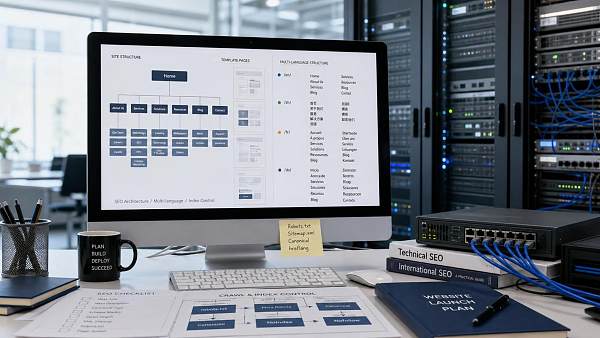
Crawl and Indexing Controls Are the Core Foundation of Initial SEO Implementation
Many websites do not have a “content problem”; rather, search engines have not obtained the correct pages at all. Therefore, before launch, at a minimum, the robots rules, canonical tags, status codes, sitemaps, and redirect logic should be reviewed and clarified.
Let’s start with robots. The most common problem in testing environments is that the entire site is blocked from crawling during development, but the restriction is not removed after launch. Another issue is blocking certain static resource directories, which causes pages to render incompletely. Then there is canonical. If list pagination, parameter pages, duplicate language pages, and tag pages do not have a clearly defined primary version, internal competition will arise later. The same applies to status codes. Technical teams often focus more on whether a page can be opened while overlooking whether 200, 301, and 404 responses are accurate. Search engines do not make judgments based on whether something “looks normal”; they evaluate response signals.
A sitemap is not merely a matter of “automatically generating an xml file.” What really matters is whether it contains only indexable pages, whether it is separated by content type, whether the update frequency is reasonable, and whether invalid pages continue to remain in the sitemap. For a new website, these details directly affect indexing efficiency. In projects with many products and languages, sitemap quality is more important than sitemap quantity.
Page Templates Must Be Finalized Before Launch, Otherwise They Become Harder to Fix as Content Grows
Many SEO problems are not caused by an individual page being poorly written, but by templates amplifying the problem across many pages. For example, if title rules uniformly call the site name, a large number of page titles will become highly similar; if the first screen of a product detail page contains too little text and the main content is placed entirely inside switchable tabs or scripts, important information may be difficult to access; if article pages automatically insert a large number of identical anchor texts, the site may appear to have many internal links while their actual relevance remains weak.
During a technical evaluation, it is recommended to accept templates as products in their own right. At a minimum, check the following:
- Whether each page type supports independent titles, descriptions, main headings, and auxiliary fields;
- Whether the core content of the body is visible above the fold and whether it relies excessively on scripts to load;
- Whether breadcrumbs, related recommendations, and parent-child relationships genuinely reflect the site structure rather than serving as decorative components;
- Whether images support alt text, compression, lazy loading, and stable URLs;
- Whether the system automatically generates large numbers of thin-content pages, such as empty tag pages, empty filter pages, and empty search results pages.
If this layer is built solidly, the content team can produce content normally instead of “fighting system limitations.” When providing integrated website and marketing services, truly experienced teams generally evaluate website templates, SEO fields, and advertising landing page logic together, because they ultimately compete for the same sources of traffic.
For Multilingual Websites, the Biggest Risk Is Not Translation but Confusing Version Relationships
Pre-launch checks for international websites are more complex than those for monolingual websites. Multilingual does not mean simply duplicating several sets of pages. Language, region, currency, content differences, form ownership, and server distribution strategies all affect how search engines understand whether these pages are different versions of the same topic.
There are three common mistakes. The first is using the same machine-translated content for every language, changing only the navigation while leaving the main body of the pages almost identical. This is unfavorable to users and may also result in insufficient value for each version. The second is incomplete or mismatched hreflang configuration, which prevents search engines from consistently identifying relationships between different language and regional versions. The third is implementing language switching only as a front-end display feature without generating independent crawlable URLs. Such a website may appear convenient to users but is highly unfavorable for indexing.
Platforms such as 易营宝, which serve international trade companies and brands expanding overseas over the long term, emphasize multilingual website building and localization not merely because pages should “look like the local language.” More importantly, the site must technically distinguish language versions, directory rules, and page assets. Otherwise, advertising, organic traffic, and social media content will all lead to the same confusing entry point.
Speed, Rendering, and Usability Are More Than Experience Issues
Before a website goes live, technical teams often conduct functional testing, but they may not perform performance testing from an SEO perspective. Three areas require particular attention: whether above-the-fold resources are too heavy, whether core content is visible on the server side, and whether mobile interactions interfere with access.
If there are too many large images, videos, or third-party scripts above the fold, both crawler access and user visits will be affected. In some front-end framework projects, for example, the initial HTML is very lightweight while the main content depends on subsequent script rendering. This does not make indexing impossible, but stability and efficiency need to be evaluated according to the specific implementation. For new websites, the more they rely on complex front-end mechanisms, the more carefully they should be tested. The same applies to mobile devices. Pop-ups covering the entire first screen, forced redirects during language switching, and unresponsive inquiry forms may not make a page completely impossible to index, but they can significantly reduce the quality of entry pages.
If the site will also be used for advertising in the future, speed and usability should not be left to be fixed after launch. The performance of advertising landing pages and organic traffic pages will ultimately converge on the same overall site experience. If a website-building system can handle image compression, caching strategies, resource merging, and mobile adaptation reliably at the template level, the subsequent operational workload will be much lower.
Do Not Reduce “Content Preparation” to Writing a Few Articles
The focus of pre-launch content preparation is not quantity, but whether key pages have clear topic boundaries that users and search engines can understand. The homepage should explain the brand and capabilities, category pages should define the scope, product pages should describe specifications, applications, and differences, solution pages should explain use cases, and the contact page should provide a clear action path. A common problem is that every page repeats “who we are” without separating the actual questions users are likely to search for.
Technical evaluators can ask one additional question here: Are the content fields structured? For example, can product specifications, application industries, delivery scope, supported languages, and regional service capabilities be stored as fields rather than being placed entirely in rich text? The benefit of structured fields is not visual appeal, but that they facilitate later template calls, filtering, aggregation, and the generation of related pages. This is even more evident in AI-driven website-building and optimization systems: the cleaner the underlying data, the greater the scope for subsequent automated optimization.
For Pre-Launch Acceptance, It Is Recommended to Score the Site Based on Whether It Can Be Operated Sustainably
Whether a website is ready to go live should not be judged only by whether the visual design has been accurately implemented, nor only by whether articles can be published from the backend. A more practical approach is to assess whether the site will be easy to operate over the following six months and whether the initial seo implementation is sufficient. Acceptance should focus on questions such as: Do new pages require developer involvement? Does the system support redirect management when directories change? Can language versions for different countries be maintained independently? Are analytics tracking and tools such as search consoles easy to integrate? Do page templates support long-term expansion?
If all these capabilities are missing, launching the site only marks the end of the project, not the beginning of growth. Conversely, a truly mature integrated website and marketing solution usually does not treat website building, SEO, advertising, and social media as isolated modules. Instead, it clarifies the subsequent traffic acquisition paths before the site goes live. In recent years, 易营宝 has placed intelligent website building, AI+SEO/GEO, and advertising marketing systems within the same service chain. Essentially, it is addressing this exact issue: front-end pages, content structure, crawling logic, and subsequent promotion channels cannot be developed independently.
If the pre-launch SEO preparation must be condensed into one honest sentence, it is this: Do not first ask whether the site can rank after it goes live; first ask whether its structure and templates are worth continuously investing content and traffic into. Once this judgment is made correctly, launching the website is no longer merely a point in time, but a starting point capable of supporting subsequent indexing, advertising, and conversions.
Related Articles
 How to Add Structured Data to Product Pages with JSON-LD
 How Long Does It Take to See an Increase in Inquiries from SEO for Your Website?
 How to Promote a Website on Google in France: From French Keywords to Local Link Building



Related Products
 Yiyingbao SaaS Intelligent Website Building and Marketing SystemYiyingbao SaaS Intelligent Website Building and Marketing System, AI-powered no-code website building, rapid creation of multilingual B2B international websites in 10 minutes, global server acceleration, AI-powered SEO optimization, helping businesses connect efficiently with global markets. The perfect integration of technology and operation makes building an international trade website remarkably simple
 AI+SEM Intelligent Advertising Marketing SystemAI+SEM drives intelligent ad creation, empowering full-funnel precision advertising marketing. The system automatically generates weekly/monthly reports, AI recommends keywords and target countries, monitors core metrics in real-time with intelligent alerts, and enables one-click high-conversion ad solutions to help quickly acquire customers and improve ROI.
 AI+SEO Dual-Engine System Optimization ServicesYiyingbao’s AI+SEO dual-engine optimization system helps foreign trade enterprises acquire high-quality organic traffic through AI-powered keyword research, content generation, and comprehensive technical optimization, significantly improving search rankings and conversion rates.
 AI+SNS Social Media Marketing SystemYingbao AI+SNS Social Media Marketing System - Precision social capture for the social media era. Supports one-click content synchronization across major platforms like Facebook and LinkedIn. AI intelligently rewrites posts for enhanced relevance. 24/7 AI customer service and user profiling analysis empower businesses to efficiently expand into global markets.
 AI+SEO营销解决方案易营宝AI+SEO营销解决方案,通过AI批量写作、智能生成TDK、精准关键词扩词等功能,全面优化网站SEO效果,提升流量与转化率。助力企业构建高效智能网站新生态。
 AI+SEM Advertising Marketing SolutionsAI+SEM Advertising Marketing Solution leverages AI technology to deeply empower SEM ad campaigns. It automatically generates weekly/monthly reports using AI, presenting account data across multiple dimensions for comprehensive insights into campaign performance and trends. The system precisely recommends keywords and target countries, intelligently generates high-conversion ad copy, and enables one-click activation of efficient campaign plans to help businesses rapidly acquire customers. Simultaneously, it monitors core metrics in real time, intelligently identifies abnormal fluctuations, and issues timely alerts to ensure stable, high-return advertising results.
 Domain Name ServicesEasyWin provides professional domain name services, including intelligent queries, one-stop registration, brand protection, and full lifecycle management, helping businesses build a digital brand image.
 EasyOperate B2C Cross-Border E-Commerce Platform & Independent WebsiteEasyStore B2C Cross-border E-commerce Independent Store is an intelligent website building and cross-border e-commerce integrated solution independently developed by EasyStore Information Technology (Beijing) Co., Ltd. The system is specially designed for small and medium-sized as well as large export enterprises, integrating 'website building, operation, marketing, advertising, and conversion' into one, helping enterprises quickly establish cross-border e-commerce independent stores to achieve brand globalization and global sales growth.
The platform supports multiple languages, multiple currencies, and multi-channel marketing, with built-in AI intelligent translation and SEO optimization systems, suitable for mainstream markets such as Southeast Asia, Europe and America, Latin America, and the Middle East, assisting Chinese manufacturing enterprises in efficiently deploying international e-commerce strategies. SSL证书易营宝提供专业SSL安全证书服务,包括单域名和泛域名证书,确保网站数据传输加密、身份验证和完整性保护,助力企业建立安全可信的在线业务环境。









