









- Lazada 11.11 Mega Sale: LazMall Contributes Nearly Two-Thirds of GMVNov 23, 2026View details
- Shein’s European Revenue Falls 16% as Tighter Rules on Low-Value Direct Shipments Take EffectNov 23, 2026View details
- EU Low-Value Parcel Rules Impact Cargo Flows: Air Freight Volume from China to Europe Down 17% in OctoberNov 23, 2026View details
- Indonesia and the EU Sign Comprehensive Economic Partnership Agreement, 90.4% of Tariff Lines to Become Duty-Free ImmediatelyNov 23, 2026View details
- Qingdao Port's Imports and Exports Exceed RMB 23.699 Trillion in the First 10 Months, Drawing Attention to Port IntelligenceNov 22, 2026View details
- Ningbo Cross-Border E-Commerce Export Value Surges 94.87% Year on Year, Opening Up a New Billion-Yuan Growth TrackNov 22, 2026View details
What should Google SEO analysis prioritize: traffic, indexing, or conversions?
What Should Be Checked First in Google SEO Analysis: Traffic, Indexing, or Conversions
When conducting analyse seo google, do not rush to focus solely on rankings. Traffic, indexing, and conversions reflect visibility, site health, and customer acquisition efficiency respectively. Only by identifying the right priorities can optimization truly drive growth. For foreign trade companies, manufacturing plants, and cross-border brands, SEO analysis is not about exporting a keyword report every month. It is about answering a more practical question: where is the website currently getting stuck—“Google cannot find it,” “visitors do not want to click,” or “potential customers do not want to submit their details”?
The three metrics do not have an absolutely fixed order of priority, but there is a clear diagnostic logic. If pages have not been crawled and indexed properly, discussing organic traffic has little meaning. If a site receives stable search traffic but generates no inquiries, orders, or qualified leads, continuing to expand traffic often only magnifies waste. Effective Google SEO analysis should work backward from abnormal symptoms to identify the issue, rather than viewing traffic, indexing, and conversions in isolation.
Assess Indexing First: Without Visibility, Subsequent Data Can Easily Be Misleading
For new websites, redesigned websites, multilingual websites, or B2B websites with a large number of product pages, indexing status should usually be checked first. The Page Indexing report in Google Search Console helps users distinguish between two types of issues: “indexed but not shown” and “not indexed.” The former is more often related to content relevance, competition level, or page quality; the latter requires returning to technical factors, such as robots rules, noindex settings, canonical tags, sitemaps, redirect chains, and server responses.
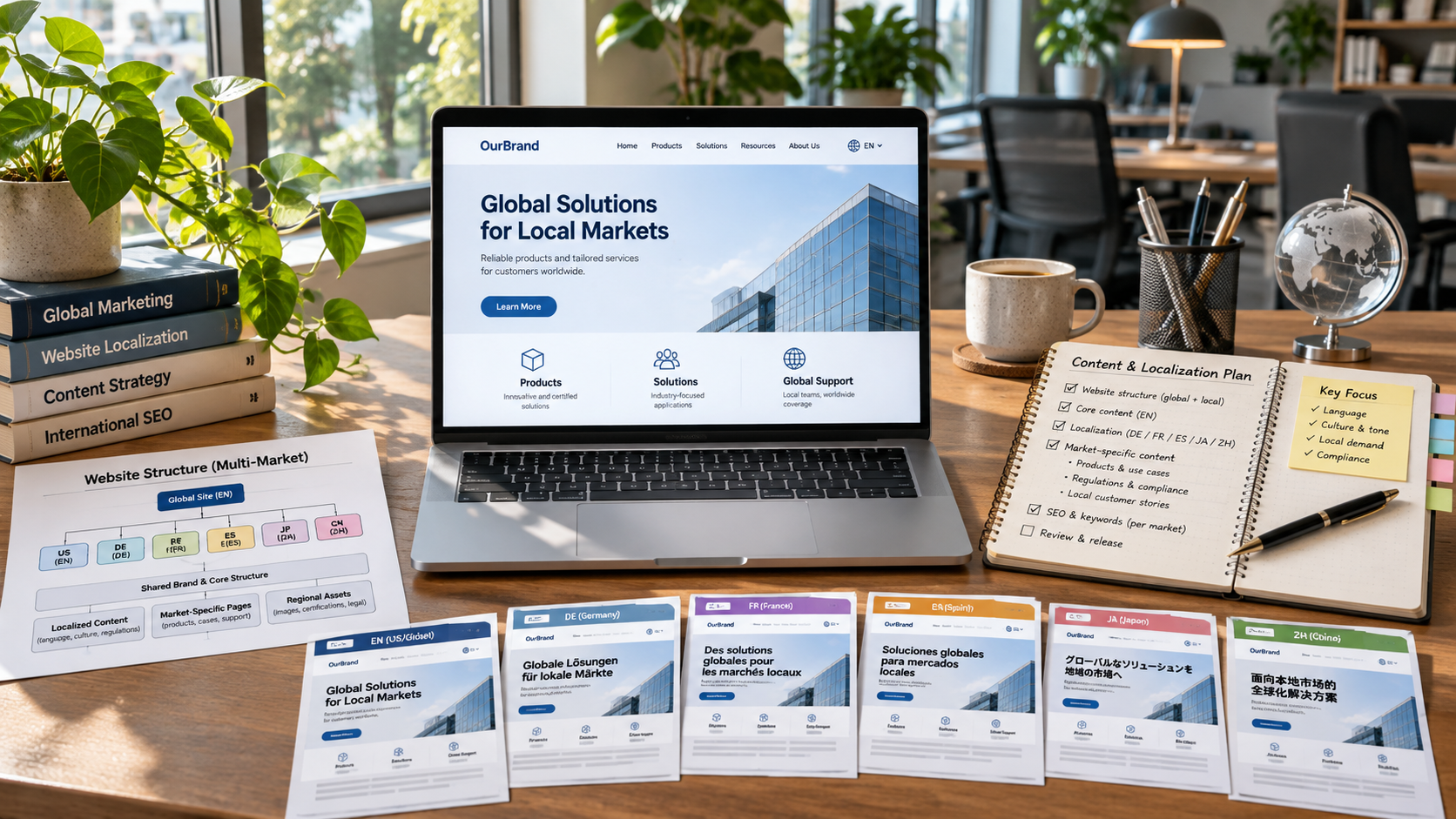
Multilingual websites are particularly prone to hidden issues. For example, English, German, and Japanese pages may only replace the text while retaining identical titles and descriptions; different language versions may point to incorrect canonical pages; or regional versions may lack clear language associations. These issues may not cause the entire website to disappear, but they can make it difficult for search engines to determine which page should be served to which users. For export-oriented companies, having a page indexed does not mean the target market can see the correct version.
Another common misconception should also be avoided: finding a page through a site query cannot replace the diagnostic results in the indexing report. The former is only suitable for a quick observation, while the latter shows the exclusion reasons and troubleshooting clues provided by Google. If core product pages, solution pages, or inquiry landing pages remain unindexed for a long time, website fundamentals should be addressed first rather than rushing to publish more content in bulk.

After Indexing Is Normal, Review Traffic Quality Rather Than Traffic Volume Alone
Once core pages have achieved stable indexing, the focus of analyse seo google should shift to search performance. At this stage, the most important factors are not total clicks, but whether impressions, click-through rate, search intent, and landing pages are aligned. When a page has high impressions but a low click-through rate, common reasons include a title that does not address the search query, a description lacking specific information, or search terms that do not match the company’s actual business.
For example, a user searching for “industrial pump supplier” may be looking for a supplier, while someone searching for “how to repair industrial pump” is more likely seeking repair information. Both types of terms can bring traffic, but they should not use the same content and conversion path. If a B2B website directs large volumes of educational keyword traffic directly to a product inquiry page, users may feel an abrupt disconnect. Conversely, directing high-purchase-intent terms to a generic blog page may miss opportunities for engagement.
Therefore, traffic analysis should at least be segmented by country or region, equipment type, language version, page type, and search intent. Purchasing cycles, language preferences, and trust information differ across the North American, European, Middle Eastern, and Latin American markets. If a certain region receives impressions but no clicks, it is not necessary to immediately conclude that the content is ineffective. It may also be that certification information, delivery details, product specifications, or contact information expected by local users does not appear in the search snippet or above the fold.
When There Is Traffic but No Inquiries, Conversions Should Become the Top Priority
Many teams face the dilemma of “traffic is increasing, but the business has not changed.” The root cause is usually not SEO itself, but that the website fails to engage visitors. For B2B businesses, conversions are not limited to a successfully submitted form. They may also include clicking an email address, opening WhatsApp, downloading a catalog, viewing specifications, scheduling a meeting, or even repeatedly visiting key product pages. These actions need to be identified through analytics tools and event settings; otherwise, operators can only see visits without knowing what users are hesitating about.
When assessing conversion issues, it is recommended to first review entry pages and exit pages: after users arrive from high-intent search terms, can they quickly confirm product applications, key specifications, minimum order requirements, production capacity, or service scope? Does the inquiry form require too many fields? Are there issues on mobile devices such as blocked buttons, slow loading, or files that cannot be opened? SEO does not bring abstract traffic; it brings people entering the website with clear tasks, and the page must provide a next step.
The principles of data governance also apply to marketing operations: only with consistent metric definitions, traceable data sources, and clear operational responsibilities can different departments avoid reviewing separate reports in isolation. For those interested in this management approach, you may also read How to Optimize Personnel and Labor Management in Public Institutions in the Digital Economy Era, where the discussion of process and data coordination also offers reference value for establishing more standardized operational mechanisms.
Connect the Three Metrics into a Diagnostic Path
In practice, a simple sequence can be used to reduce ineffective work: whether core pages are indexed properly; whether indexed pages receive impressions and clicks from target markets; and whether users who enter the pages complete valuable actions. If the first step is abnormal, prioritize technical issues and page crawlability; if the second step is abnormal, review keywords, content topics, titles and snippets, and regional-language alignment; if the third step is abnormal, examine page information, trust elements, inquiry paths, and sales follow-up connections.
This also explains why a single tool or service can hardly solve the complete problem. Website structure affects indexing, content and keywords affect search traffic, while forms, landing pages, and advertising remarketing affect conversions. Since 2013, Yiyingbao Information Technology (Beijing) Co., Ltd. has focused on overseas digital marketing. Its AI-driven enterprise SaaS platform places intelligent website building, multilingual websites, SEO, advertising, social media operations, and AI search visibility optimization within the same business chain, making it more suitable for global expansion teams that require cross-departmental collaboration.
For operators, the most practical approach is not to revise a batch of keywords every week, but to establish a fixed review cadence: monitor indexing status first after a redesign or launch; observe search terms and landing page performance after content is continuously published; and verify inquiry quality and sales feedback after stable traffic is achieved. Traffic, indexing, and conversions are not three mutually exclusive choices, but priorities at different stages. Only by fixing the earliest break point can subsequent optimization have a foundation on which to build.
Related Articles
 Google’s Sleep-Learning Architecture Draws Attention: How Search Absorbs New Knowledge
 How can you optimize the title tag to accurately reflect a page’s topic?
 How Should International Digital Agencies Develop SEO Strategies for Multiple Markets?

Related Products
 Yiyingbao SaaS Intelligent Website Building and Marketing SystemYiyingbao SaaS Intelligent Website Building and Marketing System, AI-powered no-code website building, rapid creation of multilingual B2B international websites in 10 minutes, global server acceleration, AI-powered SEO optimization, helping businesses connect efficiently with global markets. The perfect integration of technology and operation makes building an international trade website remarkably simple
 AI+SEM Intelligent Advertising Marketing SystemAI+SEM drives intelligent ad creation, empowering full-funnel precision advertising marketing. The system automatically generates weekly/monthly reports, AI recommends keywords and target countries, monitors core metrics in real-time with intelligent alerts, and enables one-click high-conversion ad solutions to help quickly acquire customers and improve ROI.
 AI+SEO Dual-Engine System Optimization ServicesYiyingbao’s AI+SEO dual-engine optimization system helps foreign trade enterprises acquire high-quality organic traffic through AI-powered keyword research, content generation, and comprehensive technical optimization, significantly improving search rankings and conversion rates.
 AI+SNS Social Media Marketing SystemYingbao AI+SNS Social Media Marketing System - Precision social capture for the social media era. Supports one-click content synchronization across major platforms like Facebook and LinkedIn. AI intelligently rewrites posts for enhanced relevance. 24/7 AI customer service and user profiling analysis empower businesses to efficiently expand into global markets.
 AI+SEO营销解决方案易营宝AI+SEO营销解决方案,通过AI批量写作、智能生成TDK、精准关键词扩词等功能,全面优化网站SEO效果,提升流量与转化率。助力企业构建高效智能网站新生态。
 AI+SEM Advertising Marketing SolutionsAI+SEM Advertising Marketing Solution leverages AI technology to deeply empower SEM ad campaigns. It automatically generates weekly/monthly reports using AI, presenting account data across multiple dimensions for comprehensive insights into campaign performance and trends. The system precisely recommends keywords and target countries, intelligently generates high-conversion ad copy, and enables one-click activation of efficient campaign plans to help businesses rapidly acquire customers. Simultaneously, it monitors core metrics in real time, intelligently identifies abnormal fluctuations, and issues timely alerts to ensure stable, high-return advertising results.
 Domain Name ServicesEasyWin provides professional domain name services, including intelligent queries, one-stop registration, brand protection, and full lifecycle management, helping businesses build a digital brand image.
 EasyOperate B2C Cross-Border E-Commerce Platform & Independent WebsiteEasyStore B2C Cross-border E-commerce Independent Store is an intelligent website building and cross-border e-commerce integrated solution independently developed by EasyStore Information Technology (Beijing) Co., Ltd. The system is specially designed for small and medium-sized as well as large export enterprises, integrating 'website building, operation, marketing, advertising, and conversion' into one, helping enterprises quickly establish cross-border e-commerce independent stores to achieve brand globalization and global sales growth.
The platform supports multiple languages, multiple currencies, and multi-channel marketing, with built-in AI intelligent translation and SEO optimization systems, suitable for mainstream markets such as Southeast Asia, Europe and America, Latin America, and the Middle East, assisting Chinese manufacturing enterprises in efficiently deploying international e-commerce strategies. SSL证书易营宝提供专业SSL安全证书服务,包括单域名和泛域名证书,确保网站数据传输加密、身份验证和完整性保护,助力企业建立安全可信的在线业务环境。









