









- 21st Century Business Herald: AI and CTV Become Core Growth Engines for Digital Marketing in Overseas MarketsNov 18, 2026View details
- China Presents 25 Cooperation Outcomes in Areas Including Cross-Border E-Commerce During APECNov 18, 2026View details
- AI Products Drive Hong Kong Exports Up 64.9% in September, Fastest Growth in Over 40 YearsNov 17, 2026View details
- National Bureau of Statistics: Foreign trade grew rapidly in October, providing stable support for global tradeNov 17, 2026View details
- The U.S. has ended the $800 de minimis exemption for non-postal shipments; express courier packages must be formally declared.Nov 16, 2026View details
- ASEAN Signs Digital Economy Framework Agreement, Moving Toward Harmonized Cross-Border E-Commerce RulesNov 15, 2026View details
Common bottlenecks that slow down Google overseas SEO results
Meta Title: What Are the Common Roadblocks That Make Google International SEO Deliver Results Slowly?
For many people working on Google international SEO, the most urgent concern is not whether to do it, but why there are still no visible results after several months. This situation is usually not caused by a single issue. Instead, several factors may be slowing progress at the same time: weak website foundations, misaligned content direction, low indexing efficiency, an unbalanced backlink-building pace, or even inaccurate data analysis. If you want to bring the time to results back to a normal range, do not rush to increase your budget. First, identify the exact roadblocks.
In one sentence: When Google international SEO delivers results slowly, it is often not because SEO itself is ineffective, but because site quality, content relevance, crawling and indexing, link building, and execution pace have not formed a closed loop.
First, the conclusion: slow does not necessarily mean abnormal
Many businesses set their expectations incorrectly from the start. This is especially true for new websites, new domains, or projects that have just moved from template websites to marketing-focused independent sites. The first few months are usually more about “laying the foundation” than “harvesting traffic.” If your website has not been online for long, has few pages, or operates in a highly competitive industry, slow ranking growth is in itself a common phenomenon.
What really requires attention is not being “slow,” but having “no positive signals at all.” For example, if after three months the number of indexed pages in Google Search Console has not increased, your brand terms cannot be found, your inquiry pages have no impressions, and your keywords remain far down the search results, this is no longer a natural-cycle issue. It indicates that there is a roadblock in the execution path.
The first common roadblock in Google international SEO: inadequate website foundations
This is particularly common. Many businesses have built a website, but it looks more like an online business card than a marketing asset that Google can easily crawl and understand.
Common issues include a confusing page structure, non-standard URLs, poor mobile experience, slow loading speed, poorly implemented language switching, duplicate titles and descriptions, and the absence of a clear internal linking system. From a user's perspective, the website may be “accessible”; from a search engine's perspective, it may not be “easy to understand.”
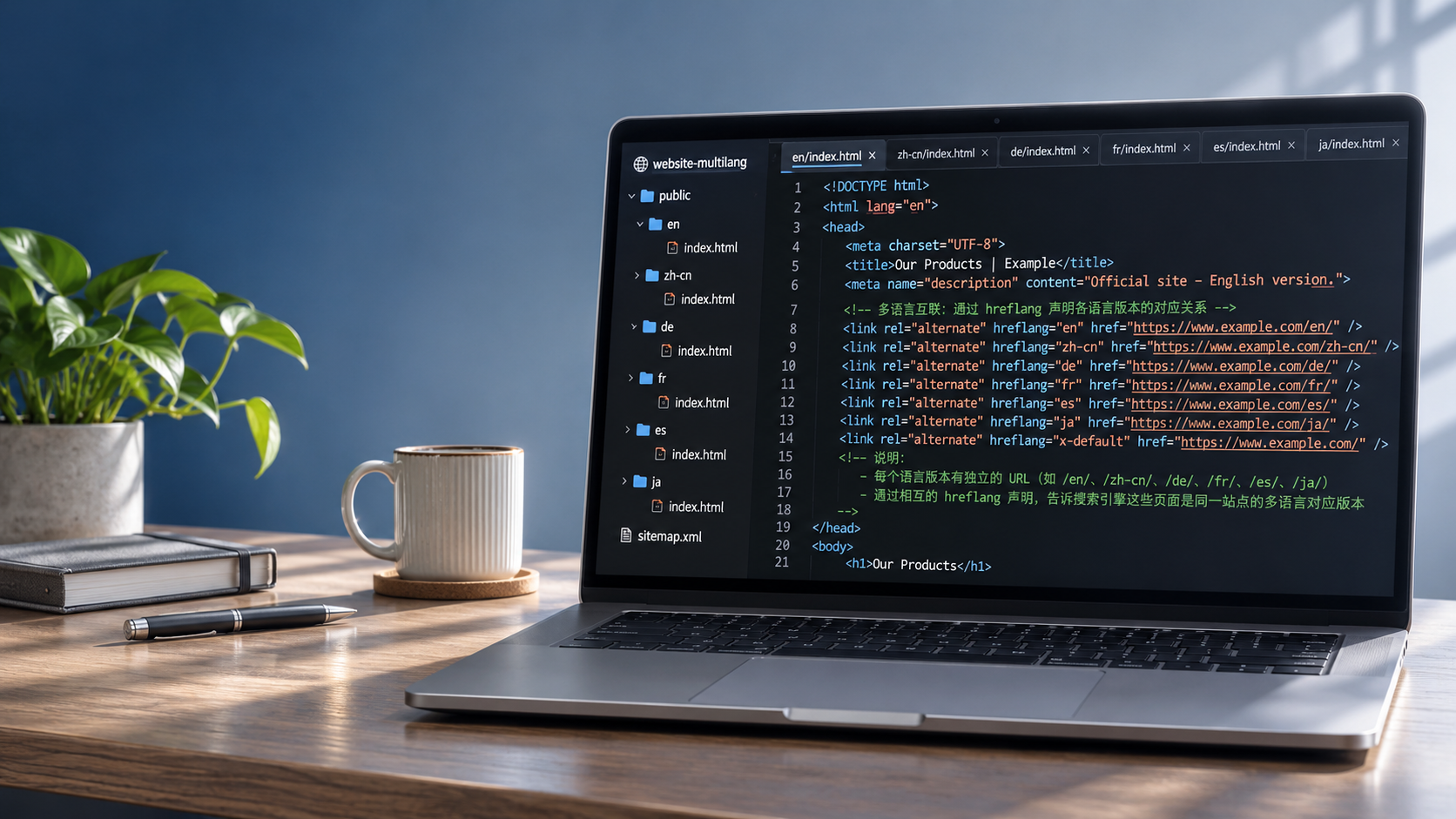
Multilingual websites are especially likely to overlook details such as hreflang, language-directory planning, and content differentiation between pages for different markets. As a result, English, Russian, and Spanish pages may interfere with one another. Google may not know which page should be shown to users in which region, slowing both indexing and ranking.
If you operate a B2B export website, you should also examine one key issue: Is the inquiry page isolated? Many websites create a “Contact Us” or “Request a Quote” page and consider the job finished. In reality, these conversion pages need to be naturally supported by product pages, solution pages, and application-scenario pages, rather than being placed separately and left waiting for users to click through.
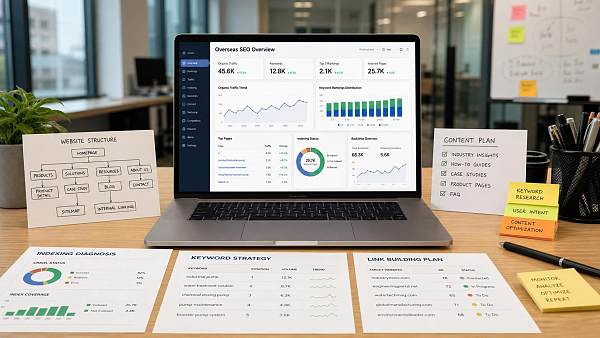
[Image placeholder 1: Display an SEO diagnostic framework for an international independent website, including the core modules of technical structure, indexing, content, and backlinks, alt="Illustration of common roadblocks in Google international SEO"]
Writing content does not mean Google will automatically rank it
The second roadblock concerns content quality and content direction.
Many business websites appear to contain plenty of content, but in practice, that content provides limited help with search rankings. There are usually three reasons.
The first is that the content is too much like a corporate brochure. The entire website repeatedly says “we are strong, high-quality, and provide excellent service,” while users are actually searching for product specifications, application scenarios, purchasing standards, material differences, certification requirements, installation and maintenance information, and delivery schedules. If what you write is not what users want to read, it is naturally difficult for Google to give you a good position.
The second is duplicate content. Different product pages may only change the model name while keeping almost identical paragraphs; multilingual pages may be translated directly by machine, resulting in awkward wording; and the news section may contain nothing but company updates. Such content may not necessarily be penalized, but it is easily judged to provide limited value, leading to slow indexing and weak rankings.
The third is misplaced keyword targeting. When doing Google international SEO, many people focus on broad industry terms without first targeting more specific long-tail keywords with stronger conversion intent. For example, if you sell industrial equipment, you may not be able to compete for the industry's core terms at the beginning. However, pages such as “a certain type of equipment for a specific application,” “the difference between one material and another,” or “a purchasing guide for a certain model” may produce results sooner.
Content takes a long time to deliver results not because too few articles have been written, but because the content does not answer the questions users actually have.
Slow indexing is often caused not by too little content, but by insufficient entry points and signals
Some websites publish a lot of content, but Google is slow to index it or indexes only the homepage and a few section pages. In this situation, do not first assume that “SEO does not work.” Check whether the indexing path is functioning properly.
Common roadblocks include:
- New pages have not been added to the website navigation or internal linking structure and have become “orphan pages”
- A sitemap has been submitted, but the actual page quality is weak
- robots or canonical settings are incorrect
- The server is unstable and frequently times out during crawling
- The page can be opened, but contains too little main content and too much template content
There is a misconception worth clarifying here: submitting a URL does not guarantee rapid indexing. Google places greater emphasis on whether the page itself is worth indexing and whether the site as a whole continuously sends clear signals. A website with thin content, a disorganized structure, and an inconsistent publishing schedule cannot solve its fundamental problems simply by “submitting pages for indexing.”
More backlinks do not necessarily mean faster results; imbalance can make things slower
When rankings fail to move, many businesses attribute the problem to “not enough backlinks.” This judgment is only half right.
Backlinks are indeed important. This is especially true for new websites with low industry trust, where appropriately selected, highly relevant links can help Google understand the site more quickly. However, backlinks are most vulnerable to two issues: poor quality and an unnatural pace.
If a new website with thin content suddenly acquires a large number of low-quality directory links, forum signature links, and unrelated blog links within a short period, it may appear to be making progress in the short term, but in the long term it can make the site's signals more confusing. More commonly, a business spends money on backlinks, but the linked pages cannot effectively retain visitors. Users leave as soon as they arrive, and SEO performance naturally fails to improve.
To put it more realistically, backlinks are suitable for amplifying an existing foundation, not replacing that foundation. Before the site's content and structure are solid, backlinks are unlikely to produce a substantial improvement.
Misjudging industry competition can also make you think results are “taking too long”
Some keywords are difficult by nature. In English-speaking and North American markets in particular, many terms are contested by established websites, industry media, distribution platforms, and brand websites that have been operating for years. If you take a new website and expect it to reach the first page within two or three months, the expectation itself is unreasonable.
This is why, when developing international markets, you should not focus only on whether a keyword ranks. You should also assess whether your objectives for each stage are reasonable. For example:
- The first stage focuses on technical fixes and effective indexing
- The second stage focuses on long-tail keyword impressions and getting product pages into the top 50
- The third stage focuses on steadily improving key pages and increasing inquiries
If the objectives for each stage have not been broken down, teams can easily become anxious: there may be clear progress, but because the website has not reached the “first page,” the work is judged ineffective.
A chaotic execution pace can be more damaging than doing nothing
This is common in outsourced partnerships. A company may modify its website, create content, and carry out optimization during the first two months, then suspend the work in the third month because there are no obvious inquiries, only to restart after some time. SEO is particularly vulnerable to this stop-and-start approach.
Google evaluates consistency signals. Is your website updated continuously? Does it maintain a stable structure over the long term? Is its content gradually expanding? Are its backlinks growing naturally? Many projects are not entirely wrong in direction; they simply keep stopping halfway. As a result, the signals accumulated earlier have not yet produced results before the process is interrupted again.
If your business does not have a mature in-house team, when choosing a service provider, do not ask only, “How long will it take to reach the first page?” You should also ask whether website development, technical SEO, content planning, multilingual strategy, and data tracking will be advanced as an integrated process. When these tasks are handled separately, responsibilities are easily fragmented. In the end, everyone does a little, but no one is responsible for the complete growth loop.
Platforms such as 易营宝, which cover intelligent website building, Google SEO, multilingual websites, and international marketing execution, are suitable for businesses that want to coordinate their site foundation, content production, and promotion while reducing the internal friction caused by having one provider build the website, another handle SEO, and a third manage advertising. However, if a business already has a mature team and only needs support for a single module, an integrated solution may not be necessary. Selecting a solution based on the actual gap is more prudent.
How to determine where you are stuck instead of blindly adding more activities
If you want to investigate the situation now, start by checking four things:
- Are the indexed pages in Google Search Console continuing to grow?
- Do core pages have impressions but a low click-through rate?
- Is traffic mainly entering irrelevant pages rather than product and conversion pages?
- After new content goes live, can it be crawled and indexed within a reasonable time?
These four questions can help you quickly determine whether the problem lies in technology, content, keyword strategy, or the conversion path.
Here is another practical observation. Many businesses see “traffic but no inquiries” and assume that SEO has no value. In reality, a more common situation is that the front end generates exposure while the back end fails to convert it. For example, the page may not look professional enough, the form may be too complicated, trust information may be insufficient, or the mobile experience may be poor. Therefore, do not attribute every outcome to SEO. Conversion on an international website is determined by website development, content, and marketing together.
Finally, some practical advice
When Google international SEO delivers results slowly, the common roadblocks are not mysterious. The difficulty is that many problems overlap: the website foundation is average, the content is too promotional, indexing efficiency is low, backlinks are built too aggressively, and in the end, considerable time is spent without noticeable ranking improvement.
The truly effective approach is not to add a temporary action, but to first complete a clear foundational diagnosis and then address issues according to priority. First ensure that the website can be crawled, understood, and converted. Then expand the content and organize keyword targeting. Finally, use backlinks and multichannel promotion to amplify the results. This approach may not deliver results “very quickly,” but it is generally more stable and closer to genuine growth.
FAQ
1. How long does it usually take to see results from Google international SEO?
There is a major difference between new and established websites. Usually, you should first assess indexing, impressions, and changes in long-tail keywords, and then evaluate core keywords and inquiries. The specific timeframe depends on industry competition, website foundations, and continuity of execution.
2. If indexing is normal but rankings do not improve, what is the most likely reason?
In most cases, the content is not sufficiently relevant, the page lacks depth, internal linking is weak, or the keyword targets are too ambitious. It may also be that the site lacks sufficient backlink support and authority.
3. Why is there still no traffic after publishing many articles?
The number of articles does not equal the amount of effective content. Common problems include topics being chosen from a corporate perspective, misaligned keywords, duplicate content, or pages not being incorporated into a complete internal linking structure.
4. Should a new website build a large number of backlinks from the beginning?
It is not recommended. A new website should first address its technical foundation and content quality. If the foundation is not stable, a large number of backlinks usually cannot amplify results.
Image placeholder list
Image placeholder 1: Recommended placement after the “Inadequate website foundations” section; content: an SEO diagnostic framework for an international independent website, showing the core modules of technical structure, indexing, content, and backlinks; alt="Illustration of common roadblocks in Google international SEO"
Recommended internal-link anchor text
- Google SEO optimization services: Recommended link to the SEO services introduction page
- Multilingual website development: Recommended link to the website development solutions page
- International independent website indexing optimization: Recommended link to the technical SEO topic page
- B2B export marketing website: Recommended link to the industry solutions page
- Lead generation through Google Ads and SEO coordination: Recommended link to the integrated marketing services page
Recommended authoritative external sources
- Official Google Search Central documentation
- Official Google Search Console Help pages
- Official technical documentation from leading SEO research organizations or brands
Related Articles
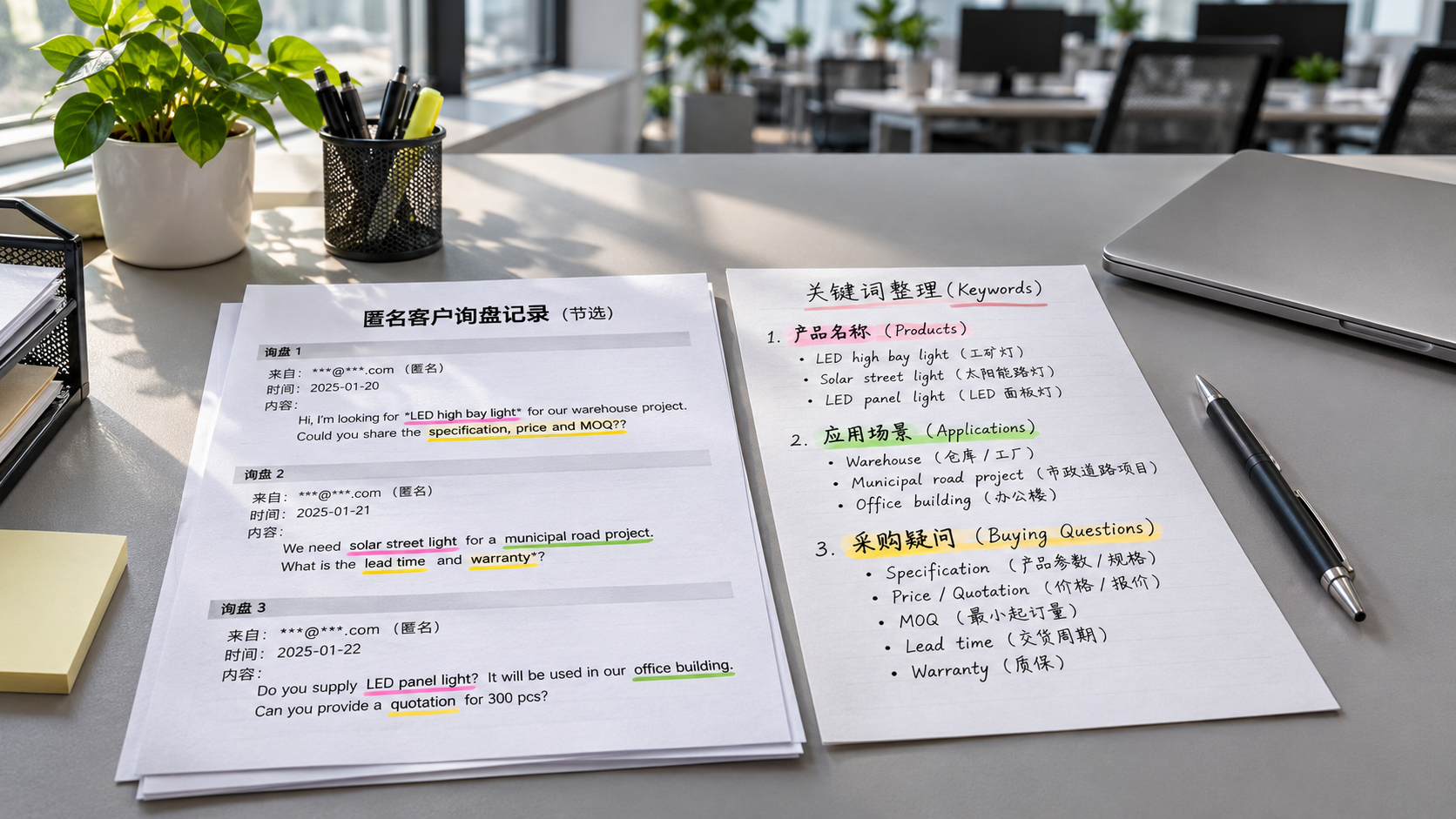
 How Can You Expand Keywords for a B2B Website Using Customer Inquiries?
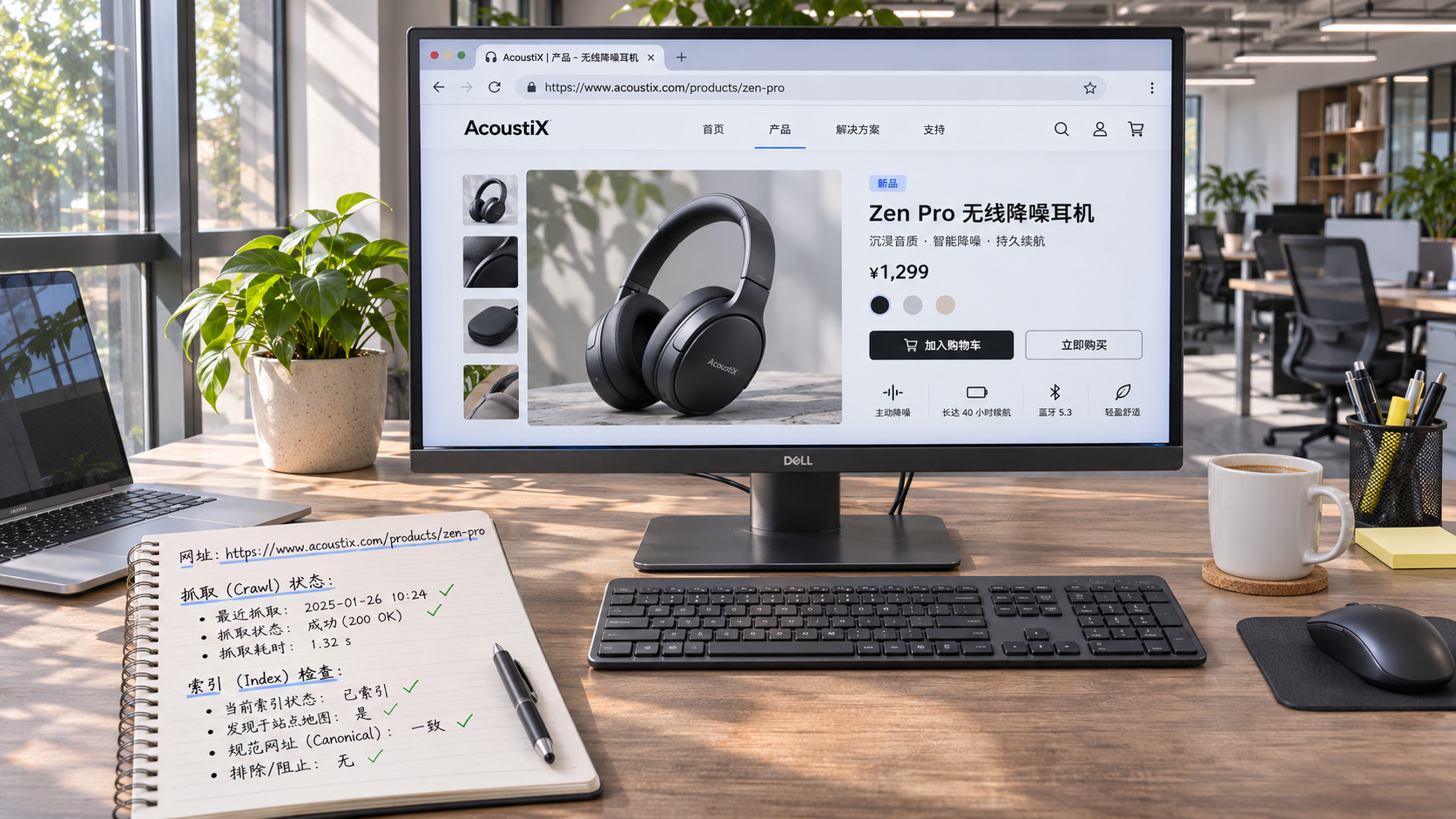
 How to troubleshoot when your website isn’t indexed by Google?
 How Can You Prevent Language Versions from Competing with Each Other in Multilingual Website SEO?
Related Products
 Yiyingbao SaaS Intelligent Website Building and Marketing SystemYiyingbao SaaS Intelligent Website Building and Marketing System, AI-powered no-code website building, rapid creation of multilingual B2B international websites in 10 minutes, global server acceleration, AI-powered SEO optimization, helping businesses connect efficiently with global markets. The perfect integration of technology and operation makes building an international trade website remarkably simple
 AI+SEM Intelligent Advertising Marketing SystemAI+SEM drives intelligent ad creation, empowering full-funnel precision advertising marketing. The system automatically generates weekly/monthly reports, AI recommends keywords and target countries, monitors core metrics in real-time with intelligent alerts, and enables one-click high-conversion ad solutions to help quickly acquire customers and improve ROI.
 AI+SEO Dual-Engine System Optimization ServicesYiyingbao’s AI+SEO dual-engine optimization system helps foreign trade enterprises acquire high-quality organic traffic through AI-powered keyword research, content generation, and comprehensive technical optimization, significantly improving search rankings and conversion rates.
 AI+SNS Social Media Marketing SystemYingbao AI+SNS Social Media Marketing System - Precision social capture for the social media era. Supports one-click content synchronization across major platforms like Facebook and LinkedIn. AI intelligently rewrites posts for enhanced relevance. 24/7 AI customer service and user profiling analysis empower businesses to efficiently expand into global markets.
 AI+SEO营销解决方案易营宝AI+SEO营销解决方案,通过AI批量写作、智能生成TDK、精准关键词扩词等功能,全面优化网站SEO效果,提升流量与转化率。助力企业构建高效智能网站新生态。
 AI+SEM Advertising Marketing SolutionsAI+SEM Advertising Marketing Solution leverages AI technology to deeply empower SEM ad campaigns. It automatically generates weekly/monthly reports using AI, presenting account data across multiple dimensions for comprehensive insights into campaign performance and trends. The system precisely recommends keywords and target countries, intelligently generates high-conversion ad copy, and enables one-click activation of efficient campaign plans to help businesses rapidly acquire customers. Simultaneously, it monitors core metrics in real time, intelligently identifies abnormal fluctuations, and issues timely alerts to ensure stable, high-return advertising results.
 Domain Name ServicesEasyWin provides professional domain name services, including intelligent queries, one-stop registration, brand protection, and full lifecycle management, helping businesses build a digital brand image.
 EasyOperate B2C Cross-Border E-Commerce Platform & Independent WebsiteEasyStore B2C Cross-border E-commerce Independent Store is an intelligent website building and cross-border e-commerce integrated solution independently developed by EasyStore Information Technology (Beijing) Co., Ltd. The system is specially designed for small and medium-sized as well as large export enterprises, integrating 'website building, operation, marketing, advertising, and conversion' into one, helping enterprises quickly establish cross-border e-commerce independent stores to achieve brand globalization and global sales growth.
The platform supports multiple languages, multiple currencies, and multi-channel marketing, with built-in AI intelligent translation and SEO optimization systems, suitable for mainstream markets such as Southeast Asia, Europe and America, Latin America, and the Middle East, assisting Chinese manufacturing enterprises in efficiently deploying international e-commerce strategies. SSL证书易营宝提供专业SSL安全证书服务,包括单域名和泛域名证书,确保网站数据传输加密、身份验证和完整性保护,助力企业建立安全可信的在线业务环境。









