









- Which customer acquisition channels will be affected by cross-border marketing trends in 2026?Sep 06, 2026View details
- Which homogenization risks should be considered in an analysis of the AI-powered website building industry?Aug 30, 2026View details
- How Will AI Marketing Trends 2026 Change Advertising Budget AllocationAug 28, 2026View details
- Is the EV SSL certificate market shrinking or upgrading? How should companies assess certificate procurement?Aug 11, 2026View details
- Why the old AMP SEO 2020 practices no longer work and what has changed in current optimization prioritiesAug 02, 2026View details
- How to Choose Topics for an Industry News Section to Attract More Organic Search TrafficJul 29, 2026View details
How Can GEO Q&A Content Improve AI Search Indexing
How Can GEO Q&A Content Improve AI Search Indexing
Since AI search has become more widely used, many companies have encountered a very practical problem: their websites clearly contain content and they have invested significantly in search optimization, so why are they still rarely mentioned in AI-generated answers? The reason is often not that they have “written too little,” but that their content has not been organized in a way that is easier for AI to understand, break down, and cite. GEO Q&A content has become important in this context. It is not simply about piling up FAQs, but about turning the questions users may ask, the decision-making logic within the industry, parameter boundaries, and usage scenarios into a structure that is more suitable for retrieval and citation.
For companies engaged in website development and overseas marketing, this is particularly important. An independent website is not merely a showcase; it also needs to attract leads, explain offerings, support comparisons, and drive conversions. If the content focuses only on brand introductions, product lists, or vague selling points, traditional search engines may still be able to identify it with some difficulty, but AI search systems will find it hard to determine which section can answer a real question. The value of GEO Q&A content lies in clearly addressing high-frequency decision-making questions such as “how to choose,” “how to use,” “how to evaluate,” and “what to watch out for” in advance, bringing the page closer to users’ actual queries.
What AI Search Values More Is Not Length, but Decomposability
Many content operators are accustomed to writing long and comprehensive articles, but comprehensiveness does not necessarily mean that content is easy to index. When processing web pages, AI generally relies more on clear topic boundaries, explicit questions, direct conclusions, and content units that can be understood in separate sections. Q&A content naturally fits this reading pattern: one question corresponds to one judgment, followed by explanations, conditions, and exceptions. The information granularity is more suitable for crawling, segmentation, and recombination.
For example, with a topic such as “How Can GEO Q&A Content Improve AI Search Indexing,” AI will not look only at the title. It will also check whether the body answers questions such as: What problem does it solve? What types of pages is it suitable for? How does it differ from ordinary FAQs? How should it work with structured data? Which writing practices may reduce its effectiveness? The more the content resembles genuine project experience, the more likely the system is to regard it as referenceable content. Conversely, if a paragraph contains only slogans without boundary conditions or specific judgments, it will be difficult for the page to form a stable semantic anchor.
Q&A Content Should First Address “How Will Users Actually Ask the Question?”
The most common mistake when creating GEO content is to write the answer first and then force a question around it. The correct order is usually to first examine how users will ask their questions. Foreign trade companies, manufacturing factories, cross-border sellers, and teams taking brands global do not have the same concerns. Some may ask, “Is it suitable for a multilingual website?” Others may be concerned about “whether it will affect Google SEO,” while some may ask directly, “Can AI search understand our product parameters?” These questions actually correspond to different page objectives.
If the question is evaluative, provide criteria; if it is operational, provide steps; if it is comparative, explain the differences; and if it concerns risks, clarify the boundaries. Whether Q&A content can improve AI search indexing depends not on merely having questions and answers, but on whether the questions are sufficiently close to real queries and whether the answers are specific enough. Many pages appear to contain substantial content, but once broken down, each paragraph turns out to be discussing the same thing. As a result, AI naturally finds it difficult to extract useful information.
Truly Effective GEO Q&A Is Not About Piling Up FAQs, but Embedding Standards in the Content
From a technical and standards perspective, GEO Q&A content should meet at least three requirements: identifiability, verifiability, and extensibility. Identifiability means that the boundaries between questions and answers are clear. Verifiability means that the content includes the basis for judgments, such as applicable scenarios, parameter ranges, page types, language versions, and regional differences. Extensibility means that similar questions can continue to be added later without rewriting the entire page each time.
For example, if a company operating an overseas independent website only writes “We provide multilingual website development,” the information is not sufficient. A more valuable approach is to expand on related questions: Do different language versions require independent URLs? Should the original product model be retained on product pages? Should terminology be localized rather than translated literally? Should image alt text also be optimized accordingly? Content of this kind is more likely to be recognized by AI as “useful technical documentation” rather than mere marketing language.
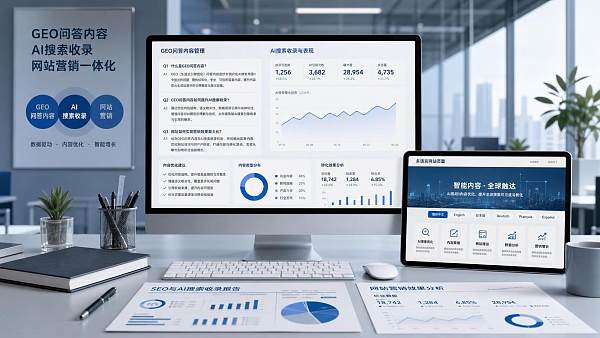
The Integration of Website and Marketing Services Determines That Q&A Content Must Serve Not Only Search, but Also Conversion
This is another point that many companies tend to overlook. If GEO Q&A content considers only “being seen,” it will often become a purely informational page. However, within an integrated website and marketing service framework, it must also guide and qualify users. After reading the questions and answers, users should have a general understanding of which step to take next: continue reviewing case studies, check parameters, learn about the delivery process, or directly confirm the configuration and scope.
Since its establishment in 2013, 易营宝信息科技(北京)有限公司 has been providing integrated services covering intelligent website development, SEO optimization, social media marketing, and advertising. The company has a clear understanding of a practical reality: if website content is disconnected from the subsequent lead-generation process, even substantial traffic may not convert into inquiries. Its overseas digital marketing services offer more than website-building tools. They provide a continuous chain extending from AI-powered intelligent website development, multilingual website development, and B2B foreign trade marketing websites to Google SEO, advertising, social media operations, and GEO optimization. Within this chain, Q&A content is not an auxiliary module, but an intermediate layer connecting search entry points with business decisions.
Three Details Can Help Determine Whether a Set of Q&A Content Meets the Requirements
First, can it be cited independently? AI prefers to retrieve answers that can stand alone as complete sections rather than sentences that require surrounding context to be understood. Second, can it cover questions at different levels? Does it form a progression from concepts and standards to execution? Third, can it work together with other parts of the page? A Q&A page is not an isolated entity. It should be interconnected with product pages, solution pages, case study pages, and technical documentation pages.
In actual projects, the slow indexing of many overseas websites is not necessarily caused by major problems with the sites themselves. Instead, the content hierarchy may be too flat. The homepage talks about the brand, product pages talk about features, and the blog talks about industry news, but there is no group of content centered on users’ real questions. GEO Q&A content can fill this gap, making it easier for search systems to determine the website’s area of expertise on a particular topic.
When Writing GEO Q&A Content, the Main Thing to Avoid Is Making It Merely “Look Complete”
Many teams formulate questions comprehensively, but the answers remain empty, generic, and superficial. For example, if “How can AI search indexing be improved?” is answered only with “optimize content, improve quality, and update regularly,” such wording provides neither standards nor boundaries, let alone actionable guidance. A better approach is to specify executable points: Does the page have a clear heading hierarchy? Does it contain independent Q&A sections? Can it distinguish product parameters from usage instructions? Is terminology consistent? Does it avoid ambiguity caused by mixing synonyms?
In addition, Q&A content is not necessarily better simply because there is more of it. For B2B websites, the number of questions should follow the business logic rather than pursue coverage of every possible way a question might be phrased. Questions truly worth including generally fall into three categories: those customers ask before making a decision, those they ask during technical implementation, and those they ask during delivery and acceptance. Beyond this scope, the content can easily become noise.
Only by Systematizing GEO Q&A Content Can AI Search Identify It More Consistently
If only one or two Q&A articles are created, the results are usually limited. A more reliable approach is to build a continuously updated Q&A system around the core business, covering basic concepts, technical standards, application scenarios, risk assessment, delivery processes, and maintenance and updates. The advantage is that the pages form a stable semantic network, making it easier for AI to understand what the website specializes in and what types of questions it is suitable for answering.
易营宝’s experience with AI+SEO/GEO optimization, cloud-based intelligent website development systems, and cross-border e-commerce systems also demonstrates one point: when website development, optimization, advertising, and social media lead generation are connected, content should not merely aim to be “written,” but should strive to be “understood, cited, and converted.” GEO Q&A content is precisely one of the most underestimated yet highly influential links in this chain.
If the next step is implementation, the priority is not to pursue quantity, but to first establish the standards: Who is your target market? What task does the page need to fulfill? Which language versions are required? Who will review the technical parameters? Which questions must be covered first? Once these conditions are clarified, GEO Q&A content will no longer remain at the level of merely “looking like it contains information.” Instead, it can become a page asset that AI search can understand, index, and continue recommending.
Related Articles


Related Products
 Yiyingbao SaaS Intelligent Website Building and Marketing SystemYiyingbao SaaS Intelligent Website Building and Marketing System, AI-powered no-code website building, rapid creation of multilingual B2B international websites in 10 minutes, global server acceleration, AI-powered SEO optimization, helping businesses connect efficiently with global markets. The perfect integration of technology and operation makes building an international trade website remarkably simple
 AI+SEM Intelligent Advertising Marketing SystemAI+SEM drives intelligent ad creation, empowering full-funnel precision advertising marketing. The system automatically generates weekly/monthly reports, AI recommends keywords and target countries, monitors core metrics in real-time with intelligent alerts, and enables one-click high-conversion ad solutions to help quickly acquire customers and improve ROI.
 AI+SEO Dual-Engine System Optimization ServicesYiyingbao’s AI+SEO dual-engine optimization system helps foreign trade enterprises acquire high-quality organic traffic through AI-powered keyword research, content generation, and comprehensive technical optimization, significantly improving search rankings and conversion rates.
 AI+SNS Social Media Marketing SystemYingbao AI+SNS Social Media Marketing System - Precision social capture for the social media era. Supports one-click content synchronization across major platforms like Facebook and LinkedIn. AI intelligently rewrites posts for enhanced relevance. 24/7 AI customer service and user profiling analysis empower businesses to efficiently expand into global markets.
 AI+SEO营销解决方案易营宝AI+SEO营销解决方案,通过AI批量写作、智能生成TDK、精准关键词扩词等功能,全面优化网站SEO效果,提升流量与转化率。助力企业构建高效智能网站新生态。
 AI+SEM Advertising Marketing SolutionsAI+SEM Advertising Marketing Solution leverages AI technology to deeply empower SEM ad campaigns. It automatically generates weekly/monthly reports using AI, presenting account data across multiple dimensions for comprehensive insights into campaign performance and trends. The system precisely recommends keywords and target countries, intelligently generates high-conversion ad copy, and enables one-click activation of efficient campaign plans to help businesses rapidly acquire customers. Simultaneously, it monitors core metrics in real time, intelligently identifies abnormal fluctuations, and issues timely alerts to ensure stable, high-return advertising results.
 Domain Name ServicesEasyWin provides professional domain name services, including intelligent queries, one-stop registration, brand protection, and full lifecycle management, helping businesses build a digital brand image.
 EasyOperate B2C Cross-Border E-Commerce Platform & Independent WebsiteEasyStore B2C Cross-border E-commerce Independent Store is an intelligent website building and cross-border e-commerce integrated solution independently developed by EasyStore Information Technology (Beijing) Co., Ltd. The system is specially designed for small and medium-sized as well as large export enterprises, integrating 'website building, operation, marketing, advertising, and conversion' into one, helping enterprises quickly establish cross-border e-commerce independent stores to achieve brand globalization and global sales growth.
The platform supports multiple languages, multiple currencies, and multi-channel marketing, with built-in AI intelligent translation and SEO optimization systems, suitable for mainstream markets such as Southeast Asia, Europe and America, Latin America, and the Middle East, assisting Chinese manufacturing enterprises in efficiently deploying international e-commerce strategies. SSL证书易营宝提供专业SSL安全证书服务,包括单域名和泛域名证书,确保网站数据传输加密、身份验证和完整性保护,助力企业建立安全可信的在线业务环境。









