









- Which customer acquisition channels will be affected by cross-border marketing trends in 2026?Sep 06, 2026View details
- Which homogenization risks should be considered in an analysis of the AI-powered website building industry?Aug 30, 2026View details
- How Will AI Marketing Trends 2026 Change Advertising Budget AllocationAug 28, 2026View details
- Is the EV SSL certificate market shrinking or upgrading? How should companies assess certificate procurement?Aug 11, 2026View details
- Why the old AMP SEO 2020 practices no longer work and what has changed in current optimization prioritiesAug 02, 2026View details
- How to Choose Topics for an Industry News Section to Attract More Organic Search TrafficJul 29, 2026View details
The relationship between Google AMP and SEO has changed: which pages are still worth keeping AMP
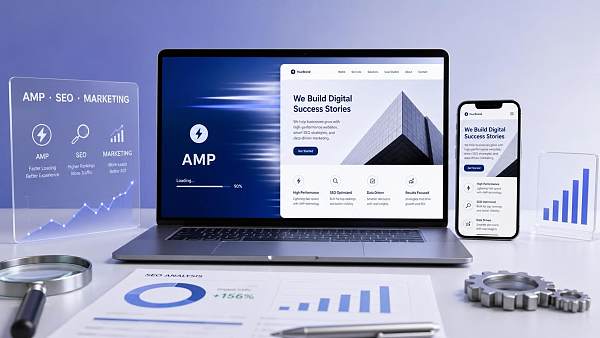
The Relationship Between Google AMP and SEO Has Changed: Which Pages Are Still Worth Keeping AMP
The proportion of mobile traffic stopped being the main issue long ago. What is really holding many businesses back is whether they should continue maintaining AMP. In earlier years, many foreign trade websites, information websites, and branded content sites treated AMP as a standard practice to gain mobile exposure. But looking at google amp and seo today, the relationship is no longer that “implementing it makes it easier to rank.” Instead, the more practical question is whether this page mechanism is still serving your traffic structure, crawling efficiency, and conversion path.
In projects involving intelligent website development, SEO optimization, and overseas marketing, a typical situation encountered by Yiyingbao is that a client launched AMP several years ago to improve mobile speed. Years later, the website architecture, content system, advertising components, and form logic have all changed, leaving AMP as an additional “legacy branch” that requires maintenance. At this point, the focus should not be technical sentiment, but whether each page type is worth keeping.
Look at the Pages First, Not the Concept
The easiest mistake when deciding whether to keep AMP is to treat the entire website the same way. In reality, homepages, blog posts, topic pages, product detail pages, and inquiry landing pages serve completely different purposes in search. On a B2B international website for a manufacturing company, article pages attract informational search traffic, while product pages target high-intent keywords and inquiries. A cross-border independent website, on the other hand, places more emphasis on detail-page interactions, review modules, recommendation areas, and the path leading to payment. AMP is inherently suited to these page types to different degrees.
If your article pages focus primarily on information acquisition, have a relatively simple structure, use few advertising scripts and interactive components, and mainly aim to let users enter quickly, read quickly, and then return to the search results to continue comparing, AMP may still be worth keeping. Especially for websites with a large amount of content, many historical articles, and high crawling frequency, AMP pages can sometimes help create a more stable above-the-fold experience on mobile devices.
Product pages, solution pages, and inquiry pages are different. Common features on foreign trade websites, such as specification switching, form tracking, online communication, video presentation, multilingual switching, and related-product recommendations, are all key conversion actions. AMP’s restrictions on scripts, styles, and interactions can make many pages look “lighter” without necessarily making them more effective at generating business. If the page is faster but users cannot complete an inquiry smoothly, the traffic generated by SEO remains only traffic.
The Content Pages That Are Usually Still Suitable for AMP
The first category is standardized content pages such as news, knowledge bases, industry observations, and Q&A analyses. Their common characteristics are clear: consistent templates, a high proportion of body content, and lightweight conversion actions. Users do more of their filtering in search, while the page itself is responsible for delivering information rather than supporting deep interaction. In this situation, if AMP maintenance costs are already low, keeping it may not be a bad choice.
The second category is certain media-style topic pages, provided that their structure remains sufficiently restrained. If a topic page simply aggregates articles, charts, and a small amount of navigation, AMP still has room to work. If the topic includes complex filtering, lead-generation components, quotation logic, and external scripts, it is no longer really a “content page” but is closer to a functional page. Continuing to use AMP may then result in an unsatisfactory compromise on both sides.
The third category is websites with substantial historical content assets that have already been deeply recognized by search indexing systems. Some companies have operated their content libraries for many years, and their AMP URLs have long been included in search indexes and external-link distribution paths. Such websites are not suitable for a crude shutdown. At a minimum, you should first assess the potential impact on canonical tags, internal redirects, cached versions, analytics standards, and advertising-slot configurations. It is not impossible to retire AMP, but it should be done in stages.
For These Page Types, Continuing with AMP Often Does More Harm Than Good
Marketing landing pages are the most typical example. When running Google Ads or social media campaigns, many companies want landing pages to load as quickly as possible and therefore consider AMP. The problem is that the core purpose of an advertising landing page is not to be “read through,” but to drive “action.” Button tracking, A/B testing, form fields, remarketing codes, customer service tools, and heatmap analysis may all be restricted. As a result, the page may run quickly but be difficult to measure accurately, modify, or optimize for stable conversions.
B2B product detail pages and solution pages are another example. For many manufacturing, equipment, and engineering companies expanding overseas, effective inquiries do not come from a slogan, but from details such as specifications, application industries, delivery methods, certification downloads, attachment uploads, and localized contact information. The closer a page is to the point of conversion, the more it depends on complete front-end capabilities. Forcing these pages into AMP typically sacrifices content depth and lead quality.
For cross-border online stores, it is also not recommended to create a separate set of product pages solely for AMP. Price variants, inventory status, promotion logic, user reviews, recommendation algorithms, and the checkout path are all directly tied to the e-commerce experience. Today, it is generally more worthwhile to optimize Core Web Vitals, image strategies, script-loading order, and caching mechanisms than to maintain a restricted version.
Many Companies Do Not Need to Abandon AMP; Their Problem Is How They Keep It
In actual projects, the common problem is not whether AMP exists, but that AMP has become disconnected from the main website over time. There are three direct manifestations. First, the main content is updated but the AMP version is not synchronized, so visitors from search see outdated content. Second, canonical tags, hreflang, and multilingual mappings are not handled properly, causing crawling signals to become scattered. Third, analytics codes and conversion-event standards are inconsistent, leading the marketing team to believe that certain content pages have low conversion rates when AMP simply failed to report data correctly.
This issue is particularly sensitive in projects integrating websites and marketing services. Website development, SEO, advertising, social media, and remarketing often rely on the same data-based decisions. If AMP pages operate separately, the impact goes beyond search analysis to campaign optimization and lead attribution. For this reason, many companies eventually choose to retain a small number of content-focused AMP pages while returning product pages and conversion pages entirely to standard pages. This approach is more consistent with operational realities.
Some clients also ask: Since AMP is no longer a “ranking pass,” should it be removed entirely? There is no universal answer. You must first examine whether the existing AMP pages are still generating stable traffic, whether the replacement pages can achieve an equally good or better loading experience on mobile, and whether the website has sufficient resources for redirects, template integration, data correction, and search monitoring. Being technically able to remove AMP does not mean it should be removed immediately from an operational perspective.
How to Decide Is Usually More Important Than Whether to Keep It
If a more practical decision-making framework is needed, start by looking at four factors: the page objective, interaction complexity, mobile performance bottlenecks, and maintenance cost. If a page is primarily intended for reading, has light interaction, and its performance issues mainly come from resource size and redundant templates, AMP can continue to be retained. Conversely, if the page focuses on inquiries or conversions and relies on numerous scripts, forms, and dynamic content, it is better to concentrate on improving the main website’s performance than to maintain AMP.
When managing content, many companies also review page classification logic together with other business decisions. This approach is more effective than discussing AMP in isolation. For example, when defining the boundary between content pages and functional pages, the thinking is somewhat similar to reviewing engineering documents: you should not focus on what something is “called,” but on the responsibility it assumes within the process. Topics such as Common Problems and Countermeasures in Engineering Settlement Audits are valuable to read for the same reason: sound judgment is never based on a surface name, but on structure, evidence, and practical conditions.
From Today’s Optimization Priorities, AMP Is No Longer the Highest-Priority Answer
What is more worthwhile today is to strengthen the main website’s mobile experience: controlling image dimensions and formats, splitting above-the-fold resources, loading scripts with delays, stabilizing server response, removing redundant templates, limiting third-party code, and standardizing the structure of multilingual pages. Unlike AMP, these efforts do not provide an “additional version,” but they are closer to long-term, maintainable SEO assets.
This is especially practical for companies engaged in overseas marketing. Search is only one part of the customer-acquisition journey; it is also connected to advertising, social media retargeting, lead nurturing, and sales follow-up. If the page system itself is fragmented, the more marketing activities you run, the more difficult it becomes to unify the subsequent data. The service model used by companies such as Yiyingbao, which coordinates AI website development, SEO/GEO optimization, and advertising systems, is essentially designed to reduce this fragmentation: keep content pages lightweight where appropriate, ensure complete capabilities on conversion pages where necessary, and do not use a single technical label to cover every scenario.
Therefore, when discussing google amp and seo today, the real question is not “Is AMP still useful?” but “Which of my pages still need it?” For standardized content pages, keeping AMP may be appropriate. For product pages, inquiry pages, online stores, and advertising landing pages that directly affect conversion and attribution, returning to a standard optimization framework is usually more suitable. Before making a decision, review your existing traffic sources, page responsibilities, technical limitations, and available maintenance resources. The conclusion will usually be clearer than one based on impressions alone.
Related Articles

Related Products
 Yiyingbao SaaS Intelligent Website Building and Marketing SystemYiyingbao SaaS Intelligent Website Building and Marketing System, AI-powered no-code website building, rapid creation of multilingual B2B international websites in 10 minutes, global server acceleration, AI-powered SEO optimization, helping businesses connect efficiently with global markets. The perfect integration of technology and operation makes building an international trade website remarkably simple
 AI+SEM Intelligent Advertising Marketing SystemAI+SEM drives intelligent ad creation, empowering full-funnel precision advertising marketing. The system automatically generates weekly/monthly reports, AI recommends keywords and target countries, monitors core metrics in real-time with intelligent alerts, and enables one-click high-conversion ad solutions to help quickly acquire customers and improve ROI.
 AI+SEO Dual-Engine System Optimization ServicesYiyingbao’s AI+SEO dual-engine optimization system helps foreign trade enterprises acquire high-quality organic traffic through AI-powered keyword research, content generation, and comprehensive technical optimization, significantly improving search rankings and conversion rates.
 AI+SNS Social Media Marketing SystemYingbao AI+SNS Social Media Marketing System - Precision social capture for the social media era. Supports one-click content synchronization across major platforms like Facebook and LinkedIn. AI intelligently rewrites posts for enhanced relevance. 24/7 AI customer service and user profiling analysis empower businesses to efficiently expand into global markets.
 AI+SEO营销解决方案易营宝AI+SEO营销解决方案,通过AI批量写作、智能生成TDK、精准关键词扩词等功能,全面优化网站SEO效果,提升流量与转化率。助力企业构建高效智能网站新生态。
 AI+SEM Advertising Marketing SolutionsAI+SEM Advertising Marketing Solution leverages AI technology to deeply empower SEM ad campaigns. It automatically generates weekly/monthly reports using AI, presenting account data across multiple dimensions for comprehensive insights into campaign performance and trends. The system precisely recommends keywords and target countries, intelligently generates high-conversion ad copy, and enables one-click activation of efficient campaign plans to help businesses rapidly acquire customers. Simultaneously, it monitors core metrics in real time, intelligently identifies abnormal fluctuations, and issues timely alerts to ensure stable, high-return advertising results.
 Domain Name ServicesEasyWin provides professional domain name services, including intelligent queries, one-stop registration, brand protection, and full lifecycle management, helping businesses build a digital brand image.
 EasyOperate B2C Cross-Border E-Commerce Platform & Independent WebsiteEasyStore B2C Cross-border E-commerce Independent Store is an intelligent website building and cross-border e-commerce integrated solution independently developed by EasyStore Information Technology (Beijing) Co., Ltd. The system is specially designed for small and medium-sized as well as large export enterprises, integrating 'website building, operation, marketing, advertising, and conversion' into one, helping enterprises quickly establish cross-border e-commerce independent stores to achieve brand globalization and global sales growth.
The platform supports multiple languages, multiple currencies, and multi-channel marketing, with built-in AI intelligent translation and SEO optimization systems, suitable for mainstream markets such as Southeast Asia, Europe and America, Latin America, and the Middle East, assisting Chinese manufacturing enterprises in efficiently deploying international e-commerce strategies. SSL证书易营宝提供专业SSL安全证书服务,包括单域名和泛域名证书,确保网站数据传输加密、身份验证和完整性保护,助力企业建立安全可信的在线业务环境。









