









- Which customer acquisition channels will be affected by cross-border marketing trends in 2026?Sep 06, 2026View details
- Which homogenization risks should be considered in an analysis of the AI-powered website building industry?Aug 30, 2026View details
- How Will AI Marketing Trends 2026 Change Advertising Budget AllocationAug 28, 2026View details
- Is the EV SSL certificate market shrinking or upgrading? How should companies assess certificate procurement?Aug 11, 2026View details
- Why the old AMP SEO 2020 practices no longer work and what has changed in current optimization prioritiesAug 02, 2026View details
- How to Choose Topics for an Industry News Section to Attract More Organic Search TrafficJul 29, 2026View details
What Should You Pay Attention to When Building Multilingual Article Pages? Synchronized Optimization of Content Structure and SEO
What should you pay attention to when building multilingual article pages? The key is not to move Chinese sentences into another language one by one, but to ensure that the content structure, language tags, URL rules, internal links, and indexing signals work together. Once a page enters a multilingual environment, search engines face more than just textual differences. They also need to process hreflang, canonical, sitemaps, pagination, regional terminology differences, and duplicate-content boundaries. If these elements are handled inconsistently, an article may be readable while still experiencing indexing and ranking issues.
Start with the content structure. Multilingual article pages should not rely solely on direct translation. The information framework should be fixed first, followed by localization at the language level. Titles, subtitles, opening paragraphs, terminology in the main text, units, date and time expressions, currency symbols, and address formats should all conform to the conventions of the target language. For example, if a technical article in Chinese refers to the “number of server nodes,” English should not mechanically retain the Chinese word order. A more natural expression should be used according to the context. When specifications are involved, such as response time, caching strategies, image compression, CMS editing logic, and the source of the translation engine, terminology must remain consistent. Otherwise, terminology drift may occur between different sections of the same page, affecting professionalism and search consistency.
Multilingual article pages must also address the issue of “the same structure, different expressions.” The paragraph hierarchy can remain consistent, but it is not advisable to copy the same sentence lengths and sentence patterns for every language. Some languages are more suited to short sentences, while others require more complete explanations of technical conditions. If the original text is forcibly divided into the same number of short sentences, the information may become fragmented and read like machine-assembled content. For technical analysis articles, it is best to retain verifiable parameter references in the main text, such as the translation engine, server nodes, caching strategy, mobile adaptation method, and static resource loading method. These details are easier to search for and compare than vague descriptions.
In terms of HTML structure, language markers are more sensitive than many people realize. The `lang` attribute, reciprocal `hreflang` references, `canonical` targets, and language versions in the sitemap should all match the actual page content. A common misjudgment is to treat pages in different languages as duplicates and provide complete indexing signals for only one version. As a result, pages in other languages may remain weakly visible for a long time. Another issue is a disorganized URL structure, in which language prefixes, regional suffixes, and parameterized URLs coexist. This makes it difficult for search engines to determine which version is the primary one, causing the authority of the article pages to be diluted.
Images and media also affect how multilingual article pages are evaluated. Image captions, alt text, and download filenames should be consistent with the language of the page. If the article is in Spanish, for example, the image alt text should not retain a Chinese path. If an article contains architecture diagrams, flowcharts, or comparison charts, visible text in the images should also be localized wherever possible. Otherwise, readers will see partially localized content, while search engines will crawl a different set of textual signals.
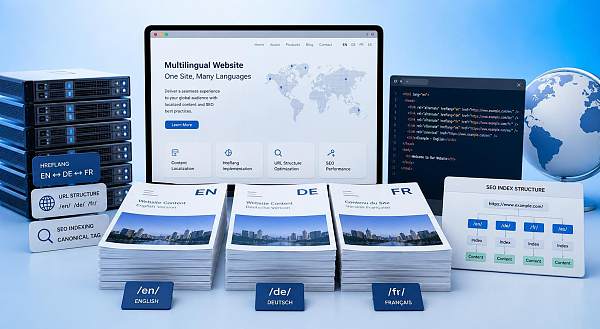
From a technical implementation perspective, internationalization and SEO are not two separate post-launch modules, but different stages of the same publishing workflow. Common problems in multilingual article page development often result from the generation sequence: Chinese content is created first, translations are added later, tags are added afterward, and indexing controls are considered last. A more reliable approach is to define language variables, URL standards, meta templates, breadcrumbs, internal-link anchor text, and pagination rules together at the template level. This allows title length, character sets, line breaks, and mobile wrapping widths to be controlled in advance when an article is copied into a new language, reducing later rework.
For integrated website and marketing service scenarios, article pages often serve three roles: search entry points, content distribution channels, and conversion destinations. Therefore, the main text must address not only readability, but also crawlability and maintainability. For example, content aimed at international trade businesses often involves product specifications, application conditions, delivery methods, installation dependencies, maintenance cycles, and compatible environments. These details are better placed in the middle sections of the main text rather than being piled up at the end. This helps search engines understand the boundaries of the topic and makes it easier to maintain the same information hierarchy across different language versions.
The translation stage requires particular caution with expressions that “appear correct but are actually inaccurate.” Technical terms cannot always be replaced one-to-one, especially terms related to site structure, SEO tags, content management, and front-end rendering. Neural machine translation such as GNMT is suitable for creating a first draft, but without localized proofreading, it may confuse “article pages,” “landing pages,” “detail pages,” and “category pages” at the semantic level. These pages serve different functions in the information architecture. Mixing them up can directly affect internal-linking strategies and indexing hierarchies. For websites that require long-term maintenance, translation should preferably be managed together with terminology lists, do-not-translate terms, and brand-term rules.
Linking strategies should not be overlooked either. Internal links on multilingual article pages should preferably point to versions in the same language, avoiding situations where users jump from an English article to a Chinese product page and then return, which disrupts the reading experience. Anchor text should not mechanically repeat keywords. It should be embedded naturally according to the context, preserving the meaning without compromising readability. For cross-language linking, hreflang tells search engines about the relationship between versions, while links in the main text guide users through the site. The two cannot replace each other.
During technical evaluations, maintenance costs are among the most easily overlooked factors. As the number of languages increases, content updates are no longer as simple as “synchronized translation.” Every change requires checks on title length, excerpt truncation, button copy, pagination, structured data, site search, sitemaps, and cache refreshing. If the content management system does not support multilingual publishing with a what-you-see-is-what-you-get workflow, one language version may eventually receive an updated main text while another still retains an old link or outdated parameters. Such inconsistencies between pages can accumulate into indexing noise.
What should you pay attention to when building multilingual article pages? Ultimately, it comes down to one thing: making every language version as complete as an independent page while ensuring that all versions correspond to one another as different expressions of the same content. Only when the structure, tags, and content rhythm are handled properly can a page remain stable in crawling, comprehension, and long-term maintenance.
Related Articles


Related Products
 Yiyingbao SaaS Intelligent Website Building and Marketing SystemYiyingbao SaaS Intelligent Website Building and Marketing System, AI-powered no-code website building, rapid creation of multilingual B2B international websites in 10 minutes, global server acceleration, AI-powered SEO optimization, helping businesses connect efficiently with global markets. The perfect integration of technology and operation makes building an international trade website remarkably simple
 AI+SEM Intelligent Advertising Marketing SystemAI+SEM drives intelligent ad creation, empowering full-funnel precision advertising marketing. The system automatically generates weekly/monthly reports, AI recommends keywords and target countries, monitors core metrics in real-time with intelligent alerts, and enables one-click high-conversion ad solutions to help quickly acquire customers and improve ROI.
 AI+SEO Dual-Engine System Optimization ServicesYiyingbao’s AI+SEO dual-engine optimization system helps foreign trade enterprises acquire high-quality organic traffic through AI-powered keyword research, content generation, and comprehensive technical optimization, significantly improving search rankings and conversion rates.
 AI+SNS Social Media Marketing SystemYingbao AI+SNS Social Media Marketing System - Precision social capture for the social media era. Supports one-click content synchronization across major platforms like Facebook and LinkedIn. AI intelligently rewrites posts for enhanced relevance. 24/7 AI customer service and user profiling analysis empower businesses to efficiently expand into global markets.
 AI+SEO营销解决方案易营宝AI+SEO营销解决方案,通过AI批量写作、智能生成TDK、精准关键词扩词等功能,全面优化网站SEO效果,提升流量与转化率。助力企业构建高效智能网站新生态。
 AI+SEM Advertising Marketing SolutionsAI+SEM Advertising Marketing Solution leverages AI technology to deeply empower SEM ad campaigns. It automatically generates weekly/monthly reports using AI, presenting account data across multiple dimensions for comprehensive insights into campaign performance and trends. The system precisely recommends keywords and target countries, intelligently generates high-conversion ad copy, and enables one-click activation of efficient campaign plans to help businesses rapidly acquire customers. Simultaneously, it monitors core metrics in real time, intelligently identifies abnormal fluctuations, and issues timely alerts to ensure stable, high-return advertising results.
 Domain Name ServicesEasyWin provides professional domain name services, including intelligent queries, one-stop registration, brand protection, and full lifecycle management, helping businesses build a digital brand image.
 EasyOperate B2C Cross-Border E-Commerce Platform & Independent WebsiteEasyStore B2C Cross-border E-commerce Independent Store is an intelligent website building and cross-border e-commerce integrated solution independently developed by EasyStore Information Technology (Beijing) Co., Ltd. The system is specially designed for small and medium-sized as well as large export enterprises, integrating 'website building, operation, marketing, advertising, and conversion' into one, helping enterprises quickly establish cross-border e-commerce independent stores to achieve brand globalization and global sales growth.
The platform supports multiple languages, multiple currencies, and multi-channel marketing, with built-in AI intelligent translation and SEO optimization systems, suitable for mainstream markets such as Southeast Asia, Europe and America, Latin America, and the Middle East, assisting Chinese manufacturing enterprises in efficiently deploying international e-commerce strategies. SSL证书易营宝提供专业SSL安全证书服务,包括单域名和泛域名证书,确保网站数据传输加密、身份验证和完整性保护,助力企业建立安全可信的在线业务环境。









