









- Which customer acquisition channels will be affected by cross-border marketing trends in 2026?Sep 06, 2026View details
- Which homogenization risks should be considered in an analysis of the AI-powered website building industry?Aug 30, 2026View details
- How Will AI Marketing Trends 2026 Change Advertising Budget AllocationAug 28, 2026View details
- Is the EV SSL certificate market shrinking or upgrading? How should companies assess certificate procurement?Aug 11, 2026View details
- Why the old AMP SEO 2020 practices no longer work and what has changed in current optimization prioritiesAug 02, 2026View details
- How to Choose Topics for an Industry News Section to Attract More Organic Search TrafficJul 29, 2026View details
Should You Build Out Content Categories First or Create Topic Pages First for SEO Content Marketing on a Standalone Website?
When conducting SEO content marketing for an independent website, many teams immediately get stuck on a seemingly simple question that actually has a significant impact on subsequent efficiency: should they establish the website sections first or create topic clusters first? There is no universal answer to this question, but it does determine the website’s early indexing pace, the difficulty of content management, and whether it can consistently obtain organic traffic in the middle and later stages.
If SEO content marketing is understood as “publishing more articles,” then regardless of whether sections or topic clusters are created first, the result can easily become a low-quality accumulation of content. What really needs to be determined is whether the website currently lacks “structural completeness” or a “breakthrough topic.” For information researchers, business managers, and foreign trade teams, this is not a dispute over editing habits, but a question of content strategy sequencing.
Why This Question Matters More for Independent Websites Than for Content Platforms
Content platforms come with built-in traffic pools. Even if an article has a loose structure, it may still gain exposure through platform distribution. Independent websites are different. Search engines first need to determine whether a website is worth crawling continuously, whether it has a clear theme, and whether it is capable of organizing content. In other words, SEO content marketing for an independent website is not only about “what to write,” but also about “how to build it.”
Foreign trade business websites commonly face three types of early-stage problems:
- The website sections appear complete, but each section contains only one or two pieces of content. The pages are empty, the topics are scattered, and the crawling value is low;
- Many topic articles have been created in succession, but the topics lack clear categorization. Internal links become confusing later, and the user journey is not smooth;
- Content production follows business intuition: industry trends today, product knowledge tomorrow, and company news the day after. As a result, search engines cannot identify the website’s core area.
Therefore, “sections first or topic clusters first” essentially means determining whether the independent website currently needs to solve the credibility of its basic architecture or improve search visibility for a particular topic.
Creating Sections First Solves the Website’s “Understandability”
Prioritizing sections is suitable for websites that are still in the foundational stage, have almost no content assets, or are managed by teams that have not yet clearly identified their core audiences. For these websites, establishing sections first is not about appearance. It is about helping search engines and users quickly understand which topics the website covers.
For example, an independent website focused on generating foreign trade leads would typically cover at least:
- Industry solutions;
- SEO and content marketing knowledge;
- Website development-related issues;
- Advertising and social media lead generation;
- Multilingual operations and overseas market management.
Once these topics are consistently established as sections, the website’s information architecture becomes clearer. Search engines can identify the site’s boundaries more quickly during crawling, while content categorization, aggregation, breadcrumb paths, and internal link recommendations become easier to establish. For a new website, this structural signal is often more important than one or two deeply written articles.
However, there is a common misunderstanding here: creating sections first does not mean simply adding category names. A section is only truly established when it contains the necessary basic supporting content. Otherwise, it is merely an empty framework that can neither improve SEO nor enhance user trust.
More realistically, if your independent website is still in any of the following situations, prioritizing sections is generally more stable:
- The website was launched recently and has very few indexed pages;
- There is more than one core business line, so topic boundaries need to be established first;
- Multiple people will collaborate on content creation later, requiring unified categorization rules;
- The website has not yet developed a clear group of traffic-entry keywords.
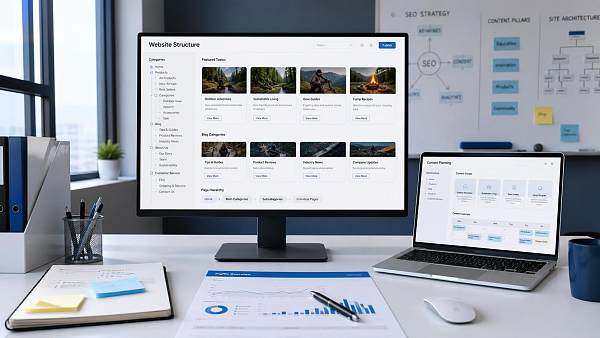
Creating Topic Clusters First Solves Topic Authority and Traffic Breakthroughs
Prioritizing topic clusters is more suitable for another situation: the website already has a certain structural foundation, or its business objectives are highly specific and it wants to build content density around a high-value topic as quickly as possible to achieve visible search growth.
The value of a topic cluster does not lie in “writing ten articles in succession,” but in continuously covering the same search-intent cluster. For example, around “SEO content marketing for independent websites,” the topic can be divided into content planning, keyword mapping, section design, topic page development, indexing optimization, internal linking strategies, foreign trade website case analysis, and the boundaries of AI content usage. This creates not an ordinary list of articles, but a content cluster with thematic depth.
As Google increasingly emphasizes topical relevance and content experience value, a topic-cluster approach often makes it easier for search engines to determine that a website is not merely mentioning a particular issue occasionally, but is continuously addressing it. For highly competitive niche keywords, this kind of “topic density” is generally more effective than distributing content evenly.
Prioritizing topic clusters is particularly suitable in the following scenarios:
- The company has already identified a primary lead-generation direction, such as B2B foreign trade inquiries;
- The website already has basic sections, but organic traffic has yet to increase;
- The company wants to first verify whether a certain type of content has search demand and conversion potential;
- The team has limited resources and cannot develop many directions at the same time.
In other words, a topic cluster is not an “advanced version of an article,” but a resource-concentration approach. It is suitable for focusing limited production capacity on the topics most worth validating.
What Really Determines the Choice Is Not the Format, but the Website’s Current Stage
Many teams struggle between sections and topic clusters because they have not first defined the website’s current objective. SEO content marketing for an independent website can generally be divided into three common stages:
Stage One: Building the Foundation. The focus is making the website crawlable, understandable, and categorizable. At this point, establishing sections first is usually more important because you need to clearly explain “who I am and what content I cover.”
Stage Two: Validation. The website has a basic structure, but it is not yet clear which topics can generate exposure and inquiries. At this stage, it is more appropriate to create topic clusters around one or two core business directions and observe indexing, rankings, and lead quality.
Stage Three: Expansion. Once stable traffic has been generated around certain topics, high-performing topic clusters can be developed into core sections, followed by horizontal expansion into related content. At this stage, sections and topic clusters are no longer mutually exclusive but work together.
In industry practice, the most common cause of failure is “stage mismatch.” A new website may begin with highly in-depth topic clusters while its overall structure remains weak, making it difficult for the topics to be crawled consistently. Alternatively, a website may have been operating for some time but still remain stuck at the stage of filling broad sections, never forming a content cluster capable of breaking through search demand.
Foreign Trade Independent Websites Should Especially Watch Out for “Fake Sections” and “Pseudo Topic Clusters”
Foreign trade and cross-border companies commonly encounter two particular problems in content development.
One is the “fake section”: many section names are added, such as “Industry News,” “Marketing Knowledge,” “Frequently Asked Questions,” and “Product Encyclopedia,” but each contains very little content, or the content is highly repetitive. This approach provides almost no benefit to search engines and can also dilute the website’s topical focus.
The other is the “pseudo topic cluster”: several articles appear to have been written continuously around one topic, but in reality their titles are different while their content is repetitive and their search intents overlap heavily. As a result, the pages compete with one another, divert traffic among themselves, and ultimately none of them can achieve a good ranking.
Neither of these problems is essentially caused by a lack of effort in execution. Rather, content planning has failed to establish a “topic map.” In independent website SEO content marketing in particular, sections and topic clusters must serve a clear hierarchy of search demand:
- Sections define topic boundaries;
- Topic clusters explore a core issue in depth;
- Articles cover specific queries;
- Internal links connect these pieces into an understandable knowledge structure.
As long as these four levels are not clearly defined, the more content is produced, the higher the cost of later correction will be.
If Resources Are Limited, a “Light Sections + Strong Topic Clusters” Transitional Approach Is Recommended
For most small and medium-sized foreign trade companies, the most realistic situation is not that they do not know how to proceed, but that they lack sufficient personnel to develop both sections and topic clusters thoroughly at the same time. In this case, instead of choosing one over the other, it is better to adopt a transitional approach featuring “light sections and strong topic clusters.”
Light sections mean first limiting the website’s core sections to a small number of clear categories without pursuing comprehensive coverage. Strong topic clusters mean concentrating production on one or two of the most important directions to quickly build content density and visibility.
For example, an independent website primarily focused on overseas lead generation could initially retain only core sections such as “SEO Content Marketing,” “Website Development and Conversion,” and “Advertising and Traffic.” It could then prioritize building a topic cluster around “SEO Content Marketing for Independent Websites” and explain the most common user decision-making issues in depth. This approach offers several benefits:
- The website structure will not be too empty;
- Content resources will not be overly dispersed;
- It will be easier to observe which topics first gain indexing and rankings;
- Additional sections can later be added based on data rather than intuition.
This is generally more effective than creating more than a dozen sections at the outset and writing two shallow pieces for each one.
What Matters in the End Is Not How Much Has Been Published, but Whether Sustainable Growth Can Be Achieved
In independent website SEO content marketing, neither sections nor topic clusters are the objective. Growth efficiency is the objective. To determine whether a strategy is correct, the focus must ultimately return to several more concrete indicators: whether indexing speed has improved, whether topic pages have begun to receive stable impressions, whether the website’s internal content has formed a clear internal linking structure, and whether target pages can generate inquiries or conversions.
If the website is still in the cold-start stage, establishing sections first is generally more beneficial for building a foundation. If the website already has a basic form but lacks a traffic breakthrough, creating topic clusters first is often more practical. For most companies, the most reliable approach is not to choose one side in an extreme manner, but to first build the framework with sufficiently clear sections and then use a small number of focused topic clusters to address core demand in depth.
This is also why many independent websites see no improvement after publishing content for half a year: the problem may not lie in writing quality, but in the incorrect content sequence. Solving the structure first and then focusing on breakthroughs is often closer to the actual logic of search growth than distributing efforts evenly.
For those conducting information research, the maturity of a company’s SEO content strategy can also be assessed by first looking at two signals: whether the website’s sections genuinely correspond to its business topics, and whether its topic content is genuinely built around user decision-making issues. Understanding these two points is generally enough to determine whether the content system is merely “accumulating articles” or building long-term, compounding assets for an independent website.
Related Articles


Related Products
 Yiyingbao SaaS Intelligent Website Building and Marketing SystemYiyingbao SaaS Intelligent Website Building and Marketing System, AI-powered no-code website building, rapid creation of multilingual B2B international websites in 10 minutes, global server acceleration, AI-powered SEO optimization, helping businesses connect efficiently with global markets. The perfect integration of technology and operation makes building an international trade website remarkably simple
 AI+SEM Intelligent Advertising Marketing SystemAI+SEM drives intelligent ad creation, empowering full-funnel precision advertising marketing. The system automatically generates weekly/monthly reports, AI recommends keywords and target countries, monitors core metrics in real-time with intelligent alerts, and enables one-click high-conversion ad solutions to help quickly acquire customers and improve ROI.
 AI+SEO Dual-Engine System Optimization ServicesYiyingbao’s AI+SEO dual-engine optimization system helps foreign trade enterprises acquire high-quality organic traffic through AI-powered keyword research, content generation, and comprehensive technical optimization, significantly improving search rankings and conversion rates.
 AI+SNS Social Media Marketing SystemYingbao AI+SNS Social Media Marketing System - Precision social capture for the social media era. Supports one-click content synchronization across major platforms like Facebook and LinkedIn. AI intelligently rewrites posts for enhanced relevance. 24/7 AI customer service and user profiling analysis empower businesses to efficiently expand into global markets.
 AI+SEO营销解决方案易营宝AI+SEO营销解决方案,通过AI批量写作、智能生成TDK、精准关键词扩词等功能,全面优化网站SEO效果,提升流量与转化率。助力企业构建高效智能网站新生态。
 AI+SEM Advertising Marketing SolutionsAI+SEM Advertising Marketing Solution leverages AI technology to deeply empower SEM ad campaigns. It automatically generates weekly/monthly reports using AI, presenting account data across multiple dimensions for comprehensive insights into campaign performance and trends. The system precisely recommends keywords and target countries, intelligently generates high-conversion ad copy, and enables one-click activation of efficient campaign plans to help businesses rapidly acquire customers. Simultaneously, it monitors core metrics in real time, intelligently identifies abnormal fluctuations, and issues timely alerts to ensure stable, high-return advertising results.
 Domain Name ServicesEasyWin provides professional domain name services, including intelligent queries, one-stop registration, brand protection, and full lifecycle management, helping businesses build a digital brand image.
 EasyOperate B2C Cross-Border E-Commerce Platform & Independent WebsiteEasyStore B2C Cross-border E-commerce Independent Store is an intelligent website building and cross-border e-commerce integrated solution independently developed by EasyStore Information Technology (Beijing) Co., Ltd. The system is specially designed for small and medium-sized as well as large export enterprises, integrating 'website building, operation, marketing, advertising, and conversion' into one, helping enterprises quickly establish cross-border e-commerce independent stores to achieve brand globalization and global sales growth.
The platform supports multiple languages, multiple currencies, and multi-channel marketing, with built-in AI intelligent translation and SEO optimization systems, suitable for mainstream markets such as Southeast Asia, Europe and America, Latin America, and the Middle East, assisting Chinese manufacturing enterprises in efficiently deploying international e-commerce strategies. SSL证书易营宝提供专业SSL安全证书服务,包括单域名和泛域名证书,确保网站数据传输加密、身份验证和完整性保护,助力企业建立安全可信的在线业务环境。









