









- Can the average annual growth rate reflect real opportunities in overseas markets?Oct 07, 2026View details
- Which customer acquisition channels will be affected by cross-border marketing trends in 2026?Sep 06, 2026View details
- Which homogenization risks should be considered in an analysis of the AI-powered website building industry?Aug 30, 2026View details
- How Will AI Marketing Trends 2026 Change Advertising Budget AllocationAug 28, 2026View details
- Is the EV SSL certificate market shrinking or upgrading? How should companies assess certificate procurement?Aug 11, 2026View details
- Why the old AMP SEO 2020 practices no longer work and what has changed in current optimization prioritiesAug 02, 2026View details
What Should Be Checked First When SEO Traffic Declines on a German Foreign Trade Website
What to Check First When SEO Traffic Drops on a German Foreign Trade Website
When SEO traffic declines on a German foreign trade website, the most common misjudgment is to attribute every issue to “insufficient content” or “changes in the Google algorithm,” followed by a rushed redesign, mass title changes, or even deletion of existing pages. Such actions often increase losses. A more effective approach is to first break down what has declined: organic search clicks, impressions, keyword rankings, or qualified inquiries? Different metrics require different investigation directions.
The German market has another characteristic: the same language does not necessarily mean the same intent. Customers in Germany, Austria, and Switzerland may differ in purchasing habits, wording preferences, measurement units, and delivery concerns. A seemingly normal multilingual website may gradually lose its previously stable search entry points due to language-version relationships, regional targeting, or insufficient localization. When addressing SEO traffic issues on a German foreign trade website, identifying “from which date, which pages, and which keywords began to decline” is more important than first discussing how many new articles to write.
First Confirm: Has Traffic Declined, or Has the Measurement Method Changed?
It is recommended to compare two similar periods before and after the decline in Google Search Console, while reviewing clicks, impressions, average position, and click-through rate in “Search results.” Do not focus only on totals; break down the data by page, query, country, and device. If impressions have dropped significantly, first examine indexing, rankings, and search demand. If impressions remain largely stable while clicks decline, check whether titles and descriptions have been rewritten, whether ranking positions have fallen, and whether stronger ads, maps, local businesses, or other rich results have appeared on the results page.
Search Console should also be cross-checked with organic traffic data from website analytics tools. Replaced code, changes to Cookie consent pop-ups, cross-domain form redirects, and changes to analytics filtering rules can all make “data appear to decline” without a corresponding drop in search visibility. Especially after a website migration, implementation of a new template, or adjustments to consent management mechanisms, rule out measurement issues first to avoid misleading the technical analysis.
Indexing and Crawlability: A Small Change Can Affect an Entire Batch of German Pages
If the decline is concentrated around a specific point in time, first review recent release records: whether the domain name, URL rules, website theme, or server was changed, and whether caching, CDN, redirect rules, or bulk page edits were added. German directories on many foreign trade websites are overlooked during migration. For example, former /de/ pages may redirect to English pages, old product pages may return 404 errors directly, or all variant pages may be redirected to the category homepage. For pages that have already accumulated rankings, such handling disrupts their existing topical relevance.
In practice, checks can begin with several areas: whether robots.txt accidentally blocks the German directory; whether noindex appears in the page source code; whether canonical URLs incorrectly point to the English version or homepage; whether the XML sitemap still includes valid German URLs; and whether the server frequently returns 5xx errors. The Page Indexing report, URL Inspection tool, and crawl statistics in Search Console can help determine whether the issue affects individual pages, a directory, or the entire website.
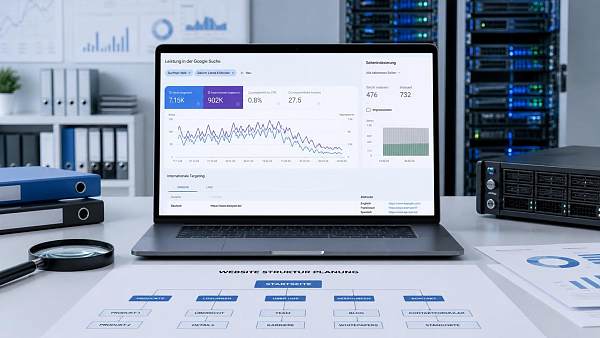
Multilingual websites must also check hreflang annotations. The German market commonly uses de-DE, but whether de-AT and de-CH are needed when the business actually serves Austria and Switzerland should be determined by the relevant page content and service scope. They should not be added arbitrarily simply to “cover more countries.” Each language or regional version should be mutually accessible, return a valid status, and remain consistent with its own canonical URL. hreflang does not automatically improve rankings, but incorrect configurations can indeed make it difficult for search engines to determine which version to show users.
When Rankings Fall, Distinguish Between Page Issues and Changes in Search Intent
When indexing is normal but rankings for core keywords continue to decline, group the affected pages. If only a small number of product pages decline, common reasons include compressed page content, missing specification tables, invalid images or PDF materials, fewer internal links, or competitors providing more complete application guidance. If many pages decline together, examine overall site speed, mobile experience, template duplicate content, internal linking structure, and external link anomalies.
German B2B purchasing searches do not revolve solely around broad product keywords. Purchasing personnel search for terms related to materials, dimensions, processes, standards, installation methods, industry applications, and delivery times. When English copy is translated directly into German, issues such as unnatural terminology, stiff word order, and information hierarchies that do not match local reading habits are common. More importantly, check whether the page genuinely answers what customers will ask next, such as applicable scenarios, available specifications, drawings and documentation, quality control methods, minimum order requirements, and inquiry paths.
Large-scale rewriting of all pages is not recommended simply to recover traffic. First select the pages with the greatest losses in impressions and clicks, retain their existing indexing foundation, and then fill in missing information. Titles should accurately describe the product or problem solved, while descriptions do not need to be stuffed with keywords. The body content should make models, technical conditions, and application relationships clear and easy to read. For multiple similar pages for the same product, also avoid repeatedly publishing content with only a few words changed, as this can dilute topical signals within the site.
Do Not Overlook Technical Experience and the Inquiry Journey
A decline in organic traffic is not necessarily caused entirely by SEO, but page experience issues can harm both rankings and conversions. Slow above-the-fold loading on mobile devices, pop-ups blocking content, oversized product images, forms that cannot be submitted, and invalid downloadable files can all cause visitors to leave early. For B2B websites serving Germany and surrounding markets, contact information, company details, privacy notices, and other required compliance information should also be verified based on the actual business location and operating model. These may not directly determine the ranking of a particular keyword, but they affect whether visitors are willing to continue learning about the company and submit inquiries.
During investigation, go through the inquiry process in practice: enter the German landing page from a Google search result, then open product details, download materials, complete the form, and check whether the email is delivered. Many teams look only at traffic and fail to discover that reduced leads actually result from changes to form fields, email blocking, or confused attribution between paid and organic traffic. The goal of SEO recovery is not merely to bring the chart back up, but to ensure that target customers entering the website can still complete the inquiry process smoothly.
Handling Issues by Priority Is Safer Than a Full Redesign
A practical sequence is to first address inaccessible pages, accidental blocking, incorrect redirects, and indexing anomalies; then correct canonical URLs, language-version relationships, and sitemaps; next optimize the key pages with the largest losses and their internal links; and only then evaluate content expansion, backlink quality, and the need for an overall redesign. After completing each batch of changes, record the date, affected URLs, and changes made, and allow an observation period to avoid being unable to determine the results after multiple actions overlap.
When website development, SEO, advertising, and social media are maintained separately by different teams, common issues include landing pages being changed without anyone updating tracking, advertising traffic amplifying technical defects, and organic search pages lacking conversion support. Since its establishment in 2013, Yiyingbao Information Technology (Beijing) Co., Ltd. has provided integrated services covering intelligent website building, SEO optimization, advertising placement, and overseas social media operations. Its AI-driven website-building and SEO/GEO optimization capabilities are better suited for unified management of multilingual pages, promotion data, and content iteration schedules. For German websites, tools and automation can improve investigation efficiency, but language quality, business materials, and target-market judgment still require confirmation by people who understand the products.
When SEO traffic on a German foreign trade website declines, there is no need to rush into overturning the existing site. First obtain data segmented by country, page, and query, verify indexing and language versions, and then return to customer search intent and the inquiry journey. This usually makes it easier to identify the real break point. If the issue involves site migration, German versions for multiple countries, or long-term content planning, clarify URL mapping, page priorities, and acceptance criteria before making changes.
Related Articles


Related Products
 Yiyingbao SaaS Intelligent Website Building and Marketing SystemYiyingbao SaaS Intelligent Website Building and Marketing System, AI-powered no-code website building, rapid creation of multilingual B2B international websites in 10 minutes, global server acceleration, AI-powered SEO optimization, helping businesses connect efficiently with global markets. The perfect integration of technology and operation makes building an international trade website remarkably simple
 AI+SEM Intelligent Advertising Marketing SystemAI+SEM drives intelligent ad creation, empowering full-funnel precision advertising marketing. The system automatically generates weekly/monthly reports, AI recommends keywords and target countries, monitors core metrics in real-time with intelligent alerts, and enables one-click high-conversion ad solutions to help quickly acquire customers and improve ROI.
 AI+SEO Dual-Engine System Optimization ServicesYiyingbao’s AI+SEO dual-engine optimization system helps foreign trade enterprises acquire high-quality organic traffic through AI-powered keyword research, content generation, and comprehensive technical optimization, significantly improving search rankings and conversion rates.
 AI+SNS Social Media Marketing SystemYingbao AI+SNS Social Media Marketing System - Precision social capture for the social media era. Supports one-click content synchronization across major platforms like Facebook and LinkedIn. AI intelligently rewrites posts for enhanced relevance. 24/7 AI customer service and user profiling analysis empower businesses to efficiently expand into global markets.
 AI+SEO营销解决方案易营宝AI+SEO营销解决方案,通过AI批量写作、智能生成TDK、精准关键词扩词等功能,全面优化网站SEO效果,提升流量与转化率。助力企业构建高效智能网站新生态。
 AI+SEM Advertising Marketing SolutionsAI+SEM Advertising Marketing Solution leverages AI technology to deeply empower SEM ad campaigns. It automatically generates weekly/monthly reports using AI, presenting account data across multiple dimensions for comprehensive insights into campaign performance and trends. The system precisely recommends keywords and target countries, intelligently generates high-conversion ad copy, and enables one-click activation of efficient campaign plans to help businesses rapidly acquire customers. Simultaneously, it monitors core metrics in real time, intelligently identifies abnormal fluctuations, and issues timely alerts to ensure stable, high-return advertising results.
 Domain Name ServicesEasyWin provides professional domain name services, including intelligent queries, one-stop registration, brand protection, and full lifecycle management, helping businesses build a digital brand image.
 EasyOperate B2C Cross-Border E-Commerce Platform & Independent WebsiteEasyStore B2C Cross-border E-commerce Independent Store is an intelligent website building and cross-border e-commerce integrated solution independently developed by EasyStore Information Technology (Beijing) Co., Ltd. The system is specially designed for small and medium-sized as well as large export enterprises, integrating 'website building, operation, marketing, advertising, and conversion' into one, helping enterprises quickly establish cross-border e-commerce independent stores to achieve brand globalization and global sales growth.
The platform supports multiple languages, multiple currencies, and multi-channel marketing, with built-in AI intelligent translation and SEO optimization systems, suitable for mainstream markets such as Southeast Asia, Europe and America, Latin America, and the Middle East, assisting Chinese manufacturing enterprises in efficiently deploying international e-commerce strategies. SSL证书易营宝提供专业SSL安全证书服务,包括单域名和泛域名证书,确保网站数据传输加密、身份验证和完整性保护,助力企业建立安全可信的在线业务环境。









