









- Which customer acquisition channels will be affected by cross-border marketing trends in 2026?Sep 06, 2026View details
- Which homogenization risks should be considered in an analysis of the AI-powered website building industry?Aug 30, 2026View details
- How Will AI Marketing Trends 2026 Change Advertising Budget AllocationAug 28, 2026View details
- Is the EV SSL certificate market shrinking or upgrading? How should companies assess certificate procurement?Aug 11, 2026View details
- Why the old AMP SEO 2020 practices no longer work and what has changed in current optimization prioritiesAug 02, 2026View details
- How to Choose Topics for an Industry News Section to Attract More Organic Search TrafficJul 29, 2026View details
What does B2B website SEO technical optimization include?A detailed explanation of crawling、internal linking and structured deployment
For B2B website SEO technical optimization,first check whether the underlying layer is crawlable
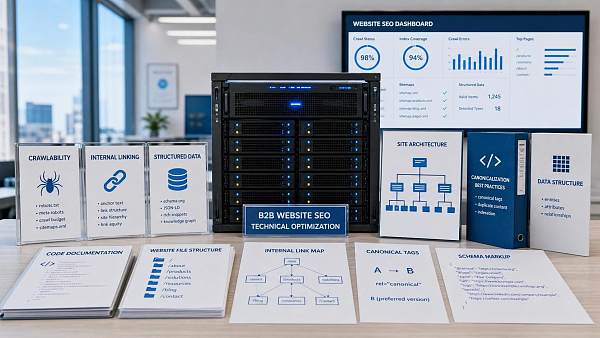
For B2B website SEO technical optimization,many people’s first reaction is titles,keywords,and content updates。
But at the technical level,what truly determines the upper limit is often crawling,linking,and structure。
If search engines cannot crawl,understand,or connect the pages,even the best content will struggle to be indexed consistently。
Therefore,to judge whether B2B website SEO technical optimization is in place,the first step is not to look at copywriting,but to look at the underlying architecture。
This is especially true for foreign trade websites,manufacturing company websites,multilingual sites,and inquiry-driven independent websites,which rely more on a technical foundation。
Once the page scale becomes larger,crawl waste,duplicate pages,and broken link paths will be quickly amplified。
This is also why technical optimization is often more worth prioritizing than changing words on a single page。
Crawl efficiency determines whether a website can be continuously discovered
Crawl efficiency is the starting point of B2B website SEO technical optimization。
The crawling resources search engines allocate to each site are limited,and they will not scan all pages without limit。
If a website has a large number of parameter pages,duplicate pages,and blank pages,the crawl budget will be consumed。
In actual business,such issues are commonly seen in product filtering,on-site search,and multilingual switching pages。
- robots rules are clear,avoiding accidental blocking of core sections。
- The XML sitemap is complete,and updates are submitted in a timely manner。
- Use canonical properly to reduce duplicate content interference。
- Issues such as 404,302,and overly long redirect chains should be checked regularly。
- Control the click depth of important pages,and try not to make them too deep。
Judging from recent changes,search engines place more emphasis on page accessibility and the stability of crawl paths。
This means that B2B website SEO technical optimization cannot only pursue the number of pages,but must also control page quality。
Page loading and rendering are also part of crawling
Many companies overlook one point:a page that can be opened does not mean it can be crawled efficiently。
If the above-the-fold content is too heavy and scripts block heavily,the cost for search engines to read content will also increase。
For B2B website SEO technical optimization,loading speed and stable rendering are basic indicators。
- Compress images and scripts,and reduce invalid requests。
- Output core content directly as much as possible,without relying on complex asynchronous loading。
- Keep the main content consistent between mobile and desktop。
- Keep server responses stable,and avoid frequent timeouts。
For multilingual marketing websites,this step is especially critical。
Because once the page template is too heavy,after being amplified across hundreds of product pages,the problem will become very obvious。
The internal linking system is the skeleton of B2B website SEO technical optimization
If crawling solves “whether users can enter”,then internal links solve “how to navigate after entering”。
Mature B2B website SEO technical optimization is certainly not a collection of scattered pages,but a network structure with clear topics。
Search engines understand section relationships,content hierarchy,and page importance through internal links。
Users also use internal links to move from industry questions to solutions,and then to inquiry conversion。
Internal linking is not about adding more links,but about building topic clusters
Many sites randomly add a few links in the body text,but this is not the same as systematic internal linking。
B2B website SEO technical optimization puts more emphasis on topic clustering and path design。
- Core product pages link to application scenario pages。
- Scenario pages then link to case pages and FAQ pages。
- Knowledge content links back to solution and service pages。
- Breadcrumb navigation helps identify the hierarchical structure。
The benefits of doing this are very direct。
First,the authority of core pages becomes more concentrated;second,related pages are more likely to form overall indexing。
For technical evaluation,the key is not the number of links,but whether the links serve the business structure。
Anchor text and hierarchy depth need to be controlled at the same time
Anchor text is a detail often overlooked in B2B website SEO technical optimization。
It is not just a clickable word,but also a signal that indicates the page topic。
Overly generic phrases such as “click to view” and “learn more” have very low information value。
A more reasonable approach is to combine product terms,scenario terms,and problem terms for natural expression。
At the same time,important pages are best reachable within three clicks。
If key pages are buried too deeply,both crawling and conversion will be affected。
Structured deployment helps search engines understand pages faster
Structured deployment is a key step for B2B website SEO technical optimization to move from “visible” to “understandable”。
Many corporate websites have plenty of content,but their topic boundaries are vague,and page semantic expression is also unstable。
At this time,structured data and standardized tags become very important。
First standardize the basic page structure
Standardizing the page structure is the foundation of B2B website SEO technical optimization。
- Each page has only one clear topic,with a clear heading hierarchy。
- URLs are concise and stable,avoiding meaningless parameters。
- Title tags,description tags,and body semantics are consistent。
- Multilingual pages use corresponding standardized markup。
- Template fields for products,cases,articles,and other content remain consistent。
After page templates are standardized,when the website expands to more directories,maintenance costs will drop significantly。
This is very important for continuously carrying out B2B website SEO technical optimization,because SEO is not a one-time project。
Structured data should correspond to business objects
Structured data is not about “adding code” for the sake of adding code。
Truly effective B2B website SEO technical optimization aligns data markup with business objects。
A more obvious signal is that both search engines and AI search increasingly rely on structured understanding of pages。
Therefore,structured deployment is no longer just a bonus item,but infrastructure for long-term visibility。
How to determine whether B2B website SEO technical optimization meets the standard
When making a judgment,it is recommended not to look only at ranking fluctuations。
Whether B2B website SEO technical optimization meets the standard should be evaluated through a set of continuous indicators。
- Whether core pages are crawled and indexed stably。
- Whether low-value pages are effectively controlled。
- Whether internal links support the collaboration of products,scenarios,and content。
- Whether structured information is unified and scalable。
- Whether pages take both search engine understanding and user conversion into account。
If these points are relatively stable,the website usually has better scalability。
Whether adding content,adding language sites,or connecting an advertising landing page system later,everything will be smoother。
From the practice of Eyingbao,truly effective website construction is not just about building the site。
Instead,through intelligent website building,SEO optimization,and AI-driven deployment,the website gains the ability to be promoted,indexed,and converted。
For foreign trade companies,manufacturing factories,and brands expanding overseas,this set of capabilities will directly affect subsequent growth efficiency。
In summary,B2B website SEO technical optimization must at least focus on three things。
First open up the crawl paths,then stabilize the internal linking skeleton,and finally complete structured deployment。
Only when these three layers work together can the website have a stable foundation for long-term indexing,topic relevance,and inquiry conversion。
Related Articles

Related Products
 Yiyingbao SaaS Intelligent Website Building and Marketing SystemYiyingbao SaaS Intelligent Website Building and Marketing System, AI-powered no-code website building, rapid creation of multilingual B2B international websites in 10 minutes, global server acceleration, AI-powered SEO optimization, helping businesses connect efficiently with global markets. The perfect integration of technology and operation makes building an international trade website remarkably simple
 AI+SEM Intelligent Advertising Marketing SystemAI+SEM drives intelligent ad creation, empowering full-funnel precision advertising marketing. The system automatically generates weekly/monthly reports, AI recommends keywords and target countries, monitors core metrics in real-time with intelligent alerts, and enables one-click high-conversion ad solutions to help quickly acquire customers and improve ROI.
 AI+SEO Dual-Engine System Optimization ServicesYiyingbao’s AI+SEO dual-engine optimization system helps foreign trade enterprises acquire high-quality organic traffic through AI-powered keyword research, content generation, and comprehensive technical optimization, significantly improving search rankings and conversion rates.
 AI+SNS Social Media Marketing SystemYingbao AI+SNS Social Media Marketing System - Precision social capture for the social media era. Supports one-click content synchronization across major platforms like Facebook and LinkedIn. AI intelligently rewrites posts for enhanced relevance. 24/7 AI customer service and user profiling analysis empower businesses to efficiently expand into global markets.
 AI+SEO营销解决方案易营宝AI+SEO营销解决方案,通过AI批量写作、智能生成TDK、精准关键词扩词等功能,全面优化网站SEO效果,提升流量与转化率。助力企业构建高效智能网站新生态。
 AI+SEM Advertising Marketing SolutionsAI+SEM Advertising Marketing Solution leverages AI technology to deeply empower SEM ad campaigns. It automatically generates weekly/monthly reports using AI, presenting account data across multiple dimensions for comprehensive insights into campaign performance and trends. The system precisely recommends keywords and target countries, intelligently generates high-conversion ad copy, and enables one-click activation of efficient campaign plans to help businesses rapidly acquire customers. Simultaneously, it monitors core metrics in real time, intelligently identifies abnormal fluctuations, and issues timely alerts to ensure stable, high-return advertising results.
 Domain Name ServicesEasyWin provides professional domain name services, including intelligent queries, one-stop registration, brand protection, and full lifecycle management, helping businesses build a digital brand image.
 EasyOperate B2C Cross-Border E-Commerce Platform & Independent WebsiteEasyStore B2C Cross-border E-commerce Independent Store is an intelligent website building and cross-border e-commerce integrated solution independently developed by EasyStore Information Technology (Beijing) Co., Ltd. The system is specially designed for small and medium-sized as well as large export enterprises, integrating 'website building, operation, marketing, advertising, and conversion' into one, helping enterprises quickly establish cross-border e-commerce independent stores to achieve brand globalization and global sales growth.
The platform supports multiple languages, multiple currencies, and multi-channel marketing, with built-in AI intelligent translation and SEO optimization systems, suitable for mainstream markets such as Southeast Asia, Europe and America, Latin America, and the Middle East, assisting Chinese manufacturing enterprises in efficiently deploying international e-commerce strategies. SSL证书易营宝提供专业SSL安全证书服务,包括单域名和泛域名证书,确保网站数据传输加密、身份验证和完整性保护,助力企业建立安全可信的在线业务环境。









