









- Can the average annual growth rate reflect real opportunities in overseas markets?Oct 07, 2026View details
- Which customer acquisition channels will be affected by cross-border marketing trends in 2026?Sep 06, 2026View details
- Which homogenization risks should be considered in an analysis of the AI-powered website building industry?Aug 30, 2026View details
- How Will AI Marketing Trends 2026 Change Advertising Budget AllocationAug 28, 2026View details
- Is the EV SSL certificate market shrinking or upgrading? How should companies assess certificate procurement?Aug 11, 2026View details
- Why the old AMP SEO 2020 practices no longer work and what has changed in current optimization prioritiesAug 02, 2026View details
How to evaluate the results of business entity information optimization
How can you evaluate the effectiveness of business entity information optimization? The key is not only to look at ranking changes, but also to focus on impressions, search clicks, customer inquiries, and conversion growth. Based on practical experience in integrated website and marketing services, this article will help you quickly identify whether optimization is truly delivering business value.
For foreign trade companies, manufacturing factories, cross-border sellers, and brands expanding overseas, the effectiveness of business entity information optimization is not a single-point metric, but a full-funnel validation from search visibility to lead conversion and deal closure. Especially in scenarios such as multilingual official websites, independent websites, map information, branded keyword searches, and AI search, determining whether “optimization is effective” requires checking whether the data continues to improve and whether it is directly related to business goals.
Why Business Entity Information Optimization Should Not Be Judged Only by Rankings
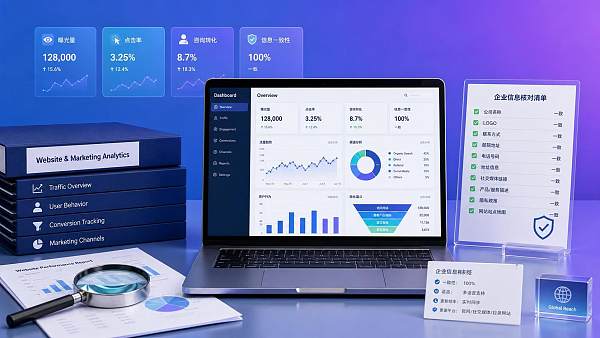
When many companies implement integrated website and marketing services, the first thing they focus on is whether keywords enter the top 10. However, in real customer acquisition, the effectiveness of business entity information optimization is often reflected at 3 levels: brand credibility, search entry coverage, and user conversion efficiency. Rankings are only process indicators, not the final result.
For example, if the English official website of a B2B manufacturing company improves in ranking, but old addresses, incorrect phone numbers, or duplicate company listings still appear under branded keywords, users may lose trust within the first 30 seconds and abandon the inquiry. In this case, there may appear to be traffic, but actual conversion is not ideal, so the optimization effect cannot be considered qualified.
4 Core Outcomes to Focus on in Business Entity Information Optimization
- Consistency in search results: company name, address, email, phone number, and official website link should keep at least 4 items consistent.
- Improved brand visibility: pages related to branded keywords, company name, and main product keywords should gradually stabilize within 7 to 30 days.
- Growth in effective clicks: do not only look at click volume, but also look at time on site after clicking, bounce behavior, and inquiry actions.
- Smooth conversion path: the path from search to the official website, then to form submission, WhatsApp consultation, or email inquiry should be clear.
Common Misconception: Treating Indexing as Results
Indexing is only the foundation and does not mean it brings business opportunities. Many corporate websites have dozens of pages indexed within 2 weeks, but if the page structure is chaotic, entity information is inconsistent, and contact entry points are scattered, search engines may be able to crawl the pages, yet users may not be willing to leave a lead. To evaluate the effectiveness of business entity information optimization, you should observe at least 30 to 90 days of continuous performance, rather than only looking at a ranking screenshot from a single day.
5 Core Metrics for Evaluating Optimization Effectiveness
When website development, SEO optimization, advertising, and social media traffic acquisition are promoted together, the effectiveness of business entity information optimization can be broken down into 5 quantifiable metrics. This makes it easier for marketing leaders, sales teams, and management to align on the same criteria and avoid relying only on intuition.
The table below is suitable for monthly reviews, especially for tracking the performance of foreign trade official websites, multilingual independent websites, and overseas promotion projects.
Looking at these 4 types of metrics, truly effective optimization usually improves impressions first, then drives clicks, and then transfers to inquiries and closed deals. If impressions increase but clicks and inquiries do not improve, you need to check whether there are problems with title wording, landing page content, and contact method settings.
1. Whether Impressions Cover Key Search Entry Points
The effectiveness of business entity information optimization should first be judged by the scope of “being seen”. It is recommended to track at least 3 types of keywords: company name keywords, branded keywords, and main product keywords. If branded keyword impressions increase within 30 days but main product keywords do not change, it indicates that the entity information has improved basic recognition, but content assets are still insufficient. The website needs to continue adding product pages, case study pages, and industry solution pages.
2. Whether the Click-Through Rate Improves at the Same Time
Click-through rate is a key metric for determining whether information is “attractive and credible”. Generally speaking, for the same type of branded keyword pages, when information is accurate, titles are clear, and descriptions are complete, the click-through rate will be more stable than pages with disorganized information. If impressions increase by more than 20%, but the click-through rate barely changes, it often means that the page title, snippet, or brand presentation has not impressed the target customers.
3. Whether Inquiry Entry Points Generate Effective Conversions
In B2B scenarios, forms, online chat, WhatsApp, email, and phone buttons should retain at least 2 or more contact methods. If business entity information optimization is effective, users can usually find a contact entry point within 1 to 3 pages after visiting the official website. If page visits increase but inquiries do not grow, the CTA position may not be obvious, or contact information may be inconsistent across different pages.
4. Whether Information Is Consistent Across Multiple Platforms
The official website is only the main base. True business entity information optimization also involves Google search results, business directories, maps, social media homepages, and third-party profile pages. It is recommended to check NAP information once a month, that is, the consistency of name, address, and phone number. If the same company has 2 address versions or multiple phone numbers, search signals will be diluted, affecting overall results.
How to Determine Whether Optimization Meets the Standard at Different Business Stages
Companies at different growth stages have different criteria for evaluating the effectiveness of business entity information optimization. New websites, growth-stage websites, and mature websites differ significantly in focus metrics, time windows, and resource investment. If the same set of standards is used for all of them, misjudgment can easily occur.
New Website Stage: Check Identifiability First, Then Indexability
For new websites that have been online for 1 to 8 weeks, the primary goal is not a large number of conversions, but to help search engines clearly identify the company’s identity. At this stage, priority should be given to checking whether the company name, page Title, contact page, footer, structured information, and multilingual pages are consistent. If a new website completes basic indexing within 2 to 4 weeks and branded keywords are searchable, it indicates that the optimization direction is basically correct.
Growth Stage: Check Whether Lead Growth Is Stable
After the website enters the 2nd to 6th month, the evaluation focus should shift from “whether it can be seen” to “whether it brings business opportunities”. It is recommended to track inquiry volume, valid form rate, time on page, and the traffic share of key countries on a monthly basis. If the target markets are North America and Europe, you should not only look at total traffic, but also check whether visits from target regions reach more than 50%.
Mature Stage: Check the Ability to Accumulate Brand Assets
Mature websites pay more attention to the moat of branded keywords and multi-channel synergy. At this stage, the effectiveness of business entity information optimization should not only be judged by organic search, but also by whether ad landing pages, social media homepages, and AI search results deliver consistent information. If brand presentation is consistent across more than 3 channels, users’ decision-making time is usually shorter, and sales follow-up efficiency is also higher.
The table below is suitable for distinguishing evaluation priorities at different stages, making it easier for companies to set more reasonable KPIs.
This means that companies should not only pursue short-term ranking fluctuations, but should integrate brand information across websites, content, advertising, and social media. Only by forming a unified corporate identity system can optimization results truly accumulate into sustainable customer acquisition capability.
3 Common Issues That Affect the Accuracy of Performance Evaluation
Many teams have clearly carried out optimization but still cannot see clear results for a long time. The reason is usually not that there is no effect, but that the evaluation method is biased. The following 3 types of issues are the most common.
Only Looking at Single-Channel Data
If you only look at organic search without combining advertising, social media, and direct visits, you will often underestimate the effectiveness of business entity information optimization. In reality, users may first learn about the brand through Google search, then confirm credibility through the Facebook homepage, and finally return to the official website to submit an inquiry. At least 2 to 3 channels of data should be connected to evaluate results.
Ignoring the Mobile Experience
In overseas marketing scenarios, mobile visits often account for more than 40%. If company information is displayed incompletely on mobile, buttons are hard to tap, footer information is missing, or maps and email addresses are not clickable, users will leave directly. At this point, even if desktop data looks good, it still cannot prove that the optimization is truly effective.
No Unified Conversion Definition
Some teams count all messages as leads, while others only count valid inquiries as conversions, resulting in completely different conclusions for the same project. It is recommended to unify at least 3 definitions: visits, inquiries, and valid business opportunities. Only in this way can the effectiveness of business entity information optimization be accurately evaluated, while also supporting subsequent budget decisions.
From Optimization to Conversion, Companies Need More Integrated Capabilities
The effectiveness of business entity information optimization must ultimately be reflected in business growth, rather than remaining at the level of data reports. For companies expanding overseas, doing website development, SEO, and advertising separately often leads to inconsistent information, fragmented pages, and difficult lead tracking. A more ideal approach is to execute website development, content optimization, advertising, social media operations, and AI search deployment within the same growth framework.
AI-driven enterprise-level SaaS intelligent website building and overseas marketing platforms like 易营宝 are suitable for companies that need multilingual official websites, B2B inquiry websites, cross-border malls, and long-term SEO growth. Their value is not only in building a website, but in using a cloud-based intelligent website building system, AI advertising marketing system, and AI+SEO/GEO optimization capabilities to move business entity information from “displayable” to “indexable, customer-acquiring, and convertible”.
Types of Companies That Should Focus on Performance Evaluation
- Foreign trade manufacturing companies: need to verify the growth trend of official website inquiries within 90 days.
- Cross-border e-commerce brands: need to unify information across independent websites, ad pages, and social media homepages.
- Multilingual overseas expansion companies: need to maintain brand consistency in more than 3 regional markets.
- Teams with existing advertising budgets: need to determine whether organic traffic and paid traffic form synergy.
The core of evaluating the effectiveness of business entity information optimization is not whether a certain keyword has moved up several positions, but whether the brand is easier to find, whether customers are more willing to click, whether inquiries continue to grow, and whether the conversion path is smoother. Only when search visibility, official website engagement capability, and lead quality are evaluated together can optimization be considered truly valuable.
If you are planning an overseas official website upgrade, Google SEO optimization, advertising landing page development, or multilingual brand overseas expansion strategy, it is recommended to establish a unified data evaluation framework as early as possible. If you would like to further understand an implementation approach suitable for your business, feel free to contact us now to get a customized solution and learn more about integrated website and marketing service solutions.
Related Articles


Related Products
 Yiyingbao SaaS Intelligent Website Building and Marketing SystemYiyingbao SaaS Intelligent Website Building and Marketing System, AI-powered no-code website building, rapid creation of multilingual B2B international websites in 10 minutes, global server acceleration, AI-powered SEO optimization, helping businesses connect efficiently with global markets. The perfect integration of technology and operation makes building an international trade website remarkably simple
 AI+SEM Intelligent Advertising Marketing SystemAI+SEM drives intelligent ad creation, empowering full-funnel precision advertising marketing. The system automatically generates weekly/monthly reports, AI recommends keywords and target countries, monitors core metrics in real-time with intelligent alerts, and enables one-click high-conversion ad solutions to help quickly acquire customers and improve ROI.
 AI+SEO Dual-Engine System Optimization ServicesYiyingbao’s AI+SEO dual-engine optimization system helps foreign trade enterprises acquire high-quality organic traffic through AI-powered keyword research, content generation, and comprehensive technical optimization, significantly improving search rankings and conversion rates.
 AI+SNS Social Media Marketing SystemYingbao AI+SNS Social Media Marketing System - Precision social capture for the social media era. Supports one-click content synchronization across major platforms like Facebook and LinkedIn. AI intelligently rewrites posts for enhanced relevance. 24/7 AI customer service and user profiling analysis empower businesses to efficiently expand into global markets.
 AI+SEO营销解决方案易营宝AI+SEO营销解决方案,通过AI批量写作、智能生成TDK、精准关键词扩词等功能,全面优化网站SEO效果,提升流量与转化率。助力企业构建高效智能网站新生态。
 AI+SEM Advertising Marketing SolutionsAI+SEM Advertising Marketing Solution leverages AI technology to deeply empower SEM ad campaigns. It automatically generates weekly/monthly reports using AI, presenting account data across multiple dimensions for comprehensive insights into campaign performance and trends. The system precisely recommends keywords and target countries, intelligently generates high-conversion ad copy, and enables one-click activation of efficient campaign plans to help businesses rapidly acquire customers. Simultaneously, it monitors core metrics in real time, intelligently identifies abnormal fluctuations, and issues timely alerts to ensure stable, high-return advertising results.
 Domain Name ServicesEasyWin provides professional domain name services, including intelligent queries, one-stop registration, brand protection, and full lifecycle management, helping businesses build a digital brand image.
 EasyOperate B2C Cross-Border E-Commerce Platform & Independent WebsiteEasyStore B2C Cross-border E-commerce Independent Store is an intelligent website building and cross-border e-commerce integrated solution independently developed by EasyStore Information Technology (Beijing) Co., Ltd. The system is specially designed for small and medium-sized as well as large export enterprises, integrating 'website building, operation, marketing, advertising, and conversion' into one, helping enterprises quickly establish cross-border e-commerce independent stores to achieve brand globalization and global sales growth.
The platform supports multiple languages, multiple currencies, and multi-channel marketing, with built-in AI intelligent translation and SEO optimization systems, suitable for mainstream markets such as Southeast Asia, Europe and America, Latin America, and the Middle East, assisting Chinese manufacturing enterprises in efficiently deploying international e-commerce strategies. SSL证书易营宝提供专业SSL安全证书服务,包括单域名和泛域名证书,确保网站数据传输加密、身份验证和完整性保护,助力企业建立安全可信的在线业务环境。









