









- 21st Century Business Herald: AI and CTV Become Core Growth Engines for Digital Marketing in Overseas MarketsNov 18, 2026View details
- China Presents 25 Cooperation Outcomes in Areas Including Cross-Border E-Commerce During APECNov 18, 2026View details
- AI Products Drive Hong Kong Exports Up 64.9% in September, Fastest Growth in Over 40 YearsNov 17, 2026View details
- National Bureau of Statistics: Foreign trade grew rapidly in October, providing stable support for global tradeNov 17, 2026View details
- The U.S. has ended the $800 de minimis exemption for non-postal shipments; express courier packages must be formally declared.Nov 16, 2026View details
- ASEAN Signs Digital Economy Framework Agreement, Moving Toward Harmonized Cross-Border E-Commerce RulesNov 15, 2026View details
What a conversion-optimized landing page needs before a campaign launch
Before a project goes live, the core task of a conversion-optimized landing page is not to “make the page look better,” but to give every incoming advertising visit a clear destination: whether users can quickly confirm that the product matches their needs, whether the project team can obtain valid leads that can be evaluated and followed up, and whether campaign data can reflect the actual conversion barriers.
For foreign trade projects that rely on Google Ads, social media advertising, or post-trade-show remarketing, if issues such as incomplete information, invalid forms, mobile layout misalignment, or untraceable inquiries are only exposed after campaigns begin, the loss involves not only budget, but also the initial data that should have been used to validate market demand. Therefore, before launching campaigns, the page should be treated as a testable business path rather than a promotional page on a website.
First determine which single action the page is intended to support
A landing page can present multiple product capabilities, but it should not simultaneously ask visitors to download a catalog, subscribe to emails, request a quote, book a demo, and place an order directly. The more action entry points there are, the more easily the advertising promise becomes disconnected from the page task, making it difficult to determine what users are actually interested in later.
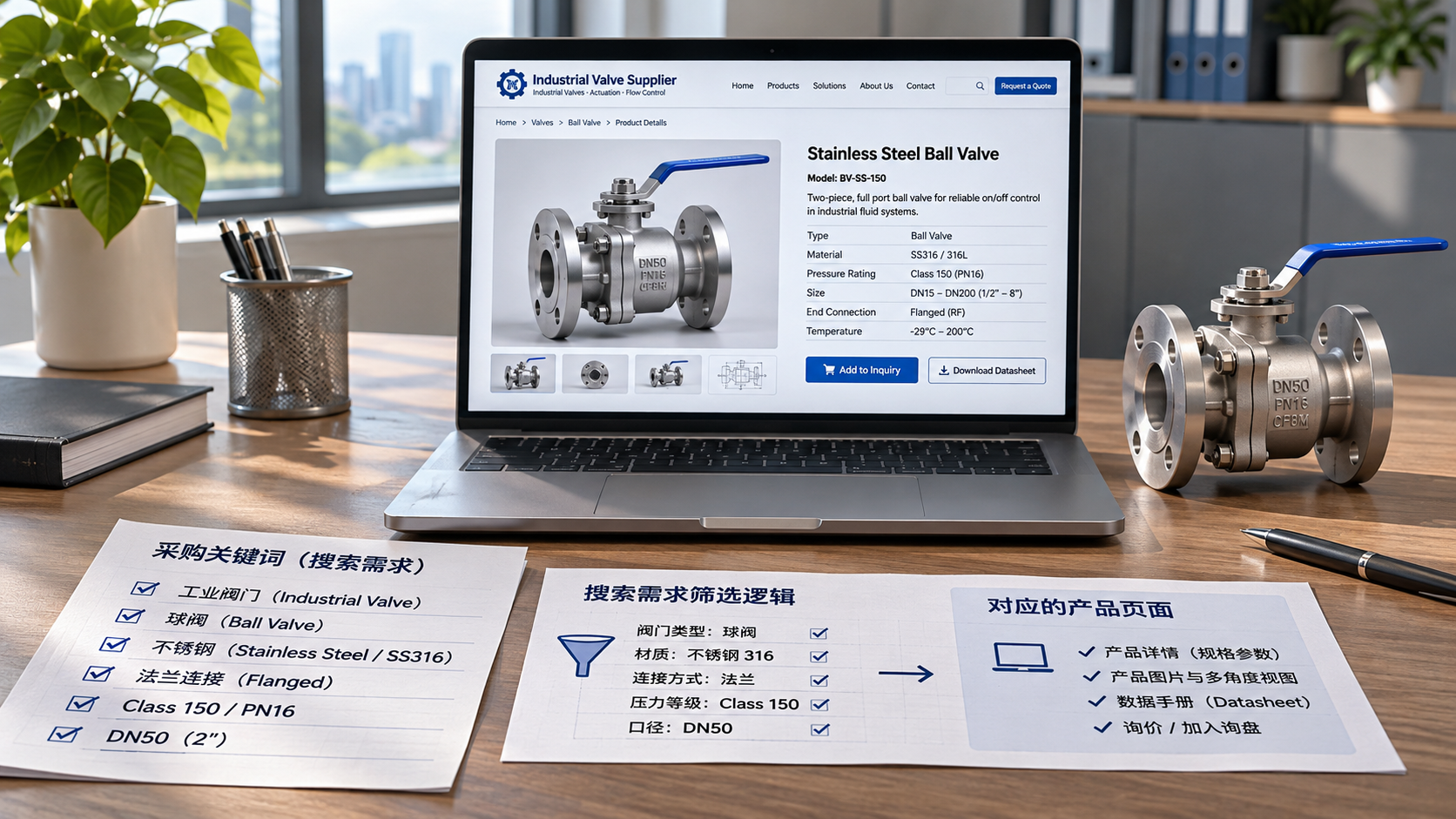
The primary action on the page should align with the intent of the ad group. Users searching for “industrial valve supplier” usually need to quickly see the product range, materials or standards, application conditions, delivery capabilities, and an inquiry entry point; users searching for a specific model or specification are more concerned with parameters, compatibility requirements, minimum order quantity, samples, or technical documentation. If the same generalized company introduction is used to receive both types of traffic, lead quality will remain low even if traffic volume is normal.
Before launch, “successful conversion” needs to be defined in actionable terms. For example, an effective submission in a B2B project should not simply mean that a form has been sent successfully; it should also include fields that support sales evaluation, such as contact information, target market, required product, or project stage. What is collected on the page determines how the sales team can subsequently qualify leads; when fields are determined entirely by internal habits, visitors may abandon the form or provide information that cannot be used.
There must be no disconnect between the advertising promise, above-the-fold information, and the form
After clicking an ad, visitors will generally not patiently search for the content mentioned in the ad. If the ad says “customized solution,” “OEM service,” or “get a quote,” the above-the-fold section should immediately present the corresponding product range, applicable scenarios, or service scope, while keeping the main call-to-action button visible. Burying core information behind lengthy brand introductions, carousels, or multi-level navigation increases comprehension costs and makes campaign keywords and conversion results less comparable.
Above-the-fold content does not mean stacking selling points. For complex industrial products, engineering services, or customized solutions, a more effective information structure is to clearly state what the offering is, which specific problem it solves, under what conditions it applies, and what will happen after the next submission. Buttons such as “Get a professional solution” can be retained, but nearby text should explain the response content, such as selection recommendations, technical documentation, quotation ranges, or a project communication entry point, to prevent users from mistaking it for an ordinary marketing subscription.
The middle section of the page is intended to reduce decision-making concerns rather than repeat above-the-fold slogans. It can include key specifications, application limitations, descriptions of certifications or test documentation, delivery-related conditions, project processes, and frequently asked questions. It should be noted that certifications, performance, or service scope may only state content that can be substantiated. Vague claims such as “global leader” and “highest quality” do not help engineering buyers make decisions and may instead reduce the page's credibility.

Form design should support lead qualification, not request a complete customer profile
The selection of form fields should be determined backward from the sales action. If the initial communication only needs to confirm the contact person, company, country or region, email address, and requirement description, there is no need to request a full address, budget, purchasing cycle, complete technical parameters, or other information at the first step. For projects requiring technical selection, key conditions can be supplemented through dropdown options or attachment uploads, such as application industry, size range, material, estimated quantity, or drawing files.
Too few fields can also create problems. Inquiries that collect only a name and email address often make it impossible to distinguish end users, trading companies, industry peers seeking quotations, or spam submissions later. A more reasonable approach is to retain a small number of standardized qualifying fields and allow users to add non-standard information in the requirement description. Required fields should be tested in practice: country codes, email formats, attachment sizes, multilingual characters, and mobile input experience can all directly affect submission rates.
The page after submission is also part of the conversion path. If users see only a blank notification or are returned to the top of the page after clicking submit, the team cannot confirm whether the lead has actually entered the system. At a minimum, the confirmation page should explain the submission status and expected response method, while retaining optional next actions such as downloading materials, viewing related products, or scheduling a discussion. Do not turn the confirmation page into a new mandatory redirect that makes users believe the original submission failed.
Technical acceptance determines whether “convertible” is genuinely achieved
Completing visual acceptance does not mean the page is ready for campaigns. Before the project starts, the page must be checked under real mobile network conditions, in different browsers, and under access conditions in the main target regions. Images, scripts, fonts, third-party form components, and analytics code can all cause loading blocks; mobile buttons obscured by floating components, Cookie pop-ups covering forms, and conflicts between telephone country codes and validation rules are also often overlooked in desktop previews.
When a page operates across multiple regions, network infrastructure can also affect access stability. When an enterprise network upgrade involvesInternet Protocol Version 6 (IPV6), it is necessary to confirm whether domain name resolution, CDN, servers, firewalls, and third-party analytics and form services can function properly in both IPv4 and IPv6 environments. IPv6 uses 128-bit addresses and supports mechanisms such as native IPSec, but these capabilities do not automatically guarantee that a landing page is usable; what truly needs to be verified is whether dual-stack access, redirects, certificate chains, callback interfaces, and security policies are consistent. If certain access paths fail only under one protocol, the advertising platform may still show clicks while the company receives no corresponding inquiries.
Performance checks should not focus only on a single page speed score. More important considerations include whether the main above-the-fold content appears promptly, whether call-to-action buttons are operable, whether form scripts have completed loading, and whether users experience noticeable waiting when submitting. Especially when advertising pages use numerous tracking scripts, chat tools, heatmaps, or external videos, a timeout from any third-party resource can slow down key interactions.
Without attribution, it is impossible to determine whether the page has truly been optimized
Before a conversion-optimized landing page goes live, it is necessary to confirm that conversion events are triggered correctly and can distinguish between different sources. Clicking the “Request a Quote” button, opening a form, submitting successfully, making a phone call, downloading materials, and redirecting to WhatsApp are not the same type of conversion. Counting all of them as having equal value will cause both the advertising system and the project team to misjudge performance.
At a minimum, verify whether advertising link parameters are passed through completely, whether cross-domain redirects cause source loss, whether thank-you page or successful submission events are triggered repeatedly, and whether the lead source can be identified in the CRM, email, or ticketing system. For multiple language versions, country sites, or different product pages, it is also necessary to check whether event naming is consistent; otherwise, subsequent reports will mix different business actions together.
More importantly, establish a feedback loop from “submission” to “qualified inquiry.” The advertising backend can record successful form submissions, but it cannot independently determine whether a lead has purchase potential. If the sales or project team does not feed back invalid reasons, such as region mismatch, product incompatibility, incorrect contact details, requests for materials only, or duplicate inquiries, the page and campaign teams can only continue optimizing around surface-level conversion rates, ultimately amplifying low-value traffic.
A complete simulated visit should be carried out before launch
The most reliable way to check is not to review backend settings item by item, but to complete a test following the target customer's path: enter the page from the advertising link, read the above-the-fold content, switch language or device, fill in the form, upload an attachment, check the confirmation information after submission, and then verify the email, CRM record, source parameters, and conversion event. Only when every step functions properly does the page meet the basic requirements for receiving budget.
During the first few days after campaigns begin, abnormal signals between visits and submissions should still be continuously monitored: clicks exist but above-the-fold dwell time is extremely short, forms are opened frequently but rarely submitted, a particular country or device type reports concentrated errors, or leads suddenly fail to enter the business system. These phenomena do not necessarily mean that ad targeting has failed; they may also indicate a break in the promise, interaction, or technical path of the landing page.
A page that can truly be used for promotion is not a design outcome that has “passed acceptance” once, but a working interface where advertising information, user needs, data collection, and internal response processes form a closed loop. Run this path successfully first, then expand campaign reach, so that the data obtained by the project can support subsequent budget adjustments and market assessments.
Related Articles
 How Can You Determine Account Ownership Arrangements with a Google Ads Agency?
 Is Google Advertising Worth the Investment for Export Businesses? Start by Calculating the Cost per Inquiry
 Comparing Match Types for International Search Ads: How to Balance Traffic and Relevance


Related Products
 Yiyingbao SaaS Intelligent Website Building and Marketing SystemYiyingbao SaaS Intelligent Website Building and Marketing System, AI-powered no-code website building, rapid creation of multilingual B2B international websites in 10 minutes, global server acceleration, AI-powered SEO optimization, helping businesses connect efficiently with global markets. The perfect integration of technology and operation makes building an international trade website remarkably simple
 AI+SEM Intelligent Advertising Marketing SystemAI+SEM drives intelligent ad creation, empowering full-funnel precision advertising marketing. The system automatically generates weekly/monthly reports, AI recommends keywords and target countries, monitors core metrics in real-time with intelligent alerts, and enables one-click high-conversion ad solutions to help quickly acquire customers and improve ROI.
 AI+SEO Dual-Engine System Optimization ServicesYiyingbao’s AI+SEO dual-engine optimization system helps foreign trade enterprises acquire high-quality organic traffic through AI-powered keyword research, content generation, and comprehensive technical optimization, significantly improving search rankings and conversion rates.
 AI+SNS Social Media Marketing SystemYingbao AI+SNS Social Media Marketing System - Precision social capture for the social media era. Supports one-click content synchronization across major platforms like Facebook and LinkedIn. AI intelligently rewrites posts for enhanced relevance. 24/7 AI customer service and user profiling analysis empower businesses to efficiently expand into global markets.
 AI+SEO营销解决方案易营宝AI+SEO营销解决方案,通过AI批量写作、智能生成TDK、精准关键词扩词等功能,全面优化网站SEO效果,提升流量与转化率。助力企业构建高效智能网站新生态。
 AI+SEM Advertising Marketing SolutionsAI+SEM Advertising Marketing Solution leverages AI technology to deeply empower SEM ad campaigns. It automatically generates weekly/monthly reports using AI, presenting account data across multiple dimensions for comprehensive insights into campaign performance and trends. The system precisely recommends keywords and target countries, intelligently generates high-conversion ad copy, and enables one-click activation of efficient campaign plans to help businesses rapidly acquire customers. Simultaneously, it monitors core metrics in real time, intelligently identifies abnormal fluctuations, and issues timely alerts to ensure stable, high-return advertising results.
 Domain Name ServicesEasyWin provides professional domain name services, including intelligent queries, one-stop registration, brand protection, and full lifecycle management, helping businesses build a digital brand image.
 EasyOperate B2C Cross-Border E-Commerce Platform & Independent WebsiteEasyStore B2C Cross-border E-commerce Independent Store is an intelligent website building and cross-border e-commerce integrated solution independently developed by EasyStore Information Technology (Beijing) Co., Ltd. The system is specially designed for small and medium-sized as well as large export enterprises, integrating 'website building, operation, marketing, advertising, and conversion' into one, helping enterprises quickly establish cross-border e-commerce independent stores to achieve brand globalization and global sales growth.
The platform supports multiple languages, multiple currencies, and multi-channel marketing, with built-in AI intelligent translation and SEO optimization systems, suitable for mainstream markets such as Southeast Asia, Europe and America, Latin America, and the Middle East, assisting Chinese manufacturing enterprises in efficiently deploying international e-commerce strategies. SSL证书易营宝提供专业SSL安全证书服务,包括单域名和泛域名证书,确保网站数据传输加密、身份验证和完整性保护,助力企业建立安全可信的在线业务环境。









