









- 21st Century Business Herald: AI and CTV Become Core Growth Engines for Digital Marketing in Overseas MarketsNov 18, 2026View details
- China Presents 25 Cooperation Outcomes in Areas Including Cross-Border E-Commerce During APECNov 18, 2026View details
- AI Products Drive Hong Kong Exports Up 64.9% in September, Fastest Growth in Over 40 YearsNov 17, 2026View details
- National Bureau of Statistics: Foreign trade grew rapidly in October, providing stable support for global tradeNov 17, 2026View details
- The U.S. has ended the $800 de minimis exemption for non-postal shipments; express courier packages must be formally declared.Nov 16, 2026View details
- ASEAN Signs Digital Economy Framework Agreement, Moving Toward Harmonized Cross-Border E-Commerce RulesNov 15, 2026View details
Comparing Match Types for International Search Ads: How to Balance Traffic and Relevance
Overseas search advertising needs to balance traffic and relevance. You generally do not have to choose exclusively between broad match and exact match. A more reliable approach is to start with keywords that have clearly defined business boundaries, then decide whether to expand coverage based on the search terms report and qualified conversion data. Accounts with limited budgets and clearly defined product applications can start with exact match and phrase match. Accounts with sufficient conversion data and the ability to continuously filter traffic can test broad match in a controlled way.
Match types determine which search queries can trigger ads for a keyword, but they do not directly guarantee the quality of inquiries. The countries targeted, language, negative keywords, bidding strategy, and landing page content all affect the final results. Consider these factors together when choosing a match type.
Three match types: the differences lie in traffic boundaries and management effort
For Google Search ads, common keyword match types include broad match, phrase match, and exact match. All three may match variations or expressions related to a keyword; their names should not be interpreted as strict restrictions on the exact wording users search for. Rules may differ on other advertising platforms, so check the relevant platform’s guidelines before applying them.
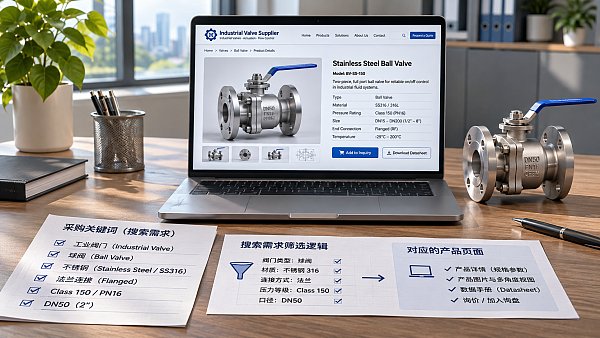
For example, when an industrial valve factory advertises using English keywords, “industrial valve manufacturer” expresses a clear need for a product and supplier. Exact match can be used to test core terms, while phrase match may reach searches that include specifications, materials, or purchasing requirements. Broad match may reach a wider range of related searches, so use actual search terms to determine which traffic is worth keeping.
This example is intended only to illustrate the boundaries; it does not mean that a particular search term will necessarily trigger an ad. Advertising platforms also consider query meaning and other signals when matching ads. Actual results should be assessed using the search term data in the account.
Choose a combination based on business conditions, not just traffic volume
For new accounts or tight budgets, focus first on core demand. Prioritize keywords that clearly express the product, service, and purchasing intent, and use exact match and phrase match to build up data. Check whether search terms relate to the target product, which countries inquiries come from, and whether customers specify quantities, requirements, or service needs that you can fulfill. This approach may miss some demand, but makes it easier to see where the budget is going.
When you have a broad product range, divide campaigns according to business boundaries first. For example, the same manufacturer may sell standard parts and offer custom processing, but the two types of customers may use different search terms and need different landing page content. Organizing keywords and pages separately helps identify which type of traffic generates qualified opportunities and makes it easier to adjust budgets independently. Do not group all products under a single broad phrase and judge performance solely by the total number of inquiries.
When preparing to scale, treat broad match as a controlled test. Once the account has a record of qualified conversions and you can regularly review search terms and maintain negative keywords, you can test broad match on selected core products. Set a budget range and evaluation period before testing, while keeping the measurement criteria for existing core keywords unchanged. If the account uses Smart Bidding, also check its optimization goal: if the system receives mostly signals from invalid forms, scaling may amplify the problem.
Budgets do not need to be distributed evenly across match types. High-value keywords with clearly defined business boundaries can support stable customer acquisition, while budgets for exploratory phrases should match the team’s ability to screen traffic. Niche products with low search volume and clearly specified model numbers may also need to operate at a smaller traffic scale, rather than simply loosening match settings to pursue more clicks.
To assess relevance, trace search terms through to qualified opportunities
Click-through rates and form submissions can help identify issues, but they are not enough on their own to determine match types. An ad may attract clicks simply because its copy seems relevant; an increase in form submissions may also come from job seekers, after-sales inquiries, or individual retail buyers who are not part of the target audience. B2B export businesses in particular need to connect advertising data with feedback from sales.
For routine reviews, follow this process:
- Start with search terms: Are users searching for the target product, or for something else, such as tutorials, repairs, jobs, or free resources?
- Then review the landing page: Does it clearly explain product specifications, applications, service regions, and purchasing methods? Does the page content match the promises made in the ad?
- Finally, review the inquiries: Do the source country, buyer profile, required specifications, and expected quantities meet business requirements? Can the sales team follow up?
If a keyword group gets plenty of clicks but few qualified inquiries, first identify where the problem lies. If search terms are outside the scope of the business, tighten match settings or add negative keywords. If the search intent is appropriate but the page lacks information, improve the page. If inquiries meet requirements but no one follows up promptly, review the follow-up process. Pausing a match type outright may obscure the real cause.
Negative keywords also need to be evaluated by level and context. Terms such as “free” and “jobs” may be clearly irrelevant for some accounts, but “price” and “sample” do not necessarily indicate low-quality customers. Before adding negative keywords, consider the product’s sales model and actual search terms to avoid excluding traffic with purchase intent. Also pay attention to the scope and match rules of negative keywords to avoid affecting other campaigns.
When to broaden targeting and when to tighten it
Signals that may support broadening targeting include: core keywords consistently generate inquiries that fit the target customer profile; there is room in the existing budget; sales can handle additional leads; and the account has enough information to distinguish qualified from unqualified conversions. In this situation, start with a small-scale test in a related product category or region, and compare the cost per qualified inquiry before and after expansion rather than comparing only the cost per click.
If search terms frequently include products you do not offer, demand from non-target regions, or many inquiries from people without purchasing requirements, first review negative keywords, geographic settings, and page wording. If the problem persists, consider tightening match settings or narrowing the test scope. B2B purchasing decisions can take a long time, so a lack of sales in the short term does not necessarily mean the traffic is ineffective. Reviews should also consider inquiry quality and subsequent opportunity progress, rather than only immediate orders.
Match types can be adjusted as the business changes. When entering a new market, first validate the local language and purchasing terminology. When adding a product line, monitor its search terms and page performance separately. Keep the comparison criteria clear for every adjustment so you can tell whether traffic growth comes from increased demand or declining relevance.
Related Articles
 How Can You Determine Account Ownership Arrangements with a Google Ads Agency?
 Is Google Advertising Worth the Investment for Export Businesses? Start by Calculating the Cost per Inquiry
 Comparing Match Types for International Search Ads: How to Balance Traffic and Relevance


Related Products
 Yiyingbao SaaS Intelligent Website Building and Marketing SystemYiyingbao SaaS Intelligent Website Building and Marketing System, AI-powered no-code website building, rapid creation of multilingual B2B international websites in 10 minutes, global server acceleration, AI-powered SEO optimization, helping businesses connect efficiently with global markets. The perfect integration of technology and operation makes building an international trade website remarkably simple
 AI+SEM Intelligent Advertising Marketing SystemAI+SEM drives intelligent ad creation, empowering full-funnel precision advertising marketing. The system automatically generates weekly/monthly reports, AI recommends keywords and target countries, monitors core metrics in real-time with intelligent alerts, and enables one-click high-conversion ad solutions to help quickly acquire customers and improve ROI.
 AI+SEO Dual-Engine System Optimization ServicesYiyingbao’s AI+SEO dual-engine optimization system helps foreign trade enterprises acquire high-quality organic traffic through AI-powered keyword research, content generation, and comprehensive technical optimization, significantly improving search rankings and conversion rates.
 AI+SNS Social Media Marketing SystemYingbao AI+SNS Social Media Marketing System - Precision social capture for the social media era. Supports one-click content synchronization across major platforms like Facebook and LinkedIn. AI intelligently rewrites posts for enhanced relevance. 24/7 AI customer service and user profiling analysis empower businesses to efficiently expand into global markets.
 AI+SEO营销解决方案易营宝AI+SEO营销解决方案,通过AI批量写作、智能生成TDK、精准关键词扩词等功能,全面优化网站SEO效果,提升流量与转化率。助力企业构建高效智能网站新生态。
 AI+SEM Advertising Marketing SolutionsAI+SEM Advertising Marketing Solution leverages AI technology to deeply empower SEM ad campaigns. It automatically generates weekly/monthly reports using AI, presenting account data across multiple dimensions for comprehensive insights into campaign performance and trends. The system precisely recommends keywords and target countries, intelligently generates high-conversion ad copy, and enables one-click activation of efficient campaign plans to help businesses rapidly acquire customers. Simultaneously, it monitors core metrics in real time, intelligently identifies abnormal fluctuations, and issues timely alerts to ensure stable, high-return advertising results.
 Domain Name ServicesEasyWin provides professional domain name services, including intelligent queries, one-stop registration, brand protection, and full lifecycle management, helping businesses build a digital brand image.
 EasyOperate B2C Cross-Border E-Commerce Platform & Independent WebsiteEasyStore B2C Cross-border E-commerce Independent Store is an intelligent website building and cross-border e-commerce integrated solution independently developed by EasyStore Information Technology (Beijing) Co., Ltd. The system is specially designed for small and medium-sized as well as large export enterprises, integrating 'website building, operation, marketing, advertising, and conversion' into one, helping enterprises quickly establish cross-border e-commerce independent stores to achieve brand globalization and global sales growth.
The platform supports multiple languages, multiple currencies, and multi-channel marketing, with built-in AI intelligent translation and SEO optimization systems, suitable for mainstream markets such as Southeast Asia, Europe and America, Latin America, and the Middle East, assisting Chinese manufacturing enterprises in efficiently deploying international e-commerce strategies. SSL证书易营宝提供专业SSL安全证书服务,包括单域名和泛域名证书,确保网站数据传输加密、身份验证和完整性保护,助力企业建立安全可信的在线业务环境。









