









- Can the average annual growth rate reflect real opportunities in overseas markets?Oct 07, 2026View details
- Which customer acquisition channels will be affected by cross-border marketing trends in 2026?Sep 06, 2026View details
- Which homogenization risks should be considered in an analysis of the AI-powered website building industry?Aug 30, 2026View details
- How Will AI Marketing Trends 2026 Change Advertising Budget AllocationAug 28, 2026View details
- Is the EV SSL certificate market shrinking or upgrading? How should companies assess certificate procurement?Aug 11, 2026View details
- Why the old AMP SEO 2020 practices no longer work and what has changed in current optimization prioritiesAug 02, 2026View details
How can testing budgets be controlled for overseas advertising in Japan?
When advertising in Japan enters the testing phase, the easiest thing to lose control of is not daily spend, but continuously increasing the budget before the variables are clearly understood. For example, when the same batch of creative assets is launched across multiple channels, regions, and audience segments at the same time, it can be difficult to determine after a few days—despite receiving clicks or inquiries—whether the changes were driven by the audience, creative, landing page, or bidding method.
The core approach to controlling the test budget is: define the testing objective and variables first, then release the budget in stages; each round of testing should validate only one primary question. Rather than distributing the budget evenly across all ad groups, prioritize pages with basic conversion conditions, clearly defined target audiences, and trackable conversion actions. In this way, even if the first-round results are unsatisfactory, you can identify what to pause and what to retain, instead of continuing to spend budget on ambiguous data.
First determine what to test; do not test everything from the start
Advertising preparation for the Japanese market often involves Japanese-language copy, product descriptions, delivery information, inquiry forms, payment methods, and mobile page experience. If these elements are not yet stable, testing channels, keywords, audiences, creative assets, and landing pages simultaneously will cause the data to be affected by multiple variables and naturally extend the testing period.
Before launch, it is recommended to formulate the task for the current round as an answerable question. For example:
- Will target customers click on a particular type of product selling point, rather than comparing all selling points?
- Do key areas such as Tokyo and Osaka generate higher-quality leads than nationwide coverage?
- Among form inquiries, phone calls, and instant consultations, which is more suitable as an initial conversion signal?
- For the same product, does presenting “technical specifications” or “application scenarios” create assets that are more likely to generate qualified visits?
Keep only one primary variable in each round. When testing audiences, keep the creative, landing page, and conversion objective as consistent as possible; when testing creative, do not change the region, page, and bidding at the same time. This may appear to slow progress, but it actually avoids repeatedly restarting tests and makes it easier to explain where expenses went when securing subsequent budgets.
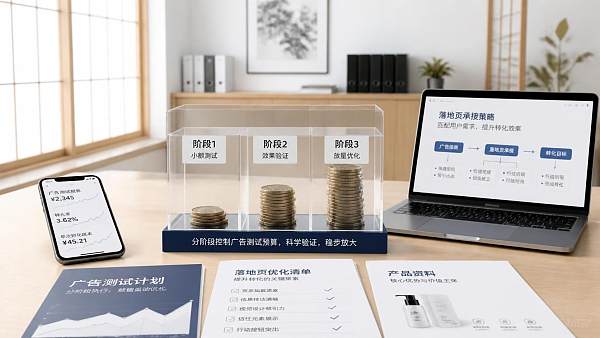
Use a three-stage budget instead of directly setting an overall monthly budget
The test budget can be divided into “validation—screening—scaling.” The key is not to set a uniform amount in advance, but to establish a cap, observation period, and stopping criteria for each stage. The budget must align with average order value, the expected conversion path, and the sales team's follow-up capacity; B2B businesses with long decision cycles in particular should not judge advertising value solely by immediate transactions.
The validation stage does not aim to “fully spend the budget.” Some ad groups show obvious deviations before sufficient signals are obtained for evaluation—for example, high volumes of clicks with no time spent on the page, visits concentrated in irrelevant regions, or distorted form submissions. Such groups should first be checked for targeting and page issues, rather than continuing to spend in order to obtain more samples.
Place budget control points outside the ad account
The spending cap in the advertising dashboard is only the first layer of control. Factors that truly affect the cost of advertising in Japan also include landing page loading, whether Japanese-language information is clear, whether form fields are excessive, and whether conversion events are properly sent back. If these elements are unstable, the dashboard may show normal click activity, while the business cannot determine which visits genuinely have commercial value.
Before advertising goes live, check at least the following:
- Whether conversion definitions are tiered. Do not treat page views, button clicks, and qualified inquiries as the same type of conversion. They can be distinguished as initial engagement, form submission, valid contact, and subsequent sales leads.
- Whether the landing page supports only one advertising theme. When an ad highlights a particular model, solution, or promotional condition, users should be able to quickly see the relevant information after entering the page, rather than being directed to a broadly themed homepage.
- Whether the Japanese page reduces the effort required for understanding. Information such as specifications, delivery scope, contact details, and privacy notices should be clearly visible. Machine translation, inconsistent terminology, or unclear form prompts can all turn click costs into ineffective visits.
- Whether the sales follow-up process can label lead quality. The advertising side can only see submission actions and cannot automatically assess purchasing intent. Feedback such as invalid inquiries, incorrect regions, and duplicate inquiries should be provided to the advertising team to adjust audiences and exclusion criteria.
Which data can be paused, and which should not be judged too early
A common mistake during the testing period is to immediately stop creative when the click-through rate appears low, or to quickly increase the budget after one ad group generates a single inquiry. The former may overlook high-intent audiences with lower click volumes, while the latter may mistake an incidental lead for a stable pattern.
A more practical approach is to assess whether the data chain is continuous. If impressions are very low, first check targeting scope, bids, and review status; if impressions are normal but clicks are weak, prioritize adjusting the headline, above-the-fold information, and creative relevance; if there are clicks but poor on-page behavior, check page speed, language expression, and whether the advertising promise is consistent; if there are many submissions but the sales team identifies them as invalid, review regions, audience conditions, and form thresholds.
Pausing does not mean giving up permanently. Some targeting combinations may simply not suit the current creative, while certain keywords or audience groups may need to be validated again with more specific landing pages. Testing records should be retained in the account, including launch period, audience conditions, creative version, page version, spending cap, conversion definition, and reason for pausing. When testing again later, this prevents repeatedly buying traffic that has already been disproven.
Before increasing the budget, check fulfillment capacity
When an ad group performs well, confirm two issues before expanding its budget: first, whether increased exposure will reach broader audiences with lower intent; second, whether someone can promptly respond to additional inquiries in Japanese or through the agreed method. Especially in B2B business, if advertising-generated leads cannot be promptly classified, replied to, and entered into the system, it will be difficult to assess the true customer acquisition cost later.
A more prudent approach is to increase the budget in batches and observe a complete cycle of visit and lead feedback after each adjustment. If costs rise but the proportion of qualified inquiries remains stable, validation can continue; if clicks increase along with low-quality inquiries, return to the screening stage and narrow the region, audience, or search intent. By linking budget growth to lead quality, testing in the Japanese market can shift from “spending money to see what happens” to a repeatable advertising process.
Related Articles


Related Products
 Yiyingbao SaaS Intelligent Website Building and Marketing SystemYiyingbao SaaS Intelligent Website Building and Marketing System, AI-powered no-code website building, rapid creation of multilingual B2B international websites in 10 minutes, global server acceleration, AI-powered SEO optimization, helping businesses connect efficiently with global markets. The perfect integration of technology and operation makes building an international trade website remarkably simple
 AI+SEM Intelligent Advertising Marketing SystemAI+SEM drives intelligent ad creation, empowering full-funnel precision advertising marketing. The system automatically generates weekly/monthly reports, AI recommends keywords and target countries, monitors core metrics in real-time with intelligent alerts, and enables one-click high-conversion ad solutions to help quickly acquire customers and improve ROI.
 AI+SEO Dual-Engine System Optimization ServicesYiyingbao’s AI+SEO dual-engine optimization system helps foreign trade enterprises acquire high-quality organic traffic through AI-powered keyword research, content generation, and comprehensive technical optimization, significantly improving search rankings and conversion rates.
 AI+SNS Social Media Marketing SystemYingbao AI+SNS Social Media Marketing System - Precision social capture for the social media era. Supports one-click content synchronization across major platforms like Facebook and LinkedIn. AI intelligently rewrites posts for enhanced relevance. 24/7 AI customer service and user profiling analysis empower businesses to efficiently expand into global markets.
 AI+SEO营销解决方案易营宝AI+SEO营销解决方案,通过AI批量写作、智能生成TDK、精准关键词扩词等功能,全面优化网站SEO效果,提升流量与转化率。助力企业构建高效智能网站新生态。
 AI+SEM Advertising Marketing SolutionsAI+SEM Advertising Marketing Solution leverages AI technology to deeply empower SEM ad campaigns. It automatically generates weekly/monthly reports using AI, presenting account data across multiple dimensions for comprehensive insights into campaign performance and trends. The system precisely recommends keywords and target countries, intelligently generates high-conversion ad copy, and enables one-click activation of efficient campaign plans to help businesses rapidly acquire customers. Simultaneously, it monitors core metrics in real time, intelligently identifies abnormal fluctuations, and issues timely alerts to ensure stable, high-return advertising results.
 Domain Name ServicesEasyWin provides professional domain name services, including intelligent queries, one-stop registration, brand protection, and full lifecycle management, helping businesses build a digital brand image.
 EasyOperate B2C Cross-Border E-Commerce Platform & Independent WebsiteEasyStore B2C Cross-border E-commerce Independent Store is an intelligent website building and cross-border e-commerce integrated solution independently developed by EasyStore Information Technology (Beijing) Co., Ltd. The system is specially designed for small and medium-sized as well as large export enterprises, integrating 'website building, operation, marketing, advertising, and conversion' into one, helping enterprises quickly establish cross-border e-commerce independent stores to achieve brand globalization and global sales growth.
The platform supports multiple languages, multiple currencies, and multi-channel marketing, with built-in AI intelligent translation and SEO optimization systems, suitable for mainstream markets such as Southeast Asia, Europe and America, Latin America, and the Middle East, assisting Chinese manufacturing enterprises in efficiently deploying international e-commerce strategies. SSL证书易营宝提供专业SSL安全证书服务,包括单域名和泛域名证书,确保网站数据传输加密、身份验证和完整性保护,助力企业建立安全可信的在线业务环境。









