









- Can the average annual growth rate reflect real opportunities in overseas markets?Oct 07, 2026View details
- Which customer acquisition channels will be affected by cross-border marketing trends in 2026?Sep 06, 2026View details
- Which homogenization risks should be considered in an analysis of the AI-powered website building industry?Aug 30, 2026View details
- How Will AI Marketing Trends 2026 Change Advertising Budget AllocationAug 28, 2026View details
- Is the EV SSL certificate market shrinking or upgrading? How should companies assess certificate procurement?Aug 11, 2026View details
- Why the old AMP SEO 2020 practices no longer work and what has changed in current optimization prioritiesAug 02, 2026View details
Will an AI-powered Google Ads automated bidding tool increase invalid clicks?
Whether it increases invalid clicks depends on whether the signals provided to AI by the account are clean. Features such as automated bidding, smart matching, and automatic expansion do not actively generate low-quality traffic by themselves. However, once conversion goals are too broad, landing-page filtering is weak, or audience boundaries are set too loosely, the system will include large numbers of clicks that appear likely to convert within its media-buying range. On the surface, clicks and impressions may increase, while the backend may show high bounce rates, short visit durations, vague inquiry content, or traffic from irrelevant regions or search terms with no purchasing intent.
Many misjudgments occur during the goal-setting stage. Some advertisers count page views, scrolling, button clicks, and time spent on a page as conversions, then hand these signals over to the system for automatic optimization. The result is straightforward: AI will prioritize users who are most likely to complete these shallow actions, rather than users who are closer to making a real purchase. This is especially common on form pages, WhatsApp redirect pages, and click-to-call pages. If the system does not distinguish between opening a form and submitting a valid form, it can easily mistake curious clicks for high-value signals, causing subsequent bids to continue shifting toward this type of traffic.
First, understand how invalid clicks are amplified
Automated advertising generally relies on three types of input: keyword or topic scope, conversion data, and historical account data. As long as any one of these is misaligned, an amplification effect will occur.
The first issue is excessive search-term expansion. When broad match is combined with smart bidding, the system will actively pursue terms that are semantically similar but have very different commercial intent. For example, people who genuinely want to purchase industrial equipment may use search expressions that differ by only a few words from those used by people looking for repair manuals, images, definitions, or free solutions. If negative keywords are not maintained promptly, the account will absorb large amounts of traffic that is related but has no purchasing value. In the short term, the click-through rate may not look poor because the wording is relevant. The real problem is the quality of the inquiries.
The second issue is overly broad geographic and scheduling management. When advertising is served across multiple regions, AI will prioritize areas where clicks are easier to obtain and traffic is cheaper. Without segmentation by country, language, shipping capability, and delivery time, the system may shift the budget toward markets where clicks are inexpensive but the sales process is weak. The average cost per click may appear to decline, while in reality the inquiries cannot be quoted, goods cannot be shipped, or certifications do not match, ultimately turning into invalid costs.
The third issue is insufficient landing-page support. Automated tools continuously direct traffic toward pages where actions are easier to generate. If a page contains only a general introduction and lacks information such as models, specifications, materials, applicable operating conditions, delivery terms, minimum order quantity, shipping methods, and installation restrictions, many unsuitable visitors may also click through. When the system sees people clicking, staying on the page, and submitting simple forms, it may mistakenly assume that the page direction is correct.
This problem is more obvious in an integrated website and marketing scenario. If website development, advertising, and data tracking are handled separately, the advertising system sees only that someone clicked and someone submitted contact information. It does not know whether the information is complete, whether the email address is valid, whether the country is within the service area, or whether the request is relevant. The more breaks there are in the signal chain, the more likely automated advertising is to optimize in the wrong direction.
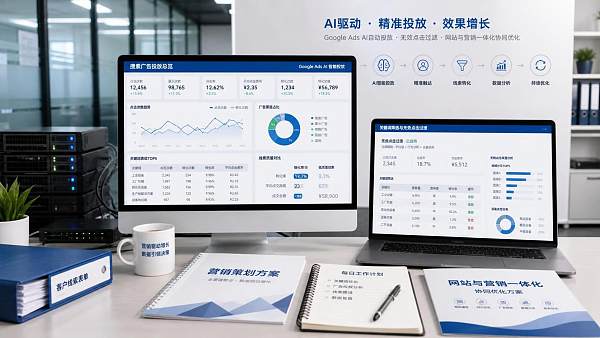
Which signs indicate that AI is not out of control, but that the account is being fed incorrect data
Several signs are particularly typical. One is that after click volume increases, the search-term report contains large numbers of informational, instructional, job-related, download-related, and sample-related terms. Another is that the number of conversions increases, but sales follow-up reveals incomplete contact details, mismatched regions, or request descriptions consisting of only one or two words. A further sign is that some ad groups appear to have an attractive cost per conversion, but after breaking the data down by equipment model, application, language version, or landing page, it becomes clear that the high conversion volume is concentrated in extremely low-quality page events.
If automated bidding is already enabled, do not focus only on cost per conversion. You should also monitor three aspects at the same time: whether search terms continue to drift off target, whether invalid leads are concentrated on specific pages or in specific regions, and whether conversion actions contain too many lightweight events. Looking only at the numbers in the advertising interface can easily lead you to mistake normal algorithmic scaling for uncontrolled spending. Looking only at complaints from the business side may likewise cause you to incorrectly blame the advertising tool for a page-related problem.
The key points for using automated advertising reliably
First, tighten the definition of a conversion. The optimization goal should be as close as possible to a genuine business opportunity, such as a valid form submission, a phone click that passes verification, a complete inquiry submission, or a quotation request containing core fields. If conditions permit, filter out invalid email addresses, blank messages, duplicate submissions, and test leads, then send the processed results back to the system. Even if the volume of returned data is lower, this is more reliable than handing a large amount of noise to the system.
At the keyword level, do not make the matching method too broad from the outset. For new accounts, redesigned accounts, and accounts with complex product lines, it is more suitable to first use phrase match or exact match to build a basic sample, then gradually introduce broad match while observing the quality of expansion. Negative keywords should not only block obviously irrelevant terms, but also cover common interference terms such as recruitment, tutorials, definitions, second-hand products, free offers, repairs, after-sales service, manuals, and drawing downloads. In industrial products and cross-border business, different countries may use very different expressions for the same product, so negative keywords should ideally be maintained separately for each language version.
Geographic segmentation is also critical. Do not place high-order-value markets, exploratory markets, and markets with limited after-sales support into one campaign and allow the system to allocate the budget freely. A more reliable approach is to segment by country group, language group, shipping accessibility, and certification requirements, allowing the budget and bidding logic to operate independently. This prevents a region that obtains cheap clicks more easily from absorbing the entire budget.
The landing page must perform a filtering function rather than merely receive clicks. The page should clearly state the information that matters, including applicable industries, specification ranges, material options, power or size ranges, customization availability, delivery methods, supported languages, service regions, sample conditions, and after-sales boundaries. Many people worry that providing detailed information will reduce the conversion rate, but the opposite is often true. After the page filters out unsuitable visitors, the number of forms may decrease, but lead quality is generally more stable, and AI can more easily learn who is worth pursuing further.
The next step concerns the handling of tracking and page events. Phone buttons, chat buttons, download buttons, and form buttons should not automatically be given equal weight. For businesses with a relatively long decision-making process, downloading a catalog, viewing a specification sheet, or visiting a case-study page can be retained as observation events, but should not be directly set as core optimization goals. Otherwise, the system will pursue people who are most likely to click, rather than people who are most likely to convert.
Which stages are automated tools suitable or unsuitable for
If an account already has clear product categorization, stable landing pages, and basically reliable conversion data, Google Ads AI automated advertising tools can generally improve bidding efficiency. This is especially true when advertising across time zones, managing a large volume of keywords, or dealing with frequent fluctuations in competition, situations in which it is difficult for people to fine-tune bids manually every hour. These tools are good at adjusting bids in real time according to the auction environment and can also identify long-tail traffic that is difficult for people to cover manually.
However, directly implementing full automation carries greater risk in the following situations: a newly launched website, landing pages with very little information, multiple business lines being advertised together, disorganized conversion actions, missing CRM data feedback, or accounts covering significantly different international trade regions without proper segmentation. In these circumstances, the system does not receive sufficiently clear feedback, and automation will only amplify existing problems more quickly.
A more practical approach is to incorporate automated advertising into a closed loop: the website side handles filtering and tracking, the advertising side handles media buying and negative keywords, the sales side determines lead validity, and the data side sends the results back to the system. If any link is broken, the world seen by AI is distorted. In many cases, so-called invalid clicks caused by automated tools are ultimately found not to result from an error in the bidding model itself, but from a failure to connect upstream signals with downstream feedback.
Do not rush to stop campaigns when invalid clicks begin to increase
The more effective order of operations is usually to review search terms and regions first, then check the definition of conversion events, review the landing-page content, and only then consider whether to reduce the level of automation. Once the system has entered a learning period, frequent major changes to the budget, goals, or advertising structure often make the situation more difficult to assess. First tighten obviously off-target traffic by keyword, region, time period, and device, then observe whether lead quality improves. This usually provides more useful information than immediately switching back to purely manual bidding.
If adjustments are necessary, it is also advisable to make them in layers. Retain existing stable campaigns while creating a separate, stricter test campaign for comparison. This avoids changing the entire account strategy at the same time and then being unable to determine whether the change was caused by the page, market fluctuations, or the bidding method itself.
Therefore, automated advertising does not inherently increase invalid clicks. It is more like an amplifier. The goals, pages, and data provided to it determine the direction in which it continues to accelerate. By making conversion definitions more precise, providing more complete page information, and blocking irrelevant traffic at the beginning, automation can genuinely reduce manual work instead of amplifying mistakes more quickly.
Related Articles


Related Products
 Yiyingbao SaaS Intelligent Website Building and Marketing SystemYiyingbao SaaS Intelligent Website Building and Marketing System, AI-powered no-code website building, rapid creation of multilingual B2B international websites in 10 minutes, global server acceleration, AI-powered SEO optimization, helping businesses connect efficiently with global markets. The perfect integration of technology and operation makes building an international trade website remarkably simple
 AI+SEM Intelligent Advertising Marketing SystemAI+SEM drives intelligent ad creation, empowering full-funnel precision advertising marketing. The system automatically generates weekly/monthly reports, AI recommends keywords and target countries, monitors core metrics in real-time with intelligent alerts, and enables one-click high-conversion ad solutions to help quickly acquire customers and improve ROI.
 AI+SEO Dual-Engine System Optimization ServicesYiyingbao’s AI+SEO dual-engine optimization system helps foreign trade enterprises acquire high-quality organic traffic through AI-powered keyword research, content generation, and comprehensive technical optimization, significantly improving search rankings and conversion rates.
 AI+SNS Social Media Marketing SystemYingbao AI+SNS Social Media Marketing System - Precision social capture for the social media era. Supports one-click content synchronization across major platforms like Facebook and LinkedIn. AI intelligently rewrites posts for enhanced relevance. 24/7 AI customer service and user profiling analysis empower businesses to efficiently expand into global markets.
 AI+SEO营销解决方案易营宝AI+SEO营销解决方案,通过AI批量写作、智能生成TDK、精准关键词扩词等功能,全面优化网站SEO效果,提升流量与转化率。助力企业构建高效智能网站新生态。
 AI+SEM Advertising Marketing SolutionsAI+SEM Advertising Marketing Solution leverages AI technology to deeply empower SEM ad campaigns. It automatically generates weekly/monthly reports using AI, presenting account data across multiple dimensions for comprehensive insights into campaign performance and trends. The system precisely recommends keywords and target countries, intelligently generates high-conversion ad copy, and enables one-click activation of efficient campaign plans to help businesses rapidly acquire customers. Simultaneously, it monitors core metrics in real time, intelligently identifies abnormal fluctuations, and issues timely alerts to ensure stable, high-return advertising results.
 Domain Name ServicesEasyWin provides professional domain name services, including intelligent queries, one-stop registration, brand protection, and full lifecycle management, helping businesses build a digital brand image.
 EasyOperate B2C Cross-Border E-Commerce Platform & Independent WebsiteEasyStore B2C Cross-border E-commerce Independent Store is an intelligent website building and cross-border e-commerce integrated solution independently developed by EasyStore Information Technology (Beijing) Co., Ltd. The system is specially designed for small and medium-sized as well as large export enterprises, integrating 'website building, operation, marketing, advertising, and conversion' into one, helping enterprises quickly establish cross-border e-commerce independent stores to achieve brand globalization and global sales growth.
The platform supports multiple languages, multiple currencies, and multi-channel marketing, with built-in AI intelligent translation and SEO optimization systems, suitable for mainstream markets such as Southeast Asia, Europe and America, Latin America, and the Middle East, assisting Chinese manufacturing enterprises in efficiently deploying international e-commerce strategies. SSL证书易营宝提供专业SSL安全证书服务,包括单域名和泛域名证书,确保网站数据传输加密、身份验证和完整性保护,助力企业建立安全可信的在线业务环境。









