









- Amazon Reportedly Sends Exclusivity Warning Letters to Multiplatform SellersNov 03, 2026View details
- New TikTok Shop Cross-Border Returns Rules for Southeast Asia Take Effect on November 5Nov 03, 2026View details
- U.S. Tightens De Minimis Exemption Channel and Revises Section 321 Data PilotNov 03, 2026View details
- Amazon FBA Fuel and Logistics Surcharge in 10 European Countries to Increase to 2% on November 2Nov 02, 2026View details
- EU Customs Code reform to take effect on November 1, with new handling fees for direct-mail small parcelsNov 01, 2026View details
- EU Plans to Raise Tax on Incoming Small Parcels to €5Oct 31, 2026View details
How to Assess ROAS for Facebook Advertising Management Services in France
How should you evaluate the return on investment of outsourced Facebook advertising operations in France? On the surface, this appears to be an assessment of advertising performance, but in essence, it is a comprehensive review of the entire customer acquisition process. For companies targeting the French market, impressions, clicks, and engagement are only front-end signals. What truly determines whether the budget is worth continuing to invest is lead quality, conversion efficiency, contribution to orders, and potential for subsequent repurchases.
Especially in an overseas expansion environment integrating websites and marketing services, advertising is not an isolated activity. The return on investment of outsourced Facebook advertising operations in France is often jointly affected by landing page structure, website loading speed, form design, multilingual communication, and remarketing mechanisms. Focusing only on the advertising backend can easily lead to one-sided conclusions.
First, understand what return on investment actually measures
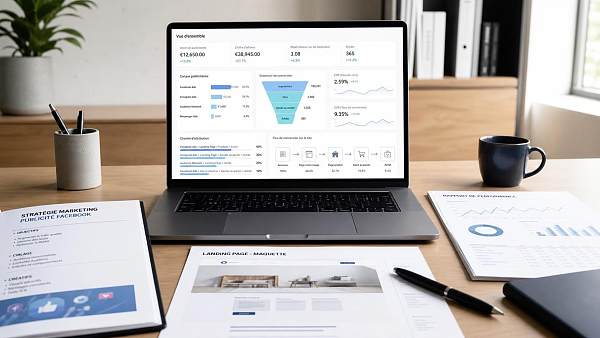
When discussing outsourced Facebook advertising operations in France, many teams simply understand “return on investment” as the ratio between advertising expenditure and transaction value. This understanding is not wrong, but it is insufficient for practical evaluation.
If the business is a B2C independent website, return on investment can be assessed relatively directly by looking at advertising expenditure, order value, refund rate, and repurchase rate. However, once B2B inquiries, long sales cycles, or multi-channel touchpoints are involved, the evaluation logic must extend further along the customer journey.
In other words, when evaluating the return on investment of outsourced Facebook advertising operations in France, you should not only ask, “How much did we spend and how much sales revenue did it generate?” You should also ask, “Are these leads genuine?”, “Do they match our target customers?”, and “Can the subsequent conversion cost be controlled?”
Why the French market requires more precise evaluation
The French market is not a region where simply running advertisements can consistently deliver results. Users are more sensitive to content expression, brand trust, privacy compliance, and page experience. It is not uncommon for front-end advertising data to look positive while backend transactions remain weak.
From the advertising perspective, common issues in outsourced Facebook advertising operations in France fall into three categories: overly broad audience targeting, insufficient creative localization, and weak landing page conversion capability. The first two can drive up invalid clicks, while the last can cause potentially convertible traffic to be lost at the page stage.
This is why an increasing number of companies no longer view outsourced advertising operations as the service of a single media buyer. Instead, they evaluate it in coordination with website development, content optimization, data tracking, and remarketing strategies. Without a complete customer journey, it is difficult to accurately assess return on investment.
When evaluating outsourced Facebook advertising operations in France, examine at least these four layers of data
The most common error in business evaluation is focusing on only one layer of metrics. A more reliable approach is to break down outsourced Facebook advertising operations in France into four layers for assessment.
Layer 1: Is the traffic effective?
Click-through rate, cost per thousand impressions, bounce rate, and time spent on the page should all be examined. However, the focus should not be on whether one individual metric is high or low, but on whether the metrics are mutually consistent. A high click-through rate combined with a short dwell time usually indicates that the promise made by the creative does not match the page content.
Layer 2: Are the conversion actions genuine?
Form submissions, add-to-cart actions, direct messages, and appointments can all be counted as conversions, but whether these actions come from genuine demand requires further verification. If outsourced Facebook advertising operations in France focus only on low-cost conversions, they may bring in a large number of low-intent leads.
Layer 3: Does the lead quality meet requirements?
This step is closer to the actual return on investment. Lead source, country or region, industry fit, purchasing stage, response rate, and the proportion of effective communications after sales follow-up should all be verified. Low-cost leads do not necessarily equal high-value leads.
Layer 4: Are the final returns sustainable?
If the profit from orders generated by advertising is thin or customer lifetime value is low, even apparently strong short-term cash recovery may not constitute high-quality advertising. Evaluating outsourced Facebook advertising operations in France requires long-term returns to be taken into account.
Website conversion capability often determines the upper limit of return on investment
The performance of outsourced Facebook advertising operations in France often does not fail at the advertising stage, but at the website conversion stage. Advertising brings visitors to the page, but if the page fails to persuade, qualify, and convert them, the budget will be consumed during the final mile.
This is also why the integrated “website + marketing services” approach is receiving increasing attention. A system that can genuinely evaluate return on investment should include a clear landing page structure, multilingual communication, mobile optimization, tracking implementation, form optimization, and remarketing interfaces.
The integrated service approach represented by EasyYingbao places greater emphasis on the connection efficiency between website development and promotion. Its self-developed cloud intelligent website-building system, AI advertising marketing system, and AI+SEO/GEO optimization system are not primarily valuable because of the accumulation of features, but because they help companies manage traffic, pages, and conversions under the same data logic.
This coordination is particularly important for outsourced Facebook advertising operations in France. Even if the advertising account is well optimized, return on investment will still be difficult to stabilize if pixel data transmission is incomplete, the landing page lacks French trust-building elements, or the website loads slowly.
Evaluation criteria cannot be mixed across different business scenarios
How to evaluate the return on investment of outsourced Facebook advertising operations in France also depends on the business model. Different scenarios have different cycles and objectives, and using the same evaluation criteria can easily distort the results.
B2B inquiry generation
This type of business is better evaluated through cost per qualified inquiry, lead follow-up rate, opportunity conversion rate, and sales cycle. A small number of short-term orders does not necessarily indicate advertising failure; the key is whether inquiry quality continues to improve.
B2C independent website
This type of business should focus on return on ad spend, average order value, add-to-cart rate, payment conversion rate, and repurchase rate. Even if recovering the cost through the first order is difficult, strong repeat purchases may still indicate advertising value.
Brand market-entry phase
When the objective is to establish a presence in the French market rather than generate immediate transactions, evaluating outsourced Facebook advertising operations in France should include medium-term metrics such as growth in branded searches, accumulation of remarketing audiences, and the quality of social media engagement.
During actual evaluation, it is recommended to verify these questions
If you need to quickly determine whether an outsourced Facebook advertising operation in France is worth continuing to invest in, you can establish an evaluation framework around the following questions.
- Are the advertising objectives consistent with the actual business objectives, avoiding the use of exposure goals to evaluate transaction results?
- Are the French-language creatives, copy, and pages genuinely localized rather than simply translated?
- Does the website have a clear conversion path, and are the forms, buttons, and inquiry entry points easy to use?
- Is data tracking complete, and can data from the advertising platform, website, and sales team be cross-checked?
- Does the outsourced operations report only display front-end metrics, or can it explain changes in backend opportunity quality?
- Is the budget optimization logic clear, and which audiences, placements, and creatives genuinely generate effective results?
These questions may seem basic, but they are the most effective way to distinguish “having data” from “having results.” The former only indicates that the advertising is running; the latter indicates that return on investment has the potential to improve continuously.
Extending the evaluation period brings conclusions closer to actual business performance
Many companies are eager to draw conclusions after only one or two weeks of launching outsourced Facebook advertising operations in France. This is often too early. Conversion feedback in the French market may be slower than expected, especially for high-value products or businesses requiring repeated communication.
A more reasonable approach is to observe performance in stages: the testing period, optimization period, and stabilization period. During the testing period, examine audience and creative directions; during the optimization period, examine improvements in lead quality; and during the stabilization period, determine whether the actual return on investment has been established.
If website development, SEO, social media, and remarketing data are also incorporated at this stage, it becomes possible to more accurately determine the role of outsourced Facebook advertising operations in France within the overall overseas expansion strategy. Whether it is the primary customer acquisition channel, an auxiliary scaling channel, or a brand awareness channel will directly affect budget allocation.
The next step is to establish unified evaluation standards first
Returning to the original question, the key to evaluating the return on investment of outsourced Facebook advertising operations in France does not lie in one attractive metric, but in whether unified criteria covering advertising, websites, leads, and transactions have been established. Only when the criteria are consistent can the data provide meaningful guidance.
If the current evaluation remains limited to impressions, clicks, and the number of form submissions, you can first review the conversion path, then improve website conversion support and data transmission, and only afterward compare the actual performance of different outsourced advertising operation solutions. The conclusions obtained this way are generally closer to business reality than those based solely on backend reports.
When outsourced Facebook advertising operations in France are examined within an integrated growth framework, return on investment is no longer merely a figure belonging to the advertising department. It becomes an important basis for companies to evaluate the efficiency of their market investment.
Related Articles
 Why shouldn’t you measure Facebook ad performance by clicks alone?
 How Can Manufacturers Reduce Unqualified Inquiries from Overseas Advertising?
 How to troubleshoot inaccurate conversion tracking for social media advertising?

Related Products
 Yiyingbao SaaS Intelligent Website Building and Marketing SystemYiyingbao SaaS Intelligent Website Building and Marketing System, AI-powered no-code website building, rapid creation of multilingual B2B international websites in 10 minutes, global server acceleration, AI-powered SEO optimization, helping businesses connect efficiently with global markets. The perfect integration of technology and operation makes building an international trade website remarkably simple
 AI+SEM Intelligent Advertising Marketing SystemAI+SEM drives intelligent ad creation, empowering full-funnel precision advertising marketing. The system automatically generates weekly/monthly reports, AI recommends keywords and target countries, monitors core metrics in real-time with intelligent alerts, and enables one-click high-conversion ad solutions to help quickly acquire customers and improve ROI.
 AI+SEO Dual-Engine System Optimization ServicesYiyingbao’s AI+SEO dual-engine optimization system helps foreign trade enterprises acquire high-quality organic traffic through AI-powered keyword research, content generation, and comprehensive technical optimization, significantly improving search rankings and conversion rates.
 AI+SNS Social Media Marketing SystemYingbao AI+SNS Social Media Marketing System - Precision social capture for the social media era. Supports one-click content synchronization across major platforms like Facebook and LinkedIn. AI intelligently rewrites posts for enhanced relevance. 24/7 AI customer service and user profiling analysis empower businesses to efficiently expand into global markets.
 AI+SEO营销解决方案易营宝AI+SEO营销解决方案,通过AI批量写作、智能生成TDK、精准关键词扩词等功能,全面优化网站SEO效果,提升流量与转化率。助力企业构建高效智能网站新生态。
 AI+SEM Advertising Marketing SolutionsAI+SEM Advertising Marketing Solution leverages AI technology to deeply empower SEM ad campaigns. It automatically generates weekly/monthly reports using AI, presenting account data across multiple dimensions for comprehensive insights into campaign performance and trends. The system precisely recommends keywords and target countries, intelligently generates high-conversion ad copy, and enables one-click activation of efficient campaign plans to help businesses rapidly acquire customers. Simultaneously, it monitors core metrics in real time, intelligently identifies abnormal fluctuations, and issues timely alerts to ensure stable, high-return advertising results.
 Domain Name ServicesEasyWin provides professional domain name services, including intelligent queries, one-stop registration, brand protection, and full lifecycle management, helping businesses build a digital brand image.
 EasyOperate B2C Cross-Border E-Commerce Platform & Independent WebsiteEasyStore B2C Cross-border E-commerce Independent Store is an intelligent website building and cross-border e-commerce integrated solution independently developed by EasyStore Information Technology (Beijing) Co., Ltd. The system is specially designed for small and medium-sized as well as large export enterprises, integrating 'website building, operation, marketing, advertising, and conversion' into one, helping enterprises quickly establish cross-border e-commerce independent stores to achieve brand globalization and global sales growth.
The platform supports multiple languages, multiple currencies, and multi-channel marketing, with built-in AI intelligent translation and SEO optimization systems, suitable for mainstream markets such as Southeast Asia, Europe and America, Latin America, and the Middle East, assisting Chinese manufacturing enterprises in efficiently deploying international e-commerce strategies. SSL证书易营宝提供专业SSL安全证书服务,包括单域名和泛域名证书,确保网站数据传输加密、身份验证和完整性保护,助力企业建立安全可信的在线业务环境。









