









- Which customer acquisition channels will be affected by cross-border marketing trends in 2026?Sep 06, 2026View details
- Which homogenization risks should be considered in an analysis of the AI-powered website building industry?Aug 30, 2026View details
- How Will AI Marketing Trends 2026 Change Advertising Budget AllocationAug 28, 2026View details
- Is the EV SSL certificate market shrinking or upgrading? How should companies assess certificate procurement?Aug 11, 2026View details
- Why the old AMP SEO 2020 practices no longer work and what has changed in current optimization prioritiesAug 02, 2026View details
- How to Choose Topics for an Industry News Section to Attract More Organic Search TrafficJul 29, 2026View details
Poor Ad Performance on Your Independent Website? Check the Landing Page First
The click data in the ad platform does not look bad: there are impressions, CTR is acceptable, yet the budget seems to be quietly “swallowed up”—inquiries do not increase, carts remain inactive, and orders are even further out of reach. In this situation, many operators immediately change creatives, adjust audiences, or increase budgets, but this often fails to address the core issue.
Poor performance in independent website advertising may not necessarily be caused by the ads themselves. Ads are responsible for bringing the right people to the door; the landing page determines whether visitors are willing to come in, keep reading, leave their contact details, or complete a purchase. When clicks are high but conversions are low, do not rush to dismiss the advertising strategy. It is advisable to conduct a systematic review starting with the landing page.
First determine: is it “no one is clicking,” or “people click but do not convert”?
Different data patterns require completely different investigation directions. If impressions and click-through rates are low, the targeting, bidding, ad creative, or product value proposition may not be reaching the target audience. However, if the ad click-through rate is normal, users spend only a short time on the website after entering, and the conversion rate remains low, the issue is most likely occurring after the ad click.
Do not look only at the “number of conversions” in platform reports. It is recommended to combine advertising data with website analytics tools and at least monitor landing page load time, bounce or engagement behavior, page scroll depth, core button click-through rate, form start rate, and submission rate. For example, if most visitors leave on the first screen, it usually indicates weak first-screen messaging or slow page loading. If they browse product content but do not submit a form, the quotation details, trust information, and inquiry threshold should be checked.
Conversion tracking should also be verified for accuracy. Actions such as thank-you page triggers, form events, WhatsApp clicks, phone calls, add-to-cart actions, and payments should be recorded separately according to business objectives. Otherwise, actual inquiries may show as zero, or test conversions may be counted repeatedly, causing subsequent optimization to be based on incorrect judgments.
A slow landing page makes even highly targeted traffic lose patience
Overseas users accessing domestic servers, pages filled with uncompressed large images and autoplay videos, and excessive third-party script loading are all common hidden causes of poor independent website advertising performance. This is especially true for mobile social media traffic, where users browse in fragmented situations. If they do not see useful content after waiting a few seconds, they may return directly to the feed.
During troubleshooting, test the desktop and mobile access experience separately in the target market, rather than opening the page just once on the company network. Focus on whether above-the-fold content is prioritized, whether product images use appropriate formats and dimensions, whether pop-ups, live chat, and tracking codes slow down the page, and whether multilingual versions call unstable resources.
Speed optimization is not only the responsibility of technical personnel. Marketers should also participate in making trade-offs: Does the first screen really need a carousel? Is it necessary to stack more than ten videos on one page? Every additional visual element should be evaluated to determine whether it is more worthwhile than its loading cost. For advertising landing pages, communicating one core action clearly is usually more important than “showing a lot of content.”
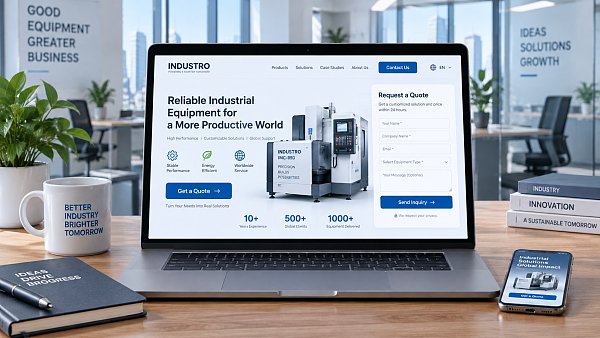
The ad says one thing, while the page says another
An ad creative promises “Get a Custom Quote in 24 Hours,” but after clicking through, users first see company news and broad brand slogans, with no corresponding product or quotation request entry. This disconnect quickly erodes trust. Users are not there to study the full picture of the company; they want to confirm whether you offer the solution they were just interested in.
Therefore, ad groups, keywords, or social media content should correspond to dedicated landing pages whenever possible. When promoting customized equipment to B2B buyers, the first screen should directly explain the product type, customization options, applicable industries, and next step. When advertising a specific product to B2C consumers, the price, specifications, delivery coverage, reviews, and purchase entry should be quickly visible.
When assessing content relevance, you can use a simple question for self-evaluation: Without looking at the navigation bar, can users understand within ten seconds from the first two screens “what this is, whether it suits them, and why it is worth contacting you or purchasing”? If the answer is no, the page needs to reorganize its information priorities.
The first screen is not a brand showcase wall, but a clear response
Many corporate websites are suitable for brand introductions, but may not be suitable for directly receiving advertising traffic. A common issue with general homepages is overly scattered information: company introductions, multiple product lines, news, and partners all compete for placement, ultimately leaving no clear focus. An advertising landing page needs to be more like a salesperson who understands customer needs and responds to visitors in the shortest possible time.
The first screen can retain brand recognition, but it should more importantly include four types of key information: a core headline consistent with the ad; a brief explanation of value or differentiation; authentic and clear product or application visuals; and a prominent primary call-to-action button. For foreign trade B2B websites, buttons do not have to be limited to “Contact Us.” Depending on the business process, expressions closer to the procurement stage, such as “Get Specification,” “Request a Quote,” and “Talk to an Engineer,” can be used.
It should be noted that there should not be only one call-to-action entry hidden at the bottom of the page. When page content is long, CTAs can reappear at key points, but the copy should relate to the context: after reviewing specifications, guide users to obtain technical materials; after reviewing case studies, guide them to inquire about similar solutions. This is more natural than repeatedly displaying the same phrase, “Submit Now.”
The more complicated the conversion path, the easier it is for drop-off to occur
Users may already be willing to make an inquiry, but then have to fill in more than ten fields, select from complex drop-down menus, complete multiple CAPTCHA verifications, or receive no feedback after clicking a button. Any of these can interrupt a valuable visit. In particular, many overseas buyers use their phones for initial screening. If the form experience is poor, they usually will not return to a desktop computer to complete it again.
It is recommended to limit form fields to what is necessary for initial follow-up, such as name, email or phone number, company name, and requirements description. For businesses that need detailed information such as drawings, purchase quantity, or target market, this can be collected later during the sales follow-up stage. After submission, provide a clear confirmation stating that the request has been received and explaining the expected response method, while offering email, phone, or instant messaging tools as alternative contact channels.
In addition, check whether forms can be delivered properly to the sales email inbox and whether external links such as WhatsApp, Messenger, and live chat are available in the target region. A form may technically display “success,” while the business team receives no lead—an easily overlooked loss in advertising campaigns.
Insufficient trust information can cause users to stop at the final step
When unfamiliar users first enter an independent website through channels such as Google and Facebook, they are essentially assessing risk. This is particularly true for industrial products, customized products, and cross-border transactions, where customers care whether the company genuinely exists, has delivery capabilities, offers products that meet standards, and can provide seamless after-sales support.
A landing page does not need to be filled with awards and slogans, but it should place decision-relevant evidence in appropriate locations: real photos of the factory or team, key certifications and testing information, clear product specifications, countries or regions served, verifiable customer reviews, delivery processes, FAQs, and more. B2B pages can also state the minimum order quantity, sampling, production lead time, and scope of trade support. Genuine, specific information reduces concerns more effectively than “a global leading supplier.”
Do not change everything at once; establish an optimization rhythm that can be reviewed
When investigating the reasons for poor independent website advertising performance, the biggest mistake is changing creatives, audiences, pages, and prices at the same time. Even if results improve, it will be difficult to determine which action made the difference. A more reliable approach is to first fix obvious technical issues, then test around one hypothesis—for example, “Will changing the first-screen headline to the same value proposition used in the ad improve the form click-through rate?”—and then compare data over a sufficient period.
For companies operating multilingual websites and advertising campaigns across multiple markets, landing page management requires consistency without sacrificing localization. The AI-powered website building, multilingual website, and advertising marketing coordination capabilities provided by Yiyingbao can help teams more conveniently build pages for different campaign scenarios and continuously adjust them around indexing, traffic, and conversion. However, regardless of which tools are used, the core judgment remains unchanged: every click generated by an ad should receive an accurate, prompt, and trustworthy response on the page.
When advertising performance is unsatisfactory, first examine the landing page as a silent salesperson. Is it fast enough? Does it understand the question brought by the ad? Does it make it easy for customers to take the next step? By resolving these details one by one, advertising budgets will have a better chance of truly turning into actionable business opportunities and orders.
Related Articles


Related Products
 Yiyingbao SaaS Intelligent Website Building and Marketing SystemYiyingbao SaaS Intelligent Website Building and Marketing System, AI-powered no-code website building, rapid creation of multilingual B2B international websites in 10 minutes, global server acceleration, AI-powered SEO optimization, helping businesses connect efficiently with global markets. The perfect integration of technology and operation makes building an international trade website remarkably simple
 AI+SEM Intelligent Advertising Marketing SystemAI+SEM drives intelligent ad creation, empowering full-funnel precision advertising marketing. The system automatically generates weekly/monthly reports, AI recommends keywords and target countries, monitors core metrics in real-time with intelligent alerts, and enables one-click high-conversion ad solutions to help quickly acquire customers and improve ROI.
 AI+SEO Dual-Engine System Optimization ServicesYiyingbao’s AI+SEO dual-engine optimization system helps foreign trade enterprises acquire high-quality organic traffic through AI-powered keyword research, content generation, and comprehensive technical optimization, significantly improving search rankings and conversion rates.
 AI+SNS Social Media Marketing SystemYingbao AI+SNS Social Media Marketing System - Precision social capture for the social media era. Supports one-click content synchronization across major platforms like Facebook and LinkedIn. AI intelligently rewrites posts for enhanced relevance. 24/7 AI customer service and user profiling analysis empower businesses to efficiently expand into global markets.
 AI+SEO营销解决方案易营宝AI+SEO营销解决方案,通过AI批量写作、智能生成TDK、精准关键词扩词等功能,全面优化网站SEO效果,提升流量与转化率。助力企业构建高效智能网站新生态。
 AI+SEM Advertising Marketing SolutionsAI+SEM Advertising Marketing Solution leverages AI technology to deeply empower SEM ad campaigns. It automatically generates weekly/monthly reports using AI, presenting account data across multiple dimensions for comprehensive insights into campaign performance and trends. The system precisely recommends keywords and target countries, intelligently generates high-conversion ad copy, and enables one-click activation of efficient campaign plans to help businesses rapidly acquire customers. Simultaneously, it monitors core metrics in real time, intelligently identifies abnormal fluctuations, and issues timely alerts to ensure stable, high-return advertising results.
 Domain Name ServicesEasyWin provides professional domain name services, including intelligent queries, one-stop registration, brand protection, and full lifecycle management, helping businesses build a digital brand image.
 EasyOperate B2C Cross-Border E-Commerce Platform & Independent WebsiteEasyStore B2C Cross-border E-commerce Independent Store is an intelligent website building and cross-border e-commerce integrated solution independently developed by EasyStore Information Technology (Beijing) Co., Ltd. The system is specially designed for small and medium-sized as well as large export enterprises, integrating 'website building, operation, marketing, advertising, and conversion' into one, helping enterprises quickly establish cross-border e-commerce independent stores to achieve brand globalization and global sales growth.
The platform supports multiple languages, multiple currencies, and multi-channel marketing, with built-in AI intelligent translation and SEO optimization systems, suitable for mainstream markets such as Southeast Asia, Europe and America, Latin America, and the Middle East, assisting Chinese manufacturing enterprises in efficiently deploying international e-commerce strategies. SSL证书易营宝提供专业SSL安全证书服务,包括单域名和泛域名证书,确保网站数据传输加密、身份验证和完整性保护,助力企业建立安全可信的在线业务环境。









