









- Which customer acquisition channels will be affected by cross-border marketing trends in 2026?Sep 06, 2026View details
- Which homogenization risks should be considered in an analysis of the AI-powered website building industry?Aug 30, 2026View details
- How Will AI Marketing Trends 2026 Change Advertising Budget AllocationAug 28, 2026View details
- Is the EV SSL certificate market shrinking or upgrading? How should companies assess certificate procurement?Aug 11, 2026View details
- Why the old AMP SEO 2020 practices no longer work and what has changed in current optimization prioritiesAug 02, 2026View details
- How to Choose Topics for an Industry News Section to Attract More Organic Search TrafficJul 29, 2026View details
For Google Ads in the German market, which metrics should you check first if you want CTR to reach 3%
If you want to bring Google Ads CTR in the German market to 3%, do not rush to change headlines or increase the budget first. For most foreign trade companies, when CTR cannot improve, the problem is usually not that the “copy is not attractive enough”, but that there are issues in the chain of keyword matching, search term quality, ad relevance, landing page alignment, and conversion assessment.
If the preceding metrics have not been clarified, even if the click-through rate is pushed up in the short term, it may bring invalid traffic and ultimately increase the cost per inquiry instead. Truly valuable optimization means first identifying which data points are dragging down ad performance, and then deciding whether to adjust the account structure, creative assets, or website pages.
Why CTR for Google Ads in the German Market Should Not Focus Only on “Copy and Bidding”
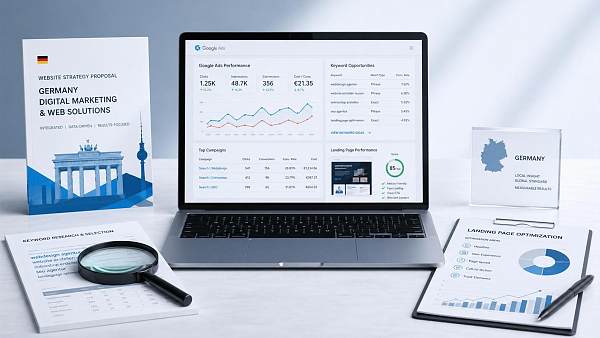
When many companies consider how to achieve a 3% CTR for Google Ads in the German market, their first reaction is to rewrite headlines, add promotional wording, or directly raise bids to compete for rankings. These actions are not useless, but if the basic diagnosis is wrong, the optimization direction will often become increasingly off track.
Search behavior in the German market has several typical characteristics: users search more specifically, have a stronger sense of comparison, make decisions more cautiously, and have higher requirements for consistency between ads and pages. In other words, whether users click first depends on whether you have “exactly answered their search intent”.
If the keywords are too broad, search terms deviate from the core business, ad groups are mixed, or the landing page does not have corresponding German content, it is very difficult for CTR to stabilize at 3%. Even if it is achieved occasionally, it is usually not sustainable, let alone able to support subsequent inquiry growth and ROI.
Start with the Search Terms Report: When CTR Is Low, It Is Often Not Because the Ad Is Poor, but Because the Traffic Is Wrong
To determine how to achieve a 3% CTR for Google Ads in the German market, the first step should be to review the search terms report instead of looking at the ad copy first. This is because what determines the upper limit of the click-through rate is often the actual search terms entering the ad auction, not the keywords you have set on the surface.
For example, you may be bidding on broad industry terms, but the actual matched search terms include job searches, tutorials, definitions and explanations, low-price comparisons, or even demand from non-target regions. This type of traffic naturally has low click intent. At this point, optimizing the copy is merely repeated polishing on low-quality traffic, with limited effect.
The German market is especially suitable for more granular intent segmentation. Brand terms, category terms, specification terms, application scenario terms, and procurement terms often have completely different CTR levels. Mixing terms with different intents in one ad group usually prevents the ad content from accurately matching the user’s question.
Therefore, do three things first: identify search terms with high impressions and low clicks; identify which terms bring clicks but no conversions; and identify which irrelevant terms should be added as negatives as soon as possible. For many accounts, the essential reason CTR cannot improve is that search term cleanup is too slow, causing the traffic to become increasingly mixed.
Quality Score Should Be Broken Down: The Focus Is Not the Score Itself, but Which Item Is Holding You Back
Many advertisers see a low Quality Score and simply interpret it as “insufficient account authority”, but this is not accurate. The more valuable role of Quality Score is that it helps you determine whether the root cause of low CTR comes from expected click-through rate, ad relevance, or landing page experience.
If the expected click-through rate is low, it indicates that under a similar competitive environment, your ad is not attractive enough, or that the keyword selection itself is not suitable for the current bid range. In this case, you can prioritize adjusting the focus of the ad theme instead of blindly expanding keywords.
If ad relevance is low, it usually means the keywords, ad copy, and ad group structure are not aligned. For example, if one ad group contains terms such as “industrial parts processing”, “custom manufacturing”, and “wholesale quotation” at the same time, it is difficult for the system to determine which type of demand you want to match, and CTR will naturally be more likely to decline.
If the landing page experience is low, the problem is often not on the ad side, but on the website side. Especially for multilingual websites, insufficient German page content, stiff headline translation, slow loading, and complex forms can all affect ad competitiveness in impressions. This is also why many companies eventually find that the advertising problem has actually extended into website development.
If Landing Page Relevance Is Insufficient, Even a Strong Ad CTR Is Hard to Stabilize
Before German users click an ad, they first scan the headline, description, and link information; after clicking, they quickly judge whether the page is “exactly what I am looking for”. If the page fails to receive and support the traffic well, Google will also gradually lower its evaluation of ad relevance, thereby affecting CTR.
This is especially critical for companies that integrate website and marketing services. Ad performance does not exist in isolation. Website structure, page copy, server access speed, and multilingual deployment methods can all have a reverse impact on advertising results.
For example, common questions for companies include: how to reduce the hreflang error rate on multilingual websites, how to control global node access latency within 100ms, and whether European inquiry volume can recover and grow after a website redesign. These issues may seem technical or website-related, but in reality, they may all affect the efficiency of receiving advertising traffic.
If the German landing page is not built around a single product or a single scenario, the first screen does not present a clear value proposition, the CTA is unclear, the form has too many fields, or the mobile loading speed is slow, both CTR and conversion rate will be affected. Attracting clicks with ads is only the first step. The page must be able to hold users’ interest before the data can move upward.
Do Not Look Only at CTR; Evaluate It Together with Conversion Rate and Inquiry Quality
Reaching a 3% CTR is a common goal, but it should not be pursued in isolation. For foreign trade and global expansion companies, the more important question is: does this 3% bring valid clicks, or cheap but useless traffic? If you focus only on CTR, it is easy to lead optimization in the wrong direction.
For example, some keywords can indeed improve click-through rate through more stimulating copy, but after users enter the site, the bounce rate is high, form submissions are few, and the visitors may not even be procurement decision-makers. In this case, the account may look “better”, but the actual customer acquisition efficiency declines instead.
Therefore, it is recommended to review at least four groups of data together: CTR, conversion rate, cost per conversion, and lead quality. If CTR rises but conversion rate drops, you need to go back and check whether the ad promise is consistent with the page content; if CTR is not high but conversion quality is good, there may not be a need to force it to reach 3%.
When business managers judge whether Google Ads agency operation or in-house operation is more cost-effective, they should also use this logic. It is not that whoever raises the click-through rate higher is more professional, but that whoever can connect clicks, conversions, and sales results has the truly valuable solution.
To Achieve a 3% CTR in the German Market, the Account Structure Usually Needs to Become More Granular First
Many accounts fail to achieve the desired CTR not because the budget is insufficient, but because the structure is too broad. Placing too many countries, languages, product lines, or procurement scenarios in one campaign will make the ad message vague. The German market is especially unsuitable for a “one-size-fits-all” campaign structure.
A more stable approach is to segment by language, product category, procurement intent, and page type. This allows ad copy to be closer to search terms, and landing pages can receive demand more accurately. The clearer the account structure, the easier it is for the system to identify relevance, and the higher the probability of improving CTR.
This is also why more and more companies are starting to focus on how to make multilingual assets for overseas advertising work together, and whether AI advertising systems can automatically optimize multilingual ads. Because when campaigns enter multiple European markets, manually maintaining a large number of ad groups and multilingual assets can easily become an efficiency bottleneck.
If an AI advertising system works together with multilingual content production, there is an opportunity to accelerate creative iteration, reduce the manpower required for multilingual advertising, and shorten the content production cycle from 7 days to around 2 days. But the prerequisite remains that the account structure and page logic must be built correctly first; otherwise, automation will only amplify existing problems.
What Companies Really Need to Build Is an Integrated “Ad-Page-Content” Optimization Mindset
For the question of how to achieve a 3% CTR for Google Ads in the German market, the final answer is usually not single-point optimization, but systematic optimization. Ads are only the traffic entry point, the website is the receiving carrier, and content is the persuasion tool. The three must work together for the data to improve steadily.
For foreign trade factories, cross-border brands, and multilingual official website operation teams, advertising and independent website development are best not viewed separately. A website that can be promoted, indexed, and converted is itself part of Google Ads performance, rather than an independent project outside of advertising.
If a company is already doing SEO, there is no need to treat whether SEO or Google Ads is better for foreign trade customer acquisition as an either-or question. A more practical approach is to use Google Ads to validate keywords and conversion pages, and use SEO to accumulate long-term organic traffic. The two complement each other, making the customer acquisition structure more stable.
Especially in a mature market like Germany, the user decision-making path is longer. Ads are responsible for quickly acquiring high-intent traffic, SEO and multilingual content are responsible for building sustained visibility, and the website and form mechanism are responsible for receiving leads. Only in this way can CTR, inquiry volume, and customer acquisition cost be optimized together.
Conclusion: A 3% CTR Is Not the Starting Point, but the Result
If you are examining how to achieve a 3% CTR for Google Ads in the German market, the first thing most worth checking is not a single line of ad copy, but four core links: whether the search terms are accurate, which item of Quality Score is low, whether the landing page is strongly relevant, and whether the conversion data supports the current optimization direction.
Achieving a 3% CTR certainly has reference value, but it is more like a result indicator rather than the first action. A truly mature judgment method is to first sort out traffic quality, page reception, and the conversion chain, and then pursue a higher click-through rate. Only data improved in this way is valuable for inquiry growth.
For companies doing overseas marketing, advertising, intelligent website development, multilingual content, and data optimization should never be separated in the first place. Only by viewing these links within the same growth logic can CTR improvement in the German market truly be converted into a more stable overseas customer acquisition capability.
Related Articles



Related Products
 Yiyingbao SaaS Intelligent Website Building and Marketing SystemYiyingbao SaaS Intelligent Website Building and Marketing System, AI-powered no-code website building, rapid creation of multilingual B2B international websites in 10 minutes, global server acceleration, AI-powered SEO optimization, helping businesses connect efficiently with global markets. The perfect integration of technology and operation makes building an international trade website remarkably simple
 AI+SEM Intelligent Advertising Marketing SystemAI+SEM drives intelligent ad creation, empowering full-funnel precision advertising marketing. The system automatically generates weekly/monthly reports, AI recommends keywords and target countries, monitors core metrics in real-time with intelligent alerts, and enables one-click high-conversion ad solutions to help quickly acquire customers and improve ROI.
 AI+SEO Dual-Engine System Optimization ServicesYiyingbao’s AI+SEO dual-engine optimization system helps foreign trade enterprises acquire high-quality organic traffic through AI-powered keyword research, content generation, and comprehensive technical optimization, significantly improving search rankings and conversion rates.
 AI+SNS Social Media Marketing SystemYingbao AI+SNS Social Media Marketing System - Precision social capture for the social media era. Supports one-click content synchronization across major platforms like Facebook and LinkedIn. AI intelligently rewrites posts for enhanced relevance. 24/7 AI customer service and user profiling analysis empower businesses to efficiently expand into global markets.
 AI+SEO营销解决方案易营宝AI+SEO营销解决方案,通过AI批量写作、智能生成TDK、精准关键词扩词等功能,全面优化网站SEO效果,提升流量与转化率。助力企业构建高效智能网站新生态。
 AI+SEM Advertising Marketing SolutionsAI+SEM Advertising Marketing Solution leverages AI technology to deeply empower SEM ad campaigns. It automatically generates weekly/monthly reports using AI, presenting account data across multiple dimensions for comprehensive insights into campaign performance and trends. The system precisely recommends keywords and target countries, intelligently generates high-conversion ad copy, and enables one-click activation of efficient campaign plans to help businesses rapidly acquire customers. Simultaneously, it monitors core metrics in real time, intelligently identifies abnormal fluctuations, and issues timely alerts to ensure stable, high-return advertising results.
 Domain Name ServicesEasyWin provides professional domain name services, including intelligent queries, one-stop registration, brand protection, and full lifecycle management, helping businesses build a digital brand image.
 EasyOperate B2C Cross-Border E-Commerce Platform & Independent WebsiteEasyStore B2C Cross-border E-commerce Independent Store is an intelligent website building and cross-border e-commerce integrated solution independently developed by EasyStore Information Technology (Beijing) Co., Ltd. The system is specially designed for small and medium-sized as well as large export enterprises, integrating 'website building, operation, marketing, advertising, and conversion' into one, helping enterprises quickly establish cross-border e-commerce independent stores to achieve brand globalization and global sales growth.
The platform supports multiple languages, multiple currencies, and multi-channel marketing, with built-in AI intelligent translation and SEO optimization systems, suitable for mainstream markets such as Southeast Asia, Europe and America, Latin America, and the Middle East, assisting Chinese manufacturing enterprises in efficiently deploying international e-commerce strategies. SSL证书易营宝提供专业SSL安全证书服务,包括单域名和泛域名证书,确保网站数据传输加密、身份验证和完整性保护,助力企业建立安全可信的在线业务环境。









