









- Which customer acquisition channels will be affected by cross-border marketing trends in 2026?Sep 06, 2026View details
- Which homogenization risks should be considered in an analysis of the AI-powered website building industry?Aug 30, 2026View details
- How Will AI Marketing Trends 2026 Change Advertising Budget AllocationAug 28, 2026View details
- Is the EV SSL certificate market shrinking or upgrading? How should companies assess certificate procurement?Aug 11, 2026View details
- Why the old AMP SEO 2020 practices no longer work and what has changed in current optimization prioritiesAug 02, 2026View details
- How to Choose Topics for an Industry News Section to Attract More Organic Search TrafficJul 29, 2026View details
Which Industries Are Suitable for Overseas Advertising in the UAE? Analysis of Budget, Channels, and Conversion Paths
The entry threshold for advertising in the UAE market is shifting from “high budget” to “high relevance”
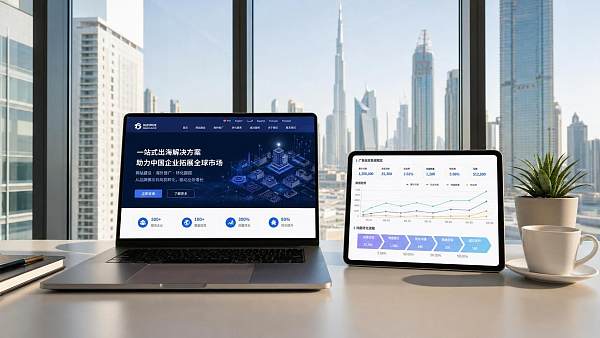
Overseas advertising in the UAE has heated up noticeably over the past two years, but what has truly changed is not just traffic pricing.
More importantly, the market is raising its expectations for ad content, landing page quality, and the entire conversion journey at the same time.
In the past, many companies regarded the UAE as a high-spending market where simply placing ads could create opportunities.
Today, overseas advertising in the UAE is better suited to businesses that can connect their website, traffic, and inquiry handling into one complete flow.
This is why, with the same budget, some projects can generate leads, while others merely end up paying more for clicks.
Judging from recent demand, the UAE is not only suitable for large brands.
Foreign trade businesses, cross-border retail, manufacturers expanding overseas, and localized services all have room to enter, as long as their channels and conversion paths are properly designed.
Why this shift is becoming more apparent
The growing popularity of overseas advertising in the UAE first comes from the stability of the regional business environment.
Dubai and Abu Dhabi continue to attract international procurement, cross-border consumption, and service-based demand, further amplifying the value of online customer acquisition.
Another signal is that user search behavior and social media-driven decision-making are increasingly overlapping.
Many users first watch short videos and social content, then move on to search, and finally visit an independent website to submit their information or place an order.
This means that overseas advertising in the UAE is no longer a single-channel game, but a matter of multi-touchpoint coordination.
In real business scenarios, differences in advertising performance increasingly resemble differences in system capability, rather than merely differences in media buying capability.
Which industries are more suitable for overseas advertising in the UAE
Not every industry should use the same approach, but the following types of businesses are more likely to achieve clear returns from overseas advertising in the UAE.
- Industrial manufacturing and engineering support: procurement demand is clear, search intent is strong, and this category is better suited to search ads combined with inquiry-oriented websites.
- Building materials, home furnishings, and equipment products: project-based transactions are common, early-stage price comparisons are frequent, and landing pages need to highlight certifications, delivery timelines, and case studies.
- Cross-border e-commerce and brand retail: suitable for the integration of social media ads, remarketing, and independent websites, with the focus not only on transactions but also on brand recall.
- Education, tourism, real estate services, and local lifestyle services: suitable for regional targeting, with conversion goals usually being forms, phone calls, or instant communication.
- Companies expanding overseas with strong demand for multilingual official websites: the user structure in the UAE is complex, and page language and content expression directly affect trust.
What deserves more attention is that overseas advertising in the UAE is becoming less tolerant of “direct ad traffic without an official website”.
Without a clear independent website to receive traffic, even strong creatives will struggle to accumulate stable conversion data.
The budget does not need to be large at the start, but the structure must be clear
For many projects, the problem is not that the budget is too small, but that the budget allocation lacks a phased structure.
Overseas advertising in the UAE is usually better divided into a testing stage, a scaling stage, and an optimization stage.
Validate first in the early stage, instead of rushing to scale across the board
The focus of the testing stage is not to pursue massive exposure, but to verify whether keywords, audience segments, creative angles, and landing page forms are aligned.
At this stage, it is more suitable to spend the budget on high-intent keywords, small geographic areas, and a limited number of high-quality creatives.
Scale in the mid-stage, based on whether conversion costs remain stable
After valid inquiries, add-to-cart actions, or consultation data begin to emerge, expanding audiences and placements usually becomes more efficient.
If the early foundation is not solid, increasing the budget often only increases waste.
Optimize for the long term, without focusing only on click prices
What truly matters in overseas advertising in the UAE is the full cost from click to form submission and then to qualified business opportunity.
Some channels offer cheap clicks but weak deal conversion; others have expensive clicks yet bring more stable downstream conversions.
Channel selection is shifting from “platform preference” to “path fit”
If the goal is inquiries, search advertising remains an efficient entry point for overseas advertising in the UAE.
It is suitable for capturing traffic that already has demand and is comparing suppliers or solutions.
If the goal is brand awareness and conversion nurturing, social media advertising is more likely to play a role.
This is especially true in cross-border retail, lifestyle consumption, and service experience businesses, where visual persuasiveness matters a great deal.
The value of remarketing channels is often underestimated.
Users may not convert on their first visit, but after a second touchpoint, the lead submission rate is usually more stable.
- Search ads: suitable for clear demand, B2B inquiries, engineering equipment, building materials, and professional services.
- Social media ads: suitable for brand exposure, consumer product promotion, and visually driven businesses.
- Remarketing ads: suitable for extending the decision-making journey and improving return visits and transactions from users who have already visited.
Truly mature overseas advertising in the UAE is usually not a single-point bet, but a coordinated division of roles across a combination of channels.
The impact is not limited to the advertising side; website traffic reception has become a decisive factor
Many projects appear to have an ad placement problem on the surface, but in reality, the website has failed to communicate business signals clearly.
Once the click cost of overseas advertising in the UAE rises, every bounce on the landing page becomes more expensive.
At this point, the website is no longer just a display page, but part of the conversion system.
Page loading speed, mobile experience, form length, case study credibility, and the payment or inquiry process all influence the final outcome.
This is also why more and more companies expanding overseas are beginning to value the integration of website building, SEO, advertising, and social media.
For platforms such as 易营宝, which have long served overseas markets, their value lies not only in ad execution.
More importantly, through intelligent website building, advertising systems, and optimization tools, they connect traffic acquisition with back-end conversion into one continuous flow.
For future assessment, start by watching these key areas
To determine whether it is worth increasing investment in overseas advertising in the UAE, it is useful to first look at several key indicators.
- Whether search terms have shifted from broad demand to clear product, scenario, and price comparisons.
- Whether the independent website supports multiple languages, localized expression, and fast mobile loading.
- Whether ad data can be tracked to qualified leads, rather than stopping at clicks and impressions.
- Whether creatives, pages, and sales follow-up use a unified message to reduce conversion gaps.
If these fundamentals remain weak, continuing to add budget will not mean much.
Instead, improving website capability, data feedback, and channel coordination first will usually do more to increase the real return from overseas advertising in the UAE.
In the longer term, the UAE market is still worth developing, but the approach will increasingly move toward refined operations.
First clarifying business fit, then testing channels on a small scale, and subsequently optimizing in phases around website traffic reception and conversion data is often more stable than pursuing large-scale ad spending from the very beginning.
Related Articles
Related Products
 Yiyingbao SaaS Intelligent Website Building and Marketing SystemYiyingbao SaaS Intelligent Website Building and Marketing System, AI-powered no-code website building, rapid creation of multilingual B2B international websites in 10 minutes, global server acceleration, AI-powered SEO optimization, helping businesses connect efficiently with global markets. The perfect integration of technology and operation makes building an international trade website remarkably simple
 AI+SEM Intelligent Advertising Marketing SystemAI+SEM drives intelligent ad creation, empowering full-funnel precision advertising marketing. The system automatically generates weekly/monthly reports, AI recommends keywords and target countries, monitors core metrics in real-time with intelligent alerts, and enables one-click high-conversion ad solutions to help quickly acquire customers and improve ROI.
 AI+SEO Dual-Engine System Optimization ServicesYiyingbao’s AI+SEO dual-engine optimization system helps foreign trade enterprises acquire high-quality organic traffic through AI-powered keyword research, content generation, and comprehensive technical optimization, significantly improving search rankings and conversion rates.
 AI+SNS Social Media Marketing SystemYingbao AI+SNS Social Media Marketing System - Precision social capture for the social media era. Supports one-click content synchronization across major platforms like Facebook and LinkedIn. AI intelligently rewrites posts for enhanced relevance. 24/7 AI customer service and user profiling analysis empower businesses to efficiently expand into global markets.
 AI+SEO营销解决方案易营宝AI+SEO营销解决方案,通过AI批量写作、智能生成TDK、精准关键词扩词等功能,全面优化网站SEO效果,提升流量与转化率。助力企业构建高效智能网站新生态。
 AI+SEM Advertising Marketing SolutionsAI+SEM Advertising Marketing Solution leverages AI technology to deeply empower SEM ad campaigns. It automatically generates weekly/monthly reports using AI, presenting account data across multiple dimensions for comprehensive insights into campaign performance and trends. The system precisely recommends keywords and target countries, intelligently generates high-conversion ad copy, and enables one-click activation of efficient campaign plans to help businesses rapidly acquire customers. Simultaneously, it monitors core metrics in real time, intelligently identifies abnormal fluctuations, and issues timely alerts to ensure stable, high-return advertising results.
 Domain Name ServicesEasyWin provides professional domain name services, including intelligent queries, one-stop registration, brand protection, and full lifecycle management, helping businesses build a digital brand image.
 EasyOperate B2C Cross-Border E-Commerce Platform & Independent WebsiteEasyStore B2C Cross-border E-commerce Independent Store is an intelligent website building and cross-border e-commerce integrated solution independently developed by EasyStore Information Technology (Beijing) Co., Ltd. The system is specially designed for small and medium-sized as well as large export enterprises, integrating 'website building, operation, marketing, advertising, and conversion' into one, helping enterprises quickly establish cross-border e-commerce independent stores to achieve brand globalization and global sales growth.
The platform supports multiple languages, multiple currencies, and multi-channel marketing, with built-in AI intelligent translation and SEO optimization systems, suitable for mainstream markets such as Southeast Asia, Europe and America, Latin America, and the Middle East, assisting Chinese manufacturing enterprises in efficiently deploying international e-commerce strategies. SSL证书易营宝提供专业SSL安全证书服务,包括单域名和泛域名证书,确保网站数据传输加密、身份验证和完整性保护,助力企业建立安全可信的在线业务环境。









