









- How Will AI Marketing Trends 2026 Change Advertising Budget AllocationAug 28, 2026View details
- Is the EV SSL certificate market shrinking or upgrading? How should companies assess certificate procurement?Aug 11, 2026View details
- Why the old AMP SEO 2020 practices no longer work and what has changed in current optimization prioritiesAug 02, 2026View details
- How to Choose Topics for an Industry News Section to Attract More Organic Search TrafficJul 29, 2026View details
- Digital Marketing Shenzhen Market Insights: Why Are Companies Expanding Overseas Looking for Growth Teams in Shenzhen?Jul 31, 2026View details
- Can Zhejiang foreign trade independent websites still be developed today? Look at changes in traffic and lead generationJul 28, 2026View details
- What New Signals Are Emerging in Enterprise Services SaaS Marketing ReportsJul 27, 2026View details
- What Does a Global Traffic Ecosystem Service Provider Do? What Are the Differences from a Single Advertising AgencyJul 16, 2026View details
Will an automotive parts export website lose SEO authority after a redesign?
After an auto parts export website is revamped, will its SEO authority decline? Whether a construction and decoration company should build a multilingual foreign trade website likewise depends on planning and migration strategy.
The answer is: it may decline, but this is not an inevitable result of a website revamp. What truly causes declines in rankings, indexation, and inquiries is usually not a visual page upgrade, but the incorrect handling of URLs, content, language versions, links, and technical settings during migration.
For auto parts companies that rely on Google to acquire overseas inquiries, a website revamp should be regarded as an SEO asset migration rather than a purely design project. As long as the value of effective pages is retained and the migration is properly completed, a revamp can also become an opportunity to increase organic traffic.
Company managers should first clarify their objectives: are they addressing an outdated website, poor mobile experience, insufficient multilingual support, or seeking to improve product page conversion rates? Different objectives require different revamp scopes, budgets, and risk control methods, so companies should not simply pursue a complete rebuild of the entire website.
Why auto parts website revamps often cause ranking fluctuations
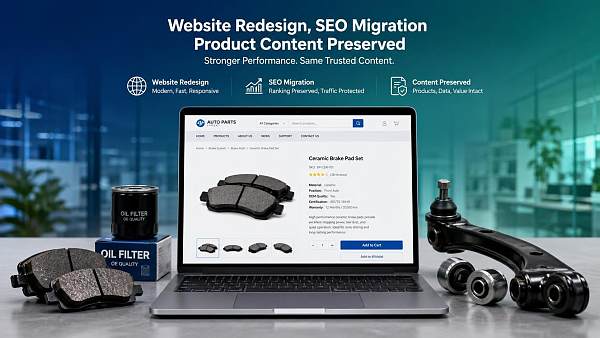
Search engines do not understand that “the new website is more attractive.” They mainly assess page value through page URLs, text topics, link relationships, loading speed, and user behavior. When these signals change simultaneously after a revamp, it may trigger reassessment.
The most common issue is that old product page URLs become invalid directly. For example, pages for brake pads, filters, and suspension components that were previously indexed by Google are replaced with new category URLs without 301 redirects, causing the original authority and backlink value to be wasted.
The second issue is substantial content reduction. Although many old websites have average designs, they have accumulated long-tail content such as model numbers, OEM numbers, compatible vehicle models, material parameters, and application scenarios. If the new website retains only images and brief selling points, it may lose a large amount of highly targeted search traffic.
Auto parts buyers often search for specific terms such as “part number + supplier” and “OEM number + manufacturer.” If product categories are merged or model pages are deleted during a revamp, the website may retain rankings for brand terms while losing the long-tail entry points that actually generate inquiries.
Assess before the revamp: Which SEO assets must be retained
Before starting a revamp, export data from Google Search Console, website analytics tools, and backlink sources to create an asset inventory of old pages. Focus on recording core pages with organic traffic, keyword rankings, inquiries, external links, and indexation.
Auto parts websites should especially retain product model pages, vehicle compatibility pages, technical documentation pages, and high-quality industry articles. Even if a page has low traffic, it should not be taken offline simply because it has “little traffic” if it targets professional search terms commonly used by buyers.
It is also necessary to map old URLs to new URLs on a one-to-one basis. Each old URL should redirect as closely as possible to the new page with the most relevant topic, rather than redirecting all URLs to the homepage. Irrelevant redirect destinations reduce search engines’ trust in the migration relationship.
If the new product architecture changes significantly, companies can retain some high-value old URLs and gradually update page templates and content instead of deleting them all at once. Seasonal products, discontinued models, or products with fewer inquiries should also have clear rules for retention, consolidation, or removal.
Will a multilingual revamp increase SEO risks?
Multilingual content itself does not cause authority to decline. The key is whether genuine and effective independent content is provided for different markets. When auto parts companies target Europe and the United States, Latin America, the Middle East, or Russian-speaking regions, multilingual websites can address different purchasing habits and search expressions.
Many companies also ask whether construction and decoration companies should build multilingual foreign trade websites. The evaluation logic is the same as for the auto parts industry: if target market languages are clear and customers have strong local search needs, multilingual content is worth investing in; if the business serves only English-speaking buyers, priority should be given to improving English content and the conversion path.
Multilingual websites should use clear language directories or independent domain structures and configure hreflang tags to help Google identify the language and region targeted by each page. Do not mechanically translate Chinese pages and publish them directly, and do not allow content across multiple language pages to be completely duplicated.
For auto parts businesses, English is usually the foundational version, while Spanish, Russian, Arabic, and other pages should prioritize core categories, key models, certification capabilities, and inquiry pages. Verify market demand first, then gradually expand the number of languages for more controllable return on investment.
The five most critical SEO checks at launch
First, confirm that all important old URLs have 301 permanent redirects in place, and use crawling tools to check for redirect chains, redirect loops, or 404 pages. During the first two weeks after a website revamp, 404 errors are usually the issue that requires the fastest response.
Second, check the new website’s robots.txt, meta robots, and sitemap settings. Development environments are often configured to block crawling. If the restriction is not removed after launch, search engines cannot index the site properly, and even the best pages will not gain organic traffic.
Third, retain the title, description, H tags, and main content topic of every core page. The wording can be optimized, but a page originally focused on “auto brake parts manufacturer” must not lose core information about products, applications, and supply capabilities after the revamp.
Fourth, check the mobile experience, image file size, page loading speed, and form functionality. Overseas buyers often initially screen suppliers on mobile devices. If product images load slowly, PDFs cannot be opened, or inquiry forms fail to submit, traffic will be difficult to convert into business opportunities even if it recovers.
Fifth, submit the new XML Sitemap after launch and continuously monitor indexation volume, core keywords, organic visits, inquiry volume, and server logs. SEO migration should not focus only on homepage rankings, but should also assess whether key product pages are recrawled and replaced properly.
How to evaluate whether a revamp is worth the investment
Companies should not only ask, “Will authority decline?” They should also assess whether the old website is already restricting growth. For example, if product categories are disorganized, pages cannot be expanded, multilingual capabilities are lacking, inquiry sources cannot be tracked, or Google Ads landing pages cannot be supported, the commercial value of a revamp is usually greater than the risk of short-term fluctuations.
A reasonable expectation is that some keywords may fluctuate for two to eight weeks after launch, while mature websites and complex multilingual projects may take longer. However, through a complete migration checklist, content retention, and ongoing monitoring, core traffic can usually recover gradually and grow through subsequent optimization.
When choosing a service provider, focus on whether it understands website development, technical SEO, content strategy, and overseas customer acquisition at the same time, rather than merely displaying design cases. An auto parts export website needs to plan product data, purchasing decision information, search entry points, and inquiry conversion within the same growth framework.
Conclusion
SEO authority does not necessarily decline after an auto parts export website is revamped. The real risk comes from a lack of migration planning and launch validation. Retaining high-value URLs and content, implementing 301 redirects properly, handling multilingual pages in a standardized manner, and continuously monitoring data are essential to turning a revamp into an upgrade in long-term customer acquisition capability.
For companies planning to expand into overseas markets, a website revamp should not focus solely on a visual refresh. Only by first identifying existing SEO assets and target market needs, then deciding whether to add multilingual support, restructure product categories, or build marketing landing pages, can every revamp investment more closely contribute to actual growth.
Related Articles


Related Products
 Yiyingbao SaaS Intelligent Website Building and Marketing SystemYiyingbao SaaS Intelligent Website Building and Marketing System, AI-powered no-code website building, rapid creation of multilingual B2B international websites in 10 minutes, global server acceleration, AI-powered SEO optimization, helping businesses connect efficiently with global markets. The perfect integration of technology and operation makes building an international trade website remarkably simple
 AI+SEM Intelligent Advertising Marketing SystemAI+SEM drives intelligent ad creation, empowering full-funnel precision advertising marketing. The system automatically generates weekly/monthly reports, AI recommends keywords and target countries, monitors core metrics in real-time with intelligent alerts, and enables one-click high-conversion ad solutions to help quickly acquire customers and improve ROI.
 AI+SEO Dual-Engine System Optimization ServicesYiyingbao’s AI+SEO dual-engine optimization system helps foreign trade enterprises acquire high-quality organic traffic through AI-powered keyword research, content generation, and comprehensive technical optimization, significantly improving search rankings and conversion rates.
 AI+SNS Social Media Marketing SystemYingbao AI+SNS Social Media Marketing System - Precision social capture for the social media era. Supports one-click content synchronization across major platforms like Facebook and LinkedIn. AI intelligently rewrites posts for enhanced relevance. 24/7 AI customer service and user profiling analysis empower businesses to efficiently expand into global markets.
 AI+SEO营销解决方案易营宝AI+SEO营销解决方案,通过AI批量写作、智能生成TDK、精准关键词扩词等功能,全面优化网站SEO效果,提升流量与转化率。助力企业构建高效智能网站新生态。
 AI+SEM Advertising Marketing SolutionsAI+SEM Advertising Marketing Solution leverages AI technology to deeply empower SEM ad campaigns. It automatically generates weekly/monthly reports using AI, presenting account data across multiple dimensions for comprehensive insights into campaign performance and trends. The system precisely recommends keywords and target countries, intelligently generates high-conversion ad copy, and enables one-click activation of efficient campaign plans to help businesses rapidly acquire customers. Simultaneously, it monitors core metrics in real time, intelligently identifies abnormal fluctuations, and issues timely alerts to ensure stable, high-return advertising results.
 Domain Name ServicesEasyWin provides professional domain name services, including intelligent queries, one-stop registration, brand protection, and full lifecycle management, helping businesses build a digital brand image.
 EasyOperate B2C Cross-Border E-Commerce Platform & Independent WebsiteEasyStore B2C Cross-border E-commerce Independent Store is an intelligent website building and cross-border e-commerce integrated solution independently developed by EasyStore Information Technology (Beijing) Co., Ltd. The system is specially designed for small and medium-sized as well as large export enterprises, integrating 'website building, operation, marketing, advertising, and conversion' into one, helping enterprises quickly establish cross-border e-commerce independent stores to achieve brand globalization and global sales growth.
The platform supports multiple languages, multiple currencies, and multi-channel marketing, with built-in AI intelligent translation and SEO optimization systems, suitable for mainstream markets such as Southeast Asia, Europe and America, Latin America, and the Middle East, assisting Chinese manufacturing enterprises in efficiently deploying international e-commerce strategies. SSL证书易营宝提供专业SSL安全证书服务,包括单域名和泛域名证书,确保网站数据传输加密、身份验证和完整性保护,助力企业建立安全可信的在线业务环境。









