









- Which customer acquisition channels will be affected by cross-border marketing trends in 2026?Sep 06, 2026View details
- Which homogenization risks should be considered in an analysis of the AI-powered website building industry?Aug 30, 2026View details
- How Will AI Marketing Trends 2026 Change Advertising Budget AllocationAug 28, 2026View details
- Is the EV SSL certificate market shrinking or upgrading? How should companies assess certificate procurement?Aug 11, 2026View details
- Why the old AMP SEO 2020 practices no longer work and what has changed in current optimization prioritiesAug 02, 2026View details
- How to Choose Topics for an Industry News Section to Attract More Organic Search TrafficJul 29, 2026View details
- Digital Marketing Shenzhen Market Insights: Why Are Companies Expanding Overseas Looking for Growth Teams in Shenzhen?Jul 31, 2026View details
- Can Zhejiang foreign trade independent websites still be developed today? Look at changes in traffic and lead generationJul 28, 2026View details
What are the differences between overseas social media and domestic social media?
What are the differences between overseas social media and domestic social media? The core differences lie not only in the platform names, but also in user habits, content ecosystems, algorithmic logic, and marketing approaches. Only by understanding these differences can companies determine which platforms to use, what content to create, and how to truly convert traffic into inquiries and orders.
For foreign trade companies, cross-border brands, and manufacturing factories, the key to this question is not simply “which platforms are used abroad and which are used domestically.” The communication mechanisms behind the two types of platforms are fundamentally different. If companies continue to use domestic approaches when operating overseas social media, they may easily encounter problems such as content not being recommended, low engagement, and poor conversion.
Why Companies Must Understand the Differences Between the Two Types of Social Media Before Going Global
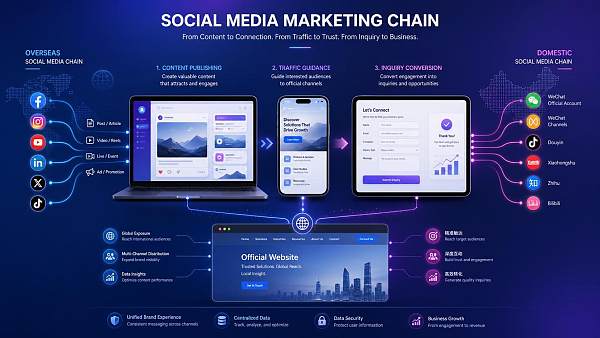
When many companies expand their brands overseas, their first reaction is to open accounts on Facebook, Instagram, LinkedIn, or TikTok. However, opening an account does not mean that operations will be effective. What truly affects results is whether platform rules, user expectations, and conversion paths align with your business objectives.
Domestic social media places greater emphasis on closed-loop transactions within the platform. Users can often complete the entire process, from content discovery and interest generation to purchase, within the same ecosystem. Overseas social media, on the other hand, places greater emphasis on “content reach plus off-platform conversion,” and is particularly dependent on independent websites, brand websites, inquiry pages, and advertising landing pages.
This is why companies going global cannot treat social media merely as a channel for posting updates. Instead, they need to consider it as part of a complete digital marketing funnel. Social media content, advertising, website experience, SEO planning, and lead conversion mechanisms often need to be designed collaboratively in order to build a stable customer acquisition capability.
What Exactly Is the Biggest Difference Between Overseas and Domestic Social Media?
The first difference lies in the platform ecosystems. Domestic platforms generally have a strong integrated nature, with content, private messaging, payments, stores, livestreaming, and e-commerce tools all concentrated within the platform. Overseas platforms are more fragmented, with clearer functional boundaries between different platforms.
For example, LinkedIn is more suitable for B2B companies to build professional trust and develop business opportunities; Instagram emphasizes visual expression and brand perception; YouTube is suitable for accumulating in-depth content; and TikTok focuses on short-video distribution and interest-based recommendations. Companies need to develop platform combinations according to their business models rather than simply expanding across every platform.
The second difference is that users have different usage habits. Domestic users are generally more accustomed to browsing content frequently, interacting immediately, and responding to strong promotional incentives. They tend to be more receptive to livestreaming, influencer-driven sales, and limited-time campaigns. Overseas users pay greater attention to information transparency, brand credibility, content value, and the establishment of long-term awareness.
Especially in B2B scenarios, overseas customers rarely place an order immediately because of a single piece of social media content. They are more likely to first review the company website, case studies, qualifications, product details, and company background before deciding whether to submit an inquiry. In other words, overseas social media often serves the preliminary role of “building trust” and “guiding visits.”
The third difference lies in algorithmic recommendation logic. On many domestic platforms, content distribution is closely tied to trending topics, strong engagement signals, livestreaming conversion capabilities, and the platform’s commercial objectives. Overseas platforms also value engagement, but place greater emphasis on content relevance, user-interest matching, and the account’s long-term consistency in publishing content.
This means that common domestic practices such as intensive promotional content, an overly sales-oriented tone, or strongly transaction-focused messaging may not be effective on overseas platforms and may even reduce user trust. By contrast, professional knowledge, authentic case studies, scenario-based demonstrations, brand stories, and practical value are more likely to build lasting influence.
What Companies Care About Most Is Not the Differences Themselves, but How They Affect Marketing Results
From a customer acquisition perspective, domestic social media is more suitable for quickly creating momentum, driving campaign spikes, and completing transactions within the platform. Overseas social media is more suitable for accumulating brand equity over the long term, increasing international exposure, and guiding traffic to independent websites, form pages, or sales communication channels for conversion.
If a company is engaged in B2B foreign trade, domestic operating experience can easily mislead the team. Overseas customers have longer decision-making cycles and more participants involved in the decision. Content must be able to answer several core questions: “Who are you?”, “What problems can you solve?”, “Are you trustworthy?”, and “What is your delivery capability?”
If a company operates a DTC or cross-border e-commerce business, the differences between overseas and domestic social media are reflected in brand expression and user engagement methods. Domestic practices more commonly focus on frequent product launches, intensive discounts, and immediate purchase conversion, while overseas markets place greater emphasis on brand personality, usage scenarios, UGC content, and word-of-mouth distribution.
In terms of return on investment, overseas social media usually does not deliver results as quickly as expected. Organic operations, in particular, are unlikely to generate large-scale conversions in the short term. Without website support, advertising assistance, and a data analytics system, companies often find it difficult to achieve replicable growth simply by publishing content.
Which Common Domestic Methods Should Not Be Directly Copied When Operating Overseas Social Media?
First, do not directly copy “hard-sell copywriting.” Many domestic social media posts pursue immediate purchases, emphasize price advantages, and promote limited-time offers. On overseas platforms, however, users are more sensitive to excessive selling. Communication is better centered on value, experience, solutions, and real-world application scenarios.
Second, do not overlook the development of websites and landing pages. Domestic platform ecosystems are comprehensive, allowing many actions to be completed within the platform. Overseas social media, however, often serves only as an entry point. If the website loads slowly after users click through, the language is unclear, the mobile experience is poor, or the form is complicated, the value of the traffic investment will be substantially reduced.
Third, do not treat all platforms as if they use the same operating approach. For example, using TikTok methods on LinkedIn for a B2B company, or treating Instagram as a product catalog, usually produces limited results. User expectations vary significantly between platforms, so content formats, publishing frequency, and engagement methods all need to be redesigned.
Fourth, do not focus only on the number of followers. Overseas social media operations should pay greater attention to effective reach, engagement quality, website clicks, inquiry costs, and conversion paths. For companies going global, reaching several hundred targeted customers is often more valuable than attracting tens of thousands of general-traffic users with no purchase intent.
How Should Different Types of Companies Determine Which Social Media Strategy Suits Them Best?
If you are a manufacturing factory or a traditional foreign trade company, the focus is usually not on creating “viral content,” but on establishing a professional and credible image. A combination of LinkedIn, YouTube, Facebook, the company website, and Google SEO is often more practical than simply pursuing short-video traffic.
If you are a cross-border e-commerce brand or DTC seller, platforms such as Instagram, TikTok, and YouTube Shorts are more suitable for visual content distribution. Combined with advertising and an independent website, they can create a complete path from exposure and interest to conversion.
If your company is targeting multiple language markets, you also need to consider the mainstream platforms and content preferences of different countries. North America, Europe, Southeast Asia, the Middle East, Japan and South Korea, and other regions differ significantly in platform penetration, communication habits, and content styles. Operating with a standardized template is generally difficult to sustain over the long term.
A more practical approach is to first clarify whether your goal is brand exposure, channel recruitment, B2B inquiries, or transactions through an independent website. Different objectives lead to different platform priorities, content structures, and budget allocations. Define the goal first and then select the platforms—this is a more suitable way to make decisions based on business results.
The Truly Effective Approach Is to Integrate Overseas Social Media into a Complete Global Marketing System
The reason many companies find overseas social media difficult to operate is essentially not that they do not know how to publish content, but that they lack systematic coordination. Social media is only one of the traffic entry points. Whether exposure can be converted into customers depends on whether website development, SEO foundations, advertising strategies, content assets, and sales follow-up are all in place at the same time.
For example, a company can publish case studies, industry insights, or product-use scenarios on social media to attract overseas users to its website. The website can then capture leads through clear multilingual pages, technical specifications, case study displays, and inquiry forms. Google SEO and advertising can subsequently be combined to expand ongoing customer acquisition capabilities.
The advantage of this approach is that it does not place all results at the mercy of a single platform’s algorithm. Even if traffic on one platform fluctuates, the company can still maintain stable reach through its independent website, search traffic, and advertising channels. For companies seeking long-term international expansion, this approach is clearly more controllable.
For companies seeking to increase their visibility in international markets, the difference between overseas and domestic social media ultimately comes down to a practical question: Do you want to pursue short-term popularity within a platform, or build a global digital marketing system that can continuously generate leads? The underlying logic is completely different.
Conclusion: Understanding the Differences Helps Companies Avoid Unnecessary Detours
What are the differences between overseas social media and domestic social media? On the surface, the platforms are different. In essence, the communication environments, user behavior, content preferences, conversion paths, and commercial logic are all different. If companies only change platforms without changing their methods, the results are unlikely to be satisfactory.
For companies going global, the more important question is not “Should I operate overseas social media?” but “How can I integrate social media with my independent website, SEO, advertising, and lead conversion?” Only by developing strategies based on the target market and business model can social media operations generate real commercial value.
Therefore, the significance of understanding these differences lies not in memorizing the names of several platforms, but in entering overseas markets with the right approach. Aligning platform characteristics and content strategies with the company’s growth objectives is the key to improving brand exposure, customer trust, and the efficiency of global customer acquisition.
Related Articles

Related Products
 Yiyingbao SaaS Intelligent Website Building and Marketing SystemYiyingbao SaaS Intelligent Website Building and Marketing System, AI-powered no-code website building, rapid creation of multilingual B2B international websites in 10 minutes, global server acceleration, AI-powered SEO optimization, helping businesses connect efficiently with global markets. The perfect integration of technology and operation makes building an international trade website remarkably simple
 AI+SEM Intelligent Advertising Marketing SystemAI+SEM drives intelligent ad creation, empowering full-funnel precision advertising marketing. The system automatically generates weekly/monthly reports, AI recommends keywords and target countries, monitors core metrics in real-time with intelligent alerts, and enables one-click high-conversion ad solutions to help quickly acquire customers and improve ROI.
 AI+SEO Dual-Engine System Optimization ServicesYiyingbao’s AI+SEO dual-engine optimization system helps foreign trade enterprises acquire high-quality organic traffic through AI-powered keyword research, content generation, and comprehensive technical optimization, significantly improving search rankings and conversion rates.
 AI+SNS Social Media Marketing SystemYingbao AI+SNS Social Media Marketing System - Precision social capture for the social media era. Supports one-click content synchronization across major platforms like Facebook and LinkedIn. AI intelligently rewrites posts for enhanced relevance. 24/7 AI customer service and user profiling analysis empower businesses to efficiently expand into global markets.
 AI+SEO营销解决方案易营宝AI+SEO营销解决方案,通过AI批量写作、智能生成TDK、精准关键词扩词等功能,全面优化网站SEO效果,提升流量与转化率。助力企业构建高效智能网站新生态。
 AI+SEM Advertising Marketing SolutionsAI+SEM Advertising Marketing Solution leverages AI technology to deeply empower SEM ad campaigns. It automatically generates weekly/monthly reports using AI, presenting account data across multiple dimensions for comprehensive insights into campaign performance and trends. The system precisely recommends keywords and target countries, intelligently generates high-conversion ad copy, and enables one-click activation of efficient campaign plans to help businesses rapidly acquire customers. Simultaneously, it monitors core metrics in real time, intelligently identifies abnormal fluctuations, and issues timely alerts to ensure stable, high-return advertising results.
 Domain Name ServicesEasyWin provides professional domain name services, including intelligent queries, one-stop registration, brand protection, and full lifecycle management, helping businesses build a digital brand image.
 EasyOperate B2C Cross-Border E-Commerce Platform & Independent WebsiteEasyStore B2C Cross-border E-commerce Independent Store is an intelligent website building and cross-border e-commerce integrated solution independently developed by EasyStore Information Technology (Beijing) Co., Ltd. The system is specially designed for small and medium-sized as well as large export enterprises, integrating 'website building, operation, marketing, advertising, and conversion' into one, helping enterprises quickly establish cross-border e-commerce independent stores to achieve brand globalization and global sales growth.
The platform supports multiple languages, multiple currencies, and multi-channel marketing, with built-in AI intelligent translation and SEO optimization systems, suitable for mainstream markets such as Southeast Asia, Europe and America, Latin America, and the Middle East, assisting Chinese manufacturing enterprises in efficiently deploying international e-commerce strategies. SSL证书易营宝提供专业SSL安全证书服务,包括单域名和泛域名证书,确保网站数据传输加密、身份验证和完整性保护,助力企业建立安全可信的在线业务环境。









