









- Which customer acquisition channels will be affected by cross-border marketing trends in 2026?Sep 06, 2026View details
- Which homogenization risks should be considered in an analysis of the AI-powered website building industry?Aug 30, 2026View details
- How Will AI Marketing Trends 2026 Change Advertising Budget AllocationAug 28, 2026View details
- Is the EV SSL certificate market shrinking or upgrading? How should companies assess certificate procurement?Aug 11, 2026View details
- Why the old AMP SEO 2020 practices no longer work and what has changed in current optimization prioritiesAug 02, 2026View details
- How to Choose Topics for an Industry News Section to Attract More Organic Search TrafficJul 29, 2026View details
- Digital Marketing Shenzhen Market Insights: Why Are Companies Expanding Overseas Looking for Growth Teams in Shenzhen?Jul 31, 2026View details
- Can Zhejiang foreign trade independent websites still be developed today? Look at changes in traffic and lead generationJul 28, 2026View details
How can form optimization improve submission rates?7 common reasons for low conversion on foreign trade websites
For form optimization,first look at the real conversion path
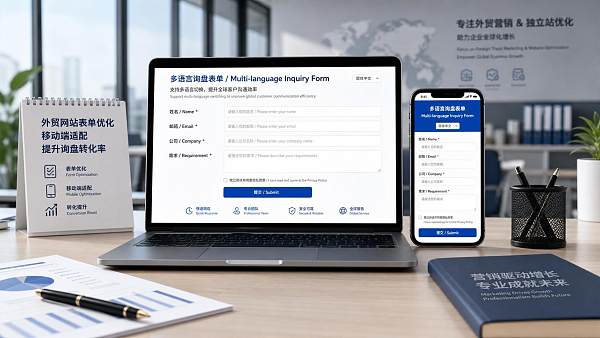
Many foreign trade websites do not lack traffic,the real place where orders are lost,is often the last few dozen seconds before submission。People view the page,and people click the button,but the form is still not completed,this is usually not a single problem,but a deviation in conversion path design。
The value of form optimization,is not just shortening fields。For website and marketing service integration projects,forms carry three tasks:lead screening,channel handoff,and sales collaboration。Different sources,different languages,and different business stages,do not have the same requirements for the submission path。
In practical applications,the focus of form optimization for inquiry pages,advertising landing pages,product detail pages,and multilingual official websites is not the same。When the judgment is wrong,the most common result is that traffic costs continue to rise,while the submission rate does not improve simultaneously。
First distinguish the sources,so the direction of form optimization will not go off track
Organic search traffic places more emphasis on trust and information completeness。Advertising traffic cares more about simple actions and fast feedback。Visits brought by social media traffic usually have shorter dwell time,and their requirements for form optimization are also more direct,one extra step may lead to loss。
If it is a B2B foreign trade website,users often confirm the product scope,delivery capability,and communication method before submitting;if it is a cross-border mall or brand independent website,form optimization also needs to consider pre-order consultation,after-sales issues,and promotional campaign handoff。Mixing these scenarios into one set of forms usually does not lead to high conversion。
For different pages,the judgment priorities are not the same
7 reasons for low conversion,often appear in these details
Too many fields,users want to leave before they even start
This is the most common form optimization issue。Many foreign trade websites hope to collect all information at once,stuffing in budget,quantity,country,usage,and delivery time。The result is that even high-intent leads are discouraged,and the submission rate drops significantly。
A more prudent approach,is to first keep key items such as name,email,and requirement description,and move complex screening to secondary communication。Especially on SEO pages and advertising landing pages,the first round of form optimization should prioritize lowering the action threshold。
Field settings are unreasonable,asking questions that should not be asked first
Fewer fields are not necessarily better。The issue lies in order and timing。Some pages first ask about company size and procurement cycle,but do not let users quickly express their current needs,which interrupts the willingness to submit。
During form optimization,low-pressure information should be collected first,and then content with high judgment value should be obtained gradually。For inquiry-oriented websites,letting visitors first explain “what they are looking for” is usually more effective than first asking “where they are from”。
Button copy is too vague,lacking clear expectations of the result
Many page buttons only say “Submit” or “Send”,this kind of expression is too neutral。Users do not know what will happen after submission,nor do they know how long it will take to receive a reply,so hesitation naturally increases。
Form optimization can make the action result clear,such as “Get a Quote” and “Submit Requirements and Wait for a Reply”。This is not simply changing the copy,but completing the decision-making loop。
Poor mobile experience,input cost is underestimated
Many foreign trade websites look fine on desktop,but on mobile,input boxes are too dense,drop-down options are too long,and buttons are too close to the keyboard,all of which directly lower the submission rate。Advertising and social media traffic are especially easily affected。
This type of form optimization should be carried out around the finger operation path。Field spacing,automatic recognition of country codes,and reducing repeated input are all more effective than simply changing the color scheme。
Insufficient trust,users worry that there will be no response after submission
In multilingual official websites and first-contact pages,one point often overlooked in form optimization is trust explanation。Without response time,privacy notice,or support for business authenticity,users are more likely to stop at the final step。
Especially when targeting cross-regional markets,the page needs to provide clear contact logic。Platforms with many years of overseas marketing experience usually design website building,SEO,advertising,and lead handoff together,so that form optimization will not be separated from the overall conversion chain。
Multilingual forms are only translated,without localization
Form optimization does not mean translating Chinese fields into another language。Different regions vary greatly in their acceptance of phone number formats,forms of address,required-field habits,and privacy wording。Pages that seem the same may have submission rates that differ by several times。
A more common judgment method is to first split versions by target market,then test field wording and submission position。The form optimization priorities for North America,Europe,and Southeast Asia are usually not completely the same。
No feedback after submission,lead handoff breaks at the last step
After successful submission on some pages,only a simple prompt pops up,with no email confirmation and no redirect explanation。Users do not know whether the submission was successful,and companies can also easily miss the window for continued communication。
Truly effective form optimization needs to design post-submission actions together,including automatic replies,source tagging,sales assignment,and re-engagement。Otherwise,even if the frontend improves the submission rate slightly,the backend may still miss leads。
Several misjudgments most easily overlooked during implementation
When many teams do form optimization,they only focus on page style,but ignore business conditions。What truly affects the submission rate is often not “whether it looks good”,but “whether it is suitable”。
- Using the same set of forms on all pages,without distinguishing SEO traffic from advertising traffic。
- Only looking at the number of first-round submissions,without following up on the proportion of valid inquiries。
- Only reducing the number of fields,without adjusting field order and guiding text。
- Ignoring the mobile filling experience,and still designing according to desktop habits。
- Only doing page revisions,without connecting form optimization to CRM or automatic assignment processes。
If the website itself carries multi-channel customer acquisition tasks such as website building,SEO,advertising,and social media,form optimization needs a unified data standard even more。Otherwise,traffic brought by different channels cannot be compared,and problems are also difficult to locate。
A more prudent approach to form optimization is to execute by scenario layers
The first step,split by page source first。Search pages emphasize trust,advertising pages emphasize speed,and social media pages emphasize simplicity。For different entrances,form optimization actions should be done separately,and a one-size-fits-all approach is not recommended。
The second step,look at business goals。Whether to first increase the submission rate,or first increase the proportion of valid inquiries,determines the field retention strategy。Short forms are suitable for scaling volume,while semi-open forms are more suitable for screening needs。
The third step,combine data verification。Observe where users drop off from visit to submission,analyze which type of fields,which device side,and which language version has the highest loss,and then advance form optimization tests。
For websites that need long-term overseas growth,a more reasonable way is to place form optimization into the operating rhythm of the entire site。When website structure,SEO handoff,advertising delivery,and AI-driven data analysis work together,the increase in submission rate will be more stable。
How to judge the next step,so the submission rate can truly be raised
Form optimization is not a single-point fix,but a recalibration of the conversion path。First confirm visit sources,then split page scenarios,then check fields,buttons,trust information,and post-submission handoff actions,and the problems will usually become clearer。
If you are building a foreign trade independent website,a multilingual official website,or an overseas promotion page,you can first establish a form checklist:whether fields are necessary,whether the mobile experience is smooth,whether the language is localized,whether there is feedback after submission,and whether leads can enter the subsequent follow-up process。
When these judgments have a basis,form optimization will no longer remain at the page level,but will truly drive inquiry efficiency,channel returns,and overall site conversion performance。
Related Articles



Related Products
 Yiyingbao SaaS Intelligent Website Building and Marketing SystemYiyingbao SaaS Intelligent Website Building and Marketing System, AI-powered no-code website building, rapid creation of multilingual B2B international websites in 10 minutes, global server acceleration, AI-powered SEO optimization, helping businesses connect efficiently with global markets. The perfect integration of technology and operation makes building an international trade website remarkably simple
 AI+SEM Intelligent Advertising Marketing SystemAI+SEM drives intelligent ad creation, empowering full-funnel precision advertising marketing. The system automatically generates weekly/monthly reports, AI recommends keywords and target countries, monitors core metrics in real-time with intelligent alerts, and enables one-click high-conversion ad solutions to help quickly acquire customers and improve ROI.
 AI+SEO Dual-Engine System Optimization ServicesYiyingbao’s AI+SEO dual-engine optimization system helps foreign trade enterprises acquire high-quality organic traffic through AI-powered keyword research, content generation, and comprehensive technical optimization, significantly improving search rankings and conversion rates.
 AI+SNS Social Media Marketing SystemYingbao AI+SNS Social Media Marketing System - Precision social capture for the social media era. Supports one-click content synchronization across major platforms like Facebook and LinkedIn. AI intelligently rewrites posts for enhanced relevance. 24/7 AI customer service and user profiling analysis empower businesses to efficiently expand into global markets.
 AI+SEO营销解决方案易营宝AI+SEO营销解决方案,通过AI批量写作、智能生成TDK、精准关键词扩词等功能,全面优化网站SEO效果,提升流量与转化率。助力企业构建高效智能网站新生态。
 AI+SEM Advertising Marketing SolutionsAI+SEM Advertising Marketing Solution leverages AI technology to deeply empower SEM ad campaigns. It automatically generates weekly/monthly reports using AI, presenting account data across multiple dimensions for comprehensive insights into campaign performance and trends. The system precisely recommends keywords and target countries, intelligently generates high-conversion ad copy, and enables one-click activation of efficient campaign plans to help businesses rapidly acquire customers. Simultaneously, it monitors core metrics in real time, intelligently identifies abnormal fluctuations, and issues timely alerts to ensure stable, high-return advertising results.
 Domain Name ServicesEasyWin provides professional domain name services, including intelligent queries, one-stop registration, brand protection, and full lifecycle management, helping businesses build a digital brand image.
 EasyOperate B2C Cross-Border E-Commerce Platform & Independent WebsiteEasyStore B2C Cross-border E-commerce Independent Store is an intelligent website building and cross-border e-commerce integrated solution independently developed by EasyStore Information Technology (Beijing) Co., Ltd. The system is specially designed for small and medium-sized as well as large export enterprises, integrating 'website building, operation, marketing, advertising, and conversion' into one, helping enterprises quickly establish cross-border e-commerce independent stores to achieve brand globalization and global sales growth.
The platform supports multiple languages, multiple currencies, and multi-channel marketing, with built-in AI intelligent translation and SEO optimization systems, suitable for mainstream markets such as Southeast Asia, Europe and America, Latin America, and the Middle East, assisting Chinese manufacturing enterprises in efficiently deploying international e-commerce strategies. SSL证书易营宝提供专业SSL安全证书服务,包括单域名和泛域名证书,确保网站数据传输加密、身份验证和完整性保护,助力企业建立安全可信的在线业务环境。









