









- China’s Tariff Commission of the State Council Adjusts Additional Tariffs on U.S. Goods: 24% Tariff Suspended for Two MonthsNov 10, 2026View details
- APEC Shenzhen Spotlight: Cross-Border E-Commerce Orders Promote Asia-Pacific Trade and Economic CooperationNov 08, 2026View details
- China-Europe Railway Express and CIIE Hold Business Matchmaking Event, Focusing on Cross-Border E-commerce B2B ExportsNov 07, 2026View details
- China’s Ministry of Commerce Responds to Additional Charges on Low-Value Imports Imposed by the EUNov 06, 2026View details
- Two Internet Development Reports Released at the 2026 World Internet ConferenceNov 05, 2026View details
- Internet Business Revenue of Enterprises Above the Designated Size Reached RMB 1.716 Trillion in the First Three Quarters, with Profits Up 17.6%Nov 05, 2026View details
How should foreign trade factories build a B2B foreign trade marketing website?Analysis of sections、content and inquiry paths
How Should Export-Oriented Factories Build a B2B Foreign Trade Marketing Website? Start with the Customer Acquisition Logic
How should export-oriented factories build a B2B foreign trade marketing website? Many factories focus on homepage style, number of languages, and page quantity from the very beginning. As a result, after the website goes live, traffic is unstable and inquiries are even fewer.
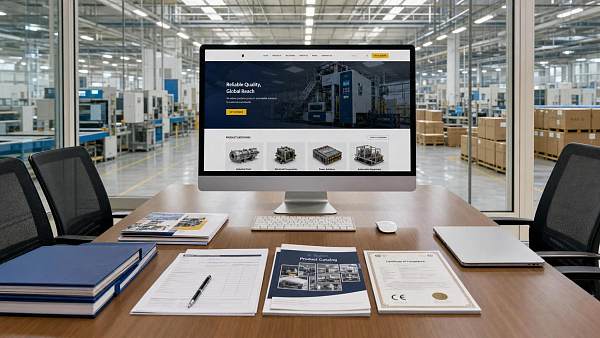
What truly determines the results is often not how attractive the pages look, but whether the section structure is clear, whether the content is close to purchasing decisions, and whether the inquiry path is convenient.
Judging from recent changes, overseas buyers are paying more and more attention to verifying the professionalism of suppliers. A website is no longer just a business card; it is more like a first-round business screening tool.
Therefore, the construction focus of a B2B foreign trade marketing website for export-oriented factories should revolve around “whether it can be found, whether it can be trusted, and whether inquiries can be initiated smoothly.”
How to Build the Section Structure Determines Whether the Website Works Like a Salesperson Who Can Take Orders
For an effective B2B foreign trade marketing website for export-oriented factories, the sections do not need to be complicated, but they must be designed around the order of purchasing decisions.
A common and practical section structure can be built according to the following logic:
- Home: Summarize products, advantages, application scenarios, and core conversion entrances.
- Product Center: Categorize by product type, use, material, and industry scenario.
- Solutions: Tell customers which purchasing needs you are suitable for.
- Factory Strength: Display production lines, certifications, delivery time, quality inspection, and cases.
- About Us: Supplement company background, history, and service capabilities.
- News or Knowledge Center: Support SEO content and long-tail search traffic.
- Contact Us: Forms, email, phone, map, and instant communication entrances.
The most common mistake here is making “About Us” too heavy while making “Product Center” and “Solutions” too light. Buyers first care about whether cooperation is possible, and only then who you are.
This also means that a B2B foreign trade marketing website for export-oriented factories should place product entrances upfront and intersperse trust proof throughout, rather than piling everything onto the company introduction page.
How to Arrange Content to Balance Indexing, Trust, and Conversion
The problem with many factory websites is not that they have no content, but that the content is written for themselves rather than for buyers. Search engines cannot understand the focus, and customers cannot grasp the value.
In actual business, a content layout with stronger conversion potential usually needs to cover four types of information.
1. Product Information Should Be Specific, Not Just Parameters
In addition to model, size, and material, product pages should clearly explain applicable scenarios, common questions, customization capabilities, MOQ, delivery time, and packaging methods.
The benefit of doing this is very direct. Customers can quickly determine whether it matches their needs, and search engines can also identify the page topic more easily.
2. Strength-Related Content Should Be Verifiable, Not Just Slogans
Expressions such as “stable quality,” “rich experience,” and “exported worldwide” are too empty. More effective content includes production equipment, certification standards, inspection processes, cooperation regions, and shipment data.
For a B2B foreign trade marketing website for export-oriented factories, trust is not shouted out; it is proven step by step.
3. Solution Content Should Be Close to Buyers’ Problems
If customers come from different industries, do not only list products. Pages can be created by application scenario, such as construction, packaging, machinery, home furnishing, medical supporting applications, and so on.
Such pages can not only capture long-tail searches, but also help customers shorten their understanding time and reduce back-and-forth communication costs.
4. SEO Content Should Serve Inquiries, Not Just Publishing Articles
Knowledge content can be written around material selection, process differences, certification requirements, purchasing pitfalls, and industry trends. This makes it easier to cover search intent and also easier to bring in precise visitors.
If there is a multilingual layout, the expression habits of different markets should also be considered. The more detailed the content localization is, the more stable the conversion foundation of a B2B foreign trade marketing website for export-oriented factories will be.
How to Design the Inquiry Path So Customers Do Not Leave After Reading
The inquiry path determines whether the website only has visits but no results. Many websites do not have low traffic, but customers get “stuck” at key points.
A more reasonable path usually completes five steps continuously: “enter the page, understand the product, build trust, trigger communication, and complete lead submission.”
During specific design, you can focus on checking the following positions:
- Whether the first screen of the homepage has clear main products and communication entrances.
- Whether the product page has a fixed inquiry button and form.
- Whether conversion entrances are set near cases, certifications, and FAQ.
- Whether contact methods are visible in the header, footer, and content pages.
- Whether the form fields are simple enough to avoid being too long.
A more obvious signal is that the inquiry button should not only say “Contact Us.” More suitable copy includes action-oriented expressions such as “Get a Quote,” “Request Samples,” and “Consult on Custom Solutions.”
These details may seem small, but for a B2B foreign trade marketing website for export-oriented factories, they often directly affect the lead submission rate and subsequent follow-up efficiency.
Which Pages Must Be Prioritized and Which Pitfalls Should Be Avoided in Advance
If budget and time are limited, there is no need to make the website very large from the start. It is more valuable to build key pages in depth first than to create a pile of empty pages.
At the same time, there are also several common pitfalls that need to be avoided. For example, the entire site has only images and no text, product pages repeat each other, the navigation hierarchy is too deep, mobile forms are difficult to submit, or only display is done without building an SEO foundation.
Once these problems exist, even if a B2B foreign trade marketing website for export-oriented factories goes live, it will still be difficult to form a stable customer acquisition capability.
From Website Building to Growth, Export-Oriented Factories Need an Integrated Operation Mindset More
Building the website is only the beginning. A truly effective B2B foreign trade marketing website for export-oriented factories also needs follow-up promotion, data analysis, and content iteration.
Taking Eyingbao as an example, it provides integrated capabilities for foreign trade enterprises, including AI intelligent website building, multilingual website construction, Google SEO optimization, advertising placement, and overseas social media operation.
The value of this model is that the website is no longer an isolated project, but the infrastructure in the entire overseas customer acquisition chain.
Especially for factories that hope to achieve long-term growth, the coordination of intelligent website building systems, self-developed SEO capabilities, and multi-channel advertising placement is more conducive to continuously expanding inquiry opportunities.
Returning to the initial question: how should export-oriented factories build a B2B foreign trade marketing website? The answer is actually very clear: first build the right sections, then write the right content, and finally make the inquiry path smooth.
When a website can be found through search, help customers quickly build trust, and enable them to initiate consultations smoothly, it truly begins to serve business growth.
Related Articles
 Qingpu’s cross-border e-commerce grew by 51.8%, ranking second in Shanghai by total volume, as it deepens ties with the CIIE
 How to Reduce High Checkout Abandonment on a Cross-Border E-commerce Website
 How long does it take to see results from increasing brand awareness? How can you tell if it’s working?
Related Products
 Yiyingbao SaaS Intelligent Website Building and Marketing SystemYiyingbao SaaS Intelligent Website Building and Marketing System, AI-powered no-code website building, rapid creation of multilingual B2B international websites in 10 minutes, global server acceleration, AI-powered SEO optimization, helping businesses connect efficiently with global markets. The perfect integration of technology and operation makes building an international trade website remarkably simple
 AI+SEM Intelligent Advertising Marketing SystemAI+SEM drives intelligent ad creation, empowering full-funnel precision advertising marketing. The system automatically generates weekly/monthly reports, AI recommends keywords and target countries, monitors core metrics in real-time with intelligent alerts, and enables one-click high-conversion ad solutions to help quickly acquire customers and improve ROI.
 AI+SEO Dual-Engine System Optimization ServicesYiyingbao’s AI+SEO dual-engine optimization system helps foreign trade enterprises acquire high-quality organic traffic through AI-powered keyword research, content generation, and comprehensive technical optimization, significantly improving search rankings and conversion rates.
 AI+SNS Social Media Marketing SystemYingbao AI+SNS Social Media Marketing System - Precision social capture for the social media era. Supports one-click content synchronization across major platforms like Facebook and LinkedIn. AI intelligently rewrites posts for enhanced relevance. 24/7 AI customer service and user profiling analysis empower businesses to efficiently expand into global markets.
 AI+SEO营销解决方案易营宝AI+SEO营销解决方案,通过AI批量写作、智能生成TDK、精准关键词扩词等功能,全面优化网站SEO效果,提升流量与转化率。助力企业构建高效智能网站新生态。
 AI+SEM Advertising Marketing SolutionsAI+SEM Advertising Marketing Solution leverages AI technology to deeply empower SEM ad campaigns. It automatically generates weekly/monthly reports using AI, presenting account data across multiple dimensions for comprehensive insights into campaign performance and trends. The system precisely recommends keywords and target countries, intelligently generates high-conversion ad copy, and enables one-click activation of efficient campaign plans to help businesses rapidly acquire customers. Simultaneously, it monitors core metrics in real time, intelligently identifies abnormal fluctuations, and issues timely alerts to ensure stable, high-return advertising results.
 Domain Name ServicesEasyWin provides professional domain name services, including intelligent queries, one-stop registration, brand protection, and full lifecycle management, helping businesses build a digital brand image.
 EasyOperate B2C Cross-Border E-Commerce Platform & Independent WebsiteEasyStore B2C Cross-border E-commerce Independent Store is an intelligent website building and cross-border e-commerce integrated solution independently developed by EasyStore Information Technology (Beijing) Co., Ltd. The system is specially designed for small and medium-sized as well as large export enterprises, integrating 'website building, operation, marketing, advertising, and conversion' into one, helping enterprises quickly establish cross-border e-commerce independent stores to achieve brand globalization and global sales growth.
The platform supports multiple languages, multiple currencies, and multi-channel marketing, with built-in AI intelligent translation and SEO optimization systems, suitable for mainstream markets such as Southeast Asia, Europe and America, Latin America, and the Middle East, assisting Chinese manufacturing enterprises in efficiently deploying international e-commerce strategies. SSL证书易营宝提供专业SSL安全证书服务,包括单域名和泛域名证书,确保网站数据传输加密、身份验证和完整性保护,助力企业建立安全可信的在线业务环境。









