









- Qingdao Port's Imports and Exports Exceed RMB 23.699 Trillion in the First 10 Months, Drawing Attention to Port IntelligenceNov 22, 2026View details
- Ningbo Cross-Border E-Commerce Export Value Surges 94.87% Year on Year, Opening Up a New Billion-Yuan Growth TrackNov 22, 2026View details
- AliExpress Global Double 11: Brand Sales Grow Nearly 50% in the First Week, U.S. GMV Rises 70%Nov 21, 2026View details
- Ministry of Commerce Reports E-commerce Development from January to October 2026, with Cross-Border Imports Performing StronglyNov 21, 2026View details
- Amazon Black Friday Orders Sluggish on Day One; NRF Forecasts 4.2 Million Fewer ParticipantsNov 21, 2026View details
- 21st Century Business Herald: AI and CTV Become Core Growth Engines for Digital Marketing in Overseas MarketsNov 18, 2026View details
What factors affect the cost of building a Russian-language website?
The cost of building a Russian-language website depends mainly on the scope of its pages and features, the depth of Russian-language content production, and whether maintenance and promotion are included after launch. The workload for a website that only presents company information and product details is relatively easy to define. If it also needs a multilingual online store, inventory integration, or ongoing search promotion, the cost structure becomes much more complex. When comparing quotes, confirming the scope of deliverables for each service is more useful than comparing total prices alone.
Website Type and Feature Scope Determine the Base Workload
A showcase website mainly features a company profile, product listings, and contact details. Its quote is largely determined by the number of pages, design approach, content entry, and mobile responsiveness. A lead-generation website also needs to account for features such as product categories, filters, forms, file uploads, and inquiry notifications. Although both may appear to have “product pages,” development and testing take more work if visitors need to filter by model and specifications and submit inquiries about multiple products through a single form.
An e-commerce site for cross-border sales has a broader scope. Product variants, shopping carts, order management, shipping cost calculations, and payment methods all affect the quote. When integrating with external inventory, order, or logistics systems, it is also necessary to confirm whether the interfaces are available, which party will organize the data, and how integration failures will be handled. The fact that a feature is listed in a quote does not mean that all integration and testing work is included.
Template-based website building also differs from custom design. Templates can reduce design and development work, but the site structure, interactions, or page layouts may be limited by the existing system. Custom pages require more design and front-end development time. If requirements are not yet clear, repeated revisions can add to the workload. The choice should be based on the need for differentiated page designs and future maintenance requirements.
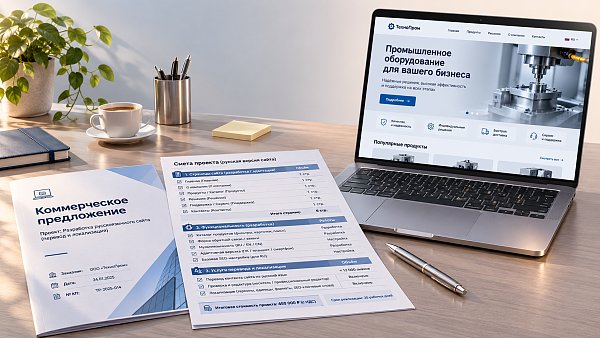
The Depth of Russian Localization Can Significantly Affect the Quote
The cost of a Russian-language website involves more than translating page text into Russian; it also depends on the volume and level of specialization of the content. Navigation, buttons, form prompts, product specifications, text in images, downloadable files, and automated reply emails may all need to be handled. If a quote covers only the main text of a fixed number of pages, additional product information may be billed separately later.
The more complex the product catalog, the more important it is to keep terminology consistent. Using different translations for the same component in a title, specification table, and inquiry form can make content harder to read and lead to communication errors. For technical specifications, units, model numbers, number formats, and consistency with the source text also need to be checked in addition to translation. Whether this proofreading work is included in the quote should be clarified in advance.
Russian text differs in length from Chinese, so existing button, menu, and card layouts may need adjustment. If text has been embedded in images, the images may need to be recreated. Video subtitles, product manuals, and similar files may be charged separately. Having an existing Chinese or English website does not mean that adding a language option is enough to complete all the work. It is also necessary to confirm whether pages in the new language will use shared templates, whether product data can be reused, and how each language version will be updated.
The target market also affects localization requirements. Contact details, currency display, delivery coverage, and business information may differ across regions where Russian is spoken. Covering multiple regions does not necessarily require multiple websites, but if each region needs its own prices, product catalog, or contact channels, configuration and maintenance work will increase accordingly.
Separate Website Setup from Ongoing Search and Promotion Services
The basic search configuration included in a website-building quote usually focuses on whether search engines can access and understand the pages. This may include setting page titles, descriptions, URL structures, sitemaps, and relationships between multilingual pages. Confirm whether the configuration covers page templates or includes unique content for every Russian-language page. For a large number of products, writing and proofreading each page requires a different level of effort from applying a standard template across them.
Ongoing search optimization may involve keyword research, content creation, technical troubleshooting, and performance tracking. The service period and update frequency directly affect the cost. Completing basic settings during website development does not mean that long-term content management is included. If a quote mentions “search optimization,” confirm the specific work involved and the delivery schedule.
The scope of advertising landing pages, conversion event configuration, and inquiry source tracking should also be clearly defined. Creating a dedicated campaign page, integrating analytics tools, or verifying that form submissions are recorded may involve additional work. Advertising spend should be listed separately from page development and account management fees to avoid mistaking budget expenditure for part of the website deliverables.
How to Compare Post-Launch Costs and Delivery Terms
Domain names, servers, website platform fees, certificates, and ongoing maintenance may be charged on different schedules. A lower-priced option may cover only the initial development. Renewal fees, storage limits, traffic limits, and feature expansion costs should be checked against the contract. The website's deployment location and the regions where visitors are based can also affect the user experience. If additional acceleration or backup configurations are needed, the associated costs and maintenance responsibilities should be specified.
The scope of maintenance services also affects total costs. System troubleshooting, content updates, Russian translation updates, and new pages may not all be covered by the same service. It is best to determine during the requirements stage which party will enter product information, how many rounds of revisions are included before launch, and how out-of-scope revisions will be charged.
When comparing multiple quotes for Russian-language website development, first align the common scope: the number of pages and products, language versions, feature list, content production, deployment timeline, and post-launch service period. If one quote includes translation, product entry, and basic search configuration while another covers only the website framework, their total prices cannot be compared directly. For features that cannot yet be confirmed, ask for separate line items with the implementation conditions stated so that they can be scheduled in phases.
The handover terms should also specify domain ownership, back-end access, website data export methods, and the extent of permitted modifications. When using an existing website-building system, source code delivery and data migration depend on the specific contract and system capabilities. Confirming these boundaries in advance helps assess the workload involved in future redesigns or switching service providers.
Related Articles
 一站式营销平台服务如何核算整体采购成本
 B2B转化率优化费用通常包含哪些项目
 What Factors Affect the Cost of Export Website Development Services in Jiangsu?


Related Products
 Yiyingbao SaaS Intelligent Website Building and Marketing SystemYiyingbao SaaS Intelligent Website Building and Marketing System, AI-powered no-code website building, rapid creation of multilingual B2B international websites in 10 minutes, global server acceleration, AI-powered SEO optimization, helping businesses connect efficiently with global markets. The perfect integration of technology and operation makes building an international trade website remarkably simple
 AI+SEM Intelligent Advertising Marketing SystemAI+SEM drives intelligent ad creation, empowering full-funnel precision advertising marketing. The system automatically generates weekly/monthly reports, AI recommends keywords and target countries, monitors core metrics in real-time with intelligent alerts, and enables one-click high-conversion ad solutions to help quickly acquire customers and improve ROI.
 AI+SEO Dual-Engine System Optimization ServicesYiyingbao’s AI+SEO dual-engine optimization system helps foreign trade enterprises acquire high-quality organic traffic through AI-powered keyword research, content generation, and comprehensive technical optimization, significantly improving search rankings and conversion rates.
 AI+SNS Social Media Marketing SystemYingbao AI+SNS Social Media Marketing System - Precision social capture for the social media era. Supports one-click content synchronization across major platforms like Facebook and LinkedIn. AI intelligently rewrites posts for enhanced relevance. 24/7 AI customer service and user profiling analysis empower businesses to efficiently expand into global markets.
 AI+SEO营销解决方案易营宝AI+SEO营销解决方案,通过AI批量写作、智能生成TDK、精准关键词扩词等功能,全面优化网站SEO效果,提升流量与转化率。助力企业构建高效智能网站新生态。
 AI+SEM Advertising Marketing SolutionsAI+SEM Advertising Marketing Solution leverages AI technology to deeply empower SEM ad campaigns. It automatically generates weekly/monthly reports using AI, presenting account data across multiple dimensions for comprehensive insights into campaign performance and trends. The system precisely recommends keywords and target countries, intelligently generates high-conversion ad copy, and enables one-click activation of efficient campaign plans to help businesses rapidly acquire customers. Simultaneously, it monitors core metrics in real time, intelligently identifies abnormal fluctuations, and issues timely alerts to ensure stable, high-return advertising results.
 Domain Name ServicesEasyWin provides professional domain name services, including intelligent queries, one-stop registration, brand protection, and full lifecycle management, helping businesses build a digital brand image.
 EasyOperate B2C Cross-Border E-Commerce Platform & Independent WebsiteEasyStore B2C Cross-border E-commerce Independent Store is an intelligent website building and cross-border e-commerce integrated solution independently developed by EasyStore Information Technology (Beijing) Co., Ltd. The system is specially designed for small and medium-sized as well as large export enterprises, integrating 'website building, operation, marketing, advertising, and conversion' into one, helping enterprises quickly establish cross-border e-commerce independent stores to achieve brand globalization and global sales growth.
The platform supports multiple languages, multiple currencies, and multi-channel marketing, with built-in AI intelligent translation and SEO optimization systems, suitable for mainstream markets such as Southeast Asia, Europe and America, Latin America, and the Middle East, assisting Chinese manufacturing enterprises in efficiently deploying international e-commerce strategies. SSL证书易营宝提供专业SSL安全证书服务,包括单域名和泛域名证书,确保网站数据传输加密、身份验证和完整性保护,助力企业建立安全可信的在线业务环境。









