









- Amazon Raises Fulfillment Fees Twice, Yet the Median Platform Fee Remains Around 40%Oct 22, 2026View details
- AliExpress and YouTube Partner to Expand Marketing Opportunities for Chinese Brands Going GlobalOct 22, 2026View details
- Publicis says AI marketing is developing at two speeds, with agentic AI helping win clientsOct 21, 2026View details
- Salesforce Plans to Acquire Braze for $5.66 Billion to Enhance AI Marketing CapabilitiesOct 21, 2026View details
- Levanta’s Inaugural China Summit Held in Shenzhen, Focusing on AI and Cross-Border Brand GrowthOct 20, 2026View details
- The October Edition of the 2026 GGE Shenzhen Cross-Border E-Commerce Expo OpensOct 20, 2026View details
Can Yiyingbao AI Image Generation Replace Product Photography?
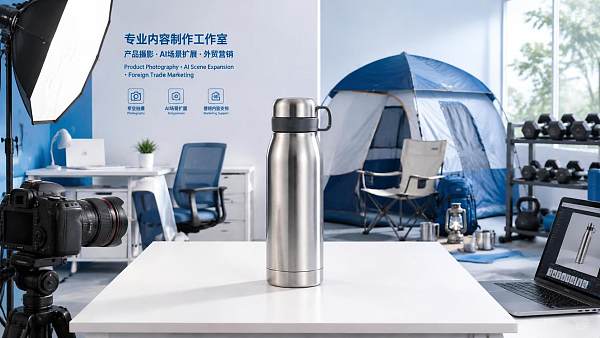
Can Yingyingbao AI Image Generation Replace Product Photography? First, Distinguish Between “Display Assets” and “Product Evidence”
Can Yingyingbao AI image generation replace product photography? For operators responsible for independent websites, social media content, or advertising landing pages, this is not a simple question of “yes” or “no.” What truly needs to be assessed is the role of the image, the decision customers will make based on it, and the degree of visual reconstruction the product itself allows.
If the goal is to quickly place a product with an existing physical basis into different settings—for example, generating office, camping, or gym usage visuals for an insulated tumbler, or adding space combinations in different styles for furniture—AI image generation can usually significantly shorten asset preparation time. However, if an image is used to confirm material texture, interface structure, dimensional proportions, package contents, or compliance labels, real photography still cannot be easily omitted. Overseas buyers repeatedly review product pages before making an inquiry. Images are not merely decorations that attract clicks; they are also a basis for reducing purchasing concerns.
What AI Image Generation Excels At Is Not Whether to Shoot, but How to Expand Content Faster
The cost of traditional product photography often extends beyond the shooting day itself. Sample delivery, set design, models, post-production retouching, repeated reshoots, and asset adjustments for different market versions can all prolong the product launch cycle. Especially for companies with many SKUs, rapidly changing seasons, or a need to operate social media accounts over the long term, the issue is often not a lack of product images, but a lack of sufficient images that can be used for promotion.
Yingyingbao AI image generation is better suited to this expansion work: based on the product itself or existing reference assets, it can quickly test backgrounds, lighting, composition, usage scenarios, and visual styles. For website operations, the same product can be prepared for homepage banners, category page visuals, blog illustrations, advertising creatives, and social media content, without having to arrange a new shoot every time another channel is added.
The value of this capability lies in improving the efficiency of content experimentation. For example, pages targeting the North American market often favor bright, lifestyle-oriented usage atmospheres; when targeting engineering procurement or industrial component customers, pages require cleaner backgrounds, close-up details, and application environments. AI can first help operators create visual drafts in multiple directions, then use more mature options to produce page and campaign assets.
Which Visuals Can Prioritize AI, and Which Must Retain Real Photography
A practical way to determine this is whether customers will treat details in the image as part of the purchasing commitment. If the answer is “yes,” real photography should take priority; if the visual is mainly used to create a setting, convey an imagined use case, or test a creative direction, AI-generated content offers greater value.
For B2B businesses involving machinery and equipment, electronic components, medical-related products, customized industrial products, and similar items, this boundary is particularly important. AI may render screw-hole locations, button counts, connection methods, or even component proportions in ways that “look reasonable” but are not actually accurate. Such visuals are suitable for communicating application concepts, but not for prominent locations where customers need to verify specifications. Once buyers find that images, descriptions, and physical products do not match, the resulting cost of lost trust is usually far greater than the photography expense saved.
Product Photography Will Not Disappear, but Photography Tasks Will Be Redistributed
A more reasonable approach is not to replace photography entirely with AI, but to first establish a library of “real assets.” Each key SKU should retain at least clear main images on a white background, multi-angle images, key detail images, packaging images, and actual usage or installation images. These are both a credible foundation for product pages and stable references for subsequent AI generation.
On this basis, operators can then use Yingyingbao AI image generation to extend different types of content: changing seasonal backgrounds, matching lifestyle scenarios in different regions, creating visuals for campaign pages, or adding images to an article focused on application pain points. The advantage of this approach is that real photography safeguards product facts, while AI accelerates content production, allowing each to do what it does best.
Many teams tend to overlook one detail: before generated images go live, they should be verified by someone familiar with the product. Check whether the model appearance has been changed, whether errors appear in the Logo or text, whether the way it is held conforms to usage habits, and whether sockets, voltage, clothing, or environments in the scene could cause misunderstandings in the target market. If the website provides multilingual content, also ensure that embedded text in images is consistent with the page language, to prevent users from encountering conflicting information.
From Website Building to Customer Acquisition, Images Must Serve the Actual Tasks of Different Pages
Image quality does not mean that the more elaborate the visual, the better. An independent website homepage needs to quickly communicate the brand and product direction, product detail pages need to answer questions about specifications and delivery, and advertising landing pages need to organize content around a clear action. Using the same AI image everywhere will usually weaken the page’s information hierarchy. During operations, visual assets can be planned together with page objectives, rather than generated first and assigned a purpose afterward.
Yingyingbao Information Technology (Beijing) Co., Ltd. was established in 2013 and is headquartered in Beijing. It has long provided digital marketing services centered on intelligent website building, search optimization, social media marketing, and advertising. Its services for foreign trade companies, manufacturing factories, cross-border sellers, and companies expanding brands overseas involve not only website development, but also multilingual websites, cross-border online stores, Google promotion, social media operations, and AI search visibility. For day-to-day operators, the significance of AI image generation lies in enabling visual content to enter website building, content updates, and campaign testing processes more smoothly, rather than generating a few “attractive but unusable” images in isolation.
However, images alone cannot solve customer acquisition challenges. Page loading speed, product information completeness, inquiry form design, multilingual communication, content supporting advertising campaigns, and subsequent follow-up all affect whether visitors are willing to contact a company. The integrated website building and marketing scenarios covered by Yingyingbao are well suited to evaluating asset production within the overall chain: an image must not only be generated, but also be placed on the right page, adapted to the channel, and kept consistent with actual product information.
Start With a Small-Scale Test to Determine Whether It Is Worth Expanding Use
If a team is just starting to use AI image generation, there is no need to rush to replace existing photography processes. Select a group of products with stable appearances and relatively low specification risks, use real white-background images as the basis, and generate several sets of assets in different scenarios for use in social media posts, blog illustrations, or advertising creative tests. Before launch, document the original assets, generated versions, and pages where they are used. This makes it easier to trace issues when disputes arise and gradually accumulate prompts and review rules suited to the company’s own product categories.
Ultimately, Yingyingbao AI image generation is more like an accelerator for product content production than “visual proof” that replaces real products. When companies need to launch products quickly, continuously update overseas website content, and adapt to multichannel marketing, it can reduce the burden of repetitive production; when customers need to verify the product itself, real photography, drawings, samples, and accurate written descriptions remain irreplaceable foundations. Only by first clearly defining this boundary can AI-generated images truly become an aid to operational work.
Related Articles
 Can content automatically generated by a website builder be published directly?
 How can you verify the factual accuracy of AI-assisted product content?
 Can an export website built with AI be migrated to another platform?

Related Products
 Yiyingbao SaaS Intelligent Website Building and Marketing SystemYiyingbao SaaS Intelligent Website Building and Marketing System, AI-powered no-code website building, rapid creation of multilingual B2B international websites in 10 minutes, global server acceleration, AI-powered SEO optimization, helping businesses connect efficiently with global markets. The perfect integration of technology and operation makes building an international trade website remarkably simple
 AI+SEM Intelligent Advertising Marketing SystemAI+SEM drives intelligent ad creation, empowering full-funnel precision advertising marketing. The system automatically generates weekly/monthly reports, AI recommends keywords and target countries, monitors core metrics in real-time with intelligent alerts, and enables one-click high-conversion ad solutions to help quickly acquire customers and improve ROI.
 AI+SEO Dual-Engine System Optimization ServicesYiyingbao’s AI+SEO dual-engine optimization system helps foreign trade enterprises acquire high-quality organic traffic through AI-powered keyword research, content generation, and comprehensive technical optimization, significantly improving search rankings and conversion rates.
 AI+SNS Social Media Marketing SystemYingbao AI+SNS Social Media Marketing System - Precision social capture for the social media era. Supports one-click content synchronization across major platforms like Facebook and LinkedIn. AI intelligently rewrites posts for enhanced relevance. 24/7 AI customer service and user profiling analysis empower businesses to efficiently expand into global markets.
 AI+SEO营销解决方案易营宝AI+SEO营销解决方案,通过AI批量写作、智能生成TDK、精准关键词扩词等功能,全面优化网站SEO效果,提升流量与转化率。助力企业构建高效智能网站新生态。
 AI+SEM Advertising Marketing SolutionsAI+SEM Advertising Marketing Solution leverages AI technology to deeply empower SEM ad campaigns. It automatically generates weekly/monthly reports using AI, presenting account data across multiple dimensions for comprehensive insights into campaign performance and trends. The system precisely recommends keywords and target countries, intelligently generates high-conversion ad copy, and enables one-click activation of efficient campaign plans to help businesses rapidly acquire customers. Simultaneously, it monitors core metrics in real time, intelligently identifies abnormal fluctuations, and issues timely alerts to ensure stable, high-return advertising results.
 Domain Name ServicesEasyWin provides professional domain name services, including intelligent queries, one-stop registration, brand protection, and full lifecycle management, helping businesses build a digital brand image.
 EasyOperate B2C Cross-Border E-Commerce Platform & Independent WebsiteEasyStore B2C Cross-border E-commerce Independent Store is an intelligent website building and cross-border e-commerce integrated solution independently developed by EasyStore Information Technology (Beijing) Co., Ltd. The system is specially designed for small and medium-sized as well as large export enterprises, integrating 'website building, operation, marketing, advertising, and conversion' into one, helping enterprises quickly establish cross-border e-commerce independent stores to achieve brand globalization and global sales growth.
The platform supports multiple languages, multiple currencies, and multi-channel marketing, with built-in AI intelligent translation and SEO optimization systems, suitable for mainstream markets such as Southeast Asia, Europe and America, Latin America, and the Middle East, assisting Chinese manufacturing enterprises in efficiently deploying international e-commerce strategies. SSL证书易营宝提供专业SSL安全证书服务,包括单域名和泛域名证书,确保网站数据传输加密、身份验证和完整性保护,助力企业建立安全可信的在线业务环境。









