









- Levanta’s Inaugural China Summit Held in Shenzhen, Focusing on AI and Cross-Border Brand GrowthOct 20, 2026View details
- The October Edition of the 2026 GGE Shenzhen Cross-Border E-Commerce Expo OpensOct 20, 2026View details
- Dongguan’s foreign trade imports and exports reached RMB 1.29 trillion in the first three quarters, a record high for the same periodOct 20, 2026View details
- Liaoning Holds Province-Wide Meeting to Advance Cross-Border E-Commerce, Emphasizing the Need to Explore Differentiated Development PathsOct 20, 2026View details
- Advanced Manufacturing Seizes Global Opportunities as Guangdong’s Q3 Foreign Trade Surpasses RMB 3 Trillion for the First TimeOct 20, 2026View details
- Can the average annual growth rate reflect real opportunities in overseas markets?Oct 07, 2026View details
Are overseas marketing tools worth purchasing? First, calculate your team's usage costs
When procuring overseas marketing tools, subscription pricing is often both the easiest item to get approved and the easiest to misjudge. A few hundred or a few thousand US dollars per month may seem acceptable; but once the tool has been purchased, who will build the website, maintain multilingual pages, handle advertising creatives, interpret data, and follow up on leads? These are the costs that continue to accrue.
For financial approval, the question should not simply be "Is this overseas marketing tool expensive?" It should become: "Can the existing team use it to generate qualified leads?" If the answer is no, even a low subscription fee may become idle spending. Conversely, a solution that is not the cheapest but can reduce system-switching and external collaboration losses may well be the more economical choice.
Don't Look Only at Software Prices; Include People Costs in the Budget First
Acquiring overseas customers is usually not a single-point activity. The website serves as the landing page; Google SEO requires coordination between content and technical work; advertising requires alignment among accounts, creatives, and landing pages; while social media operations involve content scheduling, direct-message responses, and brand communication. If a company separately procures tools for website building, email, ad management, data analytics, translation, multilingual plugins, and more, each item may appear inexpensive, but the work will in fact be distributed across multiple roles.
For example, a marketer finds that an advertising keyword has good click-through performance but a high page bounce rate. They need to ask website personnel to modify the page, then wait for content personnel to add product selling points, before reconfiguring tracking and monitoring the data. When the process spans three or four systems, the issue is not that a particular function is missing, but that waiting and communication are continually prolonged. For manufacturing companies focused on inquiries, such delays are difficult to see on software invoices, yet they directly affect the effectiveness of the advertising budget.
When approving a budget, it is recommended to list internal input as a separate item: how many people are needed for launch training, how many work hours weekly maintenance will take, who will handle page or data issues, and whether overseas sales staff can understand and use lead information. Especially for teams building an independent overseas website for the first time, do not assume that people who can use office software can operate a marketing system. Website administration, ad attribution, SEO content planning, and cross-border store configuration require different capabilities.
What Should Really Be Compared Is Total Cost of Use, Not the Number of Features
When procuring a solution, the feature list is usually long: AI content generation, multilingual support, forms, online stores, ad management, social media publishing, data dashboards... But having more features does not mean lower costs of use. Finance can require business departments to compare candidate solutions within the same cost framework, rather than comparing only first-year contract amounts.
Here is a practical guideline: if a company needs to purchase multiple additional integration tools, or relies long-term on manually exporting tables, copying creatives, and repeatedly entering leads, the total cost of ownership of the supposedly low-priced tool will usually rise quickly. In contrast, if websites, promotion, and lead handling can operate within one business chain, this can at least reduce some of the friction caused by interfaces, permissions, and boundaries of responsibility.
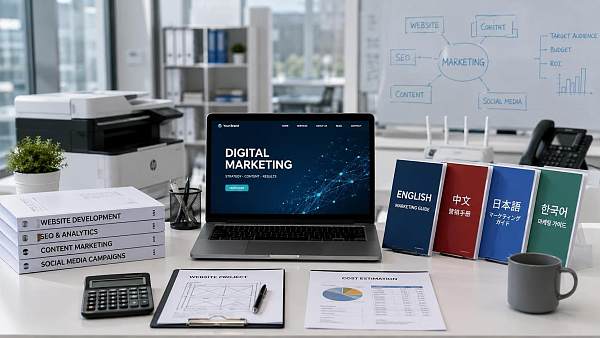
At Different Stages of Global Expansion, the Definition of What Makes a Tool “Worth It” Differs
Companies that are just beginning to test overseas markets should not purchase a complex combination of platforms from the outset. At this stage, it is more important to validate whether there is genuine demand in the target country, what terms customers will search for, whether product pages can clearly communicate the core selling points, and who will respond to inquiries. If product materials have not yet been organized and there is no review mechanism for English or other-language content, even the most advanced automation features will be difficult to use effectively.
For teams that are already running ads consistently or have sources of overseas inquiries, the focus should shift to efficiency. At this stage, what is most worth spending on is often not adding an isolated channel, but connecting ad landing pages, forms, content updates, and lead assignment. Many teams do not lack ad accounts; what they lack is the ability to modify pages for every campaign without having to find technical staff again, causing their advertising pace to fall behind market changes.
For companies with websites for multiple countries, multiple product lines, or B2C store operations, the procurement threshold should include one additional criterion: management complexity. Multilingual capability does not end with translating pages. Product naming, currencies, logistics descriptions, inquiry habits, and even advertising creatives may all need adjustments for different regions. Whether a platform can support centralized management and differentiated operations is more worthy of review than the promotional figure of “how many languages it supports.”
The Value of an Integrated Solution Does Not Mean Handing Everything Over to the Platform
The advantage of integrating website and marketing services lies in reducing breakpoints, not in promising to complete all growth work for a company. Taking platforms such as Yiyingbao that serve global expansion businesses as an example, their services cover AI-powered website building, multilingual websites, cross-border online stores, Google SEO, advertising, overseas social media, and AI search visibility-related services, making them suitable for companies seeking to assess coordinated management of website building and promotion.
Yiyingbao Information Technology (Beijing) Co., Ltd. was established in 2013 and is headquartered in Beijing. It has long served foreign trade companies, manufacturing factories, cross-border sellers, and brand globalization projects. Its self-developed cloud intelligent website-building, cross-border store, AI advertising marketing, and AI+SEO/GEO optimization systems cover the entire process from website development to multi-channel customer acquisition. For finance departments, the significance of such integration lies in being able to account for previously scattered procurement, implementation, and communication costs within one framework, rather than looking only at whether a particular tool module is inexpensive.
However, platform capabilities should not replace due diligence. Before procurement, it is still necessary to confirm website asset ownership, conditions for migrating domains and content, data export capabilities, account permission allocation, service response methods, and which work in the contract constitutes standard delivery versus which requires separate quotation. In particular, the ownership and permissions for advertising accounts, analytics tool accounts, and customer data should preferably be clarified before the project begins, rather than handled only when cooperation arrangements change.
Before Approval, Require the Business Department to Answer Four Questions
Rather than asking for an impressive feature demonstration, ask the requesting department to specify the following four matters: first, what type of customers it will prioritize acquiring over the next six to twelve months—B2B inquiries, store orders, or brand exposure—as different objectives require different tool configurations; second, which existing website and content assets can be used directly and which must be redone; third, which roles will invest how much time each week after the platform goes live; and fourth, what criteria will be used to decide whether to continue investment, make adjustments, or stop.
The last question is particularly critical. Not all overseas marketing channels can be evaluated using the same metric in the short term. Advertising can relatively quickly reveal clicks, forms, and lead quality; SEO and content development require assessment over continuous cycles; while social media requires distinguishing engagement levels from actual business opportunities. If the business department can only answer, “Let's get started and see,” finance should require a smaller pilot scope first rather than directly approving an annual budget covering all channels.
Whether an overseas marketing tool is worth procuring ultimately does not depend on how intelligent its interface is, but on whether the team can use it consistently and connect visits, inquiries, and sales follow-up. First calculate people-related input, collaboration losses, and data traceability clearly; only then discuss subscription pricing. The approval process will then be closer to a manageable business decision.
Related Articles


Related Products
 Yiyingbao SaaS Intelligent Website Building and Marketing SystemYiyingbao SaaS Intelligent Website Building and Marketing System, AI-powered no-code website building, rapid creation of multilingual B2B international websites in 10 minutes, global server acceleration, AI-powered SEO optimization, helping businesses connect efficiently with global markets. The perfect integration of technology and operation makes building an international trade website remarkably simple
 AI+SEM Intelligent Advertising Marketing SystemAI+SEM drives intelligent ad creation, empowering full-funnel precision advertising marketing. The system automatically generates weekly/monthly reports, AI recommends keywords and target countries, monitors core metrics in real-time with intelligent alerts, and enables one-click high-conversion ad solutions to help quickly acquire customers and improve ROI.
 AI+SEO Dual-Engine System Optimization ServicesYiyingbao’s AI+SEO dual-engine optimization system helps foreign trade enterprises acquire high-quality organic traffic through AI-powered keyword research, content generation, and comprehensive technical optimization, significantly improving search rankings and conversion rates.
 AI+SNS Social Media Marketing SystemYingbao AI+SNS Social Media Marketing System - Precision social capture for the social media era. Supports one-click content synchronization across major platforms like Facebook and LinkedIn. AI intelligently rewrites posts for enhanced relevance. 24/7 AI customer service and user profiling analysis empower businesses to efficiently expand into global markets.
 AI+SEO营销解决方案易营宝AI+SEO营销解决方案,通过AI批量写作、智能生成TDK、精准关键词扩词等功能,全面优化网站SEO效果,提升流量与转化率。助力企业构建高效智能网站新生态。
 AI+SEM Advertising Marketing SolutionsAI+SEM Advertising Marketing Solution leverages AI technology to deeply empower SEM ad campaigns. It automatically generates weekly/monthly reports using AI, presenting account data across multiple dimensions for comprehensive insights into campaign performance and trends. The system precisely recommends keywords and target countries, intelligently generates high-conversion ad copy, and enables one-click activation of efficient campaign plans to help businesses rapidly acquire customers. Simultaneously, it monitors core metrics in real time, intelligently identifies abnormal fluctuations, and issues timely alerts to ensure stable, high-return advertising results.
 Domain Name ServicesEasyWin provides professional domain name services, including intelligent queries, one-stop registration, brand protection, and full lifecycle management, helping businesses build a digital brand image.
 EasyOperate B2C Cross-Border E-Commerce Platform & Independent WebsiteEasyStore B2C Cross-border E-commerce Independent Store is an intelligent website building and cross-border e-commerce integrated solution independently developed by EasyStore Information Technology (Beijing) Co., Ltd. The system is specially designed for small and medium-sized as well as large export enterprises, integrating 'website building, operation, marketing, advertising, and conversion' into one, helping enterprises quickly establish cross-border e-commerce independent stores to achieve brand globalization and global sales growth.
The platform supports multiple languages, multiple currencies, and multi-channel marketing, with built-in AI intelligent translation and SEO optimization systems, suitable for mainstream markets such as Southeast Asia, Europe and America, Latin America, and the Middle East, assisting Chinese manufacturing enterprises in efficiently deploying international e-commerce strategies. SSL证书易营宝提供专业SSL安全证书服务,包括单域名和泛域名证书,确保网站数据传输加密、身份验证和完整性保护,助力企业建立安全可信的在线业务环境。









