









- Which customer acquisition channels will be affected by cross-border marketing trends in 2026?Sep 06, 2026View details
- Which homogenization risks should be considered in an analysis of the AI-powered website building industry?Aug 30, 2026View details
- How Will AI Marketing Trends 2026 Change Advertising Budget AllocationAug 28, 2026View details
- Is the EV SSL certificate market shrinking or upgrading? How should companies assess certificate procurement?Aug 11, 2026View details
- Why the old AMP SEO 2020 practices no longer work and what has changed in current optimization prioritiesAug 02, 2026View details
- How to Choose Topics for an Industry News Section to Attract More Organic Search TrafficJul 29, 2026View details
- Digital Marketing Shenzhen Market Insights: Why Are Companies Expanding Overseas Looking for Growth Teams in Shenzhen?Jul 31, 2026View details
- Can Zhejiang foreign trade independent websites still be developed today? Look at changes in traffic and lead generationJul 28, 2026View details
What is the difference between responsive websites and traditional websites?
When building a website, many businesses repeatedly compare responsive website development with conventional website development. What they really need is not a technical definition, but an answer that can directly guide their decision. Simply put, if a business website needs to support customer acquisition, SEO optimization, advertising traffic, and overseas access, a responsive website is generally more suitable for long-term operation than a conventional website.
Users searching for this topic are often not primarily interested in understanding the terms. They want to determine exactly how the two website development approaches differ, which one is more worthwhile, and whether the choice will affect the mobile experience, Google indexing, conversion performance, and subsequent maintenance costs. For business managers, the technical solution itself is not the main concern; business results are.
In practical applications, conventional websites are usually designed around a fixed page width and primarily optimized for desktop computers. Their mobile display often depends on developing a separate mobile version or simply scaling the desktop page. A responsive website uses the same program and the same content, automatically adjusting the layout, images, buttons, and typography according to different screen sizes, allowing users to browse relatively smoothly on computers, tablets, and mobile phones.
How Should Businesses Choose Between Responsive and Conventional Websites?
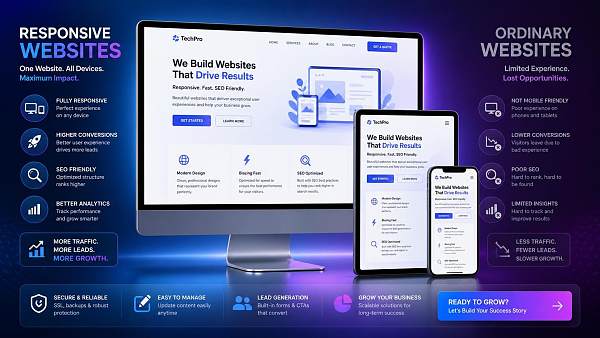
If the website is only intended as a basic presentation page, is updated infrequently, and does not rely on search traffic or mobile inquiries, a conventional website may appear sufficient in the short term. However, if a business expects its website to serve marketing purposes, such as supporting Google SEO, receiving advertising traffic, or serving overseas visitors, a responsive solution has become the more reliable choice in most cases.
The reason is straightforward. Most browsing today takes place on mobile devices. In overseas markets in particular, customers often first encounter a brand through a mobile search, a social media link, or an advertising landing page. If the text is too small, buttons are difficult to tap, or the page does not load smoothly on mobile devices, users generally will not give the website a second chance.
Therefore, the difference between responsive and conventional website development may appear to be a difference in how pages adapt to different devices, but in essence, it reflects whether a business treats its website as a genuine marketing asset. The former is more suitable for long-term growth, while the latter often remains at the stage of simply having a website.
The Core Difference Between the Two Goes Beyond Interface Display
When many people consider the differences between the two, they think only about whether the website can be viewed properly on a mobile phone. This is certainly one difference, but it is far from the only one. Responsive and conventional websites can have lasting effects on structural logic, content management, SEO performance, conversion efficiency, and maintenance methods.
The first difference is the browsing experience. If a conventional website is not deeply adapted for mobile devices, it may suffer from misalignment, scaling issues, crowded buttons, oversized images, and other problems. A responsive website automatically adjusts the order of modules, text size, and interaction methods according to the screen, making browsing more natural and usually resulting in longer user visits.
The second difference lies in development and maintenance. If a conventional website has both a desktop version and a mobile version, it often requires two sets of page logic, and content updates may need to be made repeatedly. A responsive website generally uses a unified backend and unified page structure, saving labor during later operations and reducing the likelihood of errors.
The third difference is marketing coordination. For businesses that need SEO, advertising, and social media promotion, a responsive website makes it easier to manage URLs, content, and data tracking consistently. If the desktop and mobile versions of a conventional website are separate, the tracking process can become complicated, making data analysis less intuitive.
Why Are Responsive Websites More Beneficial for SEO?
Many businesses focus on the difference between responsive and conventional website development because they are essentially concerned that their newly built website will not be found, will receive no traffic, or will generate too few inquiries. This concern is very realistic, because whether a website is suitable for SEO depends not only on its content, but also on whether its technical structure facilitates crawling and understanding by search engines.
The SEO advantage of responsive websites is first reflected in the use of a unified URL. Whether customers access the website from a computer or a mobile phone, they see the same address. This helps search engines concentrate page authority and avoids content fragmentation. If a conventional website uses a separate mobile site, improper handling can easily lead to duplicate content or diluted authority.
The second advantage is mobile friendliness. Search engines have long incorporated the mobile experience into their important evaluation criteria. Whether a page is easy to read, whether buttons can be clicked, and whether content requires horizontal scrolling all affect user experience signals. Responsive websites are more likely to meet these requirements and are more consistent with current search engine recommendations.
In addition, a responsive architecture makes unified optimization easier. When businesses operate multilingual websites, B2B marketing websites, or cross-border independent websites, SEO work usually also involves title tags, structured content, page speed, internal linking, and other elements. A unified site structure makes optimization efforts more stable and helps continuously accumulate organic traffic.
The Difference Is Even More Apparent in Customer Acquisition and Conversion
Businesses do not build websites merely to “look professional”; they build them to turn traffic into customer leads. The true value of a website is determined not only by the number of visits, but also by whether those visits result in inquiries, registrations, form submissions, or contact requests. From this perspective, the advantages of responsive websites are often more direct.
When users enter a page through a Google search, an advertisement, or a social media link, their first impression is whether the page is clear and easy to use. If the mobile page loads slowly, forms are difficult to complete, or contact information is not prominent, users will quickly leave. A responsive website can place key information, CTA buttons, and inquiry entrances more appropriately in the key positions of different devices.
This is especially important for foreign trade businesses, manufacturing factories, and cross-border brands, whose overseas customers use a wide variety of devices and browse in different time zones and usage scenarios. A responsive website can more reliably handle visits from multiple devices, reduce losses caused by device differences, and thereby improve overall lead conversion efficiency.
This is why more and more businesses no longer regard website development as a purely visual project when conducting overseas marketing. Instead, they treat it as the infrastructure of the marketing funnel. Whether a website has responsive capabilities directly affects subsequent SEO, advertising conversion, and the establishment of brand trust.
Which Businesses Should Prioritize Responsive Website Development?
If a business falls into any of the following categories, it is generally recommended to prioritize a responsive solution. The first category includes businesses that clearly plan to conduct Google SEO, because they need to continuously build search authority and mobile experience advantages. The second category includes businesses that run Google Ads or Facebook advertising over the long term, because the mobile performance of an advertising landing page directly affects conversion costs.
The third category includes businesses that need multilingual corporate websites, overseas independent websites, or B2B inquiry websites. Such projects usually cover multiple countries and device scenarios, and a unified structure is more efficient to manage than multiple sets of pages. The fourth category includes businesses planning to operate content, product pages, and case study pages over the long term, for which a responsive website is more convenient to expand later.
Conversely, if the website is only a temporary campaign page with a short lifecycle, limited traffic, and no SEO goals, a conventional page may meet short-term needs. However, this is generally a special project scenario rather than the mainstream choice for a corporate website or long-term marketing site.
What Issues Should Businesses Focus on Most When Evaluating Their Options?
Rather than repeatedly comparing concepts, it is better to look directly at several key decision points. First, consider whether the website needs to support customer acquisition. If the answer is “yes,” a responsive website should be prioritized. Second, consider whether target customers will access the website frequently on mobile devices. When targeting overseas customers, the answer is usually also “yes.”
Third, consider whether the business will need to continuously update content, conduct SEO, or run advertising campaigns in the future. As long as there will be substantial ongoing operations, a website with a unified structure will reduce costs. Fourth, consider whether the service provider has a marketing perspective. Some website development companies can create pages, but do not design them from the perspectives of indexing, speed, conversion paths, and promotional coordination. Such websites can have difficulty delivering value after launch.
For business managers, the question they should really ask is not “Will a responsive website cost a little more?” but “Which solution can better support customer acquisition efficiency over the next three years?” If saving on the initial investment leads to wasted traffic, page rework, and low conversion rates later, the overall cost may actually be higher.
Conclusion: Understanding the Difference Between Responsive and Conventional Website Development Comes Down to Marketing Results
Overall, the difference between responsive and conventional websites is not limited to the technical level. They differ significantly in mobile experience, SEO performance, content maintenance, advertising traffic handling, and conversion efficiency. For businesses that hope to acquire customers through their websites and enhance their international brand image, a responsive website is generally more aligned with the current market environment.
Therefore, when making a decision, businesses should not focus only on website development prices or page styles. Instead, they should return to the more fundamental questions: Will the website need to be indexed by search engines in the future? Will it need to receive advertising traffic? Will it allow global customers to browse smoothly on different devices? If the answer is yes, a responsive website is often more worthwhile and can better amplify marketing value.
Amid the trend toward integrated website and marketing services, a truly effective website should not only present a business, but also be found, visited, and understood, ultimately generating inquiries and growth. Understanding the difference between responsive and conventional website development is essentially about choosing a more sustainable digital growth foundation for the business.
Related Articles


Related Products
 Yiyingbao SaaS Intelligent Website Building and Marketing SystemYiyingbao SaaS Intelligent Website Building and Marketing System, AI-powered no-code website building, rapid creation of multilingual B2B international websites in 10 minutes, global server acceleration, AI-powered SEO optimization, helping businesses connect efficiently with global markets. The perfect integration of technology and operation makes building an international trade website remarkably simple
 AI+SEM Intelligent Advertising Marketing SystemAI+SEM drives intelligent ad creation, empowering full-funnel precision advertising marketing. The system automatically generates weekly/monthly reports, AI recommends keywords and target countries, monitors core metrics in real-time with intelligent alerts, and enables one-click high-conversion ad solutions to help quickly acquire customers and improve ROI.
 AI+SEO Dual-Engine System Optimization ServicesYiyingbao’s AI+SEO dual-engine optimization system helps foreign trade enterprises acquire high-quality organic traffic through AI-powered keyword research, content generation, and comprehensive technical optimization, significantly improving search rankings and conversion rates.
 AI+SNS Social Media Marketing SystemYingbao AI+SNS Social Media Marketing System - Precision social capture for the social media era. Supports one-click content synchronization across major platforms like Facebook and LinkedIn. AI intelligently rewrites posts for enhanced relevance. 24/7 AI customer service and user profiling analysis empower businesses to efficiently expand into global markets.
 AI+SEO营销解决方案易营宝AI+SEO营销解决方案,通过AI批量写作、智能生成TDK、精准关键词扩词等功能,全面优化网站SEO效果,提升流量与转化率。助力企业构建高效智能网站新生态。
 AI+SEM Advertising Marketing SolutionsAI+SEM Advertising Marketing Solution leverages AI technology to deeply empower SEM ad campaigns. It automatically generates weekly/monthly reports using AI, presenting account data across multiple dimensions for comprehensive insights into campaign performance and trends. The system precisely recommends keywords and target countries, intelligently generates high-conversion ad copy, and enables one-click activation of efficient campaign plans to help businesses rapidly acquire customers. Simultaneously, it monitors core metrics in real time, intelligently identifies abnormal fluctuations, and issues timely alerts to ensure stable, high-return advertising results.
 Domain Name ServicesEasyWin provides professional domain name services, including intelligent queries, one-stop registration, brand protection, and full lifecycle management, helping businesses build a digital brand image.
 EasyOperate B2C Cross-Border E-Commerce Platform & Independent WebsiteEasyStore B2C Cross-border E-commerce Independent Store is an intelligent website building and cross-border e-commerce integrated solution independently developed by EasyStore Information Technology (Beijing) Co., Ltd. The system is specially designed for small and medium-sized as well as large export enterprises, integrating 'website building, operation, marketing, advertising, and conversion' into one, helping enterprises quickly establish cross-border e-commerce independent stores to achieve brand globalization and global sales growth.
The platform supports multiple languages, multiple currencies, and multi-channel marketing, with built-in AI intelligent translation and SEO optimization systems, suitable for mainstream markets such as Southeast Asia, Europe and America, Latin America, and the Middle East, assisting Chinese manufacturing enterprises in efficiently deploying international e-commerce strategies. SSL证书易营宝提供专业SSL安全证书服务,包括单域名和泛域名证书,确保网站数据传输加密、身份验证和完整性保护,助力企业建立安全可信的在线业务环境。









