









- Which customer acquisition channels will be affected by cross-border marketing trends in 2026?Sep 06, 2026View details
- Which homogenization risks should be considered in an analysis of the AI-powered website building industry?Aug 30, 2026View details
- How Will AI Marketing Trends 2026 Change Advertising Budget AllocationAug 28, 2026View details
- Is the EV SSL certificate market shrinking or upgrading? How should companies assess certificate procurement?Aug 11, 2026View details
- Why the old AMP SEO 2020 practices no longer work and what has changed in current optimization prioritiesAug 02, 2026View details
- How to Choose Topics for an Industry News Section to Attract More Organic Search TrafficJul 29, 2026View details
What is the relationship between responsive design and building an independent website?
What is the relationship between responsive design and independent website development? Simply put, it determines the website experience on mobile phones, tablets, and computers, and directly affects SEO performance, user engagement, and conversion results. It is the foundation for successful operation of an independent website.
Why can't companies ignore responsive design when building an independent website?
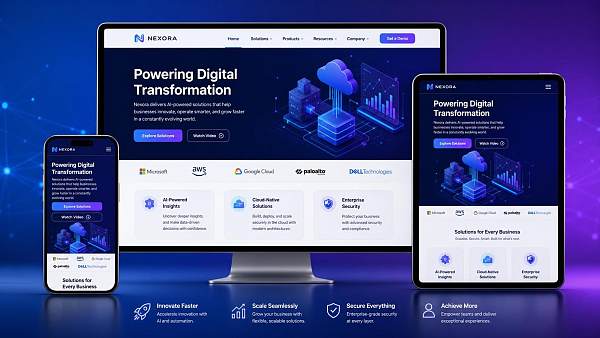
When discussing independent website development, many companies tend to focus on whether the pages look attractive, whether the backend is easy to use, and whether the website can be launched quickly, while overlooking a more fundamental question: Is the browsing experience consistent across different devices? This is precisely the core value of responsive design.
Responsive design refers to a website's ability to automatically adjust its page layout, image sizes, navigation structure, and content presentation according to the screen size, resolution, and device type used by visitors. It is not simply about making a website accessible on mobile devices, but about enabling smooth browsing and conversion across different terminals.
The goal of independent website development has never been merely to create a URL, but to build a digital asset that can be promoted, indexed, and converted. If a website loads slowly on mobile devices, has difficult-to-click buttons, or contains forms that are difficult to complete, even the best advertising and SEO traffic will be wasted.
- For B2B foreign trade companies, purchasing decision-makers often browse company information on their mobile phones first. A poor above-the-fold experience can directly affect their willingness to submit inquiries.
- For B2C cross-border sellers, mobile purchases usually account for a higher proportion of orders. An incompatible page structure can significantly reduce the add-to-cart rate and payment conversion rate.
- For companies expanding their brands overseas, responsive design is also related to maintaining a consistent brand image and avoiding disordered layouts and visual inconsistencies across different devices.
What is the relationship between responsive design and independent website development? First, consider the core impact chain
If the relationship between responsive design and independent website development had to be summarized in one sentence, it would be this: responsive design determines whether an independent website can truly accommodate traffic from multiple channels and convert visits into inquiries, orders, or brand awareness.
For the integrated website and marketing services industry, website development and customer acquisition are never separate. Site structure, content presentation, page speed, terminal compatibility, form paths, and landing page logic are all directly related to the effectiveness of SEO optimization, advertising, and social media traffic acquisition.
The table below can help companies quickly understand the practical role of responsive design in independent website development.
On the surface, responsive design may appear to be a front-end display issue. From the perspective of business results, however, it actually affects customer acquisition efficiency, advertising costs, and the website lifecycle. Therefore, if responsive design is not properly implemented during independent website development, subsequent marketing investments will often produce half the result with twice the effort.
In which scenarios does responsive design have a more significant impact on independent website performance?
Foreign trade inquiry websites
The core goal of foreign trade companies is usually to obtain qualified inquiries. Many overseas buyers first search for product keywords on their mobile phones, review company qualifications and case studies, and then decide whether to communicate further. If the mobile page is crowded with text, product specification tables are misaligned, or contact buttons are not prominent, inquiries will be lost significantly.
Cross-border e-commerce independent websites
Cross-border online stores rely even more on the smoothness of the mobile shopping process, including product image display, specification selection, shopping carts, payment pages, and logistics information. When responsive design is inadequate, the problem is often not that users “do not like it,” but that they simply cannot complete their purchases smoothly.
Advertising landing pages
Whether the traffic comes from Google Ads or Facebook Ads, a large amount of it originates from mobile devices. As the cost per advertising click continues to rise, if a landing page cannot load quickly and communicate its value clearly, companies will face the typical problem of receiving clicks but no conversions.
Multilingual brand websites
Multilingual websites also face issues such as inconsistent text lengths, different layout rules, and differences in reading direction. Responsive design must not only adapt to devices, but also maintain stable presentation after language switching, which is particularly important for global market coverage.
What responsive capabilities should companies focus on when purchasing independent website services?
When choosing a website development service provider, many companies look only at case study styles and prices, and rarely break down the technical capabilities involved. In fact, the most direct way to understand the relationship between responsive design and independent website development is to turn it into specific selection criteria.
The table below is suitable for use in pre-purchase discussions and can help companies avoid the problem of appearing usable while being difficult to convert in practice.
For companies with limited budgets or tight delivery schedules, choosing an integrated platform with a mature template system, marketing system, and SEO capabilities is often more reliable than separately engaging design, development, and optimization teams. It is also more conducive to ongoing operations.
What common problems occur when responsive design is implemented incorrectly?
- Simply scaling down the desktop website proportionally for mobile devices, resulting in text that is too small and click areas that are too crowded, requiring users to zoom in and out frequently.
- Creating navigation levels that are too deep and mobile menus that are too long, making it difficult to reach core pages within three steps and affecting product browsing efficiency.
- Using images and videos that are too large, causing the above-the-fold content to load slowly. Users may leave after clicking an advertisement before they even see the content.
- Including too many fields in inquiry forms, increasing the completion burden on mobile devices and making them particularly unsuitable for first-time visitors.
- Translating only the text on multilingual pages without checking the layout at the same time, resulting in abnormal line breaks, blocked buttons, and misaligned content.
These problems essentially demonstrate one fact: independent website development is not about “building the website first and considering marketing later.” Traffic reception and conversion paths must be designed into the website from the development stage. Responsive design is the foundation of this logic.
Why is an integrated website and marketing service more suitable for building high-converting independent websites?
What companies really need is not merely a website that can go live, but a growth system that connects search engines, advertising platforms, social media, and AI search entry points. When the relationship between responsive design and independent website development is viewed within an integrated service, it becomes clearer: responsive design is the foundation for supporting all marketing activities.
易营宝 has long served foreign trade companies, manufacturing factories, cross-border e-commerce sellers, and brands expanding overseas. During the website development stage, it simultaneously considers multilingual layouts, SEO indexing logic, advertising landing page requirements, social media traffic paths, and AI search visibility, avoiding repeated redesigns and rework later.
- Through its self-developed cloud intelligent website development system, it shortens the period from solution confirmation to launch, making it suitable for companies with tight delivery requirements.
- By integrating the AI+SEO/GEO optimization system, it takes indexing and visibility improvement into account in advance through page structure and content layout.
- It supports different models, including multilingual websites, B2B marketing websites, and B2C cross-border online stores, making it convenient to customize solutions according to business objectives.
- It can subsequently connect with Google Ads, Facebook Ads, social media operations, and short-video marketing, reducing the cost of coordinating multiple suppliers.
For companies planning to develop markets in North America, Europe, Southeast Asia, Japan and South Korea, the Middle East, or Latin America, customer acquisition efficiency is generally more stable when responsive experience, multilingual presentation, and marketing scalability have been fully considered during the website development stage.
FAQ: Several practical questions companies care about most
What is the relationship between responsive design and independent website development? Can it be changed later?
It can theoretically be changed later, but the cost is usually higher. Responsive design affects not only page styles, but also content modules, navigation structure, image specifications, form logic, and code organization. If a website is initially built without responsive design, later changes often require a complete site reconstruction.
Can a template-based website also have good responsive design?
Yes, provided that the template itself has sound terminal adaptation logic and can reorganize content according to industry scenarios. For most small and medium-sized enterprises, combining a mature template with customized optimization is often more efficient than developing everything from scratch and is also more suitable for controlling budgets and schedules.
When building a foreign trade independent website, which is more important: mobile or desktop?
Both are important, but they serve different roles. Mobile devices are more suited to initial contact, quick browsing, and immediate communication, while desktop devices are more suitable for reviewing detailed information, downloading files, and making complex decisions. The value of responsive design is precisely to enable these two visitor paths to connect smoothly instead of favoring one at the expense of the other.
If a company also plans to conduct SEO and advertising, what should be confirmed in advance during website development?
It is recommended to confirm in advance whether the page structure supports keyword placement, whether the backend makes it easy to edit titles and descriptions, whether conversion tracking codes can be deployed, and whether landing pages can be quickly duplicated and adjusted for different advertising campaigns. These capabilities will directly affect subsequent promotion efficiency.
Why choose us
If you are evaluating the relationship between responsive design and independent website development, or preparing to build a foreign trade website, cross-border online store, multilingual brand website, or advertising landing page, you can address these questions during the solution stage instead of waiting until after launch to remedy them.
易营宝 can help you confirm the website development model, responsive adaptation solution, multilingual structure, basic SEO configuration, advertising landing page planning, and delivery schedule based on your actual business objectives. Whether you are more concerned about budget control, launch speed, promotional scalability, or localization requirements for overseas markets, you can discuss these matters with us further.
- Consultation topics include: independent website type selection, responsive page planning, and coordination of SEO and advertising requirements.
- Discussion topics include: delivery schedule, feature list, scope of multilingual support, and online store or inquiry system configuration.
- Further confirmation can cover: customized solutions, pricing methods, overseas market adaptation recommendations, and subsequent promotional and operations integration paths.
When a website is not merely a display window but the infrastructure for a company's global customer acquisition, responsive design is no longer optional. It is a step that must be prioritized and implemented correctly in independent website development.
Related Articles


Related Products
 Yiyingbao SaaS Intelligent Website Building and Marketing SystemYiyingbao SaaS Intelligent Website Building and Marketing System, AI-powered no-code website building, rapid creation of multilingual B2B international websites in 10 minutes, global server acceleration, AI-powered SEO optimization, helping businesses connect efficiently with global markets. The perfect integration of technology and operation makes building an international trade website remarkably simple
 AI+SEM Intelligent Advertising Marketing SystemAI+SEM drives intelligent ad creation, empowering full-funnel precision advertising marketing. The system automatically generates weekly/monthly reports, AI recommends keywords and target countries, monitors core metrics in real-time with intelligent alerts, and enables one-click high-conversion ad solutions to help quickly acquire customers and improve ROI.
 AI+SEO Dual-Engine System Optimization ServicesYiyingbao’s AI+SEO dual-engine optimization system helps foreign trade enterprises acquire high-quality organic traffic through AI-powered keyword research, content generation, and comprehensive technical optimization, significantly improving search rankings and conversion rates.
 AI+SNS Social Media Marketing SystemYingbao AI+SNS Social Media Marketing System - Precision social capture for the social media era. Supports one-click content synchronization across major platforms like Facebook and LinkedIn. AI intelligently rewrites posts for enhanced relevance. 24/7 AI customer service and user profiling analysis empower businesses to efficiently expand into global markets.
 AI+SEO营销解决方案易营宝AI+SEO营销解决方案,通过AI批量写作、智能生成TDK、精准关键词扩词等功能,全面优化网站SEO效果,提升流量与转化率。助力企业构建高效智能网站新生态。
 AI+SEM Advertising Marketing SolutionsAI+SEM Advertising Marketing Solution leverages AI technology to deeply empower SEM ad campaigns. It automatically generates weekly/monthly reports using AI, presenting account data across multiple dimensions for comprehensive insights into campaign performance and trends. The system precisely recommends keywords and target countries, intelligently generates high-conversion ad copy, and enables one-click activation of efficient campaign plans to help businesses rapidly acquire customers. Simultaneously, it monitors core metrics in real time, intelligently identifies abnormal fluctuations, and issues timely alerts to ensure stable, high-return advertising results.
 Domain Name ServicesEasyWin provides professional domain name services, including intelligent queries, one-stop registration, brand protection, and full lifecycle management, helping businesses build a digital brand image.
 EasyOperate B2C Cross-Border E-Commerce Platform & Independent WebsiteEasyStore B2C Cross-border E-commerce Independent Store is an intelligent website building and cross-border e-commerce integrated solution independently developed by EasyStore Information Technology (Beijing) Co., Ltd. The system is specially designed for small and medium-sized as well as large export enterprises, integrating 'website building, operation, marketing, advertising, and conversion' into one, helping enterprises quickly establish cross-border e-commerce independent stores to achieve brand globalization and global sales growth.
The platform supports multiple languages, multiple currencies, and multi-channel marketing, with built-in AI intelligent translation and SEO optimization systems, suitable for mainstream markets such as Southeast Asia, Europe and America, Latin America, and the Middle East, assisting Chinese manufacturing enterprises in efficiently deploying international e-commerce strategies. SSL证书易营宝提供专业SSL安全证书服务,包括单域名和泛域名证书,确保网站数据传输加密、身份验证和完整性保护,助力企业建立安全可信的在线业务环境。









