









- Amazon Raises Fulfillment Fees Twice, Yet the Median Platform Fee Remains Around 40%Oct 22, 2026View details
- AliExpress and YouTube Partner to Expand Marketing Opportunities for Chinese Brands Going GlobalOct 22, 2026View details
- Publicis says AI marketing is developing at two speeds, with agentic AI helping win clientsOct 21, 2026View details
- Salesforce Plans to Acquire Braze for $5.66 Billion to Enhance AI Marketing CapabilitiesOct 21, 2026View details
- Levanta’s Inaugural China Summit Held in Shenzhen, Focusing on AI and Cross-Border Brand GrowthOct 20, 2026View details
- The October Edition of the 2026 GGE Shenzhen Cross-Border E-Commerce Expo OpensOct 20, 2026View details
Are AI-built websites suitable for hardware fastener companies?
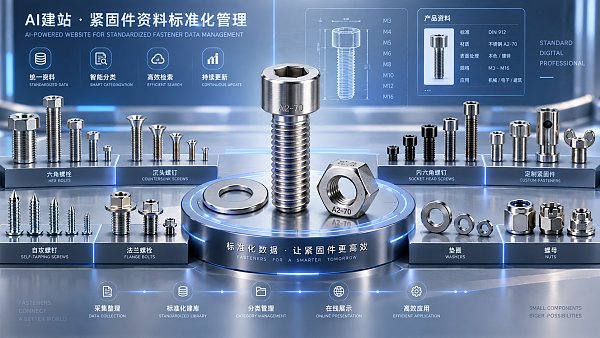
It is suitable, provided that AI website building is treated as a production tool for a hardware fastener export website, rather than a shortcut for automatically generating a few pages of English copy. Fastener procurement usually begins with comparing specifications, followed by confirmation of material, surface treatment, property class, supply method, and operating conditions. If a website displays only broad category names such as “bolts, nuts, and washers,” it will be difficult to capture search traffic with clear technical requirements, even if the pages are created quickly. It will also be harder to reduce the time spent on repeated confirmations before an inquiry.
The value of AI website building for hardware fastener export websites lies in organizing existing product information, drawing parameters, application scenarios, and multilingual pages more quickly and consistently. It is particularly suitable for situations with many SKUs, specification patterns across product series, and the need to cover multiple overseas markets. However, if material data is disorganized, specification naming is inconsistent, or product images cannot be matched to models, building a website first will only replicate the existing problems across more pages.
Professional presentation cannot rely solely on product categories
Fastener pages need to enable visitors to determine in a short time whether a product is close to their target model. An effective product page should generally place the product name, head type or structure, thread type, size range, material, heat treatment or surface treatment, strength or performance description, and applicable environment in locations that can be scanned quickly. For non-standard parts, it should also specify available drawings, samples, or key customization information, rather than using a vague statement such as “customization supported.”
For example, although all are stainless steel fasteners, the material information presented on the page should differ for indoor equipment connections, installations in humid environments, and components exposed to corrosive media. Likewise, treatments such as galvanizing, Dacromet-type coatings, and blackening are associated with corrosion resistance, appearance, coefficient of friction, and assembly requirements, and should not be merely a decorative line of text below an image. If a product is used in high-vibration positions, the locking structure, matching washers, or locking method should also be specified. If wood, sheet metal, or concrete installation is involved, the thread form and installation method should likewise be explained separately.
AI can generate initial page drafts in batches based on standardized fields, but it cannot replace parameter verification. Once information such as pitch, thread profile, length, imperial and metric units, and width across flats is confused, the page may generate mismatched inquiries. Before creating content, the field order and unit notation for the same product family should first be defined to avoid describing the same performance attribute differently across pages.
The challenge of multilingual pages lies in terminology accuracy, not the volume of translation
In overseas searches, fastener names often vary according to industry conventions. Some markets search by product structure, while others directly enter the material, size, thread form, or application scenario. Translating Chinese product names word by word into foreign languages often results in terminology that does not match local purchasing practices. When AI generates multilingual content, it should be based on confirmed primary keywords and specification terms before expanding to related applications, rather than allowing the model to infer product definitions on its own.
Broad terms such as “stainless steel screw” can be used on category pages, but specific product pages must further distinguish structural information such as self-tapping, machine screws, socket head, countersunk head, and pan head. For bolts and nuts, thread systems, grades, and matching relationships are more meaningful for search than descriptive copy. Multilingual versions should not directly share all text either: length units, packaging expressions, industry terminology, and common search combinations need to be reviewed separately.
The language relationship between pages also affects indexing. Each language should have independent, complete, and accessible page content. It is not sufficient to switch only a few titles on the front end while leaving the main content unchanged. Category pages, series pages, and individual product pages should form a clear hierarchy so that search engines can understand the relationship of “product category—structural type—specification or application.” If many pages for similar specifications differ only by model replacement, they can easily create duplicate content. Common technical descriptions can be consolidated on series pages, while individual product pages should focus on dimensions, materials, drawings, and information required for inquiries.
SEO indexing and inquiry conversion require different pages to serve different purposes
Many websites place all their emphasis on the homepage, resulting in a homepage filled with product keywords while specific pages lack searchable content. For fasteners, category pages are suitable for explaining the product range and main selection criteria, product pages address search demand for specific model or structural terms, and application pages are used to connect products with installation scenarios. The purposes of these three types of pages differ, so they do not need to be written in the same format.
Inquiry forms should also match the fastener business. If only a name, email address, and message box are provided, the result is often vague requirements that cannot be quoted. Fields can be set around the product model or image, dimensions, material, surface treatment, estimated quantity, target market, and drawing attachments. Some fields should remain optional to avoid interrupted submissions caused by overly long forms. Downloadable materials, dimension drawings, and packaging information on the page should remain consistent with the actual supply status. When models are updated, related links should also be checked at the same time.
The three types of rework most likely to occur with AI website building
The first is importing the product catalog directly and publishing it in batches. Original spreadsheets often contain internal abbreviations, old models, duplicate images, and missing fields. AI may use these to complete the copy, making it appear complete while actually combining different specifications in the description. Before publishing, spot checks should be conducted by product family, with particular attention to the correspondence between models, units, materials, and images.
The second is overstating performance descriptions. Whether a fastener is suitable for outdoor use, coastal environments, high temperatures, or high loads depends on the material, coating, installation method, and actual operating conditions. Pages may describe design features and available options, but unconfirmed weather resistance, load-bearing capacity, or compatibility should not be presented as absolute conclusions. Especially where assembly torque, preload, and safety applications are involved, technical information must come from confirmed parameter sources.
The third is publishing without maintenance. New dimensions, discontinued specifications, changes in packaging methods, and drawing version updates can all affect search pages and inquiry quality. AI is suitable for assisting with organizing change content, generating pages with the same structure, and checking the consistency of basic copy. Product managers must still retain responsibility for reviewing technical fields, inventory availability, and final published content.
To determine whether to adopt AI website building, first assess whether existing information can answer three questions: What exactly is the product? Under what conditions is it used? What still needs to be confirmed before an inquiry? If these questions can be answered consistently, AI can significantly shorten the preparation time for multilingual website building and content maintenance. If the answers are still scattered across chat records, image files, and personal experience, organize the product data first before beginning website construction. Only then will subsequent SEO indexing and inquiry quality have a reliable foundation.
Related Articles
 Can an export website built with AI be migrated to another platform?
 Is an AI website builder suitable for creating a Japanese-language corporate website?
 Why Does Responsive Design on AI-Built Websites Look Misaligned on Mobile?

Related Products
 Yiyingbao SaaS Intelligent Website Building and Marketing SystemYiyingbao SaaS Intelligent Website Building and Marketing System, AI-powered no-code website building, rapid creation of multilingual B2B international websites in 10 minutes, global server acceleration, AI-powered SEO optimization, helping businesses connect efficiently with global markets. The perfect integration of technology and operation makes building an international trade website remarkably simple
 AI+SEM Intelligent Advertising Marketing SystemAI+SEM drives intelligent ad creation, empowering full-funnel precision advertising marketing. The system automatically generates weekly/monthly reports, AI recommends keywords and target countries, monitors core metrics in real-time with intelligent alerts, and enables one-click high-conversion ad solutions to help quickly acquire customers and improve ROI.
 AI+SEO Dual-Engine System Optimization ServicesYiyingbao’s AI+SEO dual-engine optimization system helps foreign trade enterprises acquire high-quality organic traffic through AI-powered keyword research, content generation, and comprehensive technical optimization, significantly improving search rankings and conversion rates.
 AI+SNS Social Media Marketing SystemYingbao AI+SNS Social Media Marketing System - Precision social capture for the social media era. Supports one-click content synchronization across major platforms like Facebook and LinkedIn. AI intelligently rewrites posts for enhanced relevance. 24/7 AI customer service and user profiling analysis empower businesses to efficiently expand into global markets.
 AI+SEO营销解决方案易营宝AI+SEO营销解决方案,通过AI批量写作、智能生成TDK、精准关键词扩词等功能,全面优化网站SEO效果,提升流量与转化率。助力企业构建高效智能网站新生态。
 AI+SEM Advertising Marketing SolutionsAI+SEM Advertising Marketing Solution leverages AI technology to deeply empower SEM ad campaigns. It automatically generates weekly/monthly reports using AI, presenting account data across multiple dimensions for comprehensive insights into campaign performance and trends. The system precisely recommends keywords and target countries, intelligently generates high-conversion ad copy, and enables one-click activation of efficient campaign plans to help businesses rapidly acquire customers. Simultaneously, it monitors core metrics in real time, intelligently identifies abnormal fluctuations, and issues timely alerts to ensure stable, high-return advertising results.
 Domain Name ServicesEasyWin provides professional domain name services, including intelligent queries, one-stop registration, brand protection, and full lifecycle management, helping businesses build a digital brand image.
 EasyOperate B2C Cross-Border E-Commerce Platform & Independent WebsiteEasyStore B2C Cross-border E-commerce Independent Store is an intelligent website building and cross-border e-commerce integrated solution independently developed by EasyStore Information Technology (Beijing) Co., Ltd. The system is specially designed for small and medium-sized as well as large export enterprises, integrating 'website building, operation, marketing, advertising, and conversion' into one, helping enterprises quickly establish cross-border e-commerce independent stores to achieve brand globalization and global sales growth.
The platform supports multiple languages, multiple currencies, and multi-channel marketing, with built-in AI intelligent translation and SEO optimization systems, suitable for mainstream markets such as Southeast Asia, Europe and America, Latin America, and the Middle East, assisting Chinese manufacturing enterprises in efficiently deploying international e-commerce strategies. SSL证书易营宝提供专业SSL安全证书服务,包括单域名和泛域名证书,确保网站数据传输加密、身份验证和完整性保护,助力企业建立安全可信的在线业务环境。









