









- Can the average annual growth rate reflect real opportunities in overseas markets?Oct 07, 2026View details
- Which customer acquisition channels will be affected by cross-border marketing trends in 2026?Sep 06, 2026View details
- Which homogenization risks should be considered in an analysis of the AI-powered website building industry?Aug 30, 2026View details
- How Will AI Marketing Trends 2026 Change Advertising Budget AllocationAug 28, 2026View details
- Is the EV SSL certificate market shrinking or upgrading? How should companies assess certificate procurement?Aug 11, 2026View details
- Why the old AMP SEO 2020 practices no longer work and what has changed in current optimization prioritiesAug 02, 2026View details
How to build Google AMP? A detailed explanation from page specifications to the launch process
Before building a website with Google AMP, first clarify your goals and scope of application.
How to build a website with Google AMP? Don't rush to write pages. AMP is not simply compressed web pages, but a more rigorous set of page specifications. Its core goal is to make mobile pages load faster, display more stably, and handle search traffic more easily.
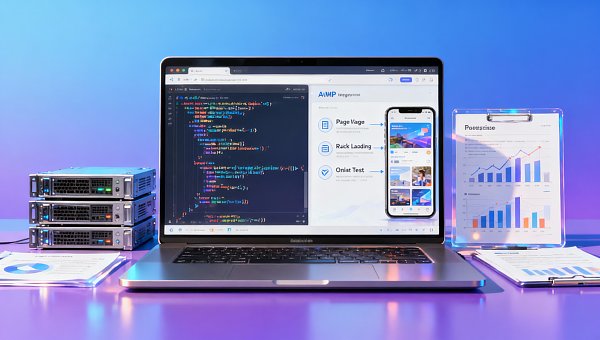
For project advancement, the most important value of Google AMP for website building is not just speed. More practically, it helps teams standardize page structure, resource loading, event tracking, and deployment processes from the outset, reducing rework later on.
However, AMP isn't suitable for all pages. News pages, event pages, special topic pages, blog pages, and advertising landing pages are generally better suited for priority deployment. This is because these types of pages rely more on loading speed and mobile experience, and also place greater emphasis on clicks and dwell time at search entry points.
For complex member centers or highly interactive backend pages, using Google AMP directly for website building may cost more than it benefits. In actual business operations, it's often more reliable to pilot the system on pages with high traffic, high conversion rates, and a high percentage of mobile visits.
Page guidelines are the first hurdle to overcome when building a website with Google AMP.
The reason why Google AMP website building often gets stuck is usually not a design issue, but a compliance issue. AMP has clear restrictions on HTML tags, script calls, style sizes, and resource references. If any one of these is not compliant, the page may become unusable.
First, the structure must be clean enough.
AMP pages require the use of specific attributes and standard components. Regular modules such as images, videos, ad placements, and forms often need to be replaced with AMP-specific tags. In other words, the original generic template cannot be directly copied.
Second, script calls are strictly limited.
Custom scripts cannot be loaded arbitrarily. Many pop-up windows, carousels, and dynamic filtering functions that rely on front-end scripts need to be re-evaluated. If this is not clearly defined in the early stages of the project, it will lead to continuous modifications and disruptions to the development schedule later on.
Third, style control should be converged in advance.
Google AMP emphasizes lightweight design. Stylesheet code should not be endlessly stacked, and visual schemes should avoid excessive complexity. A common mistake is to complete a website as a regular site first and then try to convert it to AMP. The result is often that modifications become impossible or the site becomes increasingly messy.
Therefore, a more reliable approach is to simultaneously confirm the component whitelist, page information hierarchy, and first-screen display rules during the prototyping stage. This allows technical and design teams to collaborate on the same blueprint, significantly accelerating the process.
The recommended implementation process for building a website using Google AMP is to follow six steps.
From a management perspective, the biggest problem with building a website with Google AMP is making changes as you go. Once the process becomes fragmented, it's difficult to maintain consistency in standards, development, testing, and marketing messaging. A more practical approach typically involves six steps.
- First, confirm the scope of the pilot page, clarifying whether it is a content page, a special topic page, or a landing page.
- Next, review the page modules and mark which functions can be retained and which need to be replaced.
- Then, the AMP prototype and field list are output to unify the content structure.
- When entering the development phase, validation, caching, and event tracking logic are handled synchronously.
- The testing phase focuses on checking compatibility, loading speed, and data return.
- Finally, a phased rollout will be implemented to observe indexing, click-through rates, and conversion rates.
This process may seem routine, but what truly determines efficiency is having deliverables at each step. These include pilot checklists, component comparison tables, URL rules, event tracking documentation, validation reports, and release rollback plans. Complete documentation significantly reduces communication costs.
If a company is already implementing integrated smart website building, SEO, and advertising landing pages, then Google AMP should not be implemented in isolation; instead, it should be integrated into the overall digital project. Platforms like YiYingBao, which integrate website building, SEO optimization, advertising, and AI marketing, are generally more suitable for unified planning to avoid the situation where pages are fast but the conversion path is broken.
Four key points most easily overlooked before launch
Many teams focus on completing development but neglect the details before launch. Whether Google AMP website building can truly deliver results often hinges on these key moments.
Has the specification verification passed?
A page that can be opened does not mean AMP is working. You must check the official validation results to confirm that the page has no structural errors, missing components, or abnormal resources. Otherwise, although it may appear normal after deployment, its search performance may be unstable.
Is the data statistics complete?
Many teams only discovered after launch that critical actions such as form submissions, button clicks, and phone calls were not being properly logged. As a result, Google AMP's only advantage in website building is its speed, which cannot support subsequent optimization decisions.
Have SEO relationships been properly handled?
If both regular pages and AMP pages exist, the mapping relationship must be clearly defined. Standard tags, link mappings, sitemaps, and indexing paths all need to be checked in advance. Otherwise, duplicate indexing can easily occur, and even lead to diluted page authority.
Has the conversion path been oversimplified?
Google AMP emphasizes lightweight website design, but that doesn't mean sacrificing conversion rates. Contact information, inquiry entry points, product descriptions, endorsements, and FAQs should all be placed in appropriate locations. No matter how fast the page is, without actionable guidance, traffic will be difficult to retain.
Integrating AMP into the marketing closed loop will make its effects more stable.
Recent changes indicate that Google AMP website building is no longer just about front-end optimization, but rather an integral part of mobile traffic management. This is especially true for foreign trade websites, cross-border independent websites, and campaign pages, where speed, indexing, user experience, and conversion rates are inherently interconnected.
A more effective approach is to integrate AMP pages into the overall site SEO, advertising, and content marketing strategy with a unified design. For example, which pages are used for organic search, which for ad conversion, and which for brand trust building should all be planned in advance.
In industries with high compliance and high technical barriers, the team also monitors intellectual property and risk warnings in the international market. If a company is expanding its global business, it can also refer to the ideas behind building a patent-related foreign risk warning system in the context of the digital economy , integrating website construction, marketing and customer acquisition with compliance warnings into a single operational framework to reduce hidden costs during subsequent expansion.
This also means that building a website with Google AMP shouldn't be solely the responsibility of the development team. Product, design, SEO, advertising, content, and data teams all need to be involved. The clearer the responsibilities, the more efficient the post-launch optimization will be.
Recommendations for implementing Google AMP website building: First, conduct a small-scale pilot test, then standardize and replicate.
To truly make Google AMP a successful website, the safest approach isn't to roll it out all at once, but rather to first select a type of page as a template. For example, a high-traffic blog page or a core ad landing page. First, verify loading, indexing, dwell time, and conversion rates before deciding whether to expand.
- Create a template first, then copy the page to reduce redundant development.
- First, define the tracking points, then add the content to avoid data gaps.
- Run a pilot program first, then expand the program, and control the cost of trial and error.
- First, consider the business objectives, then determine the AMP coverage ratio.
Ultimately, building a website with Google AMP isn't about chasing a technical term, but about making mobile pages go live faster, get indexed more easily, and convert better. If you align standards, processes, and marketing goals from the start, the process will go much smoother.
When businesses are already implementing AI-powered website building, multilingual websites, SEO growth, and overseas customer acquisition, Google AMP is a more suitable component of their overall solution. The true value of this work lies in turning speed advantages into business advantages.
Related Articles



Related Products
 Yiyingbao SaaS Intelligent Website Building and Marketing SystemYiyingbao SaaS Intelligent Website Building and Marketing System, AI-powered no-code website building, rapid creation of multilingual B2B international websites in 10 minutes, global server acceleration, AI-powered SEO optimization, helping businesses connect efficiently with global markets. The perfect integration of technology and operation makes building an international trade website remarkably simple
 AI+SEM Intelligent Advertising Marketing SystemAI+SEM drives intelligent ad creation, empowering full-funnel precision advertising marketing. The system automatically generates weekly/monthly reports, AI recommends keywords and target countries, monitors core metrics in real-time with intelligent alerts, and enables one-click high-conversion ad solutions to help quickly acquire customers and improve ROI.
 AI+SEO Dual-Engine System Optimization ServicesYiyingbao’s AI+SEO dual-engine optimization system helps foreign trade enterprises acquire high-quality organic traffic through AI-powered keyword research, content generation, and comprehensive technical optimization, significantly improving search rankings and conversion rates.
 AI+SNS Social Media Marketing SystemYingbao AI+SNS Social Media Marketing System - Precision social capture for the social media era. Supports one-click content synchronization across major platforms like Facebook and LinkedIn. AI intelligently rewrites posts for enhanced relevance. 24/7 AI customer service and user profiling analysis empower businesses to efficiently expand into global markets.
 AI+SEO营销解决方案易营宝AI+SEO营销解决方案,通过AI批量写作、智能生成TDK、精准关键词扩词等功能,全面优化网站SEO效果,提升流量与转化率。助力企业构建高效智能网站新生态。
 AI+SEM Advertising Marketing SolutionsAI+SEM Advertising Marketing Solution leverages AI technology to deeply empower SEM ad campaigns. It automatically generates weekly/monthly reports using AI, presenting account data across multiple dimensions for comprehensive insights into campaign performance and trends. The system precisely recommends keywords and target countries, intelligently generates high-conversion ad copy, and enables one-click activation of efficient campaign plans to help businesses rapidly acquire customers. Simultaneously, it monitors core metrics in real time, intelligently identifies abnormal fluctuations, and issues timely alerts to ensure stable, high-return advertising results.
 Domain Name ServicesEasyWin provides professional domain name services, including intelligent queries, one-stop registration, brand protection, and full lifecycle management, helping businesses build a digital brand image.
 EasyOperate B2C Cross-Border E-Commerce Platform & Independent WebsiteEasyStore B2C Cross-border E-commerce Independent Store is an intelligent website building and cross-border e-commerce integrated solution independently developed by EasyStore Information Technology (Beijing) Co., Ltd. The system is specially designed for small and medium-sized as well as large export enterprises, integrating 'website building, operation, marketing, advertising, and conversion' into one, helping enterprises quickly establish cross-border e-commerce independent stores to achieve brand globalization and global sales growth.
The platform supports multiple languages, multiple currencies, and multi-channel marketing, with built-in AI intelligent translation and SEO optimization systems, suitable for mainstream markets such as Southeast Asia, Europe and America, Latin America, and the Middle East, assisting Chinese manufacturing enterprises in efficiently deploying international e-commerce strategies. SSL证书易营宝提供专业SSL安全证书服务,包括单域名和泛域名证书,确保网站数据传输加密、身份验证和完整性保护,助力企业建立安全可信的在线业务环境。









