









- Hengqin Cooperation Zone Shares Cross-Border E-Commerce Developments, Focusing on Macao-Hengqin Collaboration and International MarketsOct 24, 2026View details
- A Shenyang study highlights the development of the “cross-border e-commerce + industrial cluster” modelOct 24, 2026View details
- Three China Advertising Association GEO group standards take effect on October 23Oct 24, 2026View details
- Amazon Raises Fulfillment Fees Twice, Yet the Median Platform Fee Remains Around 40%Oct 22, 2026View details
- AliExpress and YouTube Partner to Expand Marketing Opportunities for Chinese Brands Going GlobalOct 22, 2026View details
- Publicis says AI marketing is developing at two speeds, with agentic AI helping win clientsOct 21, 2026View details
Can You Build an Independent Foreign Trade Website Without Knowing How to Code?
When preparing to launch an official website for foreign trade business, the biggest obstacle is often not product materials, but rather, “What if I don’t know how to code?” The site needs an English version, product categories, and inquiry forms, and it should also be indexed by search engines and support future advertising campaigns. Thinking about domain names, hosting, templates, plugins, and code can easily turn website building into a project that remains on hold for a long time.
Can you build an independent foreign trade website yourself without knowing how to code? Yes, provided that you choose a website-building method suitable for non-technical users and focus on content, conversion paths, and pre-launch checks. Today’s visual website-building tools and AI-assisted features can already handle the creation of most corporate websites and basic inquiry sites. However, “being able to create pages” does not mean “being able to generate leads through the website.” The areas that still require real judgment are market positioning, website structure, product presentation, and promotion preparation.
First, determine: are you building a showcase site or a lead-generation site?
When building a website for the first time, many people spend a long time selecting templates, changing colors, and adjusting animations. In the end, the website may look complete but lack a clear inquiry entry point. The reason is that they have not first distinguished the purpose of the website.
If the website is mainly intended for existing customers to view the company and its products, the page structure can be relatively simple. However, if you expect to attract new customers through search, advertising, or social media, the website must be designed around the buyer’s decision-making process. After opening a page, visitors should be able to quickly determine what you sell, which applications it is suitable for, how you differ from similar suppliers, and how to contact you or request a quotation.
For most manufacturing companies that are just beginning to enter overseas markets, it is more prudent to first build a multilingual inquiry site with a clear structure than to start with a complex e-commerce store. The website can be expanded gradually, but the first version must allow customers to find products, understand your capabilities, and submit their requirements smoothly.
What work can you complete yourself if you do not know how to code?
When using a visual editor, sections can usually be assembled by drag and drop, while text, images, buttons, and forms can be modified directly. AI tools can also help generate first drafts, translate multilingual content, organize product selling points, or suggest page modules. This type of work does not need to rely on developers, but the company still needs to provide genuine and accurate business materials internally.
- Define the main navigation, such as Home, Products, Industries Served, About Us, and Contact pages.
- Create categories by product series, avoiding placing all models on one page.
- Prepare product names, specifications, images, packaging information, minimum order requirements, and frequently asked questions.
- Clearly describe the use, materials, processes, suitable applications, and available services for each core product category.
- Set up inquiry form fields, such as name, company, email, required quantity, and purchasing requirements.
- Configure language versions and check whether pages in different languages contain mixed content, missing translations, or incorrect units.
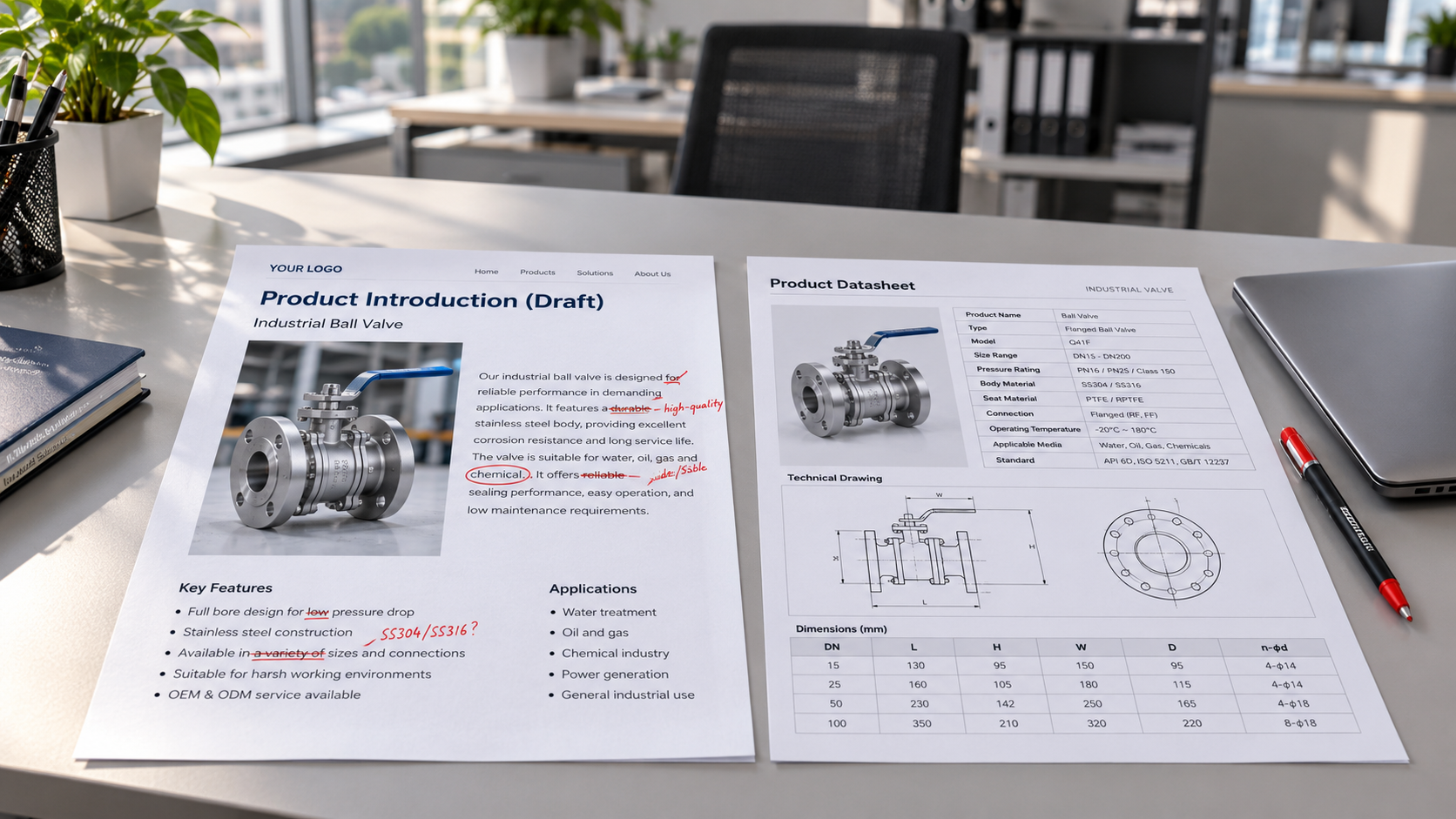
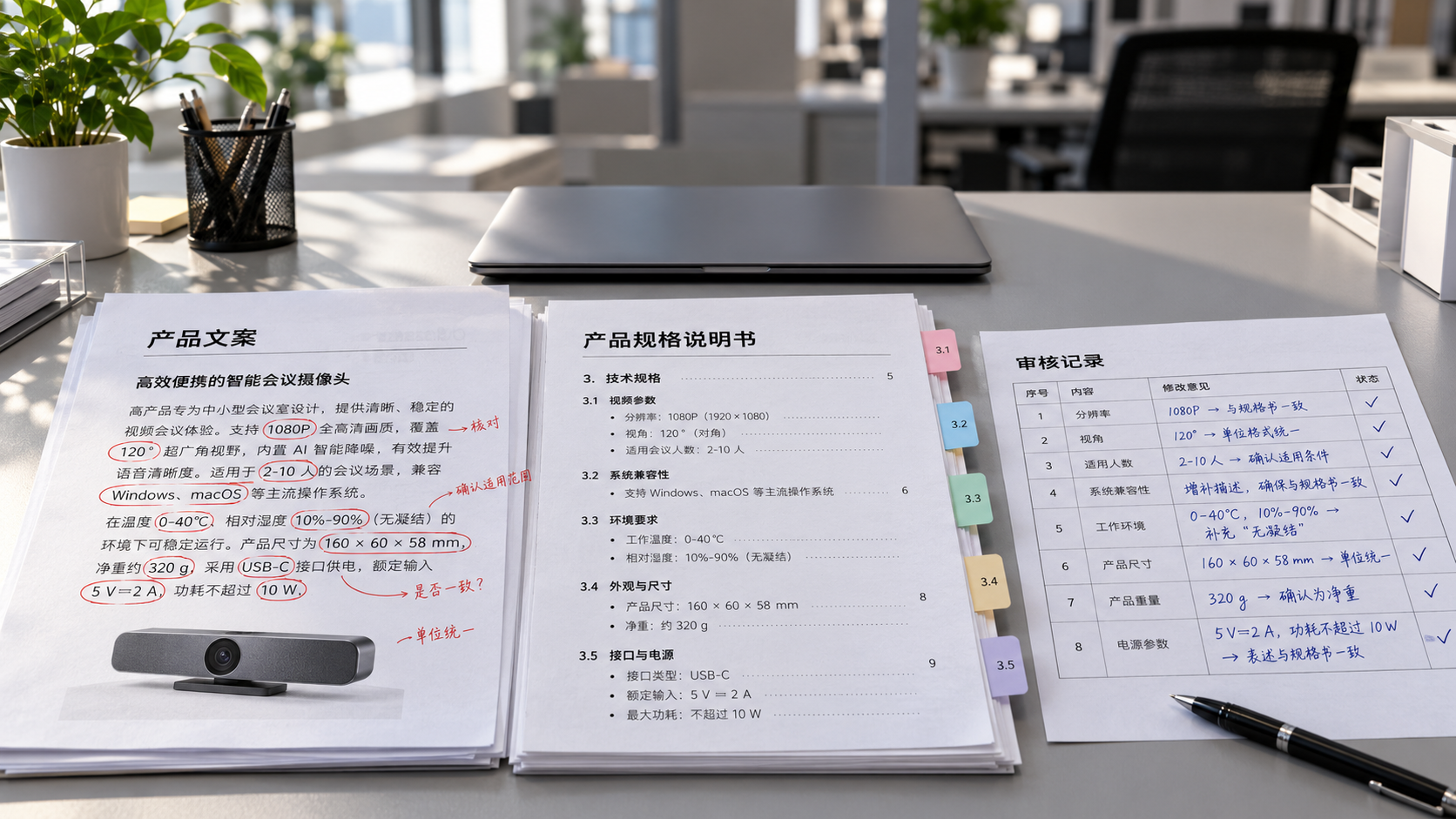
There is an easily overlooked boundary here: AI can accelerate writing and translation, but it cannot replace business verification. Information such as technical specifications, certification scope, delivery time, and applicable conditions must be verified by the company before publication. Overseas buyers often decide whether to continue communication based on these details, and vague or incorrect information will directly reduce trust.
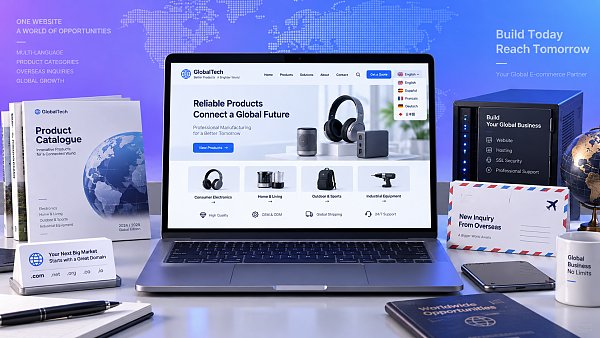
Prepare these four types of materials before building the website, and the process will go much more smoothly
Many website-building projects undergo repeated revisions not because the tools are difficult to use, but because the materials have not been fully prepared. If you discover halfway through that product images are inconsistent, English names have not been confirmed, or pricing rules cannot be made public, you will have to keep reworking the site.
Do not prepare only one main product image
At a minimum, prepare images that show the product’s appearance, details, use condition, and packaging method. If the product has multiple specifications, do not simply state “customization supported.” Instead, list the key items that can be changed, such as dimensions, material, color, surface treatment, or marking method. For products with longer purchasing decision cycles, such as equipment, components, and raw materials, technical document downloads or specification sheets should also be provided.
Think in advance about what customers will ask
An inquiry page is not simply a place to display an email address. Buyers usually care about sample availability, minimum order quantity, lead time, customization capabilities, shipping methods, and payment terms. You do not need to disclose every commercial detail, but you should let them know what information they can obtain next. The automatic reply after form submission should also explain the expected response process, so customers do not assume that their message was not delivered.
Identify one primary market and one primary language
Multilingual does not mean translating into as many languages as possible all at once. At the initial stage, you can build primary-language pages around the highest-priority target region, then expand based on the actual sources of inquiries. Units of measurement, product terminology, and purchasing habits may differ across markets, and literal translation often makes professional language sound awkward.
When building from scratch, you can proceed in this order
- Register a domain name and unify brand information. The domain name should be easy to spell and communicate, and the company name, email domain, and website name should remain as consistent as possible.
- Choose a website-building system suitable for foreign trade scenarios. Prioritize confirming support for responsive pages, multilingual functions, basic SEO settings, form management, image compression, and permission management rather than focusing only on the number of templates.
- Build the website framework first. Complete the navigation and core sections before filling in page content. The homepage is responsible for building awareness, product pages explain purchasing value, and the contact page captures inquiries.
- Add search-related information page by page. Each page should have a unique and accurate title and description; add text to images that explains their content; and avoid copying large blocks of identical descriptions on product pages.
- Complete a real browsing test on a mobile phone. Check whether the font is too small, buttons are easy to tap, images are distorted, forms can be submitted, and email notifications can be received properly.
- Connect promotional channels after launch. Before running advertisements or publishing social media links, first confirm that the landing page is consistent with the promotional content, so visitors do not fail to find the corresponding product after clicking.
The three most common misconceptions
Misconception 1: A good-looking template is automatically suitable for foreign trade. Visual presentation is only the foundation. Some templates are better suited for displaying images but do not provide space for specifications, downloadable materials, product filtering, or inquiry modules. Before choosing a template, first try filling out a page using your own product materials.
Misconception 2: The homepage is very long, while product pages are too sparse. Buyers often enter a website through specific product pages. If a product page has only one image and a few generic descriptions, it will be difficult to support inquiries even if the homepage is complete. Core product pages should be improved first instead of continually adding company introductions.
Misconception 3: Once the website is launched, it no longer needs attention. Domain resolution, form emails, page loading, broken images, and language content may all develop issues over time. Especially after adding products, adjusting models, or changing contacts, the website should be updated at the same time to prevent customers from receiving outdated information.
Which situations are suitable for doing it yourself, and which require additional technical support?
Standard corporate showcase sites, multilingual product sites, and basic inquiry sites can usually be led by business personnel, because the most critical information is already in the hands of the business team. Visual tools address the barrier to page creation, but they will not decide for a company how products should be categorized or which selling points deserve emphasis.
If the project involves complex membership systems, real-time inventory synchronization, multi-warehouse logistics, special pricing rules, data integration with third-party systems, or extensive customized interactions, the functional scope should be clearly defined before starting, and technical support should be added. Otherwise, frequently changing systems later to add missing functions usually costs more than early-stage planning.
For companies that do not understand coding, the right goal is not to turn themselves into developers, but to take control of website content and lead-generation paths: being able to update products independently, publish market pages promptly, check whether inquiries are being received properly, and continuously adjust based on promotional feedback. Only then will the independent foreign trade website you build be more than just a webpage that has “gone live.”
Related Articles
 Can content automatically generated by a website builder be published directly?
 How can you verify the factual accuracy of AI-assisted product content?
 Can an export website built with AI be migrated to another platform?

Related Products
 Yiyingbao SaaS Intelligent Website Building and Marketing SystemYiyingbao SaaS Intelligent Website Building and Marketing System, AI-powered no-code website building, rapid creation of multilingual B2B international websites in 10 minutes, global server acceleration, AI-powered SEO optimization, helping businesses connect efficiently with global markets. The perfect integration of technology and operation makes building an international trade website remarkably simple
 AI+SEM Intelligent Advertising Marketing SystemAI+SEM drives intelligent ad creation, empowering full-funnel precision advertising marketing. The system automatically generates weekly/monthly reports, AI recommends keywords and target countries, monitors core metrics in real-time with intelligent alerts, and enables one-click high-conversion ad solutions to help quickly acquire customers and improve ROI.
 AI+SEO Dual-Engine System Optimization ServicesYiyingbao’s AI+SEO dual-engine optimization system helps foreign trade enterprises acquire high-quality organic traffic through AI-powered keyword research, content generation, and comprehensive technical optimization, significantly improving search rankings and conversion rates.
 AI+SNS Social Media Marketing SystemYingbao AI+SNS Social Media Marketing System - Precision social capture for the social media era. Supports one-click content synchronization across major platforms like Facebook and LinkedIn. AI intelligently rewrites posts for enhanced relevance. 24/7 AI customer service and user profiling analysis empower businesses to efficiently expand into global markets.
 AI+SEO营销解决方案易营宝AI+SEO营销解决方案,通过AI批量写作、智能生成TDK、精准关键词扩词等功能,全面优化网站SEO效果,提升流量与转化率。助力企业构建高效智能网站新生态。
 AI+SEM Advertising Marketing SolutionsAI+SEM Advertising Marketing Solution leverages AI technology to deeply empower SEM ad campaigns. It automatically generates weekly/monthly reports using AI, presenting account data across multiple dimensions for comprehensive insights into campaign performance and trends. The system precisely recommends keywords and target countries, intelligently generates high-conversion ad copy, and enables one-click activation of efficient campaign plans to help businesses rapidly acquire customers. Simultaneously, it monitors core metrics in real time, intelligently identifies abnormal fluctuations, and issues timely alerts to ensure stable, high-return advertising results.
 Domain Name ServicesEasyWin provides professional domain name services, including intelligent queries, one-stop registration, brand protection, and full lifecycle management, helping businesses build a digital brand image.
 EasyOperate B2C Cross-Border E-Commerce Platform & Independent WebsiteEasyStore B2C Cross-border E-commerce Independent Store is an intelligent website building and cross-border e-commerce integrated solution independently developed by EasyStore Information Technology (Beijing) Co., Ltd. The system is specially designed for small and medium-sized as well as large export enterprises, integrating 'website building, operation, marketing, advertising, and conversion' into one, helping enterprises quickly establish cross-border e-commerce independent stores to achieve brand globalization and global sales growth.
The platform supports multiple languages, multiple currencies, and multi-channel marketing, with built-in AI intelligent translation and SEO optimization systems, suitable for mainstream markets such as Southeast Asia, Europe and America, Latin America, and the Middle East, assisting Chinese manufacturing enterprises in efficiently deploying international e-commerce strategies. SSL证书易营宝提供专业SSL安全证书服务,包括单域名和泛域名证书,确保网站数据传输加密、身份验证和完整性保护,助力企业建立安全可信的在线业务环境。









