









- Which customer acquisition channels will be affected by cross-border marketing trends in 2026?Sep 06, 2026View details
- Which homogenization risks should be considered in an analysis of the AI-powered website building industry?Aug 30, 2026View details
- How Will AI Marketing Trends 2026 Change Advertising Budget AllocationAug 28, 2026View details
- Is the EV SSL certificate market shrinking or upgrading? How should companies assess certificate procurement?Aug 11, 2026View details
- Why the old AMP SEO 2020 practices no longer work and what has changed in current optimization prioritiesAug 02, 2026View details
- How to Choose Topics for an Industry News Section to Attract More Organic Search TrafficJul 29, 2026View details
Can AI-Generated Foreign Trade Blog Content Be Published Directly?
“Can AI-generated foreign trade blog content be used directly?” This is one of the most common and practical questions many foreign trade companies ask after they begin using AI to write English articles. The answer is not simply yes or no: if content generated from prompts is copied directly to a website, it may seem to save time in the short term, but in the long term it can lead to inaccurate information, unnatural language, homogeneous pages, and lower-quality inquiries. However, if AI is treated as the starting point of content production rather than the end point, it can indeed significantly improve the efficiency of overseas content marketing.
For companies that rely on Google SEO, overseas social media lead generation, and inquiries through independent websites, a blog is not simply “content to publish.” It also serves to answer customer questions, build trust in products, cover long-tail search terms, and guide users to product pages or inquiry submissions. AI writes quickly, but that does not mean it has already accomplished these tasks.
Conclusion first: It can be used, but “generate and publish” is not recommended
Search engines do not automatically refuse to index an article simply because it was generated with AI assistance. What truly affects page performance is still whether the content is useful, accurate, meets searchers’ needs, and offers clear original value.
For example, an industrial valve exporter asks AI to write an English article on “how to choose an industrial valve supplier.” AI can usually provide a general framework, but it may not know the actual pressure ratings, material range, certifications, or delivery methods of the company’s products. Nor can it determine the differences between the concerns of North American buyers and Middle Eastern project clients. If the article includes parameters or commitments that do not match actual capabilities, readers will not only fail to convert but may also lose trust directly.
Therefore, can AI-generated foreign trade blog content be used directly? Only when content risk is low, information has been sufficiently constrained, and the content has undergone a quick manual review can it come close to being “ready for direct publication.” Content involving product introductions, industry technology, compliance certifications, delivery times and quotations, or market policies must be manually edited.
What content is suitable for an AI first draft, and what must be manually reviewed?
AI is more suitable for content tasks with a high degree of repetition and relatively stable structures, such as organizing article outlines based on existing materials, expanding FAQs, generating first drafts for different country markets, summarizing product application scenarios, writing multiple versions of social media posts, and supplementing existing articles with titles and summaries.
However, the following types of content cannot rely solely on model judgment:
- Technical specifications and product performance: Dimensions, materials, applicable standards, usage restrictions, and other details must be based on product documentation and information confirmed by engineering personnel.
- Certifications, regulations, and trade terms: CE, FDA, RoHS, REACH, tariffs, customs clearance requirements, and similar matters may change and also vary in their scope of application.
- Customer cases and project experience: Without genuine authorization and verifiable facts, customer names, cooperation results, or testimonials should not be fabricated.
- Localized wording: Fluent English does not necessarily mean it matches local purchasing practices. Multilingual content in German, French, Spanish, and other languages requires even more careful review of terminology and tone.
- Brand positions and sales commitments: After-sales service scope, MOQ, delivery lead times, and customization capabilities should remain consistent with the sales and delivery teams.
For many companies, the problem is not that AI “got one sentence wrong,” but that it mixes plausible yet unverified information into the entire article. These errors may not be obvious to readers unfamiliar with the industry, but actual buyers, engineers, or distributors can often spot them at a glance.
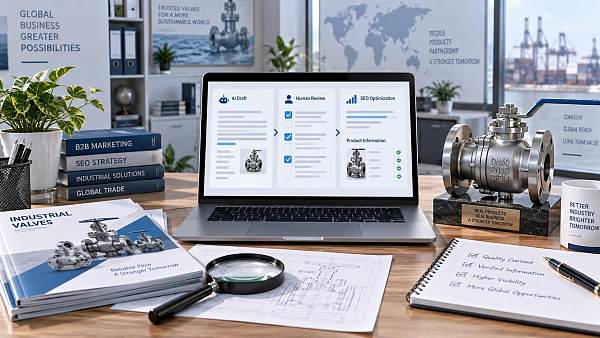
Give the AI draft a “foreign trade content checkup” before publication
Rather than repeatedly asking “can it be published directly,” a more practical approach is to establish a short and clear review process. It is usually unnecessary to rewrite every article, but the following five steps should at least be completed.
1. Verify facts; do not let “sounding professional” replace the truth
Mark each model number, specification, industry standard, certification, delivery lead time, and market conclusion in the article, and verify them against official website materials, product manuals, or internal personnel. In particular, AI tends to use broad statements such as “typically,” “widely used,” and “compliant with international standards.” If these cannot be substantiated, it is advisable to delete them or revise them into more cautious wording.
2. Confirm search intent instead of simply inserting keywords
A user searching for “how to choose a CNC machining supplier” may still be in the supplier evaluation stage, while someone searching for “custom aluminum CNC parts manufacturer” is closer to making a purchase. They need different content: the former should provide evaluation criteria, while the latter should clearly explain machining capabilities, materials, surface treatments, the inquiry process, and quality control.
Keywords should appear naturally in heading levels, opening explanations, key body paragraphs, and relevant internal links, but do not repeatedly use the same sentence merely for keyword density. What foreign trade SEO truly needs to cover is a group of related questions, rather than mechanically repeating a single term.
3. Add information that only the company knows
This is the key to turning a “generic AI article” into brand content that is “worth indexing and reading.” You can add common customer questions encountered by the factory, selection mistakes, drawing information required for sampling, packaging considerations, communication experience in different markets, or explanations of a specific process step.
There is no need to disclose sensitive business information, but readers should feel that the article comes from someone who genuinely understands the product and transaction process, rather than an answer assembled from multiple web pages.
4. Rewrite language for the target market instead of making translation-style substitutions
A common issue with foreign trade blogs is translating Chinese logic directly into English. Although the sentences may be correct, they do not read like the industry content procurement professionals usually consume. English pages typically place greater emphasis on presenting conclusions first, concise paragraphs, consistent terminology, and clear action paths. When targeting markets in different languages, literal translation alone should also be avoided; the same “supplier advantage” may need to be supported by different evidence and wording in different regions.
5. Complete the conversion path
The value of an article that ranks well but has no inquiry entry point will be greatly reduced. Before publishing, check: Does it link to the corresponding product page, category page, or case study page? Is there a consultation prompt that matches the article topic? Is the mobile form easy to complete? If readers already recognize the content but cannot find the next step, traffic can easily be lost.
An easily overlooked misconception: Changing a few words does not equal originality
Some teams, in order to increase update frequency, replace country names, product names, or a small number of adjectives in the same AI article and publish dozens of pages in bulk. This approach may create a large amount of overlapping content and can also make the website’s themes appear unfocused. Even if the pages are indexed, they may not achieve stable rankings, and it is even more difficult to establish clear industry authority.
A better approach is to build content clusters around real business operations. For example, a website exporting B2B equipment can expand from several directions, including “procurement guides,” “application industries,” “maintenance and troubleshooting,” “standards and certifications,” and “project preparation checklists.” Each article should solve one specific problem, then guide readers to product and service pages through internal links. AI is suitable for helping teams quickly build this content framework, but topic selection should still serve customer needs and the company’s business priorities.
Make AI a content assistant, not an unattended writer
For foreign trade companies with limited content resources, the most practical division of work is often this: business personnel provide real questions and materials; AI completes outlines, first drafts, and multilingual assistance; editors handle search intent, writing flow, and page structure; technical or product personnel confirm the facts; and the content is then published to an independent website where SEO elements and conversion components can be managed.
When helping companies build multilingual official websites, B2B marketing websites, and overseas promotional content, EasyBusiness also recommends this collaborative approach: use AI to improve the efficiency of topic selection, writing, and optimization, while combining website structure, Google SEO, advertising landing pages, and social media content so that every article is not merely “updated,” but can play a role in customers’ decision-making process.
Ultimately, the value of AI-generated content lies not in replacing a company’s voice, but in freeing teams from repetitive writing so they have more time to clearly communicate truly competitive products, experience, and services. The publish button may be easy to click, but conducting one more round of verification and localization before pressing it is often the dividing line between whether a foreign trade blog gains indexing, trust, and inquiries.
Related Articles



Related Products
 Yiyingbao SaaS Intelligent Website Building and Marketing SystemYiyingbao SaaS Intelligent Website Building and Marketing System, AI-powered no-code website building, rapid creation of multilingual B2B international websites in 10 minutes, global server acceleration, AI-powered SEO optimization, helping businesses connect efficiently with global markets. The perfect integration of technology and operation makes building an international trade website remarkably simple
 AI+SEM Intelligent Advertising Marketing SystemAI+SEM drives intelligent ad creation, empowering full-funnel precision advertising marketing. The system automatically generates weekly/monthly reports, AI recommends keywords and target countries, monitors core metrics in real-time with intelligent alerts, and enables one-click high-conversion ad solutions to help quickly acquire customers and improve ROI.
 AI+SEO Dual-Engine System Optimization ServicesYiyingbao’s AI+SEO dual-engine optimization system helps foreign trade enterprises acquire high-quality organic traffic through AI-powered keyword research, content generation, and comprehensive technical optimization, significantly improving search rankings and conversion rates.
 AI+SNS Social Media Marketing SystemYingbao AI+SNS Social Media Marketing System - Precision social capture for the social media era. Supports one-click content synchronization across major platforms like Facebook and LinkedIn. AI intelligently rewrites posts for enhanced relevance. 24/7 AI customer service and user profiling analysis empower businesses to efficiently expand into global markets.
 AI+SEO营销解决方案易营宝AI+SEO营销解决方案,通过AI批量写作、智能生成TDK、精准关键词扩词等功能,全面优化网站SEO效果,提升流量与转化率。助力企业构建高效智能网站新生态。
 AI+SEM Advertising Marketing SolutionsAI+SEM Advertising Marketing Solution leverages AI technology to deeply empower SEM ad campaigns. It automatically generates weekly/monthly reports using AI, presenting account data across multiple dimensions for comprehensive insights into campaign performance and trends. The system precisely recommends keywords and target countries, intelligently generates high-conversion ad copy, and enables one-click activation of efficient campaign plans to help businesses rapidly acquire customers. Simultaneously, it monitors core metrics in real time, intelligently identifies abnormal fluctuations, and issues timely alerts to ensure stable, high-return advertising results.
 Domain Name ServicesEasyWin provides professional domain name services, including intelligent queries, one-stop registration, brand protection, and full lifecycle management, helping businesses build a digital brand image.
 EasyOperate B2C Cross-Border E-Commerce Platform & Independent WebsiteEasyStore B2C Cross-border E-commerce Independent Store is an intelligent website building and cross-border e-commerce integrated solution independently developed by EasyStore Information Technology (Beijing) Co., Ltd. The system is specially designed for small and medium-sized as well as large export enterprises, integrating 'website building, operation, marketing, advertising, and conversion' into one, helping enterprises quickly establish cross-border e-commerce independent stores to achieve brand globalization and global sales growth.
The platform supports multiple languages, multiple currencies, and multi-channel marketing, with built-in AI intelligent translation and SEO optimization systems, suitable for mainstream markets such as Southeast Asia, Europe and America, Latin America, and the Middle East, assisting Chinese manufacturing enterprises in efficiently deploying international e-commerce strategies. SSL证书易营宝提供专业SSL安全证书服务,包括单域名和泛域名证书,确保网站数据传输加密、身份验证和完整性保护,助力企业建立安全可信的在线业务环境。









