









- Which customer acquisition channels will be affected by cross-border marketing trends in 2026?Sep 06, 2026View details
- Which homogenization risks should be considered in an analysis of the AI-powered website building industry?Aug 30, 2026View details
- How Will AI Marketing Trends 2026 Change Advertising Budget AllocationAug 28, 2026View details
- Is the EV SSL certificate market shrinking or upgrading? How should companies assess certificate procurement?Aug 11, 2026View details
- Why the old AMP SEO 2020 practices no longer work and what has changed in current optimization prioritiesAug 02, 2026View details
- How to Choose Topics for an Industry News Section to Attract More Organic Search TrafficJul 29, 2026View details
How can you determine whether low overseas advertising ROI is caused by a landing page issue?
Introduction: Is low ROI from overseas advertising caused by the landing page? When click volume is sufficient but inquiries are scarce, businesses need to examine page loading, multilingual content, trust signals, and conversion paths one by one to identify the key factors truly dragging down advertising returns.
For foreign trade companies and cross-border sellers, a decline in advertising ROI does not necessarily mean there is a problem with the landing page. Ad placement, target markets, product pricing, traffic quality, and sales follow-up can all affect final returns. The truly effective way to assess the issue is to first identify where the conversion funnel is breaking down.
If the ad click-through rate is normal and the cost per click is acceptable, but time spent on the website after arrival is very short, or large numbers of visitors browse without submitting forms, adding products to the cart, or making inquiries, the landing page is likely the core issue. Conversely, if the clicks themselves are not targeted, the advertising strategy should be adjusted first.
Businesses searching for “whether low ROI from overseas advertising is a landing page issue” typically do not lack advertising platform data; rather, they lack a set of criteria that can quickly distinguish between traffic issues, page issues, and conversion issues. The following steps can be used to investigate based on actual business results.
Start with funnel data: At which step is the low ROI getting stuck?
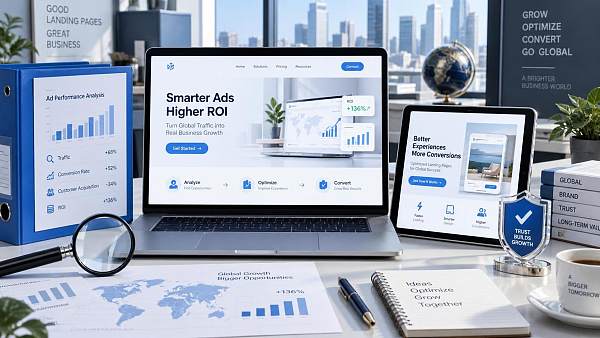
To determine whether a landing page is holding back overseas advertising ROI, do not look only at impressions, clicks, and total spend. It is recommended to break the data down into six stages: impressions, clicks, page arrivals, key actions, lead submissions, and conversions. First identify where the conversion rate drops sharply, then determine optimization priorities.
For example, if Google Ads or Facebook ads have a high click-through rate but landing page visits are significantly lower than ad clicks, this usually means that the page loads too slowly, redirects are abnormal, or mobile compatibility is insufficient. The ad has generated interest in visiting, but users leave before they have actually seen the core content.
If visits and clicks generally match, but the bounce rate is high and average engagement time is short, the issue is most likely with above-the-fold information. Users do not quickly see the product value, applicable scenarios, pricing logic, or next-step action entry point, so they cannot confirm whether the page matches the ad promise.
If users browse product pages, case study pages, or even quotation pages, but inquiries and orders remain scarce, the issue cannot simply be attributed to page design. At this point, product competitiveness, MOQ, lead time, payment terms, logistics costs, and the sales team's response speed should also be checked to avoid misallocating optimization budgets.
Inconsistency between the ad promise and above-the-fold content is the most common cause of visitor loss
When overseas users click an ad, they often have clear expectations. If an ad says “direct supply from an industrial valve manufacturer” but the landing page above the fold contains only a corporate video or a generic brand slogan, users will immediately doubt whether they have reached the right page. This mismatch directly lowers inquiry conversion rates.
The above-the-fold section of a high-converting landing page should answer four questions within seconds: What do you sell? Who is it for? Why is it worth choosing? What should the user do next? For B2B companies, product model ranges, certification capabilities, delivery regions, and quotation request entry points are usually more important than vague brand stories.
Different ad groups should not all lead to the same generic homepage. Users searching for “custom packaging supplier,” users clicking an ad for a specific packaging product, and users downloading an industry solution are at different procurement stages, so the corresponding page information and conversion actions should also differ.
This is especially important in multilingual markets. A Chinese website cannot simply be mechanically translated into English, German, or Spanish. Local customers have different concerns regarding delivery methods, certification terminology, size units, and purchasing habits. Insufficient localized content may generate interest from ad traffic but make it difficult to build willingness to take action.
Poor page experience can silently waste expensive overseas traffic
The cost per click for overseas advertising is generally high, and every additional second of page delay increases the risk of visitor loss. Companies should focus on actual loading speed in target countries rather than testing only under domestic network conditions. Server nodes, image sizes, the number of scripts, and third-party plugins can all affect the user experience.
Mobile must be reviewed as an independent page. Traffic from Facebook, Instagram, and TikTok is primarily mobile users. If forms have too many fields, buttons are collapsed, product images are blurry, or pop-ups block the main content, advertising budgets can easily be spent on ineffective visits.
The conversion path also needs to be short enough. B2B customers may not be willing to submit complete purchasing requirements immediately, but they may be willing to download a catalog, view specifications, communicate via WhatsApp, or request samples. A page that offers only “Buy Now” or a lengthy inquiry form will miss many potential customers who are still in the evaluation stage.
Heatmaps, session recordings, and event tracking can be used to examine real behavior: whether users scroll to the advantages section, click certification materials, exit at the form, or repeatedly search for contact details. This behavioral data is more reliable than subjective judgment and can clearly indicate what needs to be changed on the page.
Insufficient trust information can make users hesitate to submit an inquiry even after viewing the page
When overseas buyers enter an unfamiliar supplier's website, their primary concern is not whether the page looks attractive, but whether the company is genuine, the products are reliable, and communication is assured. Without trust signals, a landing page will struggle to convert high-intent traffic even if its copy matches the ad keywords.
For manufacturing companies, priority can be given to displaying real factory photos, production line capabilities, key certifications, testing processes, countries served, and genuine customer case studies. For cross-border brands or online stores, return and exchange policies, delivery timeframes, payment methods, reviews, and customer service channels should be presented clearly to reduce concerns about first-time transactions.
Trust information should be placed close to where users make decisions. Putting certifications, customer reviews, or delivery details only at the bottom of the page has limited practical effect. Product selling points, price inquiry buttons, and forms should be supported with concise proof materials to help users gain reassurance when hesitating.
Excessive promises should also be avoided. Claims such as “number one in the world,” “lowest price,” and “100% guaranteed” may reduce credibility in overseas markets. Verifiable data, specific cases, and clearly defined service scopes can generally improve the quality of inquiries from professional buyers and reduce ineffective sales follow-up.
How can you use low-cost testing to confirm whether the landing page is really the issue?
Do not redesign the entire website without validation. A more effective approach is to retain the original ad targeting and budget, create a test version of the landing page for the same ad group, change only the above-the-fold selling points, call-to-action buttons, form length, or trust modules, and then compare key conversion data.
Test only one core hypothesis at a time. For example, if you suspect users do not understand the product's purpose, optimize the above-the-fold scenario description; if you suspect the inquiry threshold is too high, reduce a ten-field form to name, email, requirements, and contact details. When there are too many variables, the results cannot guide subsequent optimization.
Companies should prioritize cost per qualified lead rather than simply pursuing the number of form submissions. One page may generate more inquiries but attract many users without purchasing authority; another may generate fewer inquiries, but sample requests and quotation requirements are more accurate, resulting in higher actual ROI.
For long-cycle B2B projects, ad leads also need to be linked to CRM conversion results. Only by tracking quotations, samples, orders, and repeat purchases can companies determine whether page optimization has genuinely increased revenue rather than merely improving surface-level conversion rates.
Conclusion: Landing pages should be treated as part of advertising
Whether low ROI from overseas advertising is a landing page issue depends on funnel data, not intuition. When ad clicks are normal, visitor loss after arriving on the site is significant, and engagement exists but inquiries are insufficient, page loading, information alignment, trust signals, and conversion paths are the areas that should be investigated first.
Advertising brings the right people in, while the landing page helps them understand the value, build trust, and take action. Through multilingual localized pages, trackable conversion events, and continuous A/B testing, companies can make every overseas advertising budget more closely aligned with real business returns.
Related Articles


Related Products
 Yiyingbao SaaS Intelligent Website Building and Marketing SystemYiyingbao SaaS Intelligent Website Building and Marketing System, AI-powered no-code website building, rapid creation of multilingual B2B international websites in 10 minutes, global server acceleration, AI-powered SEO optimization, helping businesses connect efficiently with global markets. The perfect integration of technology and operation makes building an international trade website remarkably simple
 AI+SEM Intelligent Advertising Marketing SystemAI+SEM drives intelligent ad creation, empowering full-funnel precision advertising marketing. The system automatically generates weekly/monthly reports, AI recommends keywords and target countries, monitors core metrics in real-time with intelligent alerts, and enables one-click high-conversion ad solutions to help quickly acquire customers and improve ROI.
 AI+SEO Dual-Engine System Optimization ServicesYiyingbao’s AI+SEO dual-engine optimization system helps foreign trade enterprises acquire high-quality organic traffic through AI-powered keyword research, content generation, and comprehensive technical optimization, significantly improving search rankings and conversion rates.
 AI+SNS Social Media Marketing SystemYingbao AI+SNS Social Media Marketing System - Precision social capture for the social media era. Supports one-click content synchronization across major platforms like Facebook and LinkedIn. AI intelligently rewrites posts for enhanced relevance. 24/7 AI customer service and user profiling analysis empower businesses to efficiently expand into global markets.
 AI+SEO营销解决方案易营宝AI+SEO营销解决方案,通过AI批量写作、智能生成TDK、精准关键词扩词等功能,全面优化网站SEO效果,提升流量与转化率。助力企业构建高效智能网站新生态。
 AI+SEM Advertising Marketing SolutionsAI+SEM Advertising Marketing Solution leverages AI technology to deeply empower SEM ad campaigns. It automatically generates weekly/monthly reports using AI, presenting account data across multiple dimensions for comprehensive insights into campaign performance and trends. The system precisely recommends keywords and target countries, intelligently generates high-conversion ad copy, and enables one-click activation of efficient campaign plans to help businesses rapidly acquire customers. Simultaneously, it monitors core metrics in real time, intelligently identifies abnormal fluctuations, and issues timely alerts to ensure stable, high-return advertising results.
 Domain Name ServicesEasyWin provides professional domain name services, including intelligent queries, one-stop registration, brand protection, and full lifecycle management, helping businesses build a digital brand image.
 EasyOperate B2C Cross-Border E-Commerce Platform & Independent WebsiteEasyStore B2C Cross-border E-commerce Independent Store is an intelligent website building and cross-border e-commerce integrated solution independently developed by EasyStore Information Technology (Beijing) Co., Ltd. The system is specially designed for small and medium-sized as well as large export enterprises, integrating 'website building, operation, marketing, advertising, and conversion' into one, helping enterprises quickly establish cross-border e-commerce independent stores to achieve brand globalization and global sales growth.
The platform supports multiple languages, multiple currencies, and multi-channel marketing, with built-in AI intelligent translation and SEO optimization systems, suitable for mainstream markets such as Southeast Asia, Europe and America, Latin America, and the Middle East, assisting Chinese manufacturing enterprises in efficiently deploying international e-commerce strategies. SSL证书易营宝提供专业SSL安全证书服务,包括单域名和泛域名证书,确保网站数据传输加密、身份验证和完整性保护,助力企业建立安全可信的在线业务环境。









