









- CBP Finalizes Electronic Rail Export Manifest Rule, Effective October 26, 2026Oct 26, 2026View details
- Amazon’s 2026 peak season surcharge takes effect on October 25Oct 26, 2026View details
- AI Is Eating SaaS: Three Real-World Cases in One AfternoonOct 25, 2026View details
- Exiger CEO: The SaaS Apocalypse Is Real, but It Means Something DifferentOct 25, 2026View details
- Hengqin Cooperation Zone Shares Cross-Border E-Commerce Developments, Focusing on Macao-Hengqin Collaboration and International MarketsOct 24, 2026View details
- A Shenyang study highlights the development of the “cross-border e-commerce + industrial cluster” modelOct 24, 2026View details
How Can Cross-Border E-Commerce Businesses Avoid Exaggerated Claims in AI-Generated Product Descriptions?
How Can Cross-Border E-Commerce Businesses Avoid Exaggerated Claims in AI-Generated Product Descriptions?
When using AI to generate product descriptions for cross-border e-commerce, the risk often lies in a seemingly smooth rewrite: turning “easy to clean” into “antibacterial,” “splash-resistant” into “waterproof in all weather,” or “helps you relax” into “relieves disease.” The wording becomes more appealing, but the claims go beyond the available evidence.
Avoiding exaggerated claims takes more than adding “do not make anything up” to a prompt. A more reliable approach is to connect the sources of facts, the boundaries of permitted claims, and publication review in a single workflow. AI organizes the wording, product owners confirm the facts, and localization reviewers assess whether the language is appropriate for the target market.
Check Whether Claims Are Supported, Not Just Whether They Contain Sensitive Words
Words such as “permanent,” “100 percent,” and “zero risk” should raise concern, but removing them does not make a description safe. “Suitable for all sensitive skin” makes a broad suitability claim without using an absolute adverb; “professional-grade purification” may also lead consumers to misunderstand the product’s performance, despite being vague.
Break descriptions down into verifiable claims: Are specifications such as materials and dimensions supported by the documentation? Are claims about effects backed by testing? Have the intended users or usage conditions been broadened? In particular, check what was tested. Do not apply test results for an ingredient directly to the finished product, or use a report for one model to cover an entire product line.
The key question is “What will readers understand this to mean?” If a headline implies a treatment effect, adding a disclaimer at the end of the body text is usually not enough to correct the overall impression.
Give AI a Traceable Factual Source Document
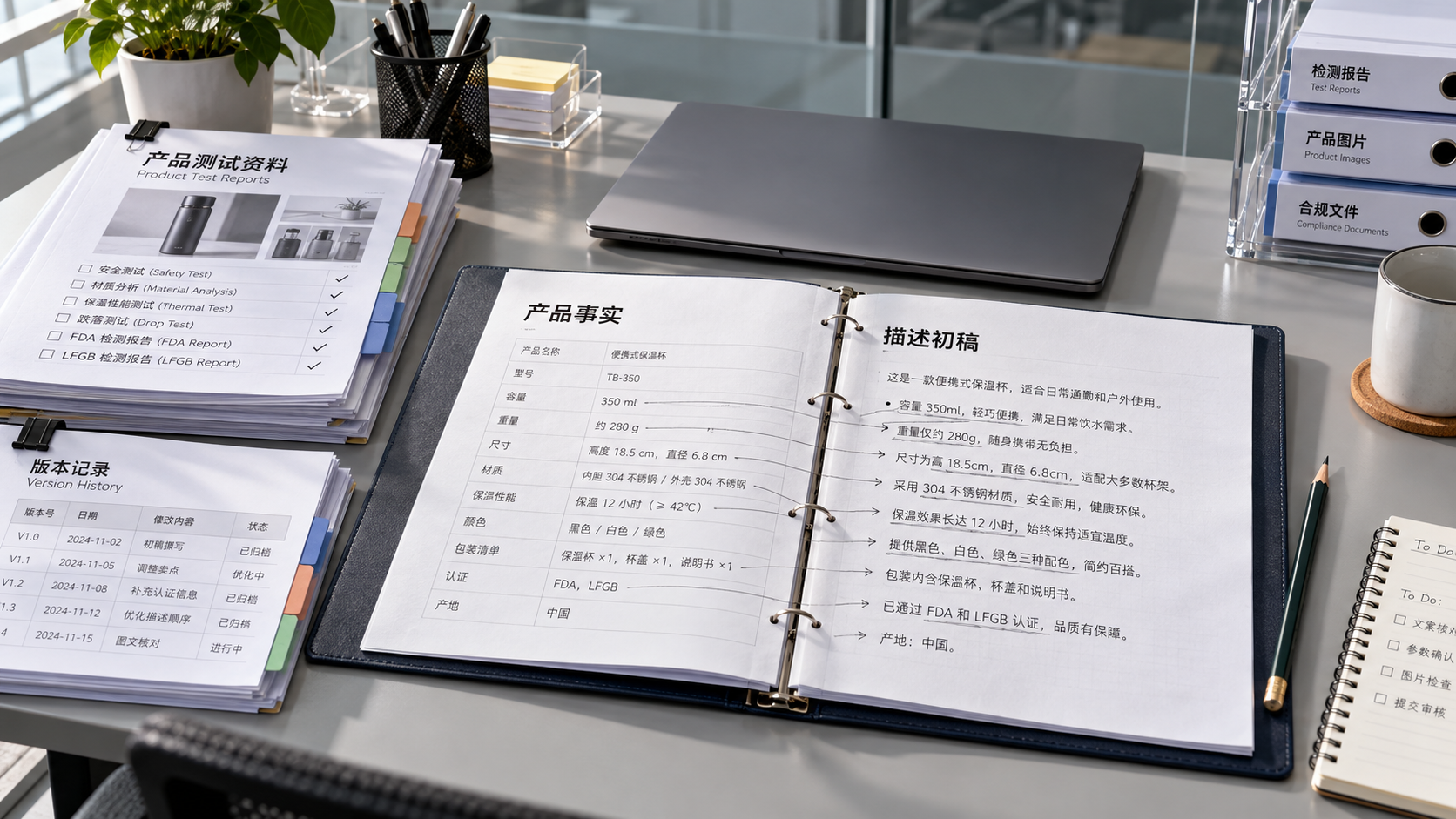
Do not provide only the product name and competitor links. Competitor pages can be a reference for structure, but they are not evidence of product efficacy. Before generating copy, prepare a product fact sheet for each model, including at least the following:
- Confirmed specifications: materials, dimensions, capacity, compatibility range, and the corresponding document version.
- Permitted performance claims: supporting documents, test subjects or items, test conditions, and the original conclusions.
- Limitations and unknowns: unsuitable scenarios, unverified performance, and uses that must not be inferred.
- Sales boundaries: target markets, channels, product categories, and requirements that need further verification.
For example, if the documentation confirms only that the housing is designed to resist splashes, the copy must not extend that claim to “can be submerged for cleaning.” If battery-life testing has not been conducted, do not have AI invent a duration that is “typical for the industry.” Mark missing fields as pending confirmation instead of concealing gaps with fluent wording.
A generation prompt could say: “Use only the information in the fact sheet. Do not infer medical, antibacterial, environmental, or safety benefits. Retain applicable conditions in all performance claims. Provide consumer-facing copy, a table mapping claims to supporting evidence, and a list of questions requiring confirmation. Do not include unsupported claims in the final copy.”

In Localization Reviews, Check Whether Claims Have Been Amplified in Translation
Words such as “nourish,” “repair,” and “inhibit bacteria” in Chinese may convey different efficacy claims across languages, product categories, and markets. Multilingual product descriptions need more than a grammar check: compare the strength of each claim in the translation with that in the original. Has “helps” become a guaranteed effect? Has “under specific conditions” become a claim of universal suitability?
For categories such as food, cosmetics, medical-related products, and children’s products, verify claims against public requirements from local authorities, product classification, and sales platform policies. Where necessary, have them reviewed by professionals familiar with local regulations. Being able to publish content on a website or pass an advertising review does not replace a compliance assessment.
“Natural,” “non-toxic,” and “eco-friendly” are not modifiers to use casually. A more reliable approach is to state the specific materials, confirmed ingredient information, or packaging features, rather than infer overall safety, health, or environmental benefits.
Once the Website Is Updated, Update Ads and Product Summaries Too
When website and marketing content are maintained separately, an exaggerated claim may be removed from a product detail page while the old version remains in ad creative, social media posts, and product summaries. The review should cover page titles, text in images, FAQs, product data feeds, and structured data—not just the main body copy.
Yingyingbao, founded in 2013 and headquartered in Beijing, provides AI-powered website building, multilingual websites, SEO, advertising, and overseas social media operations. When using an integrated website and marketing service of this kind, the key deliverable requirement is not “how many pieces of content can be generated in bulk,” but whether teams can work from the same set of product information and agree on review responsibilities, version records, and the scope of updates across channels. These capabilities should be confirmed specifically as part of the project.
Before Publishing, Trace Every Efficacy Claim Back to Its Evidence
At publication, claims can be routed by risk: publish basic specification descriptions after checking the documentation; add manual review for content involving effects, comparative advantages, or specific user groups; and pause claims involving disease, absolute safety, or conflicting documentation. Any change that alters the meaning of a claim must be reviewed again and should not be treated as routine polishing.
There is no need to wait until every product has been organized. Start with one priority model and annotate each sentence with “where is the evidence, are the conditions complete, and who is responsible for confirmation?” Then review its multilingual pages and ads at the same time. Expand AI-generated content only when the source of each claim can be clearly explained; if an efficacy claim cannot yet be substantiated, leave it out.
Related Articles
 How Can Cross-Border E-Commerce Businesses Avoid Exaggerated Claims in AI-Generated Product Descriptions?
 Linghu Releases Double 11 Trend Insights: AI Is Reshaping E-Commerce Purchase Decisions
 How can you prevent AI product description generation platforms from fabricating product specifications?


Related Products
 Yiyingbao SaaS Intelligent Website Building and Marketing SystemYiyingbao SaaS Intelligent Website Building and Marketing System, AI-powered no-code website building, rapid creation of multilingual B2B international websites in 10 minutes, global server acceleration, AI-powered SEO optimization, helping businesses connect efficiently with global markets. The perfect integration of technology and operation makes building an international trade website remarkably simple
 AI+SEM Intelligent Advertising Marketing SystemAI+SEM drives intelligent ad creation, empowering full-funnel precision advertising marketing. The system automatically generates weekly/monthly reports, AI recommends keywords and target countries, monitors core metrics in real-time with intelligent alerts, and enables one-click high-conversion ad solutions to help quickly acquire customers and improve ROI.
 AI+SEO Dual-Engine System Optimization ServicesYiyingbao’s AI+SEO dual-engine optimization system helps foreign trade enterprises acquire high-quality organic traffic through AI-powered keyword research, content generation, and comprehensive technical optimization, significantly improving search rankings and conversion rates.
 AI+SNS Social Media Marketing SystemYingbao AI+SNS Social Media Marketing System - Precision social capture for the social media era. Supports one-click content synchronization across major platforms like Facebook and LinkedIn. AI intelligently rewrites posts for enhanced relevance. 24/7 AI customer service and user profiling analysis empower businesses to efficiently expand into global markets.
 AI+SEO营销解决方案易营宝AI+SEO营销解决方案,通过AI批量写作、智能生成TDK、精准关键词扩词等功能,全面优化网站SEO效果,提升流量与转化率。助力企业构建高效智能网站新生态。
 AI+SEM Advertising Marketing SolutionsAI+SEM Advertising Marketing Solution leverages AI technology to deeply empower SEM ad campaigns. It automatically generates weekly/monthly reports using AI, presenting account data across multiple dimensions for comprehensive insights into campaign performance and trends. The system precisely recommends keywords and target countries, intelligently generates high-conversion ad copy, and enables one-click activation of efficient campaign plans to help businesses rapidly acquire customers. Simultaneously, it monitors core metrics in real time, intelligently identifies abnormal fluctuations, and issues timely alerts to ensure stable, high-return advertising results.
 Domain Name ServicesEasyWin provides professional domain name services, including intelligent queries, one-stop registration, brand protection, and full lifecycle management, helping businesses build a digital brand image.
 EasyOperate B2C Cross-Border E-Commerce Platform & Independent WebsiteEasyStore B2C Cross-border E-commerce Independent Store is an intelligent website building and cross-border e-commerce integrated solution independently developed by EasyStore Information Technology (Beijing) Co., Ltd. The system is specially designed for small and medium-sized as well as large export enterprises, integrating 'website building, operation, marketing, advertising, and conversion' into one, helping enterprises quickly establish cross-border e-commerce independent stores to achieve brand globalization and global sales growth.
The platform supports multiple languages, multiple currencies, and multi-channel marketing, with built-in AI intelligent translation and SEO optimization systems, suitable for mainstream markets such as Southeast Asia, Europe and America, Latin America, and the Middle East, assisting Chinese manufacturing enterprises in efficiently deploying international e-commerce strategies. SSL证书易营宝提供专业SSL安全证书服务,包括单域名和泛域名证书,确保网站数据传输加密、身份验证和完整性保护,助力企业建立安全可信的在线业务环境。









