









- CBP Finalizes Electronic Rail Export Manifest Rule, Effective October 26, 2026Oct 26, 2026View details
- Amazon’s 2026 peak season surcharge takes effect on October 25Oct 26, 2026View details
- AI Is Eating SaaS: Three Real-World Cases in One AfternoonOct 25, 2026View details
- Exiger CEO: The SaaS Apocalypse Is Real, but It Means Something DifferentOct 25, 2026View details
- Hengqin Cooperation Zone Shares Cross-Border E-Commerce Developments, Focusing on Macao-Hengqin Collaboration and International MarketsOct 24, 2026View details
- A Shenyang study highlights the development of the “cross-border e-commerce + industrial cluster” modelOct 24, 2026View details
Which Products Are Suitable for AI Product Description Generation? Balancing Efficiency and Compliance Boundaries
The most direct value of AI product description generation is that it removes “repetitive copywriting” from the product listing process: enter the basic parameters, select the language and sales market, and the system can generate titles, selling points, specification descriptions, and short page copy. For independent websites with many SKUs, multiple markets, and frequent updates, this can indeed reduce the time operators spend on basic writing. However, people who have actually worked on cross-border sites usually find that being able to generate content does not mean it can be published directly. The more complex the product attributes, the more serious the purchasing decision, and the clearer the regulatory requirements, the less dispensable manual review becomes.
To determine whether a product is suitable for AI product description generation, the question should not simply be “Can it be written?” Instead, consider three factors: whether the information is structured, whether the wording could easily create compliance risks, and whether buyers rely on professional details to make decisions. Only by understanding these three points can AI serve as an efficiency tool rather than a shortcut that creates hidden content risks for a website.
The most suitable products for batch generation are standardized products with stable parameters and clear differences
Clothing accessories, household goods, conventional packaging materials, stationery, basic hardware, and general storage products are typically categories where AI performs relatively consistently. Their common characteristics are that fields such as dimensions, materials, colors, usage scenarios, and package quantities are relatively complete, and differences between SKUs can be clearly identified. For example, for a set of stainless steel screws, once the length, diameter, thread specification, and applicable scenarios are entered correctly, AI can quickly organize different versions suitable for category pages, product detail pages, and advertising landing pages.
For cross-border e-commerce sellers, the real time savings often come not from the initial Chinese draft, but from multilingual rewriting and expansion within the same product category. A product needs both a long description suitable for search indexing and short selling points suitable for mobile browsing; expression habits also cannot be copied exactly when targeting North American, European, or Middle Eastern markets. AI can first complete the step of “reorganizing information,” after which operators can check terminology, units, local language conventions, and prohibited wording, making the process more reliable.
However, even standardized products have a common pitfall: supplier information itself may be incomplete. AI can complete sentences based on existing text, but it cannot verify whether claims such as “high-temperature resistant,” “waterproof,” or “food-contact grade” truly have supporting evidence. If the source information is inaccurate, faster generation merely copies errors onto more pages more quickly.
Technical B2B products can use it, but generated content must not be treated as technical documentation
Industrial equipment, electronic components, network services, automation accessories, and engineering materials are also suitable for using AI to organize descriptions, but the approach should shift from “automatic publishing” to “content production reviewed by technical personnel.” Buyers of these products are often not satisfied with generalized statements such as “excellent performance” or “stable and reliable.” They will examine interfaces, protocols, environmental conditions, compatibility, delivery scope, and whether deployment limitations exist.
Using an enterprise network upgrade scenario as an example, content related to Internet Protocol Version 6 (IPV6) can first be used by AI to explain basic features such as its 128-bit address length, virtually unlimited address space, multicast support, and built-in IPSec. Engineering or product personnel can then add information on existing network compatibility, device support, and migration conditions. The address example “3001:0da8:75a3:0000:0000:8a2e:0370:7334” can be used as an informative illustration, but it must not be expanded into a claim that a specific customer network already has this configuration capability.
A common error on technical product pages is to write “supports a certain technology” as “suitable for all environments,” or to present theoretical capabilities as project commitments. Especially for descriptions involving speed, security, encryption, and compatibility, it is essential to distinguish between product design capabilities, actual deployment conditions, and the customer-side network environment. AI is good at translating parameters into language users can understand, but it cannot replace engineering judgment.

For medical products, food, cosmetics, and children's products, the review threshold should be significantly higher
Highly regulated categories are not entirely unsuitable for AI product description generation; rather, they are unsuitable for batch drafting based on just a few keywords. Ingredients, allergens, and storage methods in food-related products; efficacy claims and target users for cosmetics; age guidance and safety warnings for children's products; and treatment, diagnosis, and prevention statements for medical and health-related products can all affect page compliance and consumer judgment.
These products are better suited to a controlled content library: enter verified formula information, testing materials, packaging label content, permitted selling points, and prohibited terms in a centralized manner, allowing AI to rewrite only within approved boundaries. Do not allow the system to infer efficacy on its own from ambiguous terms such as “natural,” “soothing,” “improves,” or “safe.” Different sales markets may have different requirements for labels, claims, and advertising language, and website content, social media copy, and advertising materials may not necessarily be used interchangeably.
For high-ticket and customized products, AI is more suitable for initial communication than for replacing sales
Products such as large machinery, custom furniture, engineering services, and industrial solutions often do not have one “universal description.” Buyers may be concerned with production capacity matching, drawing confirmation, minimum order quantity, certification documents, after-sales service boundaries, and delivery schedule coordination, all of which are highly dependent on the specific project. In this situation, having AI generate generic “professional customization services” may make the page appear complete, but it will not actually drive inquiries.
A more effective approach is to have AI build a selectable information framework: applicable industries, available materials, common configurations, parameters requiring customer confirmation, and information that should be provided when submitting an inquiry. This can help search users quickly understand the product scope while reducing ineffective inquiries received by the sales team. For manufacturing companies, product pages do not need to present all capabilities as established facts; clearly stating “assessment can be made based on drawings or samples” is often more credible.
When selecting a tool, focus on content control capabilities, not just generation speed
When selecting AI content functions, operators are advised to first confirm several practical aspects: whether structured product fields can be read; whether different website language and market versions can be distinguished; whether brand terminology and technical terms can be retained; whether generated content can enter a review workflow; and whether revised high-quality content can be retained as future templates. The ability to simply “generate hundreds of articles with one click” may not be suitable for long-term operations.
For teams that simultaneously handle website building, SEO, advertising, and social media traffic acquisition, content must also take page placement into account. Product detail pages require complete specifications and answers to purchasing questions, category pages require clear selection logic, while advertising landing pages should reduce irrelevant information and highlight calls to action. Yiyingbao provides integrated services such as intelligent website building, multilingual websites, SEO, and advertising marketing for foreign trade enterprises and businesses expanding overseas with their brands. The practical value of such platforms is not merely generating a description, but enabling product information to be organized synchronously across website content, promotional pages, and multichannel operations. The prerequisite remains the same: the enterprise is responsible for the authenticity of product data, while the system is responsible for improving organizational and expression efficiency.
Placing AI within the “draft—review—publish” workflow usually delivers better results
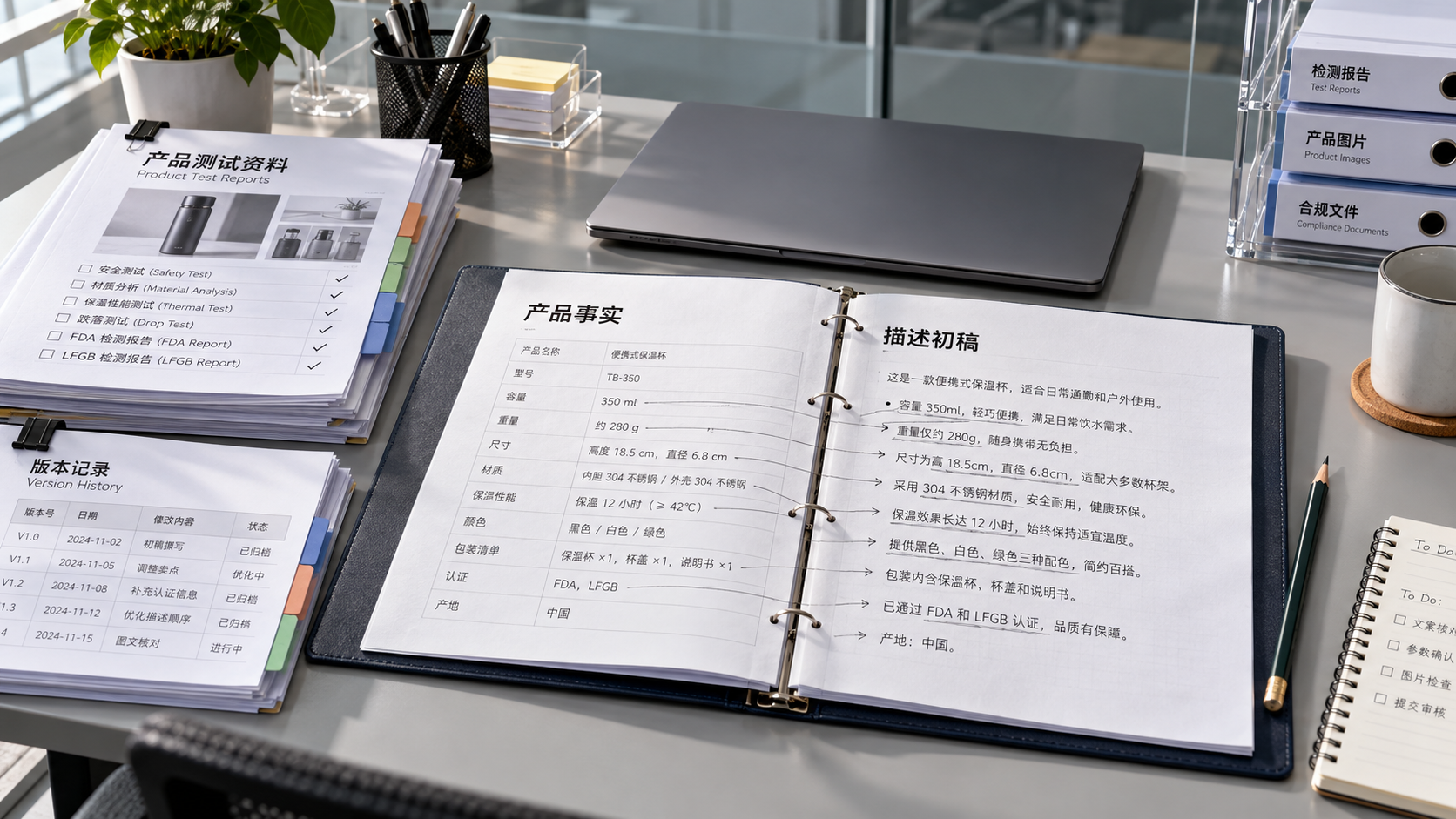
In practice, it is better to first select 20 to 50 representative SKUs for testing rather than covering the entire website at once. Divide products into three categories: low-risk standardized products, products requiring technical review, and high-risk compliance products; establish different prompts, required fields, and reviewers for each category. After launch, check whether descriptions are consistent with images, specification sheets, and variant options, paying particular attention to unit conversions, mixed-up models, exaggerated wording, and information discrepancies between pages in different languages.
AI product description generation is suitable for solving repetitive work, not for bypassing product knowledge, regulatory judgment, or business commitments. Highly standardized products can confidently increase the proportion of automation; for technically complex or regulation-sensitive products, AI should remain at the “organizing and drafting” stage. Only by clearly defining the boundaries can content efficiency avoid coming at the expense of credibility.
Related Articles
 How Can You Use Time-Tracking Data to Quantify the Efficiency of Multilingual Marketing Automation?
 How can you use data from a SaaS marketing platform to identify sources of high-quality leads?
 How Can Cross-Border E-Commerce Businesses Avoid Exaggerated Claims in AI-Generated Product Descriptions?


Related Products
 Yiyingbao SaaS Intelligent Website Building and Marketing SystemYiyingbao SaaS Intelligent Website Building and Marketing System, AI-powered no-code website building, rapid creation of multilingual B2B international websites in 10 minutes, global server acceleration, AI-powered SEO optimization, helping businesses connect efficiently with global markets. The perfect integration of technology and operation makes building an international trade website remarkably simple
 AI+SEM Intelligent Advertising Marketing SystemAI+SEM drives intelligent ad creation, empowering full-funnel precision advertising marketing. The system automatically generates weekly/monthly reports, AI recommends keywords and target countries, monitors core metrics in real-time with intelligent alerts, and enables one-click high-conversion ad solutions to help quickly acquire customers and improve ROI.
 AI+SEO Dual-Engine System Optimization ServicesYiyingbao’s AI+SEO dual-engine optimization system helps foreign trade enterprises acquire high-quality organic traffic through AI-powered keyword research, content generation, and comprehensive technical optimization, significantly improving search rankings and conversion rates.
 AI+SNS Social Media Marketing SystemYingbao AI+SNS Social Media Marketing System - Precision social capture for the social media era. Supports one-click content synchronization across major platforms like Facebook and LinkedIn. AI intelligently rewrites posts for enhanced relevance. 24/7 AI customer service and user profiling analysis empower businesses to efficiently expand into global markets.
 AI+SEO营销解决方案易营宝AI+SEO营销解决方案,通过AI批量写作、智能生成TDK、精准关键词扩词等功能,全面优化网站SEO效果,提升流量与转化率。助力企业构建高效智能网站新生态。
 AI+SEM Advertising Marketing SolutionsAI+SEM Advertising Marketing Solution leverages AI technology to deeply empower SEM ad campaigns. It automatically generates weekly/monthly reports using AI, presenting account data across multiple dimensions for comprehensive insights into campaign performance and trends. The system precisely recommends keywords and target countries, intelligently generates high-conversion ad copy, and enables one-click activation of efficient campaign plans to help businesses rapidly acquire customers. Simultaneously, it monitors core metrics in real time, intelligently identifies abnormal fluctuations, and issues timely alerts to ensure stable, high-return advertising results.
 Domain Name ServicesEasyWin provides professional domain name services, including intelligent queries, one-stop registration, brand protection, and full lifecycle management, helping businesses build a digital brand image.
 EasyOperate B2C Cross-Border E-Commerce Platform & Independent WebsiteEasyStore B2C Cross-border E-commerce Independent Store is an intelligent website building and cross-border e-commerce integrated solution independently developed by EasyStore Information Technology (Beijing) Co., Ltd. The system is specially designed for small and medium-sized as well as large export enterprises, integrating 'website building, operation, marketing, advertising, and conversion' into one, helping enterprises quickly establish cross-border e-commerce independent stores to achieve brand globalization and global sales growth.
The platform supports multiple languages, multiple currencies, and multi-channel marketing, with built-in AI intelligent translation and SEO optimization systems, suitable for mainstream markets such as Southeast Asia, Europe and America, Latin America, and the Middle East, assisting Chinese manufacturing enterprises in efficiently deploying international e-commerce strategies. SSL证书易营宝提供专业SSL安全证书服务,包括单域名和泛域名证书,确保网站数据传输加密、身份验证和完整性保护,助力企业建立安全可信的在线业务环境。









