









- Qingdao Port's Imports and Exports Exceed RMB 23.699 Trillion in the First 10 Months, Drawing Attention to Port IntelligenceNov 22, 2026View details
- Ningbo Cross-Border E-Commerce Export Value Surges 94.87% Year on Year, Opening Up a New Billion-Yuan Growth TrackNov 22, 2026View details
- AliExpress Global Double 11: Brand Sales Grow Nearly 50% in the First Week, U.S. GMV Rises 70%Nov 21, 2026View details
- Ministry of Commerce Reports E-commerce Development from January to October 2026, with Cross-Border Imports Performing StronglyNov 21, 2026View details
- Amazon Black Friday Orders Sluggish on Day One; NRF Forecasts 4.2 Million Fewer ParticipantsNov 21, 2026View details
- 21st Century Business Herald: AI and CTV Become Core Growth Engines for Digital Marketing in Overseas MarketsNov 18, 2026View details
Can website performance optimization directly increase the number of inquiries?
When advertising budgets have been invested and search traffic is growing, but inquiry forms show no significant improvement, website performance often becomes an item to investigate. After visitors click an ad or search result, pages that take too long to display, mobile pages that keep shifting, or submit buttons that do not respond promptly can all cause potential buyers to leave directly.
Can website performance optimization directly increase the number of inquiries? The answer is: possibly, but not necessarily. Performance optimization itself does not create demand, nor can it replace product competitiveness, traffic quality, or sales follow-up. However, it can reduce drop-off during visits and submissions, allowing existing traffic to enter the inquiry stage more completely. For companies that rely on overseas search, advertising landing pages, or multilingual official websites to acquire customers, performance improvements are generally closer to “improving conversion efficiency” than generating inquiries independently.
First, clarify which part of the conversion journey is affected by performance
An inquiry typically goes through several stages from generation to submission: “seeing an entry point—clicking to visit—understanding the content—building trust—completing an action.” Website performance mainly affects the middle three stages: whether the page becomes usable quickly, whether content is displayed steadily, and whether visitors can operate smoothly.
For example, a buyer opens a product landing page on a mobile phone, but the above-the-fold area remains blank for a long time, or the main image loads and pushes specifications and buttons elsewhere. Even if the product itself meets their needs, the user may return to the search results to continue comparing. In another case, there is no clear feedback after form fields are completed, leaving visitors unable to determine whether their information was submitted successfully. Such losses may not be marked as “performance issues” in the backend, but they will directly appear as higher bounce rates, shorter visit durations, and lower form completion rates.
Therefore, when evaluating the value of performance optimization, the question should not only be “how much faster has the website become?” but rather: Can existing visitors more easily see the core information and complete the intended action?
Which performance issues are more likely to affect inquiries
Not every minor change in technical metrics will create a business difference. Prioritizing issues that block browsing, understanding, and submission is usually more meaningful than blindly pursuing test scores.
- Slow above-the-fold content display: Users cannot see product names, key selling points, images, or navigation immediately after entering the page, which particularly affects advertising landing pages. Paid traffic often arrives with clear expectations, so the cost of waiting is higher.
- Unstable mobile pages: Images, fonts, pop-ups, or embedded components load later, causing text and button positions to keep changing. Visitors may click the wrong item, miss action buttons, or be interrupted while filling out forms.
- Slow interaction response: Lag when filtering products, switching languages, clicking inquiry buttons, opening file downloads, or submitting forms can weaken the website’s sense of reliability. B2B visitors generally will not repeatedly attempt complex operations.
- Failure to load key resources: Abnormal responses from third-party scripts, maps, online chat, videos, tracking code, or external fonts may slow down the entire page and even affect the normal operation of forms and buttons.
- Significant access differences across regions: When targeting overseas markets, origin server distance, resource deployment, and network routes can all create inconsistent experiences between regions. Normal testing on the headquarters network does not mean users in the target market can access the site smoothly.
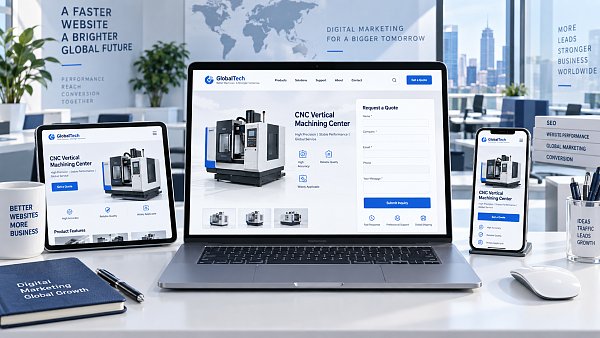
Faster speed does not necessarily mean more inquiries
This is one of the most common misjudgments in business evaluation. Performance optimization addresses whether existing opportunities are lost to technical friction, while inquiry volume is also influenced by traffic sources, page relevance, completeness of product information, trust elements, quotation thresholds, and form design.
If page loading is already generally smooth but visitors still rarely proceed to the inquiry stage, the marginal value of reducing another few dozen milliseconds may be limited. At this point, it is more important to check whether the page clearly explains product applications, differentiating features, certification materials, contact options, and next steps. Performance is a foundational condition for conversion, not a universal switch that replaces marketing content.
Determining whether performance optimization is worth prioritizing
Rather than defining the scope of technical upgrades first, work backward from the business journey. First identify the pages closest to inquiries: advertising landing pages, core product pages, inquiry pages, multilingual homepages, or document download pages. Then review both desktop and mobile performance separately, especially actual access performance in target markets.
- Confirm whether key pages have obvious blank waiting periods, delayed image display, scrolling lag, or non-functioning buttons.
- Compare traffic quality across different channels. Users arriving through organic search, advertising, and social media referrals have different intent, so all pages should not be evaluated by the same standard.
- Check whether users can successfully reach the form page, click contact entry points, and receive submission feedback. This should be assessed together with tracking data, submission records, and backend error information, rather than page visits alone.
- Review mobile performance. Some websites have complete desktop layouts, but pop-ups, floating buttons, and image sizes interfere with each other on mobile, affecting precisely the high-frequency access scenarios.
- Rule out content and lead-handling issues. If forms are submitted successfully but sales responses are very slow, or inquiry entry points do not match the actual business, performance optimization cannot compensate for subsequent losses.
Signals that are more suitable for prioritizing optimization include: noticeably high bounce rates on important landing pages, significantly weaker mobile conversion than desktop conversion, pages that frequently load incompletely in specific regions, form submission failures, or declining responsiveness during traffic peaks. Conversely, if website traffic is very low or the traffic does not match the product target, resolving customer acquisition sources and page positioning first is often more effective than conducting deep performance upgrades first.
Do not focus only on scoring tools during optimization
Performance testing tools can identify issues such as resource size, script blocking, uncompressed images, and cache configuration, but tool scores do not equal actual user experience, much less inquiry conversion. For business evaluation, it is advisable to observe technical metrics alongside business actions: when above-the-fold content becomes visible, when inquiry buttons become clickable, whether forms can be submitted, and where users exit key pages.
The optimization sequence should generally focus on the core journey. First, reduce redundant resources that affect above-the-fold display and optimize the loading method for large images and videos; then check unnecessary plugins, pop-ups, and third-party scripts; next, ensure mobile layout stability and test key interactions such as form submissions, file downloads, and online inquiries one by one. When multiple languages and target regions are involved, also verify whether different language versions reference abnormal resources, preventing a translated page from becoming significantly slower because of fonts, images, or external components.
After optimization, it is not advisable to look only at inquiry changes on a single day. Inquiries are affected by factors such as campaign pace, seasons, and industry purchasing cycles. A more reasonable approach is to continuously compare the usability of key pages, visit duration, the proportion reaching forms, submission success rates, and the quality of valid inquiries. Only then can you determine whether improvements come from the website experience or from changes in traffic structure.
Put performance optimization in the right place
Website performance optimization cannot promise to directly generate a certain number of inquiries, but it can reduce the likelihood that already acquired traffic opportunities are wasted. For companies using their official websites to receive search and advertising traffic, the closer a page is to the inquiry action, the more strictly its performance should be managed. Only by first fixing obvious obstacles that affect loading, reading, and submission, and then evaluating performance together with traffic quality, content persuasiveness, and lead-handling efficiency, can technical upgrades be turned into a more reliable foundation for customer acquisition.
Related Articles
 全球服务器部署如何降低海外网站访问延迟
 XYZ Applies for the .seo Top-Level Domain in ICANN’s New Round; Launch May Be Coming Soon
 How to troubleshoot slow server response times when optimizing website speed?



Related Products
 Yiyingbao SaaS Intelligent Website Building and Marketing SystemYiyingbao SaaS Intelligent Website Building and Marketing System, AI-powered no-code website building, rapid creation of multilingual B2B international websites in 10 minutes, global server acceleration, AI-powered SEO optimization, helping businesses connect efficiently with global markets. The perfect integration of technology and operation makes building an international trade website remarkably simple
 AI+SEM Intelligent Advertising Marketing SystemAI+SEM drives intelligent ad creation, empowering full-funnel precision advertising marketing. The system automatically generates weekly/monthly reports, AI recommends keywords and target countries, monitors core metrics in real-time with intelligent alerts, and enables one-click high-conversion ad solutions to help quickly acquire customers and improve ROI.
 AI+SEO Dual-Engine System Optimization ServicesYiyingbao’s AI+SEO dual-engine optimization system helps foreign trade enterprises acquire high-quality organic traffic through AI-powered keyword research, content generation, and comprehensive technical optimization, significantly improving search rankings and conversion rates.
 AI+SNS Social Media Marketing SystemYingbao AI+SNS Social Media Marketing System - Precision social capture for the social media era. Supports one-click content synchronization across major platforms like Facebook and LinkedIn. AI intelligently rewrites posts for enhanced relevance. 24/7 AI customer service and user profiling analysis empower businesses to efficiently expand into global markets.
 AI+SEO营销解决方案易营宝AI+SEO营销解决方案,通过AI批量写作、智能生成TDK、精准关键词扩词等功能,全面优化网站SEO效果,提升流量与转化率。助力企业构建高效智能网站新生态。
 AI+SEM Advertising Marketing SolutionsAI+SEM Advertising Marketing Solution leverages AI technology to deeply empower SEM ad campaigns. It automatically generates weekly/monthly reports using AI, presenting account data across multiple dimensions for comprehensive insights into campaign performance and trends. The system precisely recommends keywords and target countries, intelligently generates high-conversion ad copy, and enables one-click activation of efficient campaign plans to help businesses rapidly acquire customers. Simultaneously, it monitors core metrics in real time, intelligently identifies abnormal fluctuations, and issues timely alerts to ensure stable, high-return advertising results.
 Domain Name ServicesEasyWin provides professional domain name services, including intelligent queries, one-stop registration, brand protection, and full lifecycle management, helping businesses build a digital brand image.
 EasyOperate B2C Cross-Border E-Commerce Platform & Independent WebsiteEasyStore B2C Cross-border E-commerce Independent Store is an intelligent website building and cross-border e-commerce integrated solution independently developed by EasyStore Information Technology (Beijing) Co., Ltd. The system is specially designed for small and medium-sized as well as large export enterprises, integrating 'website building, operation, marketing, advertising, and conversion' into one, helping enterprises quickly establish cross-border e-commerce independent stores to achieve brand globalization and global sales growth.
The platform supports multiple languages, multiple currencies, and multi-channel marketing, with built-in AI intelligent translation and SEO optimization systems, suitable for mainstream markets such as Southeast Asia, Europe and America, Latin America, and the Middle East, assisting Chinese manufacturing enterprises in efficiently deploying international e-commerce strategies. SSL证书易营宝提供专业SSL安全证书服务,包括单域名和泛域名证书,确保网站数据传输加密、身份验证和完整性保护,助力企业建立安全可信的在线业务环境。









