









- Which customer acquisition channels will be affected by cross-border marketing trends in 2026?Sep 06, 2026View details
- Which homogenization risks should be considered in an analysis of the AI-powered website building industry?Aug 30, 2026View details
- How Will AI Marketing Trends 2026 Change Advertising Budget AllocationAug 28, 2026View details
- Is the EV SSL certificate market shrinking or upgrading? How should companies assess certificate procurement?Aug 11, 2026View details
- Why the old AMP SEO 2020 practices no longer work and what has changed in current optimization prioritiesAug 02, 2026View details
- How to Choose Topics for an Industry News Section to Attract More Organic Search TrafficJul 29, 2026View details
6 Questions to Consider Before Building a Cross-Border E-Commerce Website: Platform, Payments, and Advertising
When building a cross-border e-commerce standalone website, many companies focus first on page design, template style, and launch speed. Only after the website is completed do they realize that the payment solution does not match the target market, advertising costs are too high to sustain campaigns, and the backend cannot support future growth. For business decision-makers, a standalone website is not simply a “website development project,” but an operating system for overseas markets. If the platform, payment solution, and customer acquisition path are not carefully planned from the outset, every subsequent step may require repeated rework, with costs often exceeding those of website development itself.
What truly needs to be clarified in advance is not “whether to build a standalone website,” but “what type of standalone website to build, how it will generate conversions, and how customers will be acquired continuously.” This is also the aspect most likely to be underestimated before building a cross-border e-commerce standalone website.
Question 1: Are you building a brand asset or simply adding another sales channel?
This is the most fundamental and most easily overlooked consideration. Different objectives determine completely different platform architectures, content strategies, payment designs, and advertising approaches.
If a company builds a standalone website to reduce its dependence on traffic from a single platform and establish a brand asset based on accumulated user data, repeat purchases, and long-term operations, the website should prioritize content depth, SEO foundations, membership capabilities, email marketing, and remarketing. Such websites generally do not pursue short-term traffic surges, but place greater emphasis on traffic quality and customer lifetime value.
If the standalone website is currently intended only to receive advertising traffic, test products quickly, or supplement orders outside third-party platforms, the focus will shift to page conversion rates, payment success rates, advertising landing page efficiency, promotional mechanisms, and rapid iteration capabilities.
The problem for many companies is not that the website was poorly built, but that they initially treated a “brand website” and a “sales website” as the same thing. The former requires long-term content operations, while the latter functions more like a growth tool. When the objective is unclear, the frontend may appear complete while backend operations remain cumbersome.
Question 2: What should you look for when selecting a platform—not just “how many features it has”?
A common mistake companies make when selecting a platform is placing too much emphasis on templates, the number of plugins, or the initial quotation. For purchasing decisions, the truly important question is whether the system can support operational requirements over the next 12 to 24 months.
A platform suitable for cross-border business should answer several practical questions: How will multiple languages be handled? How will multiple currencies be processed? Is the mobile experience stable? Are the SEO foundations complete? Can advertising landing pages be duplicated quickly? Can orders, logistics, payments, and marketing tools be integrated smoothly?
If a company has relatively few SKUs and emphasizes brand presentation, the platform needs stronger content management and marketing extension capabilities. If it has multiple product categories and a large number of SKUs, backend product management, category logic, filtering capabilities, and onsite search become more important. For products such as electronic components and industrial parts, an attractive appearance alone is not enough. The website must efficiently display large numbers of models, specifications, and compatibility relationships. In such scenarios, systems with intelligent categorization and parameterized display capabilities provide greater practical value. For example, the electronic components industry solution is more suitable for industries with high product complexity and long purchasing decision cycles.
Platform selection should also consider an often-overlooked issue: whether you will depend on third parties in the future. The more third-party dependencies there are, the more restricted subsequent operations may become. For example, if core promotions, member data, SEO structures, and settlement rules are all tied to an external ecosystem, the website may launch quickly in the short term but lack flexibility in the long term.
Question 3: A payment solution is not simply about “being able to accept payments”; success rates and compliance are key
Payment is often not given sufficient attention until the later stages of a project, yet it directly determines the conversion rate. If users leave the payment page because their preferred payment habits are not supported, too many transactions are blocked by risk controls, the currency experience is poor, or local payment methods are unavailable, the cost of the traffic generated earlier is essentially wasted.
Decision-makers should first assess the mainstream payment preferences in their target markets. Payment structures vary across North America, Europe, Southeast Asia, and the Middle East. Some markets have high credit card penetration, while others rely more heavily on local wallets, bank transfers, or cash on delivery. A payment gateway that theoretically covers the global market may not necessarily be suitable for your primary sales regions.
A payment solution should be evaluated from at least four dimensions: first, coverage of target countries; second, payment success rate; third, chargeback and risk management; and fourth, settlement cycles and fund security. For companies sensitive to cash flow, settlement speed and account stability are more important than the level of transaction fees.
Compliance must not be overlooked either. When requirements involve taxation, user data, anti-money laundering, and consumer protection, companies should not rely solely on verbal assurances from service providers. Some specific rules may change with the target market. Relevant requirements should be based on official explanations from payment institutions and local regulatory requirements. Certain details, such as local payment access policies in specific countries, remain [to be verified]. A prudent approach is to clarify the countries where payments are available, risk control rules, and procedures for handling exceptional disputes before launch.
Question 4: How you plan to acquire customers determines how the website should be built
The logic behind many cross-border e-commerce standalone website projects is “build the website first and think about traffic later.” In practice, this carries significant risks because different customer acquisition paths impose very different requirements on website structure.
If the main channel is Google SEO, the website must prioritize technical indexability, page hierarchy, content structure, keyword-intent matching, and the ability to update content continuously. Organic traffic does not appear automatically after launch, and simply adding large numbers of product pages will not generate rankings. SEO is suitable for companies that have patience and are willing to build long-term value, but results are generally slower than those from advertising.
If the business primarily relies on Google Ads, Facebook Ads, TikTok, and other advertising channels, the website should place greater emphasis on above-the-fold information density, page loading speed, product trust signals, checkout paths, and attribution analysis. Advertising traffic is expensive, and every additional bounce represents a direct loss of budget.
If a company operates both third-party platform stores and a standalone website, the standalone website does not need to compete with the platforms for the same type of traffic. Instead, it should handle brand searches, repeat purchases from existing customers, promotional campaigns, off-site content traffic, and testing in key markets. The biggest risk for a standalone website is unclear positioning: trying to acquire customers through long-term SEO, generate immediate orders through advertising, and showcase the brand at the same time, ultimately without doing any of these thoroughly.
For decision-makers, advertising is not an action to be taken “after launch,” but a planning consideration that must be involved before website development begins. Page structure, conversion paths, tracking implementation, and content organization should all be designed around future traffic sources.
Question 5: Should the budget be allocated to website development, advertising, or operations?
Many companies have a typical bias when allocating budgets: they are willing to invest in the “visible website” but underestimate the “invisible operating system.” As a result, the website looks complete at launch, but growth stagnates three months later.
The cost of a standalone website generally includes more than website development fees. It also covers ongoing investment in content creation, payment and plugin fees, advertising testing budgets, data analysis, page optimization, customer service coordination, and multilingual support. For most companies, success is not determined by how much was spent on the homepage, but by whether sufficient room for trial and error was reserved.
If the budget is limited, a more rational approach is not to pursue a “large and comprehensive” website from the outset, but to focus on one primary market, one main product line, and one verifiable traffic model. First validate the conversion loop, then expand product categories, regions, and languages. Many projects fail not because the direction is wrong, but because the scope is spread too widely from the beginning, leaving every part insufficiently developed.
Companies should also be cautious about “low-cost website development” solutions when making purchasing decisions. Although they may appear to save on initial investment, they can lead to higher ongoing costs for customization, plugins, maintenance, migration, and marketing expansion. What companies should truly compare is the total cost of ownership, not the quotation shown on the first page of the contract.
Question 6: Who will operate the website after launch? This matters more than the launch date
A standalone website is not a digital project that ends upon delivery. It is more like an ongoing overseas business touchpoint. Without a clearly designated person internally, even the best system can easily sit idle.
Before making a decision, it is best to clarify who will be responsible for adding new products, how prices and inventory will be synchronized, who will provide advertising materials, who will review data reports, who will continuously update SEO content, and how customer service and after-sales teams will handle overseas orders. If none of these questions has an answer, the standalone website can easily become a showcase website that is “live but lacks ongoing activity.”
For companies with complex product lines in particular, backend management efficiency directly affects future operating costs. For example, in industries with numerous models and highly differentiated specifications, if the system cannot support batch management, parameterized searches, and precise product displays, the maintenance burden on the operations team will quickly increase. More specialized capabilities, such as the electronic components industry solution, create value not only through frontend presentation, but also through the efficiency of subsequent team collaboration.
In practice, the standalone websites that truly achieve results are generally not those with the “most advanced technology,” but those with the smoothest operational collaboration. Website development providers can deliver tools and frameworks, but sustainable growth ultimately depends on whether the company has a mechanism for continuous optimization.
What decision-makers should focus on is not “whether it can be done,” but “whether it can work in practice”
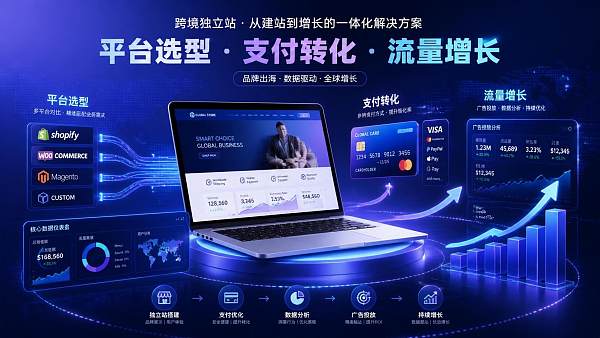
Discussions about building cross-border e-commerce standalone websites can no longer remain at the stage of “creating an overseas corporate website” or “setting up an online store.” Platforms, payments, and advertising are essentially three interdependent elements: the platform determines scalability, payment determines the foundation for conversion, and advertising determines the speed of growth. If all three are not configured around the same business objective, the faster the website goes live, the more rework may be required later.
For business decision-makers, a more reliable way to evaluate options is not to ask “which website provider is the cheapest,” but instead to ask: Where are our primary markets? How do customers complete transactions? How can target users be reached? What capabilities do we want to build over the next year? Only after clarifying these questions should companies compare suppliers. This is when a website development project truly has investment value.
A standalone website is never an isolated procurement item. It is a reconstruction of a company’s overseas growth capabilities. When the direction is right, customer acquisition, conversion, and repeat purchases can develop steadily.
Related Articles



Related Products
 Yiyingbao SaaS Intelligent Website Building and Marketing SystemYiyingbao SaaS Intelligent Website Building and Marketing System, AI-powered no-code website building, rapid creation of multilingual B2B international websites in 10 minutes, global server acceleration, AI-powered SEO optimization, helping businesses connect efficiently with global markets. The perfect integration of technology and operation makes building an international trade website remarkably simple
 AI+SEM Intelligent Advertising Marketing SystemAI+SEM drives intelligent ad creation, empowering full-funnel precision advertising marketing. The system automatically generates weekly/monthly reports, AI recommends keywords and target countries, monitors core metrics in real-time with intelligent alerts, and enables one-click high-conversion ad solutions to help quickly acquire customers and improve ROI.
 AI+SEO Dual-Engine System Optimization ServicesYiyingbao’s AI+SEO dual-engine optimization system helps foreign trade enterprises acquire high-quality organic traffic through AI-powered keyword research, content generation, and comprehensive technical optimization, significantly improving search rankings and conversion rates.
 AI+SNS Social Media Marketing SystemYingbao AI+SNS Social Media Marketing System - Precision social capture for the social media era. Supports one-click content synchronization across major platforms like Facebook and LinkedIn. AI intelligently rewrites posts for enhanced relevance. 24/7 AI customer service and user profiling analysis empower businesses to efficiently expand into global markets.
 AI+SEO营销解决方案易营宝AI+SEO营销解决方案,通过AI批量写作、智能生成TDK、精准关键词扩词等功能,全面优化网站SEO效果,提升流量与转化率。助力企业构建高效智能网站新生态。
 AI+SEM Advertising Marketing SolutionsAI+SEM Advertising Marketing Solution leverages AI technology to deeply empower SEM ad campaigns. It automatically generates weekly/monthly reports using AI, presenting account data across multiple dimensions for comprehensive insights into campaign performance and trends. The system precisely recommends keywords and target countries, intelligently generates high-conversion ad copy, and enables one-click activation of efficient campaign plans to help businesses rapidly acquire customers. Simultaneously, it monitors core metrics in real time, intelligently identifies abnormal fluctuations, and issues timely alerts to ensure stable, high-return advertising results.
 Domain Name ServicesEasyWin provides professional domain name services, including intelligent queries, one-stop registration, brand protection, and full lifecycle management, helping businesses build a digital brand image.
 EasyOperate B2C Cross-Border E-Commerce Platform & Independent WebsiteEasyStore B2C Cross-border E-commerce Independent Store is an intelligent website building and cross-border e-commerce integrated solution independently developed by EasyStore Information Technology (Beijing) Co., Ltd. The system is specially designed for small and medium-sized as well as large export enterprises, integrating 'website building, operation, marketing, advertising, and conversion' into one, helping enterprises quickly establish cross-border e-commerce independent stores to achieve brand globalization and global sales growth.
The platform supports multiple languages, multiple currencies, and multi-channel marketing, with built-in AI intelligent translation and SEO optimization systems, suitable for mainstream markets such as Southeast Asia, Europe and America, Latin America, and the Middle East, assisting Chinese manufacturing enterprises in efficiently deploying international e-commerce strategies. SSL证书易营宝提供专业SSL安全证书服务,包括单域名和泛域名证书,确保网站数据传输加密、身份验证和完整性保护,助力企业建立安全可信的在线业务环境。









