Which SSL certificate should you buy if your multilingual website uses subdomains? This article helps you distinguish wildcard certificates from multi-domain certificates, taking coverage, cost, and deployment requirements into account so your business can choose the right configuration before building its website and promoting it overseas.
If each language site uses a first-level subdomain under the same primary domain, a wildcard certificate is usually the first option to consider. If your setup includes multiple independent domains or subdomains at different levels, compare a multi-domain certificate with the option of issuing separate certificates.
For international trade businesses, cross-border sellers, and brands expanding overseas, the key is whether the certificate covers every access point and whether the website platform can deploy and renew it automatically. A more expensive certificate is not necessarily a better fit for a multilingual website.
Start with your URL structure: Which language sites can a wildcard certificate cover?
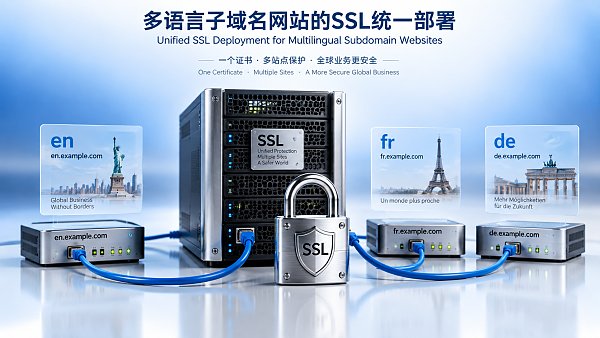
Suppose your primary domain is example.com, and your English, German, and French sites use en, de, and fr as subdomain prefixes. This setup can use a wildcard certificate, and adding another first-level language subdomain usually does not require buying a new certificate.
The asterisk in a wildcard certificate matches only one domain level. Therefore, a certificate covering first-level language subdomains cannot automatically cover an additional store subdomain beneath a language site. Check these access points separately when planning a store or member center.
You should also confirm whether the primary domain is included in the certificate. Some wildcard products also include the bare domain, but the asterisk itself does not cover it. Before ordering, check the list of domains covered by the certificate to avoid a situation where the main site opens but another access point triggers an error.
Businesses should also check www-prefixed addresses, advertising landing pages, and redirect entry points. Even if an address is used only for redirects, it needs a valid certificate if users first access it over an encrypted connection.
When should you choose a multi-domain certificate, and when should you issue separate certificates?
If your German site uses a separate German domain and your French site uses a separate French domain, a single wildcard certificate cannot cover them all. A multi-domain certificate lists multiple domains using Subject Alternative Names (SANs), making it suitable for businesses that need to manage these access points centrally.
A multi-domain certificate can also cover subdomains at different levels, but you must add each specific name to the certificate. When you add a language site later, you will usually need to update the domain list and reissue the certificate. Whether this incurs an additional charge depends on the product allowance and the provider’s policy.
If you have only a few language sites and their number is unlikely to change, issuing separate single-domain certificates is also a practical option. Platforms that support automatic renewal can reduce maintenance work. Using a separate private key for each site can also limit the impact if a key for one site is compromised.
Some products let you add multiple wildcards to the same certificate. This can suit setups where multiple primary domains need to support additional sub-sites. However, domain validation, deployment scope, and purchase costs will be more complex, so confirm your actual requirements before choosing this option.
Free or paid? Where should businesses spend their money?
When reputable free and paid certificates use the same algorithms and configuration, there is no inherent difference in encryption strength. If your budget is limited, first check whether your website platform already provides a browser-trusted certificate and automatic renewal.
A Domain Validation (DV) certificate verifies control of the domain and is suitable for most corporate websites and marketing sites. An Organization Validation (OV) certificate also verifies organizational information and may suit businesses with procurement procedures or partner requirements. It does not mean higher search rankings.
Extended Validation (EV) certificates involve more rigorous identity checks, but cannot be issued as wildcard certificates. Modern browsers also generally do not prominently display the company name in the address bar. Do not assume you need this type of certificate simply because your website serves overseas customers.
When comparing prices, also calculate domain limits, renewal fees, deployment support, and incident response. A low-cost certificate that requires manual renewal may increase maintenance costs. Whether a paid option is worthwhile depends on whether it addresses your team’s actual maintenance needs.
Confirm the deployment method before buying to avoid having a valid certificate you cannot put into use
If you use an intelligent website-building platform, first confirm whether it supports uploading your own certificate, binding wildcard certificates, and automatic renewal. Some platforms automatically issue certificates for each language subdomain, in which case buying a single certificate for all of them may offer no practical benefit.
Wildcard certificates usually require domain control to be verified through DNS records. Confirm who manages your DNS and whether verification records can be updated automatically. Otherwise, manual coordination may still be needed before the certificate expires, potentially affecting website availability.
If your website uses both a content delivery network and an origin server, check the encrypted connections from the browser to the network nodes and from the network nodes to the origin server separately. A security lock displayed on the front end does not prove that the connection behind it has also been properly verified and encrypted.
When multiple servers share a wildcard certificate, restrict access to the private key. For language sites maintained by different providers, consider issuing separate certificates instead of distributing the same private key to too many people for deployment convenience.
Before launch, visit each language site and check domain matching, the certificate chain, validity period, and page resources. If images, scripts, or forms still use unencrypted URLs, mixed-content issues may arise, affecting page functionality and users’ trust in the website.
How does SSL help with international SEO, and what can it not replace?
A valid certificate is essential for providing stable, encrypted website access. An expired certificate or domain mismatch may trigger browser warnings, preventing visitors from accessing the site after clicking an ad or submitting an inquiry. For this reason, reliable renewal matters more than the certificate brand.
Encrypted access is one of the ranking signals Google has publicly confirmed, but buying a more expensive certificate does not provide an additional ranking advantage. Multilingual search performance still depends on factors such as localized content, language annotations, indexing configuration, and page experience.
When migrating a website from unencrypted to encrypted URLs, also update permanent redirects, internal links, canonical URLs, and sitemaps. Include certificate deployment in your launch checklist to avoid crawling and access problems caused by old and new URLs being used at the same time.
How to make the final choice: Base it on your website structure and maintenance capabilities
If you have multiple first-level language subdomains under the same primary domain and expect to add more languages, evaluate a wildcard certificate first. If you need to manage multiple independent domains centrally, consider a multi-domain certificate. For a small number of stable sites, separate certificates may be suitable if the platform supports automatic issuance.
Businesses using website-building and marketing platforms such as 易营宝 should first confirm the coverage of the certificates provided by the platform and who is responsible for renewal before deciding whether to purchase additional certificates. Asking the provider to check your actual domain list is more effective than asking only about the certificate price.
Ultimately, choosing certificates for a multilingual website comes down to three things: all access points are covered, the deployment environment supports the certificates, and someone is responsible for renewal. Confirming these requirements helps control costs while keeping overseas promotion and customer access reliable.