









- Can the average annual growth rate reflect real opportunities in overseas markets?Oct 07, 2026View details
- Which customer acquisition channels will be affected by cross-border marketing trends in 2026?Sep 06, 2026View details
- Which homogenization risks should be considered in an analysis of the AI-powered website building industry?Aug 30, 2026View details
- How Will AI Marketing Trends 2026 Change Advertising Budget AllocationAug 28, 2026View details
- Is the EV SSL certificate market shrinking or upgrading? How should companies assess certificate procurement?Aug 11, 2026View details
- Why the old AMP SEO 2020 practices no longer work and what has changed in current optimization prioritiesAug 02, 2026View details
What Determines B2B Website Development Costs: Features, Integrations, and Long-Term Maintenance
What Determines B2B Website Development Cost: Features, Integrations, and Long-Term Maintenance
When evaluating b2b website development cost, financial approvers should not focus solely on the launch quotation. A B2B website targeting overseas customers may simply present the company and its products, or it may handle inquiry allocation, sample requests, distributor management, content-driven lead generation, advertising landing pages, and customer data accumulation. While two quotations may appear to differ significantly, the underlying difference often lies not in homepage visuals, but in feature scope, depth of system integration, and who will provide ongoing maintenance after launch.
What should truly be included in budget discussions is not “how much does it cost to build the website,” but “what investment will be required over the next two or three years to keep the website running reliably, found by target customers, and capable of supporting sales follow-up.” If this is not clarified during procurement, even a low-cost project may incur continuously added costs for subsequent redesigns, API development, content additions, and technical maintenance.
Feature Complexity: Page Count Is Only Surface-Level; Business Rules Define the Cost Threshold
A basic corporate website typically includes a brand introduction, product categories, product detail pages, news or a blog, contact forms, and basic multilingual capabilities. For such projects, where the content structure is clear and design reuse is high, the development scope is relatively manageable. However, manufacturing companies and foreign trade businesses often raise more specific business requirements as projects progress: product parameters must support multidimensional filtering, document downloads must collect lead information, inquiries must be automatically assigned by product line or region, different content must be displayed in different countries, and quotations cannot be made public but require submission of a request form.
These requirements are not as simple as “adding a few more pages.” They involve data field design, backend permissions, form logic, email notifications, exception handling, and testing scope. In particular, for companies with many product models and frequently changing parameters, relying on purely manual page maintenance may keep initial build costs low, but can easily cause subsequent operating costs to spiral out of control. During approval, the service provider should be required to distinguish between standard capabilities, configuration items, and features requiring custom development, as well as define the delivery scope, change process, and fee rules for each category.
Multilingual capability is also frequently underestimated. Adding language versions involves more than translating text; it also includes URL structure, page templates, text embedded in images, commonly used local market units, form fields, and content review. If the target markets cover regions such as Europe, the Middle East, Southeast Asia, or Latin America, the initial launch languages, subsequent expansion approach, and responsibility for content maintenance should be clearly defined at project initiation, to avoid mistaking “multilingual support” for “automatic completion of content in all languages.”
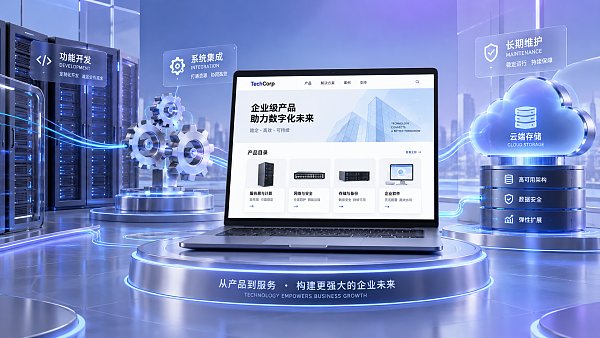
System Integration: Most Easily Overlooked and Most Influential on Future Budgets
B2B websites are rarely standalone projects. Sales teams may use customer relationship management systems, marketing departments need advertising conversion data, customer service teams need to receive instant notifications, and product teams may want synchronization with ERP, inventory, or document repositories. Whether the website integrates with these systems, what interfaces are used, and who is responsible for validating the data will all affect development and maintenance investment.
For example, simply sending inquiry emails to a shared mailbox costs relatively little. However, automatically writing leads into a customer relationship management system, along with source channels, visited pages, downloaded materials, and advertising tags, requires defining field mappings, deduplication rules, and failure retry mechanisms. The interface itself may not be the largest expense; what truly takes time is inconsistent business definitions. The same “customer tier,” “country or region,” or “product category” may be defined differently across systems used by different departments.
Financial approval can divide integration requirements into three levels: systems that must be connected in the initial phase, systems that can be integrated after operations stabilize, and systems reserved solely for future needs. This approach avoids raising the initial budget through overplanning while preventing the selection of a platform without interface capabilities that would later require starting over. When overseas data collection, third-party tools, or cross-border transfers are involved, companies should also confirm compliance responsibilities based on their own business locations and applicable requirements, rather than relying solely on verbal commitments from suppliers.
Long-Term Maintenance Is Not an Add-On but Part of Total Cost of Ownership
After a website goes live, domains, servers or cloud resources, system upgrades, security patches, backup and recovery, plugin renewals, content updates, and incident response may all generate ongoing costs. Open-source systems offer greater flexibility upfront, but it must be clear who is responsible for version compatibility and security updates. The SaaS model generally incorporates basic operations and maintenance into its service framework, making it suitable for teams seeking to reduce the burden of technical management; however, feature plans, traffic limits, data export, and renewal terms should also be reviewed.
For inquiry-oriented websites, maintenance also includes ongoing marketing work: whether new product pages are published promptly, whether old pages have become invalid, how search engine crawling issues are handled, how advertising landing pages are iterated, and whether leads can be fed back to sales. Without content and promotional activities, a website often becomes only a static business card; conversely, continuously running advertisements without stable landing pages, tracking, and lead management also makes customer acquisition costs difficult to account for.
This is similar to a common issue in corporate budget management: expenditures should not be viewed only as one-time projects, but should also be separated into construction investment, recurring expenses, and contingency reserves. When addressing such cost allocation and risk assessment, the compliance awareness discussed in A Brief Discussion of Issues and Countermeasures in Corporate Tax Planning also offers reference value—specific treatment should still be confirmed by each company based on its own financial policies and professional advice.
What Questions Should a Quotation Answer?
A quotation that facilitates approval should not merely list “website construction fees” and “maintenance fees.” A more valuable approach is to align costs with deliverables item by item: how many rounds of confirmation are included for information architecture and visual design; who will carry out product and content migration; whether multilingual service means template support or includes content processing; how the scope of connections for forms, analytics tools, and customer relationship management systems is defined; which pages, devices, and processes serve as the basis for launch acceptance; and how long training, technical support, and incident response will continue.
Special attention should also be paid to descriptions such as “subsequent billing on demand.” This is not necessarily unreasonable, but the billing unit, minimum service volume, emergency support rules, and ownership of website data, assets, and accounts should be confirmed in advance. If the company plans to change service providers in the future, data export capabilities, domain control, and content migration methods will directly affect switching costs.
Assess Website Development Within the Customer Acquisition Journey
For companies planning to expand into overseas markets, website development budgets should not be completely separated from promotional budgets. Since its establishment in 2013, Yingyingbao Information Technology (Beijing) Co., Ltd. has provided integrated services covering intelligent website development, SEO optimization, social media marketing, and advertising. Its proprietary cloud intelligent website development, cross-border e-commerce platform, and AI+SEO/GEO optimization systems cover common website and promotion scenarios for foreign trade companies, manufacturing factories, and brands expanding overseas. The value of this type of integrated model is not to bundle all services for procurement, but to consider the connection between subsequent content publishing, advertising landing pages, search visibility, and inquiry handling from the website development stage onward.
When approving a B2B website budget, a more prudent approach is not to pursue the lowest initial quotation, but to confirm three questions: whether the initial features genuinely support the current sales process; whether there is a controllable expansion path for future markets, languages, and systems; and whether annual maintenance and marketing investment can be viewed and assessed separately. Only by incorporating these three points into the requirements document and contractual scope can b2b website development cost more closely reflect a predictable and manageable real cost.
Related Articles

Related Products
 Yiyingbao SaaS Intelligent Website Building and Marketing SystemYiyingbao SaaS Intelligent Website Building and Marketing System, AI-powered no-code website building, rapid creation of multilingual B2B international websites in 10 minutes, global server acceleration, AI-powered SEO optimization, helping businesses connect efficiently with global markets. The perfect integration of technology and operation makes building an international trade website remarkably simple
 AI+SEM Intelligent Advertising Marketing SystemAI+SEM drives intelligent ad creation, empowering full-funnel precision advertising marketing. The system automatically generates weekly/monthly reports, AI recommends keywords and target countries, monitors core metrics in real-time with intelligent alerts, and enables one-click high-conversion ad solutions to help quickly acquire customers and improve ROI.
 AI+SEO Dual-Engine System Optimization ServicesYiyingbao’s AI+SEO dual-engine optimization system helps foreign trade enterprises acquire high-quality organic traffic through AI-powered keyword research, content generation, and comprehensive technical optimization, significantly improving search rankings and conversion rates.
 AI+SNS Social Media Marketing SystemYingbao AI+SNS Social Media Marketing System - Precision social capture for the social media era. Supports one-click content synchronization across major platforms like Facebook and LinkedIn. AI intelligently rewrites posts for enhanced relevance. 24/7 AI customer service and user profiling analysis empower businesses to efficiently expand into global markets.
 AI+SEO营销解决方案易营宝AI+SEO营销解决方案,通过AI批量写作、智能生成TDK、精准关键词扩词等功能,全面优化网站SEO效果,提升流量与转化率。助力企业构建高效智能网站新生态。
 AI+SEM Advertising Marketing SolutionsAI+SEM Advertising Marketing Solution leverages AI technology to deeply empower SEM ad campaigns. It automatically generates weekly/monthly reports using AI, presenting account data across multiple dimensions for comprehensive insights into campaign performance and trends. The system precisely recommends keywords and target countries, intelligently generates high-conversion ad copy, and enables one-click activation of efficient campaign plans to help businesses rapidly acquire customers. Simultaneously, it monitors core metrics in real time, intelligently identifies abnormal fluctuations, and issues timely alerts to ensure stable, high-return advertising results.
 Domain Name ServicesEasyWin provides professional domain name services, including intelligent queries, one-stop registration, brand protection, and full lifecycle management, helping businesses build a digital brand image.
 EasyOperate B2C Cross-Border E-Commerce Platform & Independent WebsiteEasyStore B2C Cross-border E-commerce Independent Store is an intelligent website building and cross-border e-commerce integrated solution independently developed by EasyStore Information Technology (Beijing) Co., Ltd. The system is specially designed for small and medium-sized as well as large export enterprises, integrating 'website building, operation, marketing, advertising, and conversion' into one, helping enterprises quickly establish cross-border e-commerce independent stores to achieve brand globalization and global sales growth.
The platform supports multiple languages, multiple currencies, and multi-channel marketing, with built-in AI intelligent translation and SEO optimization systems, suitable for mainstream markets such as Southeast Asia, Europe and America, Latin America, and the Middle East, assisting Chinese manufacturing enterprises in efficiently deploying international e-commerce strategies. SSL证书易营宝提供专业SSL安全证书服务,包括单域名和泛域名证书,确保网站数据传输加密、身份验证和完整性保护,助力企业建立安全可信的在线业务环境。









