









- Can the average annual growth rate reflect real opportunities in overseas markets?Oct 07, 2026View details
- Which customer acquisition channels will be affected by cross-border marketing trends in 2026?Sep 06, 2026View details
- Which homogenization risks should be considered in an analysis of the AI-powered website building industry?Aug 30, 2026View details
- How Will AI Marketing Trends 2026 Change Advertising Budget AllocationAug 28, 2026View details
- Is the EV SSL certificate market shrinking or upgrading? How should companies assess certificate procurement?Aug 11, 2026View details
- Why the old AMP SEO 2020 practices no longer work and what has changed in current optimization prioritiesAug 02, 2026View details
How Much Does It Cost to Build a B2B Foreign Trade Marketing Website?
How much does it cost to build a B2B international trade marketing website? Before focusing on “how much does it cost to build a website,” it is important to understand that even websites for international trade businesses can vary significantly in price. The difference in quotations often comes from the number of pages, information architecture, front-end interactions, multilingual processing, inquiry paths, SEO foundations, content production methods, as well as post-launch maintenance and promotion integrations. An inexpensive website may only complete the task of “going live,” while a more expensive website usually takes indexing, visits, conversions, and compatibility with subsequent advertising into account. If cost is assessed solely by the visual design of the homepage, the cost of subsequent rework can easily be underestimated.
What does the cost of a B2B international trade marketing website usually include?
The first component is the basic development fee, including the domain name, server or cloud resources, SSL certificate, program deployment, template or front-end development, and back-end configuration. The difference is not limited to whether a back end is available, but also includes whether the back end makes it convenient to add products, edit multilingual pages, set URL rules, upload images in batches, and manage form leads. If every subsequent page change depends on developers, the budget seemingly saved at the initial stage may gradually be consumed during maintenance.
The second component is design and content presentation. The difference between a B2B international trade marketing website and an ordinary presentation website is that its pages are not simply used to display information, but are organized around inquiry conversion. Common high-cost items in the industry include custom homepages, product detail page templates, application scenario pages, case study pages, downloadable resource pages, and interaction details adapted for both desktop and mobile devices. Manufacturing, equipment, and component websites are especially likely to have substantial cost differences in this area because parameter tables, material descriptions, process flows, packaging and transportation conditions, delivery methods, and after-sales maintenance boundaries all need to be presented clearly and cannot be glossed over with just a few images and a brief overview.
The third component is multilingual support and localization. Many people understand multilingual support as machine-translating content and duplicating several additional sets of pages, but the factors that actually affect cost are language structure and management methods. Different languages may require independent URLs, hreflang tags, separately written titles and descriptions, unit conversions, terminology consistency, differences in form fields, and even detailed adjustments to image content and contact information presentation for different regions. If the target market extends beyond English-speaking regions to Europe, Japan and South Korea, or the Middle East, multilingual costs are generally not low.
The fourth component is SEO and technical optimization. This part is sometimes described only briefly in quotations, but it has a direct impact on the cost of building a B2B international trade marketing website. Whether the site structure is easy for search engines to crawl, and whether category pages and product pages support customized titles, descriptions, structured data, breadcrumbs, Canonical, image Alt text, sitemaps, 404 pages, and 301 rules all affect the foundation for future organic traffic. If these tasks are completed before launch, costs can be controlled; if they are added after launch, they often involve templates, links, and content structures, making implementation more expensive.
Why can quotations vary so much for websites that are all called “marketing websites”?
The biggest difference is not how attractive the pages look, but whether the site is genuinely designed around the conversion journey. Some projects only include a company profile, product list, and contact page. Others further divide the site into industry application pages, solution pages, frequently asked questions, certificate downloads, video pages, inquiry landing pages, and advertising landing pages. The latter requires more work, but is also closer to real international trade scenarios because overseas visitors may not enter through the homepage. A significant amount of traffic may land directly on product pages, article pages, or advertising pages.
The development method can also directly affect the price. Template websites cost less and can go live quickly, making them suitable for projects with relatively stable site structures. Semi-custom websites adjust layouts, modules, and fields within an existing system. Fully customized websites require separate handling of the front end, back end, permissions, data structures, and integrations. If the project involves complex product filtering, permission-based PDF downloads, inquiry distribution, CRM synchronization, sample requests, or tracking of multiple form entry points, it is difficult to estimate the cost using the standards of an ordinary corporate website.
Another frequently overlooked factor is the cost of preparing content. The most difficult part of a B2B website is not the visual design, but organizing product information into language suitable for overseas search and inquiry communication. For example, it is necessary to determine whether material models use internationally accepted names, whether dimensions should be expressed in mm or inch, and whether surface treatment, temperature resistance range, packaging specifications, minimum order quantity, delivery conditions, shipping methods, installation limitations, and maintenance cycles should be divided into independent fields. More detailed organization increases the initial content investment, but makes the site easier for search engines to crawl after launch and helps reduce invalid inquiries.
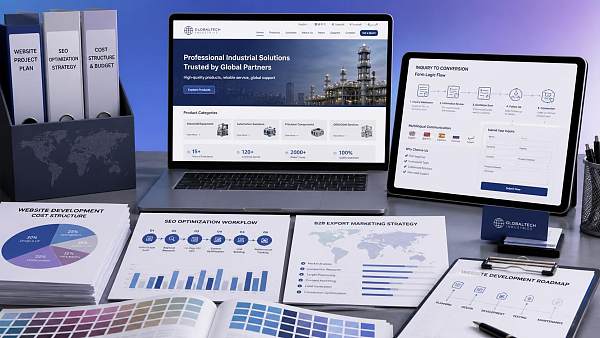
When evaluating costs, which items should be included in the scope first?
If a quotation only states “homepage + several inner pages,” it is essentially impossible to assess the actual cost. A more useful reference is whether the delivery scope clearly specifies items such as page wireframes, UI design files, front-end slicing, back-end data entry logic, product category hierarchy, the number of inquiry forms, email notification methods, anti-spam submission mechanisms, page loading optimization, image compression rules, sitemap generation, redirect settings, analytics tracking deployment, and search console integration. The more detailed the scope, the fewer disputes will arise later.
It is also important to check whether pre-launch testing is included. Common problems with international trade websites often do not appear in the demonstration environment but emerge after official publication. Examples include network access latency in different countries, failed form submissions on mobile devices, PDFs that cannot be opened in certain browsers, product filters becoming misaligned in less commonly used languages, and search results being truncated because title lengths exceed limits. If these testing tasks are not included in the contract, subsequent repairs are usually charged separately.
The cost logic differs among several common website development solutions
The advantage of a template-based solution is speed. It is suitable for projects with clear product lines, limited requirements for page depth, and a need to go live quickly for initial traffic testing. Its limitation is that the structure has limited flexibility. If industry pages, country pages, or campaign pages are added later, the template may not support them, styles may be difficult to keep consistent, and URL rules may be restricted.
A semi-custom solution is more suitable for an international trade marketing website because it can control the development cycle while allocating key resources to inquiry paths and the SEO foundation. For example, an established content management system can be retained while targeted development is carried out for product detail pages, landing pages, language-switching logic, form tracking, and page components. The cost of this type of solution is generally closer to actual business requirements and makes coordination with subsequent promotion easier.
Fully customized development is not automatically better. It is more valuable only when business processes are complex, product data volumes are large, or deep integration with ERP, CRM, or advertising tracking systems is required. Otherwise, excessive development will result in a longer launch cycle and increase the maintenance threshold. When calculating the cost of building a B2B international trade marketing website, the key is not to choose the most complex solution, but to align system complexity with business complexity.
Many budgets get out of control after the website is built
The stage when an international trade website actually begins to incur significant costs is often not the initial launch, but the period after promotion begins. Organic optimization requires continuous additions of category pages, product pages, knowledge content, and external-link landing pages. Advertising requires the rapid duplication of high-conversion pages and A/B testing. Social media traffic acquisition requires pages to place greater emphasis on visual presentation, loading speed, and mobile experience. If the initial site does not reserve a structure for these activities, every subsequent promotional adjustment may require redevelopment.
There are also maintenance costs, including server expansion, program upgrades, vulnerability fixes, plugin compatibility, handling of spam form submissions, page backups, log monitoring, CDN configuration, broken-link management, image replacement, and synchronized updates of language versions. International trade websites often undergo product iterations, packaging adjustments, parameter changes, and discontinued or replacement models. If site content cannot be updated quickly, the information in inquiries may become inconsistent with the company’s actual supply capabilities.
Several key points can help determine whether a quotation is reasonable
- Check whether the quotation is based on business scenarios rather than only on the number of pages. The complexity of a product center, industry application page, article system, download center, and advertising landing page can vary significantly.
- Pay attention to whether multilingual versions are managed independently or simply duplicated. The former has a higher initial cost, but makes subsequent maintenance, SEO, and regional promotion more convenient.
- Confirm who is responsible for entering content. If there are many product parameters, images, and documents, data entry and proofreading are tasks in their own right and should not automatically be assumed to be included in the three words “website development.”
- Check whether technical optimization is actually implemented at the template level. Simply stating “SEO supported” is meaningless; specific items such as URLs, titles, descriptions, sitemaps, and redirect rules should be clearly identified.
- Check whether the inquiry path has been designed separately. The position of contact information, length of form fields, attachment uploads, automatic replies, and source tracking can all affect conversion quality.
If website development and subsequent promotion need to be considered as one continuous process, greater attention is usually paid to whether the site supports content expansion, page reuse, and data tracking, rather than merely comparing the appearance of the first screen. Some implementation methods that combine AI-assisted content, SEO/GEO coordination, and advertising landing page integration may appear to involve more project items at the initial stage, but they can reduce hidden expenses caused by repeated redesigns later.
There is no fixed answer to how much it costs to build a B2B international trade marketing website without considering specific requirements. Clarifying the requirements is more important than rushing to compare prices: how many languages will be used, how complex the product data is, whether SEO and advertising must both be supported, whether independent landing pages are needed, whether there is a long-term content update plan, and whether lead management needs to be integrated. The final cost is the combined result of these conditions. As long as structure, functions, content, promotion, and maintenance are calculated on the same checklist, the website price will no longer be merely an abstract figure, but will more closely represent the actual investment in customer acquisition.
Related Articles


Related Products
 Yiyingbao SaaS Intelligent Website Building and Marketing SystemYiyingbao SaaS Intelligent Website Building and Marketing System, AI-powered no-code website building, rapid creation of multilingual B2B international websites in 10 minutes, global server acceleration, AI-powered SEO optimization, helping businesses connect efficiently with global markets. The perfect integration of technology and operation makes building an international trade website remarkably simple
 AI+SEM Intelligent Advertising Marketing SystemAI+SEM drives intelligent ad creation, empowering full-funnel precision advertising marketing. The system automatically generates weekly/monthly reports, AI recommends keywords and target countries, monitors core metrics in real-time with intelligent alerts, and enables one-click high-conversion ad solutions to help quickly acquire customers and improve ROI.
 AI+SEO Dual-Engine System Optimization ServicesYiyingbao’s AI+SEO dual-engine optimization system helps foreign trade enterprises acquire high-quality organic traffic through AI-powered keyword research, content generation, and comprehensive technical optimization, significantly improving search rankings and conversion rates.
 AI+SNS Social Media Marketing SystemYingbao AI+SNS Social Media Marketing System - Precision social capture for the social media era. Supports one-click content synchronization across major platforms like Facebook and LinkedIn. AI intelligently rewrites posts for enhanced relevance. 24/7 AI customer service and user profiling analysis empower businesses to efficiently expand into global markets.
 AI+SEO营销解决方案易营宝AI+SEO营销解决方案,通过AI批量写作、智能生成TDK、精准关键词扩词等功能,全面优化网站SEO效果,提升流量与转化率。助力企业构建高效智能网站新生态。
 AI+SEM Advertising Marketing SolutionsAI+SEM Advertising Marketing Solution leverages AI technology to deeply empower SEM ad campaigns. It automatically generates weekly/monthly reports using AI, presenting account data across multiple dimensions for comprehensive insights into campaign performance and trends. The system precisely recommends keywords and target countries, intelligently generates high-conversion ad copy, and enables one-click activation of efficient campaign plans to help businesses rapidly acquire customers. Simultaneously, it monitors core metrics in real time, intelligently identifies abnormal fluctuations, and issues timely alerts to ensure stable, high-return advertising results.
 Domain Name ServicesEasyWin provides professional domain name services, including intelligent queries, one-stop registration, brand protection, and full lifecycle management, helping businesses build a digital brand image.
 EasyOperate B2C Cross-Border E-Commerce Platform & Independent WebsiteEasyStore B2C Cross-border E-commerce Independent Store is an intelligent website building and cross-border e-commerce integrated solution independently developed by EasyStore Information Technology (Beijing) Co., Ltd. The system is specially designed for small and medium-sized as well as large export enterprises, integrating 'website building, operation, marketing, advertising, and conversion' into one, helping enterprises quickly establish cross-border e-commerce independent stores to achieve brand globalization and global sales growth.
The platform supports multiple languages, multiple currencies, and multi-channel marketing, with built-in AI intelligent translation and SEO optimization systems, suitable for mainstream markets such as Southeast Asia, Europe and America, Latin America, and the Middle East, assisting Chinese manufacturing enterprises in efficiently deploying international e-commerce strategies. SSL证书易营宝提供专业SSL安全证书服务,包括单域名和泛域名证书,确保网站数据传输加密、身份验证和完整性保护,助力企业建立安全可信的在线业务环境。









