









- Which customer acquisition channels will be affected by cross-border marketing trends in 2026?Sep 06, 2026View details
- Which homogenization risks should be considered in an analysis of the AI-powered website building industry?Aug 30, 2026View details
- How Will AI Marketing Trends 2026 Change Advertising Budget AllocationAug 28, 2026View details
- Is the EV SSL certificate market shrinking or upgrading? How should companies assess certificate procurement?Aug 11, 2026View details
- Why the old AMP SEO 2020 practices no longer work and what has changed in current optimization prioritiesAug 02, 2026View details
- How to Choose Topics for an Industry News Section to Attract More Organic Search TrafficJul 29, 2026View details
At What Stage Should Website Conversion Rate Optimization Services Be Implemented?
Many companies first seriously consider website conversion rate optimization services at a less-than-ideal moment: they have invested in advertising but received no inquiries; SEO rankings have started to improve, but lead quality remains average; or after a website redesign goes live, traffic is not low, yet very few visitors submit forms. On the surface, the issue appears to be “poor conversion.” In essence, however, it is often not a problem with a single button or a particular piece of copy, but rather that the website, traffic, audience, and business objectives were never planned as part of the same overall framework from the outset.
For business professionals responsible for evaluating suppliers, reviewing budgets, and assessing return on investment, the question they truly need to answer is not “Should we invest in website conversion rate optimization services?” but rather: At what stage should these services be introduced to reduce rework, lower the cost of trial and error, and determine earlier whether marketing investments can generate effective returns?
If the website is viewed as part of a company’s overseas customer acquisition journey, conversion optimization should not be understood as a remedial action taken after traffic arrives, but more as a capability that needs to be established in advance. The website development stage determines the page structure and conversion path; the SEO and advertising stages determine whether the visitors entering the site are relevant; and the operational evaluation stage determines whether the company can continuously identify bottlenecks and improve results. The later the intervention, the higher the cost of making corrections.
It Should Not Begin Only When Traffic Becomes a Problem, but Should Be Considered When Preparing to Acquire Customers
Many companies equate website conversion rate optimization services with “page optimization” or “A/B testing.” These are certainly part of the process, but for procurement decisions, this interpretation can easily lead to an underestimation of their value. In particular, for foreign trade companies, manufacturing factories, cross-border sellers, and brands expanding internationally, a website does more than showcase products. It also needs to receive traffic from Google SEO, advertising campaigns, social media referrals, and AI search. The more traffic sources there are, the more complex the conversion journey becomes, and the less appropriate it is to wait until results are unsatisfactory before taking corrective action.
More realistically, companies are most likely to waste their budgets in the following three situations: first, focusing only on design rather than inquiry paths when launching the site; second, monitoring only cost per click while ignoring landing-page performance after starting advertising; and third, having data after a period of operation but lacking consistent criteria for determining whether the problem lies in traffic quality, page content, or the conversion mechanism. This is precisely why website conversion rate optimization services need to be introduced in advance.
The Four Most Suitable Stages for Intervention Do Not Have the Same Priority
If a judgment must be made from a procurement perspective, the ideal time for intervention is not a single point in time, but a phased integration.
1. Website Planning Stage: The Most Cost-Effective Point for Intervention
When the website has not yet been built, or is about to be redesigned, introducing website conversion rate optimization services at this stage generally involves the lowest cost and produces the most direct benefits. This is because many conversion problems are not “optimized” later; they are “avoided” earlier. For example, does the category structure enable users to quickly find product capabilities, industry applications, and trust-building information? Do the homepage and landing pages provide clear calls to action? Are multilingual versions merely translations, or do they take into account the decision-making habits of different markets? Are mobile forms too long? Are inquiry entry points designed in layers? Once these issues are considered clearly during website development, many detours can be avoided later.
This stage is particularly advantageous for suppliers that provide integrated website development, SEO, advertising, and social media services. They are more likely to design “promotable, indexable, and convertible” as one unified project, rather than first creating a website that appears complete and then relying on subsequent teams to continually patch it. Platforms such as 易营宝, which combine AI-powered website development, multilingual website construction, B2B marketing websites, and cross-border e-commerce capabilities, are well suited to embedding conversion objectives into the website architecture during the initial planning stage instead of making temporary adjustments after traffic has already arrived.
2. SEO and Content Planning Stage: Traffic Can Arrive Without Converting
When reviewing SEO proposals, many business evaluators are accustomed to asking about rankings, indexing, and keyword coverage. What is truly related to business performance, however, is “which search intent is being directed to which page.” If an SEO page is written only to cover keywords, but users cannot find clear product relevance, industry solutions, delivery capabilities, or contact paths after entering the page, improved rankings may not necessarily generate more leads.
At this stage, the focus of website conversion rate optimization services is not simply to change page buttons, but to reorganize the logic for connecting content with user needs: Do informational keywords lead to educational pages? Do commercial-intent keywords lead directly to solution pages? Do branded keywords support trust building? Does multilingual content conform to local search and reading habits? This step is particularly important for overseas business, because visitors from different regions can have very different concerns before submitting an inquiry. Pages cannot simply be foreign-language versions created from a Chinese way of thinking.
If the company is also concerned with Google SEO and AI search visibility, the content structure, page semantics, and clarity of conversion entry points should all be planned at this stage, rather than separating SEO and conversion between two teams with no coordination.
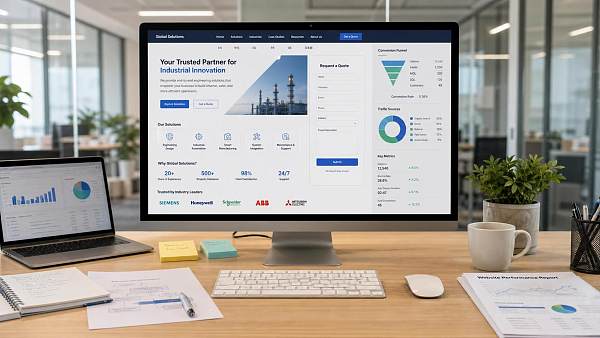
3. Advertising Launch Stage: The More You Pay for Traffic, the Earlier You Need to Intervene
When a company begins running Google Ads, Facebook Ads, or independent-site promotion campaigns, the need for website conversion rate optimization services increases rapidly. The reason is simple: organic traffic growth is usually relatively slow, so problems are exposed more gradually; once paid traffic enters, the effectiveness of page engagement is quickly magnified, and budget losses become more obvious.
The most common mistake at this stage is to focus optimization on account settings while overlooking the consistency between the landing page and the promise made in the advertisement. The ad copy says “rapid prototyping,” but the landing page discusses the company’s history throughout; the advertisement promises “customization for multiple models,” but the key models are not visible above the fold; the audience is procurement managers, yet the page is filled with brand stories. There may be no problem with clicks, but conversion results will naturally be poor.
Therefore, introducing website conversion rate optimization services before or at the beginning of an advertising campaign is often more prudent than waiting until performance has remained poor for a prolonged period before making corrections. When evaluating these services, business professionals should also determine whether the supplier has the ability to coordinate the “traffic side + website side,” rather than merely being capable of beautifying individual pages.
4. Operational Review Stage: Suitable for Identifying Deep Bottlenecks, but Not as the Only Starting Point
If the website has been live for some time and already has data from SEO, advertising, or social media referrals, intervention at this stage can also be valuable. It can help the company identify whether the problem lies in entry-point quality, page information, form design, device compatibility, content credibility, or the conversion process.
From a procurement decision perspective, however, this is more of a “diagnosis and correction” stage than the best starting point. Once problems have taken shape—for example, a disorganized underlying site structure, extensive duplication across multilingual pages, or content logic that does not match market demand—subsequent optimization often involves restructuring, increasing both the time required and the cost of communication.
During Business Evaluation, Do Not Ask Only “Can Conversion Be Improved?” Ask “How Do We Determine When to Intervene?”
Rather than making the broad statement “We need conversion optimization,” a more effective approach is to first determine which situation the company is in.
If the website is still in the planning stage, prioritize service providers that can connect website development, SEO, content, and conversion objectives; if advertising has already begun, first assess the engagement capability of the core landing pages; if SEO traffic is growing but leads remain limited, focus on whether search intent matches page objectives; and if all channels are active but the data is fragmented, the company likely needs a team capable of conducting cross-channel conversion diagnostics.
This is also why website conversion rate optimization services should not be procured in isolation. On the surface, they concern “website issues,” but in practice they often involve user sources, market positioning, page content, technical performance, form mechanisms, and follow-up processes. A team that understands only page redesign but not traffic structure will find it difficult to provide genuinely actionable recommendations.
When Selecting a Service Provider, Business Professionals Should Pay Particular Attention to These Three Things
First, determine whether the provider understands your business conversion objectives, rather than merely discussing user experience in general terms. B2B foreign trade websites, brand-owned websites, and cross-border e-commerce stores do not define conversion in the same way. Some companies seek a higher number of inquiries, some place greater importance on high-quality leads, while others focus on registration, add-to-cart, or lead-capture efficiency. Different objectives require completely different optimization paths.
Second, determine whether the service can cover the complete cycle “from diagnosis to implementation.” Some providers are good at producing reports but lack the capabilities for website development, page adjustments, content restructuring, event tracking analysis, and multilingual adaptation. The result is often many recommendations but little implementation. For companies seeking to control project schedules and budget risks, this type of fragmented service is far from effortless.
Third, determine whether the provider has experience with international markets. In particular, websites targeting North America, Europe, Southeast Asia, Japan and South Korea, the Middle East, or Latin America face significant differences in users’ reading habits, trust assessments, and action triggers. Conversion optimization that is detached from the market context can easily become an overseas page built according to Chinese logic.
A More Practical Conclusion: The Earlier the Intervention, the More It Resembles an Investment; the Later the Intervention, the More It Resembles Remedial Action
Procurement decisions are most concerned about two situations: discovering that the direction is wrong only after the project is complete, and continuously adding budget without being able to clearly explain where the problem lies. The true value of website conversion rate optimization services is not merely to make existing pages easier to use, but to help the website develop the ability to support growth when the company begins building its overseas digital marketing system.
So, at what stage should website conversion rate optimization services be introduced? The optimal answer is usually not “a particular stage,” but to establish conversion logic from the beginning of website planning, calibrate it simultaneously during SEO and advertising campaigns, and continue validating it during operational reviews. For business professionals evaluating service providers, the focus should not be on who presents “optimization” in the most appealing way, but on who can genuinely connect the website, traffic, and business objectives, reduce ineffective spending, and make subsequent growth more predictable.
Related Articles


Related Products
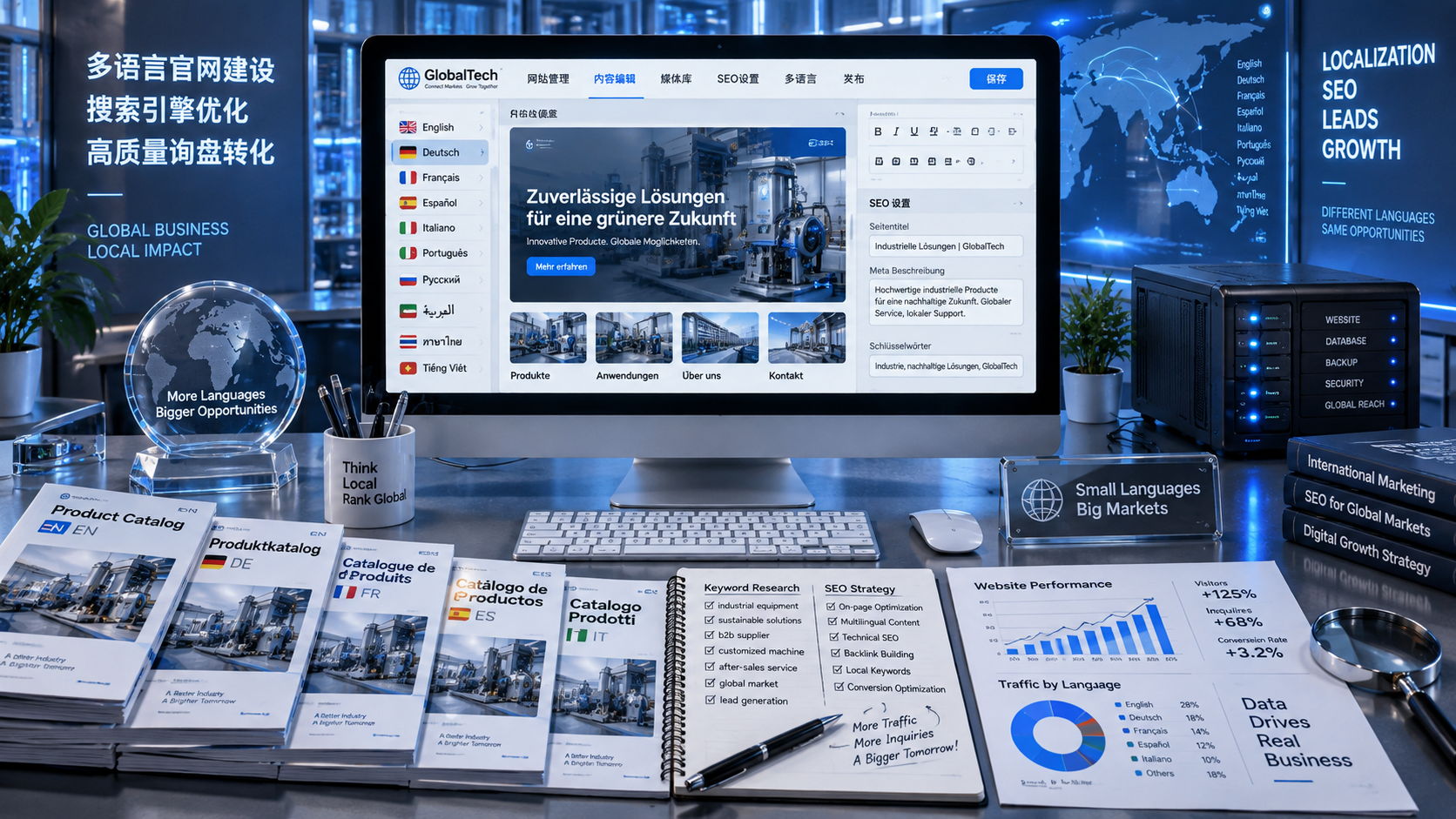
 Yiyingbao SaaS Intelligent Website Building and Marketing SystemYiyingbao SaaS Intelligent Website Building and Marketing System, AI-powered no-code website building, rapid creation of multilingual B2B international websites in 10 minutes, global server acceleration, AI-powered SEO optimization, helping businesses connect efficiently with global markets. The perfect integration of technology and operation makes building an international trade website remarkably simple
 AI+SEM Intelligent Advertising Marketing SystemAI+SEM drives intelligent ad creation, empowering full-funnel precision advertising marketing. The system automatically generates weekly/monthly reports, AI recommends keywords and target countries, monitors core metrics in real-time with intelligent alerts, and enables one-click high-conversion ad solutions to help quickly acquire customers and improve ROI.
 AI+SEO Dual-Engine System Optimization ServicesYiyingbao’s AI+SEO dual-engine optimization system helps foreign trade enterprises acquire high-quality organic traffic through AI-powered keyword research, content generation, and comprehensive technical optimization, significantly improving search rankings and conversion rates.
 AI+SNS Social Media Marketing SystemYingbao AI+SNS Social Media Marketing System - Precision social capture for the social media era. Supports one-click content synchronization across major platforms like Facebook and LinkedIn. AI intelligently rewrites posts for enhanced relevance. 24/7 AI customer service and user profiling analysis empower businesses to efficiently expand into global markets.
 AI+SEO营销解决方案易营宝AI+SEO营销解决方案,通过AI批量写作、智能生成TDK、精准关键词扩词等功能,全面优化网站SEO效果,提升流量与转化率。助力企业构建高效智能网站新生态。
 AI+SEM Advertising Marketing SolutionsAI+SEM Advertising Marketing Solution leverages AI technology to deeply empower SEM ad campaigns. It automatically generates weekly/monthly reports using AI, presenting account data across multiple dimensions for comprehensive insights into campaign performance and trends. The system precisely recommends keywords and target countries, intelligently generates high-conversion ad copy, and enables one-click activation of efficient campaign plans to help businesses rapidly acquire customers. Simultaneously, it monitors core metrics in real time, intelligently identifies abnormal fluctuations, and issues timely alerts to ensure stable, high-return advertising results.
 Domain Name ServicesEasyWin provides professional domain name services, including intelligent queries, one-stop registration, brand protection, and full lifecycle management, helping businesses build a digital brand image.
 EasyOperate B2C Cross-Border E-Commerce Platform & Independent WebsiteEasyStore B2C Cross-border E-commerce Independent Store is an intelligent website building and cross-border e-commerce integrated solution independently developed by EasyStore Information Technology (Beijing) Co., Ltd. The system is specially designed for small and medium-sized as well as large export enterprises, integrating 'website building, operation, marketing, advertising, and conversion' into one, helping enterprises quickly establish cross-border e-commerce independent stores to achieve brand globalization and global sales growth.
The platform supports multiple languages, multiple currencies, and multi-channel marketing, with built-in AI intelligent translation and SEO optimization systems, suitable for mainstream markets such as Southeast Asia, Europe and America, Latin America, and the Middle East, assisting Chinese manufacturing enterprises in efficiently deploying international e-commerce strategies. SSL证书易营宝提供专业SSL安全证书服务,包括单域名和泛域名证书,确保网站数据传输加密、身份验证和完整性保护,助力企业建立安全可信的在线业务环境。









