









- Which customer acquisition channels will be affected by cross-border marketing trends in 2026?Sep 06, 2026View details
- Which homogenization risks should be considered in an analysis of the AI-powered website building industry?Aug 30, 2026View details
- How Will AI Marketing Trends 2026 Change Advertising Budget AllocationAug 28, 2026View details
- Is the EV SSL certificate market shrinking or upgrading? How should companies assess certificate procurement?Aug 11, 2026View details
- Why the old AMP SEO 2020 practices no longer work and what has changed in current optimization prioritiesAug 02, 2026View details
- How to Choose Topics for an Industry News Section to Attract More Organic Search TrafficJul 29, 2026View details
How to Configure Payments for Cross-Border E-Commerce Independent Website Development? A Guide to Choosing PayPal, Credit Cards, and Local Payments
For cross-border e-commerce independent website payment collection,first solve “can pay、feel safe paying、pay smoothly”
How to configure payment collection for cross-border e-commerce independent website development may seem on the surface to be about connecting several payment tools,but what it actually affects is order conversion,chargeback risk,settlement efficiency and the ability to expand later。
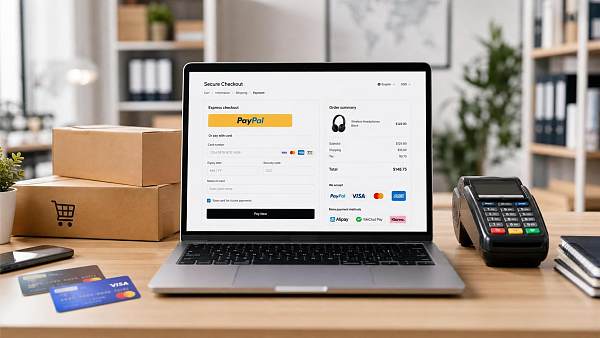
After many websites go live,traffic is not low and there are also inquiries,but orders are slow to grow。The problem is often not that the pages are not attractive enough,but that the payment collection path is not smooth。
Users are very sensitive at the payment step。Whether they can pay with a familiar method,whether the page is trustworthy,and whether local currency is supported will all directly affect the transaction。
Therefore,payment collection for cross-border e-commerce independent website development is not a single-choice question,but a combination question。The common core combination is usually PayPal,international credit cards,plus local payment methods in the target market。
From actual business operations,early-stage sellers pursue collecting payments first,mid-stage sellers begin to focus on risk control and rates,and when they reach the scaling stage,the focus shifts again to payment success rates and regional coverage。
This also means that payment collection solutions for cross-border e-commerce independent website development must be designed together with business stage,category attributes and market structure,and cannot simply copy someone else’s template。
Why independent website payment collection configuration directly affects conversion
When users pay,the decision window is very short。As long as there is one more redirect step,or they see an unfamiliar payment entrance,hesitation will rise significantly。
Especially on mobile,the payment experience depends more on a concise path。Button position,currency display,and the number of payment methods will all affect the final payment completion rate。
Another issue that is easily overlooked is the risk control strategy。If the payment channel is too single,once account review,increased disputes or regional restrictions occur,orders will get stuck。
Therefore,payment collection for cross-border e-commerce independent website development must take three things into account:improving the payment success rate,controlling fund risks,and supporting subsequent multi-market expansion。
- At the front-end level,users must be able to understand it and feel safe paying。
- At the transaction level,failed payments and chargeback losses must be reduced。
- At the operations level,stable settlement and account health must be ensured。
What stage is PayPal suitable for,and where are its advantages and boundaries
PayPal is still one of the most common entrances in payment collection for cross-border e-commerce independent website development。The reason is very direct:high overseas recognition,fast integration,and low user trust cost。
For a new website,the value of PayPal first lies in “getting started first”。Especially when testing markets,validating product selection,and launching cold-start advertising,it can shorten the go-live cycle。
But PayPal is not suitable for taking on all payment collection tasks。As orders grow,account reviews,dispute handling,fund freezes and fee pressure will gradually increase。
If the average order value is relatively high,or the logistics cycle is relatively long,dispute risk will also be more prominent。For this type of business,relying only on PayPal is usually not stable enough。
Scenarios more suitable for integrating PayPal
- The independent website has just gone live and needs to generate the first batch of orders as soon as possible。
- European and American markets account for a relatively high share,and users have strong acceptance of PayPal。
- The average order value is medium to low,and the fulfillment cycle is relatively short。
- Users need an additional trust endorsement。
Points to manage in advance when using PayPal
- Product descriptions,refund policies and logistics information should be complete and consistent。
- Abnormal order monitoring should be placed earlier to avoid concentrated disputes。
- Do not put the only payment collection entrance on a single account。
Why credit card channels are a basic capability for independent website payment collection
If PayPal solves the initial trust issue,then international credit cards solve the scaling issue of payment collection for cross-border e-commerce independent website development。
For many mature websites,core transactions are ultimately completed by credit card。The reason is not complicated:wide coverage,short path,high conversion,and more favorable for brand accumulation。
From the user experience perspective,paying directly by card on the website is often smoother than being redirected to a third-party account。For brand websites,this is especially important。
However,credit card channels have higher requirements for the website’s basic conditions。Entity qualifications,website compliance,privacy terms,shipping timeliness and after-sales mechanisms will all affect review and risk control scores。
Practical value brought by credit card channels
- Support more mainstream overseas payment habits。
- Reduce redirects and improve checkout completion rates。
- Facilitate subsequent multi-currency and multi-market expansion。
- More suitable for accumulating data assets of brand-oriented independent websites。
In actual business,connecting a credit card channel is not the end。What is more critical is payment success rate optimization,including billing address verification,3D Secure authentication and abnormal transaction identification。
Local payments are not an add-on,but a key variable for regional transactions
When many teams handle payment collection for cross-border e-commerce independent website development,they tend to put local payments very late。In fact,once entering segmented markets,this often becomes a conversion watershed。
For example,some regions in Europe are accustomed to bank transfer-type payments,Southeast Asian users rely more on e-wallets,and the Middle East and Latin American markets also each have clear local payment preferences。
If a website only provides PayPal and credit cards,it may appear to cover the international mainstream on the surface,but in reality it may miss a group of local users who are most willing to pay。
When should local payments be added
- The traffic share of a certain country or region continues to increase。
- Add-to-cart is high,payment completion rate is low,and this is concentrated in a specific market。
- Advertising has already scaled,and further improvement of conversion return is needed。
- The brand is preparing for localized operations and long-term deep cultivation。
The significance of local payments is not just adding one more button,but allowing users to complete transactions in a familiar way。This step often creates the greatest gap between similar independent websites。
How to configure payment collection for cross-border e-commerce independent website development at different business stages
A more prudent approach is to configure by stage,rather than connecting all methods at once。In this way,costs,risk control and operational burden are all more controllable。
For enterprises pursuing long-term growth,the payment collection system is best planned together with website development,advertising and data analysis。Only in this way can the payment performance and input-output of each market be truly seen clearly。
When implementing a payment collection solution,do not ignore website and marketing coordination
Payment collection for cross-border e-commerce independent website development is never an isolated module。It is closely related to website structure,page trust,advertising strategy and SEO layout。
For example,after advertising traffic enters the website,if the landing page information is incomplete,no amount of payment options can save conversion。Conversely,when the website experience is done well,payment collection configuration will also amplify results faster。
For platforms like 易营宝 that provide integrated capabilities in intelligent website development,cross-border malls,SEO optimization,advertising and overseas marketing,the advantage lies in being able to view website development,payment and customer acquisition within the same growth chain。
The benefit of doing this is very clear:it can not only complete the launch of multilingual independent websites faster,but also continuously adjust the payment collection combination based on payment habits and advertising performance in different countries。
If the goal is to operate overseas markets for the long term,then the correct thinking for payment collection in cross-border e-commerce independent website development is not to choose the most popular tool,but to build a payment system that can grow,expand and withstand risks。
At the execution level,you can first sort out payment preferences by target market,then configure PayPal,credit cards and local payments according to business stage,and finally continue iterating based on website experience and marketing data。Only in this way can payment collection truly become a transaction accelerator。
Related Articles



Related Products
 Yiyingbao SaaS Intelligent Website Building and Marketing SystemYiyingbao SaaS Intelligent Website Building and Marketing System, AI-powered no-code website building, rapid creation of multilingual B2B international websites in 10 minutes, global server acceleration, AI-powered SEO optimization, helping businesses connect efficiently with global markets. The perfect integration of technology and operation makes building an international trade website remarkably simple
 AI+SEM Intelligent Advertising Marketing SystemAI+SEM drives intelligent ad creation, empowering full-funnel precision advertising marketing. The system automatically generates weekly/monthly reports, AI recommends keywords and target countries, monitors core metrics in real-time with intelligent alerts, and enables one-click high-conversion ad solutions to help quickly acquire customers and improve ROI.
 AI+SEO Dual-Engine System Optimization ServicesYiyingbao’s AI+SEO dual-engine optimization system helps foreign trade enterprises acquire high-quality organic traffic through AI-powered keyword research, content generation, and comprehensive technical optimization, significantly improving search rankings and conversion rates.
 AI+SNS Social Media Marketing SystemYingbao AI+SNS Social Media Marketing System - Precision social capture for the social media era. Supports one-click content synchronization across major platforms like Facebook and LinkedIn. AI intelligently rewrites posts for enhanced relevance. 24/7 AI customer service and user profiling analysis empower businesses to efficiently expand into global markets.
 AI+SEO营销解决方案易营宝AI+SEO营销解决方案,通过AI批量写作、智能生成TDK、精准关键词扩词等功能,全面优化网站SEO效果,提升流量与转化率。助力企业构建高效智能网站新生态。
 AI+SEM Advertising Marketing SolutionsAI+SEM Advertising Marketing Solution leverages AI technology to deeply empower SEM ad campaigns. It automatically generates weekly/monthly reports using AI, presenting account data across multiple dimensions for comprehensive insights into campaign performance and trends. The system precisely recommends keywords and target countries, intelligently generates high-conversion ad copy, and enables one-click activation of efficient campaign plans to help businesses rapidly acquire customers. Simultaneously, it monitors core metrics in real time, intelligently identifies abnormal fluctuations, and issues timely alerts to ensure stable, high-return advertising results.
 Domain Name ServicesEasyWin provides professional domain name services, including intelligent queries, one-stop registration, brand protection, and full lifecycle management, helping businesses build a digital brand image.
 EasyOperate B2C Cross-Border E-Commerce Platform & Independent WebsiteEasyStore B2C Cross-border E-commerce Independent Store is an intelligent website building and cross-border e-commerce integrated solution independently developed by EasyStore Information Technology (Beijing) Co., Ltd. The system is specially designed for small and medium-sized as well as large export enterprises, integrating 'website building, operation, marketing, advertising, and conversion' into one, helping enterprises quickly establish cross-border e-commerce independent stores to achieve brand globalization and global sales growth.
The platform supports multiple languages, multiple currencies, and multi-channel marketing, with built-in AI intelligent translation and SEO optimization systems, suitable for mainstream markets such as Southeast Asia, Europe and America, Latin America, and the Middle East, assisting Chinese manufacturing enterprises in efficiently deploying international e-commerce strategies. SSL证书易营宝提供专业SSL安全证书服务,包括单域名和泛域名证书,确保网站数据传输加密、身份验证和完整性保护,助力企业建立安全可信的在线业务环境。









