









- Amazon Raises Fulfillment Fees Twice, Yet the Median Platform Fee Remains Around 40%Oct 22, 2026View details
- AliExpress and YouTube Partner to Expand Marketing Opportunities for Chinese Brands Going GlobalOct 22, 2026View details
- Publicis says AI marketing is developing at two speeds, with agentic AI helping win clientsOct 21, 2026View details
- Salesforce Plans to Acquire Braze for $5.66 Billion to Enhance AI Marketing CapabilitiesOct 21, 2026View details
- Levanta’s Inaugural China Summit Held in Shenzhen, Focusing on AI and Cross-Border Brand GrowthOct 20, 2026View details
- The October Edition of the 2026 GGE Shenzhen Cross-Border E-Commerce Expo OpensOct 20, 2026View details
Can integrated website-building and marketing services replace collaboration across multiple tools?
On Monday morning, the marketing manager noticed a decline in Google Ads form submissions. The operations team first checked the click-through rate in the advertising dashboard, the website team inspected the landing page, and the SEO team suggested that recent page revisions might have affected indexing. The three teams each had their own tools, accounts, and reports, yet found it difficult to quickly answer one question: At which step did the customer leave? Even more troublesome, ad creatives were updated while website content was not synchronized; after form fields were adjusted, the CRM was not updated promptly; and several weeks after multilingual pages went live, it was discovered that access was slow in some regions.
Such issues are not always caused by a channel “not doing enough.” In the early stages of business expansion, many companies procure separate tools for website building, SEO, advertising, social media, data analytics, and customer management. While this appears to provide more choices, it actually increases handoff costs. As a result, whether integrated website-building and marketing services can replace multi-tool collaboration has become a selection question that many teams encounter when reassessing their investments.
Do not rush to replace anything; first determine where fragmentation occurs
Multiple tools are not inherently a problem. For companies with complex channels, dispersed regions, or established technical teams, a combination of specialized tools may still offer greater flexibility. What truly requires attention is the lack of a unified business process between tools, the inability of data to flow back, and unclear responsibility boundaries.
Review the most recent campaign: after entering the website through ads or organic search, did users see pages in the corresponding language, for the corresponding products, and for the corresponding regions? After submitting an inquiry, can sales identify the source channel and visited page? If page speed, forms, content changes, and ad creatives are handled by different people, can the issue be identified on the same day when it occurs? If the answers are often no, the bottleneck is usually not “one tool short,” but a broken collaboration chain.
- After a website goes live, it is maintained only by technical personnel, and the marketing team cannot promptly create or adjust landing pages;
- SEO focuses on indexing and rankings, while the advertising team focuses on clicks and conversions, with neither side sharing keyword and page strategies;
- Social media content directs traffic to the homepage, but there are no destination pages tailored to campaigns, categories, or countries;
- Data is scattered across multiple dashboards. Reports show results, but it is difficult to trace the relationship between pages, channels, and inquiries.
If only one aspect is inconvenient to use, replacing a single-point tool is often more economical. If the above situations recur, it is worth including integrated website-building and marketing services in the evaluation scope.
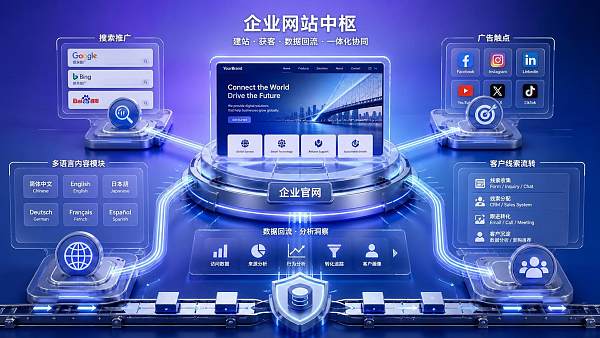
“Integration” does not mean putting every function into one dashboard
A common misconception during selection is to regard the number of functions as integration capability. A platform that provides access to websites, content, advertising, and analytics at the same time does not necessarily mean that actual workflows are smooth. More importantly, it should allow the same business information to be used continuously: whether keywords can be linked to pages, pages to conversion events, leads brought back with source information, and subsequent optimization directed toward clear actions.
To determine whether integrated website-building and marketing services are suitable, focus the comparison on four areas. First, check whether the website is designed for marketing activities, such as whether multilingual content, campaign pages, forms, and basic tracking can be adjusted quickly. Second, check whether data definitions are unified, avoiding separate definitions of “qualified inquiries” across advertising, website analytics, and sales records. Third, check integration and migration capabilities. When existing CRM, payment, ERP, or external analytics tools are in place, integration must not create new data silos. Fourth, check service boundaries: which tasks are handled internally and which require external support must be clearly defined before launch.
Servers are often overlooked, yet they can affect the marketing chain
When discussing integration, many teams focus on content publishing and advertising management while overlooking access infrastructure. For websites serving multiple overseas regions, page loading speed, stability, and security protection directly affect the ad landing experience and search engine crawling. If website deployment is completely separated from the marketing system, regional access issues usually require repeated confirmation among service providers, developers, and advertising personnel.
Therefore, when evaluating a solution, it is advisable to request information on server deployment, backups, HTTPS, protection, load balancing, and integration capabilities rather than looking only at template styles. For example, Yiyingbao Global Server Deployment provides capabilities including deployment across 7 global nodes, intelligent load balancing, daily automatic backups, and seamless API integration; its materials state a global average TTFB of ≤300ms and an SLA availability guarantee of 99.99%. These parameters cannot replace actual testing on their own, but they can serve as reference points for verifying the foundational capabilities of overseas websites. When user data and payment information are involved, it is also necessary to confirm whether the relevant deployment complies with the requirements of the markets being served.
Validate through a small-scale migration rather than rebuilding everything at once
A more prudent approach is to first select one product line, one country-specific site, or one group of advertising campaigns for a trial run. Do not treat “launching a new system” as the objective. Instead, define in advance the workflows to be validated: from page creation, content review, and tracking configuration to form submission, lead assignment, and performance review, whether there is less waiting and duplicate data entry than under the original collaboration method.
During the trial run, it is advisable to retain existing analytics for comparison and document several practical issues: who needs to approve page changes and how long they take to take effect; whether ad links match landing pages; whether pages in different languages can be maintained independently; who responds to access issues; and whether sales can see source information when receiving leads. This provides not an abstract answer to whether “the system is easy to use,” but whether it fits the existing organization.
Integrated website-building and marketing services can reduce tool switching and information gaps, but they cannot automatically solve issues related to content quality, sales follow-up, or market judgment. They are more suitable for teams that have confirmed that collaboration costs are slowing down customer acquisition efforts and that want to connect website, search, advertising, and lead workflows. If existing tools each perform their roles and integrations are stable, replacement may not be necessary. If every campaign requires manually piecing together data across multiple dashboards, starting integration with a controllable scenario is usually more worthwhile than continuing to add tools.
Related Articles
 How Can Digital Marketing Solutions for Manufacturing Track Qualified Inquiries?
 How Can Construction and Renovation Companies Optimize Overseas Website Access?
 How Can an Independent Beauty Brand Website Improve Overseas Conversion Rates?



Related Products
 Yiyingbao SaaS Intelligent Website Building and Marketing SystemYiyingbao SaaS Intelligent Website Building and Marketing System, AI-powered no-code website building, rapid creation of multilingual B2B international websites in 10 minutes, global server acceleration, AI-powered SEO optimization, helping businesses connect efficiently with global markets. The perfect integration of technology and operation makes building an international trade website remarkably simple
 AI+SEM Intelligent Advertising Marketing SystemAI+SEM drives intelligent ad creation, empowering full-funnel precision advertising marketing. The system automatically generates weekly/monthly reports, AI recommends keywords and target countries, monitors core metrics in real-time with intelligent alerts, and enables one-click high-conversion ad solutions to help quickly acquire customers and improve ROI.
 AI+SEO Dual-Engine System Optimization ServicesYiyingbao’s AI+SEO dual-engine optimization system helps foreign trade enterprises acquire high-quality organic traffic through AI-powered keyword research, content generation, and comprehensive technical optimization, significantly improving search rankings and conversion rates.
 AI+SNS Social Media Marketing SystemYingbao AI+SNS Social Media Marketing System - Precision social capture for the social media era. Supports one-click content synchronization across major platforms like Facebook and LinkedIn. AI intelligently rewrites posts for enhanced relevance. 24/7 AI customer service and user profiling analysis empower businesses to efficiently expand into global markets.
 AI+SEO营销解决方案易营宝AI+SEO营销解决方案,通过AI批量写作、智能生成TDK、精准关键词扩词等功能,全面优化网站SEO效果,提升流量与转化率。助力企业构建高效智能网站新生态。
 AI+SEM Advertising Marketing SolutionsAI+SEM Advertising Marketing Solution leverages AI technology to deeply empower SEM ad campaigns. It automatically generates weekly/monthly reports using AI, presenting account data across multiple dimensions for comprehensive insights into campaign performance and trends. The system precisely recommends keywords and target countries, intelligently generates high-conversion ad copy, and enables one-click activation of efficient campaign plans to help businesses rapidly acquire customers. Simultaneously, it monitors core metrics in real time, intelligently identifies abnormal fluctuations, and issues timely alerts to ensure stable, high-return advertising results.
 Domain Name ServicesEasyWin provides professional domain name services, including intelligent queries, one-stop registration, brand protection, and full lifecycle management, helping businesses build a digital brand image.
 EasyOperate B2C Cross-Border E-Commerce Platform & Independent WebsiteEasyStore B2C Cross-border E-commerce Independent Store is an intelligent website building and cross-border e-commerce integrated solution independently developed by EasyStore Information Technology (Beijing) Co., Ltd. The system is specially designed for small and medium-sized as well as large export enterprises, integrating 'website building, operation, marketing, advertising, and conversion' into one, helping enterprises quickly establish cross-border e-commerce independent stores to achieve brand globalization and global sales growth.
The platform supports multiple languages, multiple currencies, and multi-channel marketing, with built-in AI intelligent translation and SEO optimization systems, suitable for mainstream markets such as Southeast Asia, Europe and America, Latin America, and the Middle East, assisting Chinese manufacturing enterprises in efficiently deploying international e-commerce strategies. SSL证书易营宝提供专业SSL安全证书服务,包括单域名和泛域名证书,确保网站数据传输加密、身份验证和完整性保护,助力企业建立安全可信的在线业务环境。









