









- Which customer acquisition channels will be affected by cross-border marketing trends in 2026?Sep 06, 2026View details
- Which homogenization risks should be considered in an analysis of the AI-powered website building industry?Aug 30, 2026View details
- How Will AI Marketing Trends 2026 Change Advertising Budget AllocationAug 28, 2026View details
- Is the EV SSL certificate market shrinking or upgrading? How should companies assess certificate procurement?Aug 11, 2026View details
- Why the old AMP SEO 2020 practices no longer work and what has changed in current optimization prioritiesAug 02, 2026View details
- How to Choose Topics for an Industry News Section to Attract More Organic Search TrafficJul 29, 2026View details
When reviewing website design case studies for industrial companies, which conversion and brand metrics should be evaluated?
When viewing referenzen webdesign industrie, many industrial companies are initially drawn to the layout, color scheme, and animations. However, what truly determines whether a project succeeds is often not whether it looks sophisticated, but whether the website can generate inquiries, help customers build trust quickly, be found by search engines, and support subsequent promotion. For decision-makers, a case study is not something to "admire"; it is a way to determine whether a company truly understands the logic of industrial product customer acquisition.
If you are currently selecting a provider, remember this principle: the more industrial website case studies you review, the more you should shift your attention from "whether it looks good" to whether it can convert visitors, build long-term brand equity, and support ongoing operations. This is the step most often overlooked when selecting a service provider, yet it has one of the greatest impacts on results.
When reviewing referenzen webdesign industrie, do not rush to assess the homepage visuals
Industrial websites are different from consumer brand websites. Industrial procurement cycles are longer and involve more decision-makers. Customers generally do not place an order immediately simply because a homepage looks attractive. In most cases, a website has three responsibilities: enabling potential customers to quickly determine whether you are professional, helping search engines understand your business, and allowing interested visitors to initiate contact smoothly.
Therefore, the first principle for evaluating a case study is: do not focus only on the homepage.
Many case-study homepages are packed with videos, animations, and full-screen images. However, once you move to the product pages, application pages, or industry solution pages, you may find that the content is thin, the structure is confusing, and the form entry points are weak. Such projects may look impressive in a presentation, but their value in real customer-acquisition scenarios is often limited.
Case studies that truly deserve extra credit usually have several clear characteristics: product categories are well organized, application scenarios are clearly explained, page paths are short, key contact information is easy to find, and technical documents or downloads are readily accessible. They may not be the most visually striking, but they are usually closer to actual business needs.
A simple evaluation standard is: the quality of an industrial website case study is not determined by how much the homepage resembles a brand website, but by whether customers can understand within a few minutes what you sell, who it is suitable for, and why they should contact you after entering any internal page.
What you should really evaluate is the page capability behind conversion metrics
Many service providers talk about "marketing websites" when presenting case studies. But without specific conversion actions, the term is essentially empty. When industrial companies review case studies, they should focus on the following types of conversion metrics.
First, are inquiry entry points sufficiently clear? Industrial customers do not click "Buy Now" as frequently as retail users. They are more likely to "Submit an Inquiry," "Request a Quote," "Download Materials," or "Schedule a Consultation." Therefore, when reviewing a case study, check whether these entry points are fixed, visible, and distributed appropriately; whether the form fields are sufficient without being excessive; and whether the form is easy to complete on mobile devices. If a case study only provides an email address in the footer and has almost no guidance in the middle of the page, the design is generally weak for industrial product scenarios.
Second, do the pages drive conversion rather than merely display information? For example, does the product page provide a clear parameter structure, application industries, delivery capabilities, certification information, and frequently asked questions? Does the solution page merely describe concepts, or does it fully explain the pain points, solution, and results? Industrial customers want to reduce the cost of evaluation, not read a collection of empty claims.
Third, does the website support multiple conversion touchpoints? Some visitors will not submit an inquiry on their first visit, but they may bookmark a page, download a catalog, click WhatsApp, copy an email address, or return later. If a case study shows this type of multi-level conversion design, it indicates that the provider understands real business processes rather than simply adding an "Online Message" button.
Fourth, data-tracking capabilities. After many industrial websites go live, companies cannot even clearly determine which page generates the most inquiries or which channel brings customers who are more likely to convert. A case study may not disclose all data, but you can ask the provider whether it supports GA4, Google Ads, Search Console, form-source tracking, event tracking, and other tracking capabilities. Without tracking, subsequent optimization is essentially based on guesswork.
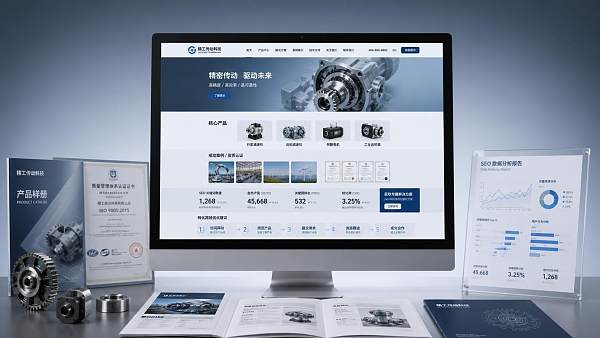
Experienced teams generally do not rely solely on design mockups. Instead, they explain the website as part of the customer-acquisition journey. For platform-based service providers such as 易营宝, which have long served foreign trade companies, manufacturing factories, and brands expanding overseas, the value often goes beyond website development itself. It lies in connecting intelligent website building, SEO, advertising, multilingual content, and subsequent operations. For industrial companies, this integrated capability is more meaningful than simply creating several attractive pages, because the website must ultimately connect to real promotional activities rather than remain at the moment it goes live.
How to assess brand metrics: the key is whether credibility can be verified
Brand perception is certainly important when industrial companies build websites, but it does not mean using premium colors or displaying the company slogan in large type. In the industrial sector, brand credibility comes more from a high density of verifiable information.
When reviewing a case study, pay particular attention to the following:
- Is the company’s strength clearly communicated: founding date, factory/team, production capacity, service regions, certifications, qualifications, and delivery experience?
- Is product expertise reflected in the details: specifications, materials, application scenarios, testing standards, and supporting services?
- Are there sufficient real trust signals: customer case studies, certificates, trade fair records, media coverage, FAQs, and after-sales service methods?
- Does the language sound like that of an industry company rather than template copy? Many websites clearly consist of generic phrases, which immediately reduces customer trust.
There is a common misconception that a "brand-oriented website" should discuss fewer specifications and focus more on concepts. This may work in some consumer product industries, but in the industrial sector it can often have the opposite effect. Buyers first need to confirm that you "can deliver" before they are willing to understand "who you are." If a case study has strong brand messaging but weak communication of product capabilities, it can generally be considered more exhibition-oriented than business-oriented.
Another detail worth examining is whether the content hierarchy remains consistent. A truly mature website will not have a sophisticated homepage and internal pages that look as though they were assembled temporarily. Customer trust is not built only on the homepage; it develops gradually through multiple visits.
SEO performance is not simply a matter of adding keywords
SEO is often underestimated when industrial companies review website case studies. Many decision-makers believe SEO is something to address after launch: build the website first and deal with it later. In reality, site structure, URL rules, page hierarchy, language versions, loading speed, and content templates all directly affect subsequent indexing and rankings.
Therefore, when evaluating a case study, examine at least four points:
First, is the structure suitable for indexing? Are sections such as product categories, industry applications, solutions, blogs/news, and case studies clearly organized? Are URLs standardized, and can pages be indexed independently? Websites with only a homepage and a few isolated pages generally have limited room for future organic traffic.
Second, does the content have search value? A major problem with many industrial website case studies is that every page resembles a corporate brochure, lacking content built around product keywords, application issues, and purchasing questions. Such pages may be barely sufficient for customers, but they are weak from a search-engine perspective.
Third, is the technical foundation reliable? Loading speed, mobile adaptation, image compression, redundant code, sitemaps, and basic tag configuration all affect visibility. There is no need to sacrifice speed for visual spectacle. This is especially important when targeting overseas markets, where cross-region access experience directly affects the bounce rate.
Fourth, does it support multilingual content and localization? If the company targets more than one country, examine closely how multilingual websites are implemented in the case studies. Is the content simply machine-translated, or is the content structure adapted by market? Do all languages share one set of pages, or are localized keyword strategies used? These approaches differ significantly.
In this respect, service providers with AI website-building capabilities, multilingual support, and an SEO/GEO optimization system are better suited to industrial companies seeking long-term customer acquisition overseas. The reason is practical: today’s website is no longer a single display window. It must also support search engines, advertising landing pages, social media traffic acquisition, and even information visibility in AI search environments.
Do not overlook loading speed and backend operability: they affect long-term return on investment
At the time of signing many projects, discussions focus on the number of pages, visual style, and development cycle. Several months after launch, however, problems often concentrate on two other issues: the site is too slow and difficult to manage.
The impact of speed is straightforward. If customers cannot open the core content within three seconds after clicking through, many opportunities are lost. Industrial companies often use large images, PDFs, videos, and complex modules. If performance is not controlled at the beginning, the cost of remediation later can be high.
Backend operability is even more likely to be underestimated. A case study may look good, but if the backend only allows technical staff to edit content, or if adding every new product requires secondary development, it is highly inconvenient for the business team. During evaluation, ask directly: Can operations staff independently maintain product pages, case-study pages, news pages, and language versions? Can form leads be managed centrally? Will content updates affect existing SEO? These questions are more important than whether another animation can be added to the homepage.
Some corporate management teams also refer to content governance practices in other industries, such as how research-oriented pages organize information while balancing standardization and readability. Content such as Research on the Construction Path of Internal Controls in Public Hospitals from the Perspective of Financial Supervision is not itself an industrial website case study, but it highlights one point: for any website serving a professional audience, information structure, logical completeness, and credible communication are more important than flashy packaging. This evaluation method is broadly applicable.
How to understand case studies: use an internal evaluation form
If you are selecting 3 to 5 service providers, consider having the team score them according to the same criteria. This can prevent internal discussions from becoming subjective debates such as "I think it looks good" or "It does not look like a large company."
A practical evaluation form should include at least the following dimensions: clarity of the conversion path, brand credibility, SEO foundation, loading speed, mobile experience, multilingual capabilities, backend maintainability, level of industry understanding, and coordination with subsequent promotion.
Among these, "level of industry understanding" should be evaluated separately. The product logic, purchasing cycle, and content communication of industrial companies differ from those of SaaS, consumer products, catering, and education. If a provider presents a collection of general-industry case studies but cannot explain why industrial websites need to emphasize application scenarios, qualifications, delivery capabilities, and inquiry paths, then regardless of how many case studies it has, their reference value is limited.
A common situation in actual consultations is that companies use the number of case studies as their primary criterion. Quantity naturally has some reference value, but what matters more is whether there are case studies close to your business model. A B2B inquiry website and a B2C e-commerce store require completely different approaches. A domestic Chinese corporate website and an overseas multilingual independent website also follow different logic.
One final check: can this case study support your growth over the next three years?
Choosing a website service provider is not only choosing a project implementation team; it is also choosing the foundation of your digital operations for a period of time to come. The referenzen webdesign industrie you review today should answer not only whether the website can go live, but also whether it can continue to support growth.
If a case study combines conversion design, brand credibility, an SEO foundation, technical performance, and room for subsequent operations, it is generally more worthy of serious consideration. Conversely, if it relies primarily on visual impact, lacks content depth, and cannot explain how promotion connects with data tracking, it is probably just an attractive showcase project.
For industrial companies, a website is more than a corporate business card. It should be a pre-sales communication tool, an entry point for brand trust, and a destination for future search, advertising, social media, and AI visibility. Understanding case studies correctly is more important than simply reviewing more of them.
Frequently Asked Questions
1. When industrial companies review website case studies, which is more important: homepage design or product-page design?
If the goal is customer acquisition, product pages and solution pages are generally more important. The homepage creates the first impression, while internal pages determine whether customers will continue learning about the company and initiate contact.
2. Are case studies without publicly available conversion data still worth reviewing?
Yes, but focus on whether the conversion path is complete. Ask the service provider about event tracking, form management, and subsequent optimization capabilities rather than looking only at the visual presentation.
3. If a website is intended only for brand presentation, is SEO still important?
It is not advisable to view it that way. Even when brand presentation is the primary purpose, basic indexing, speed, and content structure affect whether customers can successfully find you when searching for your company name or product name.
4. What is the most common pitfall of multilingual industrial websites?
The most common issue is directly translating Chinese content without adapting the keywords, page structure, and writing style to the target market. The pages may exist, but traffic and inquiries fail to increase.
Image Placeholder Checklist
Suggested position: after the section "What you should really evaluate is the page capability behind conversion metrics"; image content: an illustration of the evaluation dimensions for industrial website case studies, which may include inquiry entry points, content structure, trust signals, SEO fundamentals, and backend management; alt text: Illustration of core evaluation metrics for industrial website case studies
Suggested Internal Link Anchor Text
- Industrial marketing website development: Link to the industrial website development service page or solutions page
- How to do SEO for multilingual foreign trade websites: Link to the overseas SEO topic page
- Planning approach for B2B inquiry-driven independent websites: Link to a foreign trade customer-acquisition article or case-study page
- Key points for optimizing Google Ads landing pages: Link to the advertising service page or a knowledge article
- Common issues in redesigning manufacturing company websites: Link to an industry website development guide
Suggested External Authoritative Sources
- Official search-engine documentation, such as Google Search Central resources on website structure, mobile experience, and indexing guidelines
- Research reports on manufacturing digitalization and foreign trade customer acquisition published by industry associations or chambers of commerce
- Official technical documentation in the fields of website performance and usability, such as explanations related to Core Web Vitals
Related Articles


Related Products
 Yiyingbao SaaS Intelligent Website Building and Marketing SystemYiyingbao SaaS Intelligent Website Building and Marketing System, AI-powered no-code website building, rapid creation of multilingual B2B international websites in 10 minutes, global server acceleration, AI-powered SEO optimization, helping businesses connect efficiently with global markets. The perfect integration of technology and operation makes building an international trade website remarkably simple
 AI+SEM Intelligent Advertising Marketing SystemAI+SEM drives intelligent ad creation, empowering full-funnel precision advertising marketing. The system automatically generates weekly/monthly reports, AI recommends keywords and target countries, monitors core metrics in real-time with intelligent alerts, and enables one-click high-conversion ad solutions to help quickly acquire customers and improve ROI.
 AI+SEO Dual-Engine System Optimization ServicesYiyingbao’s AI+SEO dual-engine optimization system helps foreign trade enterprises acquire high-quality organic traffic through AI-powered keyword research, content generation, and comprehensive technical optimization, significantly improving search rankings and conversion rates.
 AI+SNS Social Media Marketing SystemYingbao AI+SNS Social Media Marketing System - Precision social capture for the social media era. Supports one-click content synchronization across major platforms like Facebook and LinkedIn. AI intelligently rewrites posts for enhanced relevance. 24/7 AI customer service and user profiling analysis empower businesses to efficiently expand into global markets.
 AI+SEO营销解决方案易营宝AI+SEO营销解决方案,通过AI批量写作、智能生成TDK、精准关键词扩词等功能,全面优化网站SEO效果,提升流量与转化率。助力企业构建高效智能网站新生态。
 AI+SEM Advertising Marketing SolutionsAI+SEM Advertising Marketing Solution leverages AI technology to deeply empower SEM ad campaigns. It automatically generates weekly/monthly reports using AI, presenting account data across multiple dimensions for comprehensive insights into campaign performance and trends. The system precisely recommends keywords and target countries, intelligently generates high-conversion ad copy, and enables one-click activation of efficient campaign plans to help businesses rapidly acquire customers. Simultaneously, it monitors core metrics in real time, intelligently identifies abnormal fluctuations, and issues timely alerts to ensure stable, high-return advertising results.
 Domain Name ServicesEasyWin provides professional domain name services, including intelligent queries, one-stop registration, brand protection, and full lifecycle management, helping businesses build a digital brand image.
 EasyOperate B2C Cross-Border E-Commerce Platform & Independent WebsiteEasyStore B2C Cross-border E-commerce Independent Store is an intelligent website building and cross-border e-commerce integrated solution independently developed by EasyStore Information Technology (Beijing) Co., Ltd. The system is specially designed for small and medium-sized as well as large export enterprises, integrating 'website building, operation, marketing, advertising, and conversion' into one, helping enterprises quickly establish cross-border e-commerce independent stores to achieve brand globalization and global sales growth.
The platform supports multiple languages, multiple currencies, and multi-channel marketing, with built-in AI intelligent translation and SEO optimization systems, suitable for mainstream markets such as Southeast Asia, Europe and America, Latin America, and the Middle East, assisting Chinese manufacturing enterprises in efficiently deploying international e-commerce strategies. SSL证书易营宝提供专业SSL安全证书服务,包括单域名和泛域名证书,确保网站数据传输加密、身份验证和完整性保护,助力企业建立安全可信的在线业务环境。









